The Frost Settles Deep
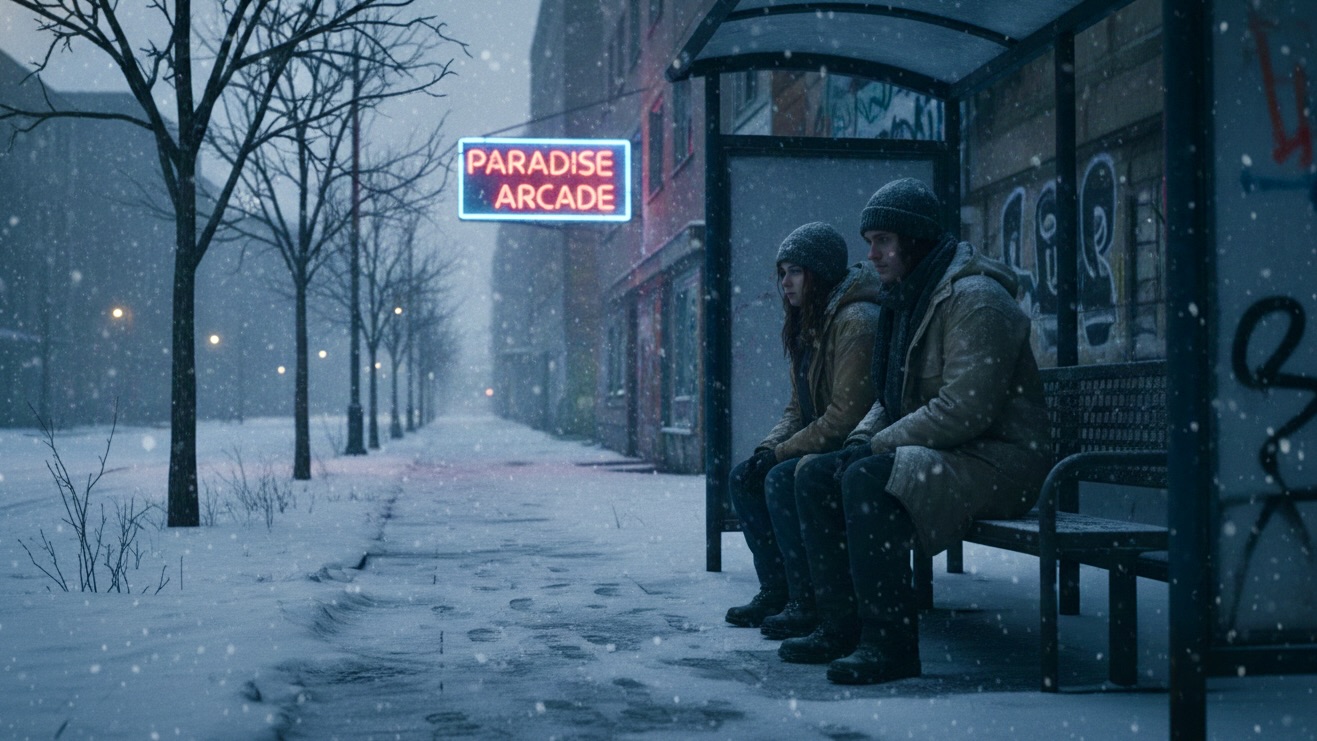
Late 2025. A cold, windswept city street in winter. Two young adults, Alex and Corrine, sit on a grimy bench near a bus stop, bundled in worn coats. The air is thick with the smell of damp asphalt and distant, smoldering trash. The sky is a bruised purple, promising more snow, and the streetlights cast long, weak shadows.
The wind bit, sharp and relentless, peeling sensation from fingertips even through the worn wool of Alex’s gloves. His breath plumed, thick and white, dissolving into the brittle air. Across from him, Corrine tugged her scarf tighter, her eyes tracking the slow, uneven wobble of a derelict shopping cart rolling down the street, pushed by a figure shrouded in too many layers. The cart’s wheels groaned, a rusted protest against the cracked pavement.
“Another one,” Corrine murmured, not looking at him. Her voice was flat, a low hum against the wind’s howl. She watched the cart disappear around the bend, leaving only the sound of a distant, persistent alarm, probably from a car, maybe a shop. Hard to tell these days. Everything just blended into the general hum of strain.
Alex shifted on the cold metal bench, the shock of it seeping through his already thin coat. He felt the phantom itch of a half-healed scrape on his palm, a souvenir from a skirmish over a discarded battery pack. Small things. Everything felt small, yet constant. He thought about the man at the corner store, earlier, how he’d just stared, eyes blank, when Alex had tried to return a dropped glove. No thanks, no nod, just the dead weight of a gaze. The glove lay there still, probably frozen to the ground by now. It wasn't about the glove. It was about the blankness.
He watched a flake of ash, impossibly small, drift past his eye, a slow dance in the dim light before settling on his sleeve. He brushed it off, a futile gesture. Everything felt futile. The city breathed a shallow, grimy breath. The skeletal trees along the street shivered, their branches brittle, stripped bare by the cold. Not just the cold, though. Something else had stripped them too, long before the winter came. The bark looked scored, scarred, as if trying to hold on to something that was already gone. He wondered if trees felt kindness. Stupid thought. But then, he often had stupid thoughts lately.
“You ever think about… before?” Corrine asked, breaking the silence. Her eyes were still on the empty street where the cart had vanished. Her face was smudged, a faint streak of something dark near her temple, probably grease. She didn’t bother to wipe it. Nobody really bothered with things like that anymore. Not out here.
“Before what?” Alex knew what she meant. They always did. But he asked anyway, buying time, trying to articulate the knot in his stomach that tightened every time someone mentioned 'before.' Before the shortages. Before the news feeds turned into just a loop of rising numbers and falling expectations. Before the quiet started to feel heavy, suffocating.
“Before… people stopped caring about stupid stuff. Like, if you dropped something. Or held a door.” She hugged her knees, pulling them up to her chest, making herself a smaller target for the wind. The movement made her jacket crinkle, a cheap, synthetic sound. She was trying to make sense of something that refused to be neat. They all were.
Alex picked at a loose thread on his sleeve. “I don’t know if they stopped caring. Maybe they just… ran out.” He thought of his neighbor, an old woman named Clara, who used to bring them cookies. Now, she just kept her blinds drawn, a sliver of light the only sign of life. He hadn’t seen her in weeks. Had he checked on her? No. Had he thought about it? Yes. Had he done it? No. He didn’t want to admit that. Not to Corrine. Not to himself.
The silence stretched, filled by the distant drone of a municipal cleaner and the rustle of dry leaves skittering across the sidewalk. The leaves weren't even brown anymore; they were just grey, pulverized by car tires and foot traffic. A true winter had settled, not just in the air, but in the bones of everything. The light from a broken neon sign across the street flickered, blue and red, casting an unsettling pallor over their faces. It promised something long gone, a place that probably sold stale beer and lottery tickets.
“Ran out of what?” Corrine’s voice was softer now, almost a whisper against the wind. Her gaze finally drifted to him, a question in her tired eyes. She looked like she hadn’t slept properly in days, the faint purple crescents under her eyes stark against her pale skin. He felt a pang, sharp and unexpected. He wanted to say something comforting, but the words felt trapped, heavy and useless.
“Energy? Patience? Money, probably. All of it.” Alex shrugged, a small, involuntary movement. His shoulders ached. He’d spent the morning trying to salvage copper wire from an abandoned construction site. A fool’s errand, mostly. Someone else always got there first. Or the metal was too rusted, too corroded to be worth the effort. The risk always felt bigger than the reward.
He remembered a news piece, from maybe a year ago, talking about 'societal friction points.' A fancy phrase for people getting fed up. He'd scoffed at it then. Now, he saw it everywhere. In the way people dodged eye contact on the street, in the quick, sharp movements of hands reaching for limited goods, in the silence of empty doorways where friends used to gather. It wasn’t a friction point; it was a constant, low-grade hum of hostility. Like a faulty circuit, always on the verge of sparking.
Corrine traced patterns on the frosty condensation of the bus shelter’s plastic panel. Her fingernails were short, bitten. “My dad says it’s just how it is. Survival. He says kindness is a luxury. Something you can’t afford when everything else is… like this.” She didn’t sound like she believed it entirely, but she didn’t sound like she completely disagreed either. It was the careful neutrality of someone trying to understand a world that kept shifting under their feet.
“Is it?” Alex asked, more to himself than to her. He remembered Clara’s cookies, the specific scent of cinnamon and nutmeg. Not a luxury, then. Just… a gesture. A choice. But choices seemed harder to make now, when every decision felt like a zero-sum game. If he gave something, he had less. If he helped someone, he might not be able to help himself. It was a cold equation, and it was hard to argue with the logic of it, even if it made his stomach clench.
A distant siren wailed, growing louder, then fading again, its melancholy cry swallowed by the city’s vast indifference. It was the sound of someone else’s problem, a fleeting thought, then gone. They didn’t even flinch. Sirens were just background noise now. Part of the decay. A soundtrack.
“Saw a kid today,” Corrine started again, her voice low. “No older than eight. Tried to pickpocket a delivery driver. Driver just… grabbed his arm. Held it. Didn’t yell. Didn’t hit him. Just held his arm. Real tight. Until the kid started crying.” She paused, a shiver running through her. “Then he let go. Driver didn’t even look at him. Just got back in his truck.”
Alex frowned. He pictured it. The driver’s face, probably hardened by endless routes and empty pockets. The kid’s desperate, small hand. The raw, guttural cry. It wasn’t a story of malice, not exactly. More like… exhaustion. A world too tired for rage, too numb for empathy. The kind of story that lodged in your throat, refusing to go down.
“What did you do?” he asked, a dull ache starting behind his eyes. He already knew the answer. They never did anything. What was there to do? Jump in? Yell at the driver? Give the kid money he didn’t have? It felt like choosing between two impossible things.
Corrine shook her head slowly. “Nothing. What could I do? Just stood there. Like everyone else.” Her voice cracked on the last word, and she cleared her throat, rubbing her gloved hands together. She didn’t look at him, her gaze fixed on a dirty pigeon pecking at something indistinguishable near a gutter.
The pigeon hopped, then flew off, disturbed by a loose sheet of newspaper scudding past, propelled by the wind. The paper was emblazoned with headlines about dwindling resources and renewed mandates. The kind of news that was no longer news, just a constant, grinding update. It made Alex feel small, insignificant, like a speck of dust caught in a much larger, darker current.
He remembered a story his grandmother used to tell, about people leaving food on doorsteps for neighbors, about spontaneous help after a storm. It sounded like a fable now, something from a forgotten book. The idea of leaving anything unguarded, un-claimed, felt alien. Everything was claimed now. Or fought for. Or stolen. There was no 'extra.' No 'leftover.'
“It’s not just people,” Alex said, the words feeling heavy on his tongue. “It’s the whole damn system. It’s designed to make us… not kind. Right? Everything is a competition. Always has been. Just, now it’s… sharper.” He thought of the ration lines, the way elbows nudged, the quick, defensive glances. The way people stood just a little too close, ready to react.
Corrine nodded. “My sister, she works at the supply depot. Says people scream at her every day for things that aren’t even there. Things that stopped being made months ago. She comes home… just empty.” Her voice trailed off, a testament to the hollowness she described. The exhaustion was contagious, a collective fatigue settling over everyone.
He pictured Corrine’s sister, younger than them, forced into a job that eroded her bit by bit. That was the coming-of-age for them. Not graduation, not first jobs in their chosen fields, but navigating the subtle, soul-crushing bureaucracy of a society barely holding itself together. Learning to internalize the scarcity, to harden their own shells. To not expect kindness, and to feel a flicker of suspicion if they encountered it.
“So, no hope then?” Alex asked, the question hanging between them, a fragile thing in the bitter air. He didn’t want the answer, but he needed to ask. It felt important, a test. To see if there was any flicker left, anywhere.
Corrine blew out a slow breath, watching it cloud and disappear. She looked up at the bruised sky, where the first few hesitant snowflakes began to fall, tiny white specks against the gathering gloom. They melted almost instantly on the frigid pavement, leaving only darker wet spots.
“Hope for what?” she countered, her voice dry, without accusation. It was a genuine question, an echo of his own internal debate. What did hope even look like now? A fully stocked shelf? A day without sirens? A conversation that didn't end with a knot in your gut?
He had no answer. He felt a shiver, not just from the cold, but from the realization that the question itself felt like a luxury. Hope. It required space, a belief in a future that wasn’t just a slightly worse version of the present. They didn’t have that space. Not anymore.
The bus shelter light flickered, then died completely, plunging their immediate area into deeper shadow. The blue and red neon sign across the street continued its broken dance, painting their faces in sickly, stuttering colors. It felt like a warning, a prophecy, a glimpse into a world that would continue its slow, grinding descent, whether they watched or not.
He looked at Corrine, her face half-hidden by her scarf, her eyes distant. He wondered if she saw it too, the same unavoidable trajectory. The air grew colder. The snowflakes began to fall with more conviction, dusting their shoulders, settling on the worn fabric of their coats like tiny, cold tears. Soon, they would be covered. Soon, everything would be covered.
The city held its breath, exhaling only the metallic tang of static electricity and the low thrum of failing infrastructure. A faint tremor ran through the ground, barely perceptible, a distant heavy machinery at work, or perhaps something else, something deeper, shifting beneath the city’s collapsing skin.
He thought of the news reports, the whispers about the 'new normal,' the way everyone used that phrase with a grim, knowing nod. But this wasn’t normal. It was a cold, quiet surrender, one gesture at a time, one dropped glove, one unanswered plea. The ice was setting in, not just on the pavement, but in the marrow.
Corrine finally turned to him, her eyes searching his, a flicker of something he couldn't quite name passing between them. Not hope, exactly. More like… shared recognition. The kind of wordless understanding that came from standing together on the edge of something vast and unknown.
He wondered if this was what growing up felt like now. Not finding answers, but learning to live with the weight of unanswerable questions. To feel the cold, and know it would only get colder. To see the unraveling, and understand there was no rewinding the thread. His hand, still tingling with cold, reached instinctively for hers, a tentative gesture that hung in the frigid air between them. A fleeting urge, a moment of weakness, perhaps. He pulled it back, tucking it deeper into his pocket.
The air grew heavy with the weight of unspoken things, of future winters already casting their shadows. They sat, two young people on a cold bench, watching the snow fall, waiting for a bus that might never come, in a world that felt increasingly indifferent to their waiting, their existence, or their fading light.
The faint tremor returned, this time a little stronger, rattling a loose pane of glass in the bus shelter. It wasn’t a natural tremor. It was the city groaning, a beast turning in its sleep, or perhaps… waking up.
A distant sound, not a siren, but something deeper, a sustained rumble from somewhere far beyond the city’s immediate edge, began to grow, like the low, threatening growl of a coming storm, or something far worse, something that promised to strip away not just the kindness, but everything else they had left.
The streetlights, one by one, flickered out down the block, swallowed by the falling snow and the deepening gloom, leaving them in a cold, encroaching darkness that felt less like night, and more like an ending.
The cold pressed in, an almost physical presence. He looked at Corrine, her outline blurring in the snow, a silent silhouette against a dying city. They were just waiting. But for what, neither of them knew, only that whatever it was, it was coming, inexorably, from the dark beyond the streetlights, colder than anything they had felt before.
The air tasted like rust and grit, and something else, something sharp and acrid, clinging to the back of his throat. He shivered again, not from the cold this time, but from a deeper chill. The rumble grew. It was closer now. And it was definitely not natural. It was mechanical. Relentless. And it was heading their way, promising a future that had no room for even the most basic human connection.
The last functional streetlight on their corner blinked once, twice, then gave out with a faint crackle, plunging them into absolute, stinging darkness, broken only by the fractured neon glow from across the street. And the rumble. It was here now. Right on their street. They turned, heads snapping towards the sound, their breath catching in their throats.
The future was here. And it brought no warmth, no light, and certainly no kindness.
He wondered if anyone else was out there, in the dark, feeling the tremor, hearing the rumble, understanding what it meant. Or if they were all just waiting for the last light to go out, convinced they were the only ones left.
The city, a vast, indifferent husk, offered no comfort, only the promise of more winters, colder and longer than any they had yet endured, under a sky that seemed to be forgetting the very concept of dawn.
He felt the cold deep in his bones, a permanent ache. This wasn't just a season. This was the way things were now. This was the 'new normal.' A world without warmth. A world without light. A world that was slowly, meticulously, grinding kindness into dust.
And in the absolute quiet that followed the distant rumble, broken only by the frantic beat of his own heart, he knew with chilling certainty that the conversation hadn't been hopeful at all. Not even a little bit.
The future was here. And it brought no warmth, no light, and certainly no kindness.
Share This Story


