The Frost on the Unseen Window
The air bit. Not a hard, cruel bite, but a quiet, insistent nip that promised real winter was waiting just behind the bruised, grey clouds. Debbie pulled the collar of her worn jacket higher, the rough wool scratching at her chin. The leaves, what few remained, clung stubbornly to skeletal branches, brown and brittle, ready to give up their hold at the slightest breath of wind. Below, the pavement glistened with the ghost of a recent shower, reflecting the muted light of a late afternoon that already felt like dusk. This particular part of the city, tucked behind the defunct cannery and a string of boarded-up warehouses, always felt like a forgotten breath between two exhalations. It was a good place for looking, for seeing what others missed.
"You sure this is the spot?" Clem's voice, high and impatient, cut through the quiet. She was already clambering over a low concrete barrier, her bright red knitted hat a defiant spot against the drab palette of brick and concrete. "My toes are officially numb, Debbie. This treasure better be worth it."
Debbie didn't look up from examining a discarded, crumpled flyer for a long-past municipal election, its colours faded to a sickly pastel. "It's about the journey, Clem. Besides, Dad said this used to be a proper park. Before... everything." She kicked at a loose stone, sending it skittering across the damp ground, the sound sharp in the stillness. "And what treasure? We're just exploring. You always jump straight to pirates."
Clem scoffed, landing with a soft thud on the other side of the barrier. "Pirates have more fun than 'just exploring.' And what's 'everything'? He always says that. 'Before everything.' Super helpful."
"He means before the Council sold off half the waterfront," Debbie murmured, though she wasn't sure if that was actually it. Adults used 'everything' for a lot of things. Before the good jobs, before the factory closed, before grandpa got sick. It was a word that swallowed up a whole history of little collapses.
They continued deeper, past rusted swings that creaked a lonely tune in the wind and a sandpit choked with stubborn weeds. The ground here was a patchwork of shattered asphalt and tenacious moss, smelling of damp earth and something vaguely metallic. A thin, grey light filtered through the skeletal canopy of what had once been a small copse of ash trees. Each step crunched faintly on fallen, brittle twigs.
It was under a half-collapsed lean-to, fashioned from corrugated iron sheets and splintered plywood, that they found it. Not gleaming treasure, but something else entirely. A dull, dark leather briefcase. It sat half-buried in a pile of wet leaves and broken glass, looking profoundly out of place, too slick and expensive for its surroundings. Its presence felt like a whisper in a scream.
"Whoa," Clem breathed, her usual bluster momentarily muted. She reached for it, fingers already outstretched.
"Don't just grab it!" Debbie snapped, her hand shooting out to stop Clem's. The leather looked soft, supple, expensive. Not the sort of thing someone just ‘lost’ here. Her own jacket, with its worn elbows and a faint scent of old campfire, felt suddenly rough and inadequate.
As Debbie knelt, her knee scraped against a sharp shard of glass. She ignored the sting. The briefcase had a small, silver clasp, reflecting the muted sky like a cold eye. No obvious locks. She pressed the clasp. It clicked open with a faint, precise sound that resonated in the quiet. Inside, nestled amongst layers of padding, wasn't cash or jewels. It was a single, sleek device. Black, with a small, glowing green screen displaying lines of what looked like code. Tiny, intricate symbols scrolled rapidly.
---
The Unblinking Gaze
"What is it?" Clem whispered, leaning closer, her breath smelling faintly of peppermint from the gum she’d been chewing. "A super-secret game? Like those spy ones?"
Debbie traced a finger over the cool, smooth surface of the device. It felt solid, heavy. Not like any game console she’d ever seen. No buttons, just the screen and a single, almost invisible, port on one side. "I don't think it's a game, Clem. Look at this."
She pointed to a small, almost imperceptible etching on the device's casing – a stylized, geometric emblem. It looked familiar, but she couldn't place it. Maybe from one of the boring flyers her dad sometimes brought home. The ones about city planning or new developments that went straight into the recycling.
The air, already chilly, seemed to drop a few more degrees. A sudden, sharp gust of wind whistled through the gaps in the corrugated iron, rattling the loose sheets like skeletal bones. Debbie's breath caught. A figure in a dark, oversized coat, standing impossibly still at the far end of the alley, near the skeletal outline of an old oak tree. Too far to make out details, but the stance, the way their head tilted, suggested they were watching. Unmoving. Waiting.
Debbie didn't like it. Didn't like the cold, clinical stillness of the figure. It wasn't someone taking a shortcut; it was someone positioned. Someone assessing. A shiver, colder than the wind, ran down her spine. "Someone's watching us," she mumbled, her voice barely a breath.
Clem squinted. "Who? Old Man Hemlock from the corner shop? Is he mad we didn't buy any stale licorice?"
"No, not him. The person by the tree. See?" Debbie pointed, her hand trembling slightly. It wasn't just a person. It was a dark shape that seemed to absorb the already scarce light, a silent sentry in a forgotten place. There was no casualness in their posture, no hint of a distracted walk. Just the still, unnerving presence of someone completely focused.
Clem followed her gaze, and her bravado seemed to deflate, a silent hiss of escaping air. "Oh. Yeah. They've been there... for a bit, haven't they? I thought they were just waiting for their dog or something."
Debbie didn't respond. She just watched, her heart a drum against her ribs. The figure didn't move, didn't wave, didn't acknowledge them. It was a presence, stark and unsettling, in the desolation.
"We should go," Debbie finally said, the words tasting like rust and fear. She wanted to snap the briefcase shut, forget they’d ever seen it, but some stubborn, defiant part of her clung to the device, to the puzzle it presented.
"But what about the spy thingy?" Clem whispered, her eyes wide now, her earlier enthusiasm replaced by a nascent fear. "Are they spies? What if they're, like, the bad guys?"
"There aren't 'bad guys' like in your comics, Clem," Debbie tried, but even as she said it, the words felt thin, unconvincing. The figure by the tree certainly felt like a 'bad guy,' in the adult, complicated way she was only just beginning to understand. The device in her hand felt heavy, suddenly heavier than it looked, weighted with a kind of silent, dangerous significance.
She snapped the briefcase shut, the silver clasp clicking with a sound that seemed ridiculously loud in the sudden, breathless silence. The device was hidden again, but the knowledge of its presence, the knowledge of the figure, wasn't. That was inside her now.
"We leave it here," Clem said, a little too quickly, her voice higher than usual. "Just leave it. Someone will find it. A grown-up. They'll know what to do."
---
The Unasked Questions
But Debbie just clutched the briefcase tighter. The thought of leaving it, of just walking away and pretending she hadn't seen the scrolling green text, hadn't seen the silent watcher, felt… wrong. Like leaving a question unanswered, and she hated unanswered questions. Her dad, a local reporter who was always grumbling about "the truth being buried under committee reports," had instilled that in her, perhaps inadvertently.
"No," Debbie said, surprising herself with the firmness in her voice. "No, we don't. It's... important. I think." She didn't know why it felt important, only that it did. It hummed with a quiet power, a secret that had found them. Or that they had found.
They scrambled back over the concrete barrier, Debbie clutching the briefcase awkwardly under her arm. She risked another glance back at the old oak tree. The figure was gone. Just a bare tree, silhouetted against the deepening grey. The sudden absence was almost more unsettling than their presence had been. Had they moved? Or had they simply decided they had seen enough? The thought made Debbie's stomach clench.
"See? They left!" Clem chirped, a little too loudly, as if trying to conjure back her lost confidence. "Maybe they were just really lost."
"Maybe," Debbie murmured, but she didn't believe it. The air was colder now, the shadows longer. A sharp, distinct smell of woodsmoke drifted from somewhere far off, mingling with the damp earth scent. It was the kind of smell that usually made her think of warm fires and hot chocolate, but today it just added another layer to the city's quiet melancholy.
They walked quickly, the sound of their worn trainers scuffing against the pavement. Debbie kept glancing over her shoulder, half-expecting the dark figure to reappear from behind a rusted skip or a pile of discarded lumber. The device under her arm felt like a living thing, buzzing with an unspoken narrative. It was heavy, but not in a physical sense. It was the weight of knowing, of having stumbled into something that belonged to the adult world of hushed phone calls and closed-door meetings. Her dad used to say, 'Curiosity killed the cat, but satisfaction brought it back.' Debbie wasn't so sure about the satisfaction part right now. Mostly, she just felt a creeping, unfamiliar dread.
They made their way through a narrow lane, where a few tenacious strands of ivy still clung to a brick wall, their leaves a deep, almost bruised purple. The last rays of the sun, a weak orange smear on the horizon, cast long, distorted shadows of the bare branches onto the street, making them dance like grasping fingers. She could hear the faint, distant rumble of a bus, a dull counterpoint to the city’s hushed breathing. It was almost dark now. And she had a feeling that the real darkness was just beginning.
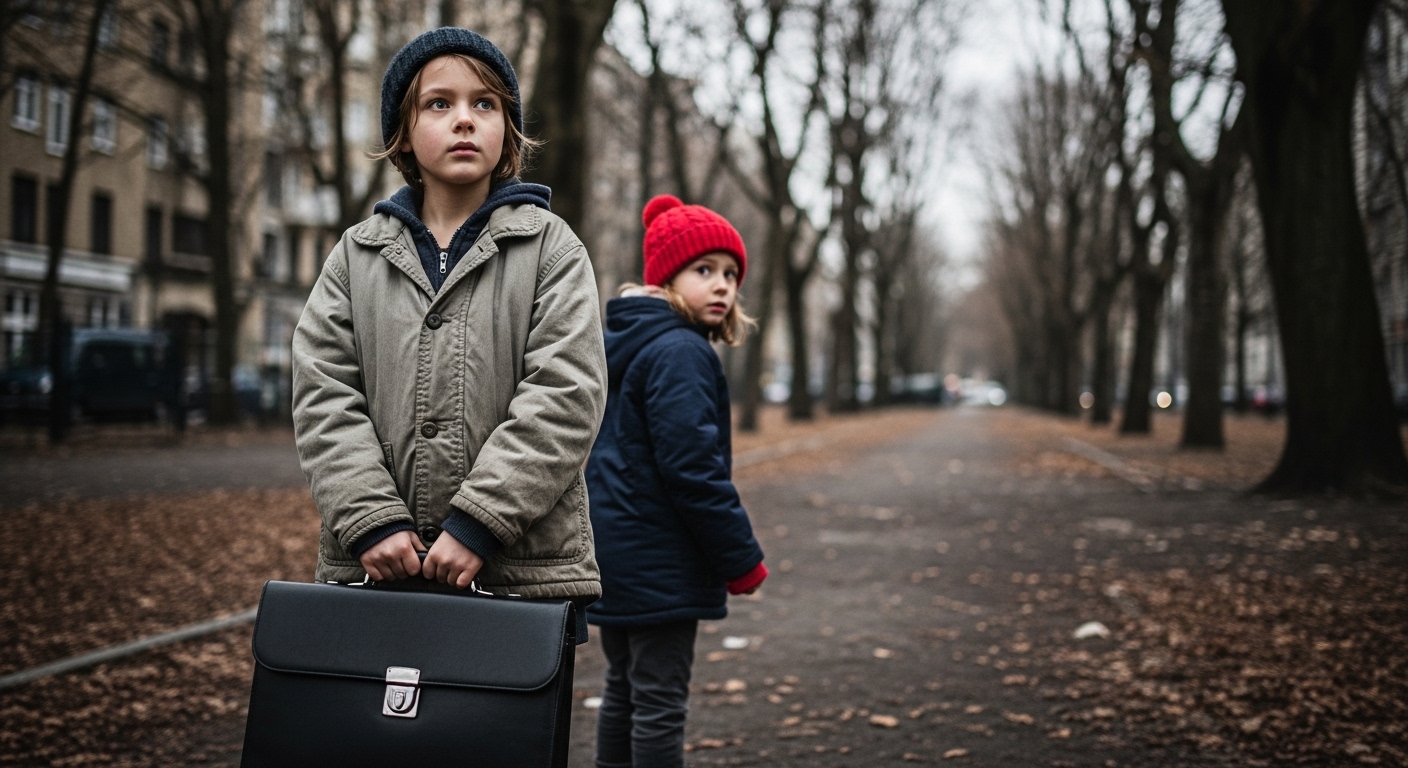
Debbie clutched the briefcase tighter, its cold leather pressing into her side. The figure was gone, but the feeling of being watched lingered, a persistent chill that had nothing to do with the early winter air. What they had found was more than just a forgotten object; it was a door, and they had just pushed it ajar, letting something unsettling, and possibly dangerous, into their quiet lives.
Share This Story


