The Daily Commotion
On a scorching summer afternoon in 2025, Art, a retired man in his late sixties, sits at a small, wobbly table in 'The Written Word', a struggling independent bookstore and coffee shop. He's observing the humid street outside, a microcosm of a society increasingly frayed. Betty, the sharp-witted owner in her early sixties, works behind the counter. Carl, a gruff regular of similar age, is engrossed in a newspaper.
"Another one," Art said, not looking up from his coffee, just nodding towards the window. The condensation on his glass was already forming a ring on the worn wooden table, leaving a dark, slick mark that spread slowly.
Betty didn't respond immediately. The clatter of ceramic cups and the hiss of the espresso machine, a relic from a time when the neighborhood had more foot traffic, filled the silence. Her hands, nimble despite the faint age spots, moved with a practiced rhythm, wiping down the counter with a cloth that smelled faintly of lemon. "Two today? Or is that the third?" she finally asked, her voice dry, without inflection, as if counting the passing cloud formations.
Art hummed, a low, gravelly sound in his throat. "Lost track. The blue sedan. Guy cut off the delivery truck. Now they’re yelling. About a dent the size of my thumbnail. The truck driver looks like he might spontaneously combust." He watched as the delivery man, face ruddy under a baseball cap, jabbed a finger inches from the sedan driver's nose. The sedan driver, younger, maybe in his forties, adjusted his designer sunglasses, a smirk playing on his lips, unbothered, almost enjoying the confrontation. Art took a slow sip of his lukewarm coffee. It tasted like ash.
"Civility's gone the way of common sense," Betty muttered, not looking up. She arranged a stack of new paperbacks, spines uncracked, into an impossibly neat tower. The air conditioning unit above the door wheezed, blowing tepid air that offered little relief from the August humidity. The street noise bled in, a constant, low thrum of distant traffic, closer car horns, the occasional shout.
Carl, perched on a stool at the far end of the counter, lowered his newspaper, rustling the newsprint. His bifocals were smudged, pushed halfway down his nose. "Never had much, did we? Just got better at pretending." He cleared his throat, a sound like gravel shifting in a bucket. "Now? Just stopped pretending. That’s all. Honest, in a way. Brutal honest, maybe."
Art considered that. Brutal honest. He remembered the neighborhood a decade ago. Busy. People still made eye contact. They still held doors. Or maybe his memory was just conveniently editing the past. He ran a finger over the smooth, worn edge of the table. A shallow gouge, like a crescent moon, was etched into the wood, probably from some long-forgotten argument, a spilled drink, a tantrum.
The shouting outside intensified. A woman, pushing a stroller, hurried past the scene, her head down, pulling her child tighter against her. Nobody looked at the child, or the woman. Just the spectacle. Art felt a familiar ache behind his ribs. Not exactly sadness. More like a dull, steady pressure. A sense of something… lost. Irrevocably lost.
"Coffee," Carl barked, pushing his empty mug across the counter. Betty filled it without a word, her movements economical. The coffee was strong, black. Carl didn't add sugar. Didn't add cream. Just drank it down, a stoic ritual.
Art watched Betty. Her hair, a practical bob, was streaked with gray. Fine lines webbed around her eyes, etched there by years of reading small print and a lifetime of observation. She wore a simple dark blouse, practical, not flashy. She wasn’t looking at him, but he felt her presence, a quiet anchor in the shifting currents of the day. He’d been coming to 'The Written Word' for months now, ever since his wife, Martha, passed. Martha had loved books. Loved coffee. He used to read the paper while she browsed the new arrivals. Now he just watched. And waited. For what, he wasn't sure.
The air smelled of old paper, ground coffee, and the faint, sweet decay of summer trash from the alley. A fly buzzed lazily near the window, bumping against the glass, seeking escape into the oppressive heat. Art traced the condensation line on his glass again. It was blurring the reflection of the street, making the shouting men look like distorted puppets.
"Anything interesting in the paper, Carl?" Art asked, more to break the quiet than for genuine curiosity. The news these days was a broken record. More division. More outrage. Every headline a fresh wound.
Carl snorted, flipping a page with a sharp crack. "Same old, same old. Another politician calling the other side 'enemies of the state'. Another expert saying the sky is falling. Good thing I ain't got long left, huh? Save me the trouble of watchin' it all burn down."
Betty placed a small plate of shortbread cookies on the counter, near Carl's elbow. "Don't talk like that, Carl. You'll outlive us all. And if the sky falls, you'll be the one complaining about the dust."
Carl grunted, a flicker of something almost like a smile touching the corner of his mouth. He picked up a cookie, dunked it in his coffee. "Fair point. These for free?" he asked, not quite looking at Betty.
"On the house. For enduring the morning news cycle." Her tone was light, but Art caught the subtle weariness underneath it. Running a small business in 2025, especially one that wasn't 'essential' in the way fast food or tech support was, felt like trying to swim upstream in a river of mud.
Art watched the exchange. A small, almost imperceptible gesture of kindness. Carl, for all his gruffness, looked at the cookie for a beat longer than necessary before eating it. It wasn't a grand pronouncement. Just a small, warm thing. Like a flicker of light in a dim room. He wondered how many such small things went unnoticed, swallowed by the noise.
He remembered Martha baking him shortbread. The smell of butter and sugar. The way she'd hum a tuneless song, her hands dusted with flour. He hadn’t thought about that in a while. The memories were still sharp, still had teeth, but they didn’t tear him apart quite as much anymore. Time, he’d learned, wasn’t a healer, but a duller of edges.
The shouting outside began to subside. One of the men, the sedan driver, finally got back in his car, slamming the door. The delivery truck driver, still fuming, climbed back into his cab with a final, disgusted shake of his head. The blue sedan sped off, tires squealing faintly, a puff of exhaust hanging in the still, hot air. Another skirmish resolved, or at least, abandoned.
"Peace returns," Art observed dryly. "Until the next one."
Betty sighed, a soft expulsion of air. She leaned against the counter, her gaze drifting out the window, past Art, to the now-empty patch of asphalt where the confrontation had played out. "You know," she said, her voice softer, almost reflective, "sometimes I wonder if it’s always been this way. And we just, what? Had more filters? More social graces to hide the ugliness?"
"Maybe," Art mused, swirling the last dregs of coffee in his cup. "Or maybe the filters just broke. All at once. Like a dam giving way. And now the river's rushing, carrying all the garbage."
Carl grunted again, finishing his shortbread. "River's got a name now. It's called 'online'. Everyone's got a megaphone. No one's got a mute button."
Art nodded. The internet. The great connector. And the great divider. He thought of the comments sections, the news feeds, the endless scrolling. The way people talked to each other. Faceless. Furious. He remembered a time when arguments happened face-to-face, or not at all. There was a certain vulnerability in that, a necessity for a kind of restraint. Now, the anonymity was a weapon, and everyone seemed eager to use it.
He watched Betty turn from the window, her eyes scanning the sparse shelves. The bookstore was quiet now, the lunchtime rush long gone, replaced by the heavy stillness of the afternoon. Dust motes, or rather, small, almost invisible particles of lint and fiber, danced in the shafts of sunlight slicing through the tall front windows, illuminating the faded covers of forgotten novels, the gleam of polished wood. He wondered about her. Running this place. Alone. What kept her going? Stubbornness? Hope? Or something else entirely, something he hadn't quite deciphered yet.
"Slow day," he offered, stating the obvious.
"Every day's a slow day, Art," she replied, a faint, almost imperceptible curve to her lips. "People don't read much anymore. Too busy shouting."
"Or scrolling," Carl added, flipping to the sports section with a dramatic flourish.
Art felt a strange pull. Not pity, not exactly. More like… recognition. He saw a kindred spirit in Betty, someone else trying to hold onto something fragile in a world that seemed determined to smash everything to pieces. His own life, post-Martha, had been a series of routines, carefully constructed walls against the quiet despair. Coming here, sitting in this slightly dusty, slightly forlorn bookstore, felt like a small act of defiance. A whisper against the roar.
"You ever think about… packing it in?" he asked, surprising himself with the bluntness of the question. He watched her reaction closely. Her shoulders tensed, almost imperceptibly, then relaxed. Her gaze flickered to him, a quick, assessing look.
"Every morning," she admitted, her voice low. "Every single morning I wake up and wonder if today's the day. If I should just sell the last of the inventory for pennies on the dollar and turn this into… I don't know. A vape shop. A cryptocurrency exchange. Something that actually makes money."
Carl snorted again, a louder sound this time. "Don't give her ideas, Art. Then where would I get my overpriced coffee and free shortbread?"
Betty rolled her eyes, a genuine, unforced gesture. "You'd find somewhere, Carl. You always do."
"And you wouldn't sell this place," Art said, more a statement than a question. He knew it. He saw the way she ran her hand over a book spine sometimes, a gentle, almost reverent touch. The way she’d adjust a misplaced bookmark. The way she knew every regular’s preferred brew, their reading habits. It wasn't just a business. It was… something more.
She looked at him then, truly looked at him. Her eyes, a warm, deep hazel, held a flicker of something he couldn't quite name. Vulnerability, perhaps. Or a shared understanding. "No," she said, her voice barely above a whisper. "I suppose I wouldn't. Not yet, anyway. What about you?" Her head tilted slightly. "You don't strike me as the 'sitting around doing nothing' type."
He let out a short, humorless laugh. "Martha used to say I was a 'builder of bridges, not a burner of them.' She’d tease me. Said I always saw the plan. The potential. Now… I just see the cracks. Everywhere. In the pavement. In the conversations. In people's eyes."
He paused, picking at a loose thread on his cuff. The confession hung in the air, heavier than the humidity. He hadn't talked about Martha like that, not to anyone. Not really. He’d kept her tucked away, a private grief, a wound he picked at only when no one was looking.
Betty didn't offer platitudes. She didn't say 'I'm sorry for your loss' in that polite, distant way people did. She just nodded, a slow, understanding nod. "Cracks are easier to spot than the new foundations, I suppose," she said quietly. "Especially when you're looking for them."
Carl folded his newspaper with a decisive snap. "Alright, lovebirds. Don't go getting all philosophical on me. It's too hot for thinking." He slid off the stool, his joints creaking audibly. "I got a leaky faucet to fix. Some poor soul whose pipes decided to spring a leak at exactly the worst possible time."
He paused at the door, his hand on the metal handle, worn smooth by countless grips. He didn’t look back at them, but his voice, when he spoke, held a rough kindness. "Take care of each other, you two. World's gone mad. But it ain't all bad. Not yet, anyway." And then he was gone, the bell above the door jingling briefly, then settling into silence.
Art watched the empty doorway. Carl, the self-proclaimed cynic, with his gruff words and his free shortbread. Fixing a leaky faucet. A small act, practical, immediate. A way to patch up one tiny corner of the fractured world. Maybe that was it. Not grand gestures. Just the small, quiet ones.
He turned back to Betty. She was watching him, a faint, almost shy smile on her face. The heat of the afternoon pressed in, but a different kind of warmth bloomed in his chest. It was unexpected. Unasked for. And profoundly unsettling.
"Leaky faucets, huh?" Art finally said, a corner of his own mouth twitching upwards. "Sounds like a metaphor."
Betty laughed, a soft, pleasant sound that cut through the stifling air. "Everything's a metaphor if you look hard enough, Art. Especially in a bookstore."
He found himself smiling, a genuine smile that felt foreign, a little stiff on his face. He hadn't smiled like that in a long time. It felt… good. And a little terrifying. He looked around the quiet shop, at the rows and rows of stories, waiting. Waiting to be picked up. To be read. To connect. He thought of Carl, patching a pipe. Betty, selling books in a world that preferred screens. Himself, sitting here, finding something he hadn’t known he was looking for.
The afternoon sun slanted lower, painting long, dusty rectangles on the floor. The world outside remained a cacophony of distant sirens and muted arguments, but in here, for a moment, there was a different kind of noise. A quiet hum. A pulse. He realized he was still holding his empty coffee cup. He should probably get another. Or leave. But the thought of leaving felt like stepping back into the rush of the river.
"Maybe…" Art began, then trailed off. The word hung there, unfinished, a thread in the humid air, waiting for her to pick it up, or let it fall. He looked into her hazel eyes, and for the first time in a very long time, felt a flicker of something that wasn’t resignation. A warmth that spread slowly, an ember in the fading light.
Betty just watched him, her smile a little wider now. The unspoken questions, the hesitant hopes, the shared weariness and the nascent understanding, all simmered between them. The street noise persisted. The city continued its chaotic ballet. But for a suspended moment, in the hushed space of the bookstore, the world outside felt a little less urgent. The future, too, felt like an unread page, waiting. The long, humid summer stretched ahead, full of its own slow, unpredictable currents.
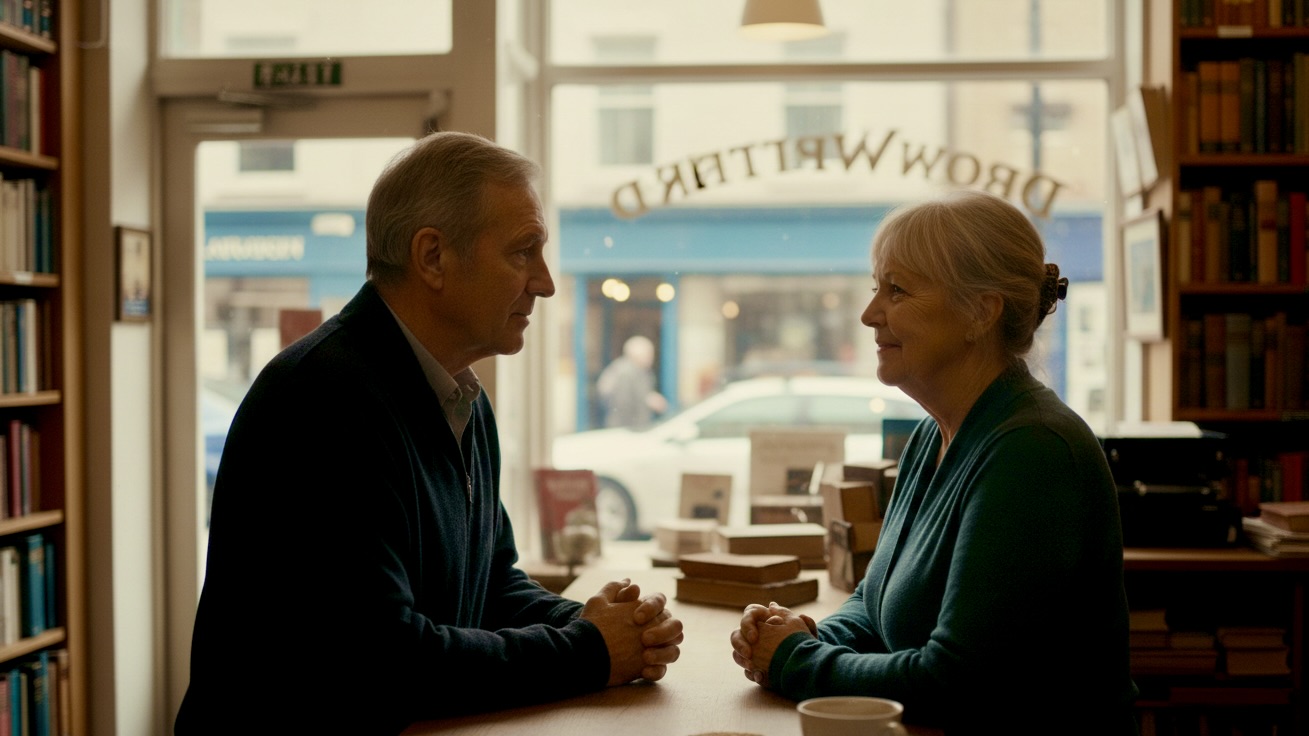
The long, humid summer stretched ahead, full of its own slow, unpredictable currents.
Share This Story


