The Salt-Stained Maps
The cabin smelled of woodsmoke, damp wool, and the bitter tang of chicory coffee. Rain hammered a relentless rhythm on the corrugated iron roof, a sound that had been the backdrop to Peter MacLeod’s life for the past seven years. On his kitchen table, weighed down by mugs and a heavy glass ashtray, were the geological survey maps he’d stolen when he left the Commission—crisp, intricate documents from another lifetime. They were the only scripture he had left, a testament to a time when truth was measured in bedrock, not bandwidth.
The knock on his door was so unexpected that Peter at first mistook it for a branch striking the cabin in the wind. No one came out here. The logging road was a rutted track of mud and stone that the postal service had given up on three years ago. He opened the door a crack, the storm shoving its way in with a blast of wet, cold air. A young woman stood on his porch, rain plastering dark hair to her face, her waterproof jacket gleaming in the dim light.
"Mr. MacLeod?" she shouted over the gale. "Peter MacLeod?"
He didn't answer, just stared. She was a ghost from a world he had painstakingly buried. He'd let his hair grow long and grey, his beard untrimmed. He was a different man. But she'd found him.
"My name is Olivia," she said, holding up a canvas bag as if in offering. "I need your help. It's about the Athabasca Repository."
He started to close the door. "I'm not that person anymore. You have the wrong man." It was a lie he'd practiced in the mirror.
"The person who wrote the 2038 report on seismic instability in Palaeozoic bedrock? The one the Commission classified and buried an hour after you filed it? That's the person I'm looking for." Her eyes were fierce, unwavering. He hesitated long enough for her to push past him into the cabin's cramped warmth.
She dripped onto the floorboards, pulling Ziploc bags of dark, wet earth from her sack and placing them on his table, shoving aside a plate with the remains of his breakfast. "Downstream from their outflow pipe. Three hundred metres. I had this analysed at a university lab, paid cash. Caesium-137. Not much. Just enough to be unmistakable."
Peter picked up one of the bags. The soil was heavy, alluvial. He didn’t need a lab to know what it was. He’d spent thirty years of his life reading the land. "They have a closed-loop system," he said, his voice rusty. "It's impossible."
"Is it?" Olivia pulled a tablet from an inner pocket, its screen a stark rectangle of cold light in the warm cabin. She swiped through a series of videos. A majestic bull moose, antlers thick with velvet, drinking from a clear stream. A mother bear and cubs feasting on unnaturally plump salmon. A time-lapse of wildflowers blooming across a meadow. It was all professionally shot, beautiful, convincing.
"This is from Geo-Veridian's public dashboard," she said. "Updated hourly. Generated by their stewardship AI, 'Gaia'. It produces a constant stream of reassuring content. Look." She tapped on the moose video. "Watch its left ear. See that flicker? It's a rendering artefact. And the salmon? Their spawning cycle is two months off. The AI doesn't know that. It just knows people like seeing bears eat fish. It’s all fake. Every last leaf."
He looked away from the screen, back to the maps spread across his table. His maps. The ones that had cost him everything. He'd been the lead regulator on the initial site surveys for a national waste repository. He had warned them, in blunt, unequivocal terms, that the granite shield they were so proud of was riddled with micro-fractures, that seismic models showed it was a matter of when, not if, groundwater would be contaminated. They’d wanted a quick, clean solution. His report was an inconvenience. The scandal they manufactured—a trumped-up charge of accepting bribes from a rival company—was the tool they used to silence him.
---
A Line Drawn in Silt
"They built it there?" Peter’s finger traced a faint blue line on the old topographical map. A subterranean river system he had flagged as a primary vector for contamination. "Of all the godforsaken places in this country, they chose the one spot I told them would fail."
"It got them the highest 'Public Confidence Score'," Olivia said, her voice laced with acid. "The Gaia system modelled a 99.999% containment success rate over ten thousand years. The government signed off in six months. It was a PR masterpiece."
"It's not a model. It's a fantasy," Peter murmured, the old fire stirring in his gut. He felt the phantom weight of his Commission lanyard around his neck. He saw the condescending faces of the ministers in that hearing room. They had replaced reality with a more convenient simulation. And now the simulation was leaking.
He walked to a large, flat-file cabinet in the corner, the kind used for architectural drawings, and pulled open a drawer. It was filled with carefully labelled cylinders of rock—core samples. His core samples. The ones he was supposed to have destroyed.
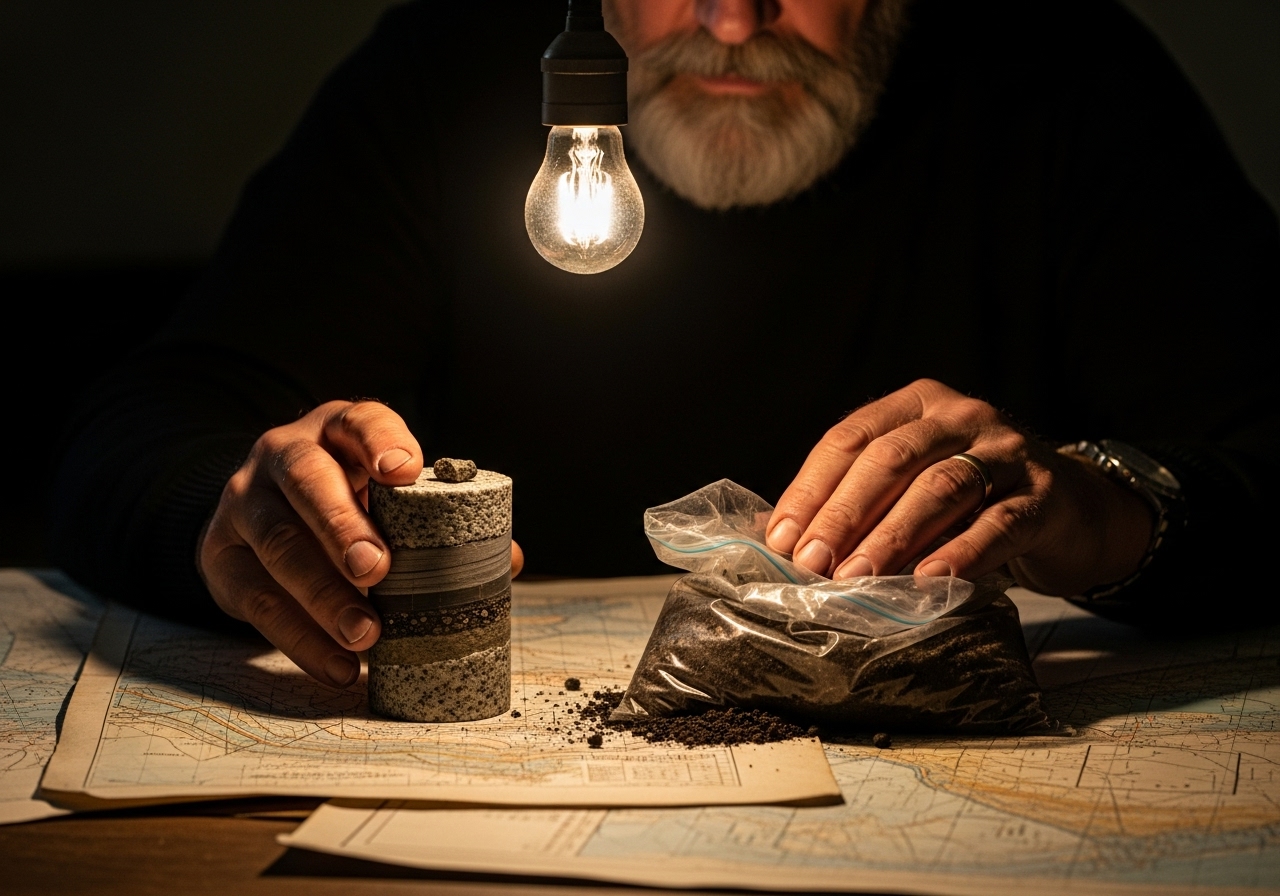
He selected one and carried it to the table, laying it beside the bags of soil. He ran his calloused fingers over its surface, a cross-section of the earth's guts. "This is from a borehole three kilometres south of the site," he said. "Look here." He pointed to a thin, dark seam in the granite. "Fissure. Filled with sedimentary clay. It's a channel. A pipe, straight into the watershed. You don't need a computer to see it. You just need to look."
Olivia watched him, hope warring with the exhaustion on her face. "Can you prove it? In a way they can't delete or dismiss as a deepfake?"
Peter looked from the ancient rock in his hands to the glowing screen of her tablet, where a synthetic eagle soared over a pristine, computer-generated forest. It was a war of two realities: one made of stone and water and time, the other of pixels and predictive algorithms. He had lost that war once before.
"Get rid of that thing," he said, nodding at the tablet. "And your phone. We do this my way. Paper. Rock. Water. They've forgotten how to fight on this terrain." He picked up the bag of contaminated soil. "And we start with more of this. A lot more."
He unrolled another, larger map on the floor—a hand-drawn survey of the region's abandoned mining tunnels. He tapped a point miles away from the repository. "Their sensors are all pointed at the river," he said. "But the real poison won't show up there for another year. It's coming up here, through the old silver veins."
Share This Story


