The Humid Exchange
In a sweltering, disused art studio during a sticky summer, three artists debate the theme for a local history exhibition, their artistic temperaments clashing as a darker undertone emerges from the town's past.
"The folly, I contend, is in the very premise of 'glorious heritage,'" the Sculptor declared, wiping a bead of sweat from his brow with the back of a hand smudged with dried clay. He gestured dramatically with a half-eaten bagel, crumbs scattering onto the blueprints for his proposed installation. "Our town's past is not a gilded tapestry; it is a cheap, stained tablecloth, threadbare in places, covering questionable stains."
I took a slow sip from my lukewarm coffee, the condensation on the paper cup making my fingers stick. "The 'stained tablecloth' approach, while certainly evocative," I began, my voice a dry rasp, "might not garner the philanthropic enthusiasm necessary to fund a public exhibit, much less one intended to celebrate local history. The council, you recall, specified 'uplifting and community-oriented.'"
The Painter, ever the romantic, scoffed, a soft sound that barely cut through the drone of the single, wheezing fan attempting to stir the humid air. "Uplifting, yes. But truth need not be saccharine. We are artists, not propagandists. A nuanced portrayal is surely what is desired." He straightened a faded map of the old industrial district, pushing his spectacles higher on his nose. "Consider the mill workers, the backbone of this town. Their grit, their sacrifice… that is a story begging to be told, to be rendered in light and shadow, not merely in the dull statistics of decline."
"Decline, precisely!" the Sculptor retorted, his voice rising, bouncing off the exposed brick walls. "The decline that began with the mysterious disappearance of the original mill plans, conveniently allowing for the 'modernization' that ultimately gutted the workforce and left us with this hollowed-out husk of an industrial park." He stabbed a finger at the map, narrowly missing the Painter's outstretched hand. "There's your story, my dear fellow: not one of 'grit' but of systemic, engineered decay. A true noir narrative, perhaps, for the discerning eye."
I watched them, the familiar dance. The Sculptor, always drawn to the brutalist truth, the uncomfortable angle. The Painter, seeking beauty, even in the ruins. And me, I suppose, perpetually sifting through the detritus, searching for the logic, the pattern in the chaos, trying to piece together how the present got so thoroughly tangled with the past. The summer heat pressed in, thick and palpable, making the air feel heavy with unspoken things, with forgotten grievances that seemed to linger in the dust motes dancing in the faint light from the grimy window. It was always summer when things got complicated in this town. Always. The kind of summer where the asphalt shimmered and the air smelled faintly of hot tar and impending disappointment.
Our commission, a rather meager one, was to create a 'definitive artistic interpretation' of the town's first fifty years. The caveat, delivered by a councilman whose face suggested he’d swallowed a bad oyster, was that it absolutely, unequivocally, must not 'stir up old resentments.' A rather tall order for a town whose history was less a narrative and more a collection of half-whispered rumors and conveniently misplaced archives.
"The mill plans," I mused aloud, mostly to myself, picking at a loose thread on the sleeve of my worn denim jacket. "That's the recurring whisper, isn't it? The fire that gutted the old municipal records office, the 'unfortunate mishap' that preceded the mill's expansion. All very convenient, as you say, Sculptor. A structural flaw in the narrative, wouldn't you agree?"
The Painter, who usually dismissed such 'conspiracy theories' as beneath the dignity of serious art, paused. He tapped a finger against the map. "It is true that the official account of the 'Great Mill Fire of '78' has always felt... streamlined. Too neat. No real investigation, merely an insurance payout and a quick demolition. An inconvenient truth, perhaps, but hardly the stuff of a grand exhibit. Unless we're venturing into the realm of the polemic?"
"A polemic, or perhaps a re-examination," I offered, pushing my empty cup aside. "A detective, if you will, seeking to reconstruct the scene, not merely paint over it. The records, or lack thereof, are a clue in themselves. Absence, as they say, speaks volumes. Who benefited most from the 'streamlined' narrative?"
The Sculptor's eyes glinted. "Ah, now we are approaching something substantial. Not merely decorative history, but history as a problem to be solved. A case. I could envision a series of distorted figures, emerging from the shadows of forgotten documents, their forms hinting at the suppressed truths. Brutal, uncompromising. A monument to the unseen hands that shaped this town."
"And I," the Painter countered, a slight flush on his cheeks, "could imagine a triptych, perhaps, depicting the resilience of the common folk, their faces etched with the struggles, yes, but also with an indomitable spirit. The mill, in the background, a silent sentinel, its smokestacks reaching to a sky heavy with both industry and hope. We could show the human cost, not just the abstract loss."
Their arguments, though often passionate, usually circled the same aesthetic principles: realism versus abstraction, beauty versus truth. I, however, had always found myself more interested in the why of things. The missing pieces. The anomalies. The loose threads that, if pulled, threatened to unravel the entire fabric. The official story of the mill fire, for instance. It always felt less like a natural disaster and more like a tidy piece of stagecraft. The kind of stagecraft that left a permanent stain on the town's collective memory, yet no one ever seemed to want to scrub it clean.
I leaned back in my chair, the worn rattan creaking under my weight. "Let's consider this, for a moment, not as a canvas, but as a crime scene," I proposed, watching their faces for a reaction. The Sculptor nodded slowly, intrigued. The Painter looked faintly annoyed. "Suppose the 'Great Mill Fire' was not an accident. Suppose the disappearance of those original plans was not an 'unfortunate mishap.' What then becomes our 'definitive artistic interpretation' of the town's first fifty years?"
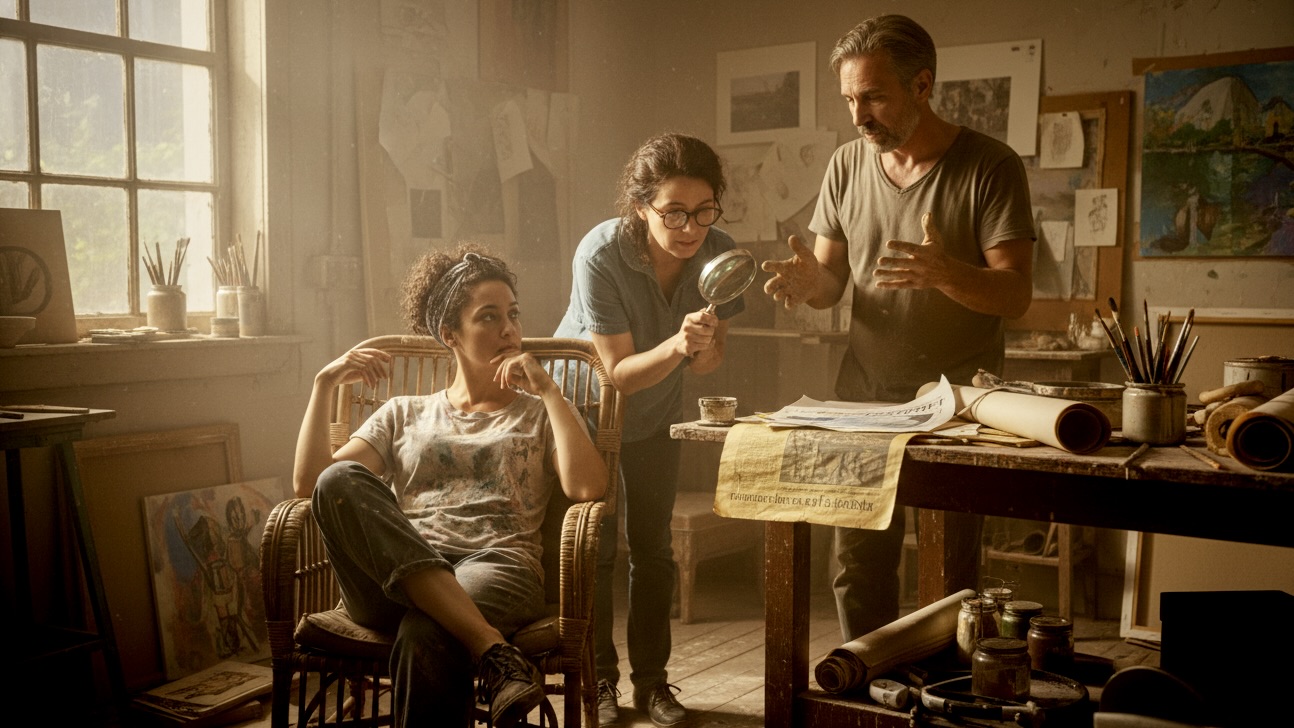
The air conditioning unit in the far corner finally sputtered to life with a groan, pushing out a weak, cloying breeze that smelled of stale water and ancient dust. It did little to alleviate the heat, only serving to underscore the lethargy of the afternoon. The Sculptor produced a crumpled, yellowed newspaper clipping from his bag, unfolding it carefully on the workbench. "I found this tucked away in a box of my grandfather's things. An obituary for a junior architect, a certain Mr. Elias Finch. Died suddenly, they say, a week before the fire. 'Heart attack.' Young man, only twenty-eight."
The Painter peered over his shoulder, his brow furrowed. "Finch? I don't recall that name. Not in any of the town histories I've consulted. Surely, an architect involved in the mill's design would warrant a mention." He picked up a magnifying glass from a nearby drafting table, his movements slow, deliberate, as if entering a trance.
"Indeed," I murmured. "Especially one who died 'suddenly' right before a 'convenient' fire. Heart attack, at twenty-eight, and then silence. A ghost in the archives, a ripple in the official narrative that was quickly smoothed over. This, Sculptor, is not merely an absence. It is an erasure."
The Sculptor placed a heavy hand on the clipping, his gaze fixed on the grainy photograph of a young, earnest face. "An erasure. A void. Precisely the kind of negative space my work thrives upon." He looked up at me, a flicker of something almost conspiratorial in his eyes. "One could sculpt the very silence of a forgotten man. The weight of what was lost. The burden of what was never said."
The Painter, however, still seemed reluctant to fully embrace this morbid turn. "But to make such a claim, in a public exhibit… without evidence beyond a speculative newspaper clipping and a conveniently timed fire… it verges on libel, does it not? We are artists, not historical revisionists. We must deal in facts, in demonstrable truths, even if the truth is merely the resilience of the human spirit in the face of adversity."
"Facts, my dear Painter," I replied, leaning forward, my voice low. "Are often precisely what is hidden. The resilience of the human spirit, while noble, can also be a convenient curtain behind which certain unsavory truths are swept. Think of it: a town built on industry, powered by ambition, but perhaps also… by something less savory. A single thread pulled. A name, Elias Finch, appearing then vanishing. A fire that cleared the way. These are not coincidences for the disinterested observer. These are clues for the curious." The heat was starting to make my head pound, or perhaps it was the implications of what we were discussing.
The Sculptor, clearly invigorated by the new direction, pulled out a small, dog-eared notebook. "I recall my grandfather mentioning, in passing, a local industrialist, a Mr. Sterling, who acquired most of the mill's assets shortly after the 'Great Mill Fire.' He was known for his… aggressive business practices. And he certainly abhorred any kind of oversight, particularly from 'prying' architects who might insist on things like structural integrity or worker safety over profit margins." He flipped through the pages, his finger tracing faded ink.
"Sterling," I repeated, the name tasting like rust in my mouth. "Now, that name rings a bell. Not in the official histories, perhaps, but certainly in the darker corners of local lore. The man who 'built' this town, they say. Or perhaps, more accurately, bought it, brick by bloody brick. His portrait hangs in the town hall, a grim-faced titan in sepia tones, overlooking every council meeting with a gaze that promises no quarter."
The Painter, for his part, had gone quiet. He was studying the newspaper clipping with renewed intensity, as if the fibers of the paper themselves held some hidden message. His initial dismissiveness seemed to have evaporated, replaced by a thoughtful frown. "Sterling… yes, the Sterling Foundry was the progenitor of most of the town's later industries. A powerful man. Perhaps too powerful to have his early ventures scrutinized too closely." He looked up, meeting my gaze. "You speak of facts, yet propose a narrative built on inference. How, precisely, does one 'exhibit' the truth of a crime without a confession or definitive proof?"
"One exhibits the questions," I countered, resting my elbows on the table. "The inconsistencies. The gaps in the record. The unsettling patterns. We create a space where the viewer is compelled to ask: what really happened here? We don't solve the crime, Painter. We merely bring it back into the light. We shine a spotlight on the dust and the cobwebs, and let the dust settle where it may. And perhaps, in doing so, we might just stir up something more than just dust."
The humidity seemed to press down on us, stifling. The Sculptor closed his notebook with a decisive snap. "I find this infinitely more compelling than the romanticized lament of the common man, Painter. The common man, in this scenario, is merely a casualty, a backdrop. The real drama lies in the machinations, the cover-up, the hidden machinations that shaped their fate." He rose, pacing the cramped studio, his shadow stretching long and distorted on the wall. "A monumental sculpture of obfuscation! A fractured, incomplete form, echoing the shattered truth!"
"And I, if I am to abandon my idyllic visions," the Painter said, his voice softer, almost a whisper, "would need to portray the aftermath. The lingering silence. The weight of memory, even when that memory is suppressed. Not merely the struggle, but the enduring absence of justice. The echoes of a life unlived, a story untold." He looked at the clipping again, his eyes lingering on Elias Finch's face. There was a subtle shift in his demeanor, the artistic temperament giving way to something more akin to quiet resolve.
I felt a strange prickling sensation at the back of my neck. The air, despite the faulty fan, felt strangely charged. We had come for art, for an exhibit, for a superficial celebration. But we had stumbled, perhaps, onto something far older, far colder, lurking beneath the town's veneer of quaint history. The kind of thing that once disturbed, tends to continue to disturb, often with unexpected, sharp consequences.
The conversation died down, replaced by the persistent whir of the fan and the distant, muffled sounds of summer traffic. Each of us was lost in our own thoughts, contemplating the implications of our chosen theme. The mill fire. Elias Finch. The Sterling acquisition. The pieces, though disparate, were beginning to align in a way that felt less like coincidence and more like a carefully constructed lie. And the more I considered it, the less humorous our artistic squabble seemed, and the more like a precarious dance on the edge of something far more substantial, far more dangerous, than a mere debate over aesthetics. The summer night would soon descend, bringing with it not only cooler air, but also the deeper, darker shadows that seemed to be gathering around the edges of our little artistic endeavor.
I knew, with a certainty that chilled me despite the heat, that this wasn't just about an art exhibit anymore. This was about digging up bones. And sometimes, when you dig up bones, the creatures who buried them don't appreciate the disturbance. Especially when they're still very much alive, and still very much in control of the narrative.
The heat of the summer, normally a comfort, now felt oppressive, as if the very air was holding its breath, waiting for us to make a choice. And I had a feeling that choice, whatever it was, had already been made the moment we started pulling at the thread of Elias Finch. The thread of a man, forgotten, perhaps not quite for good, whose ghost was now stirring in the stagnant air of our studio, demanding a voice after all these years. And his story, I suspected, was not one of simple decline, but of deliberate erasure. A story that, once told, would irrevocably change the way this town saw itself, and the way some very powerful people saw us.
And I had a feeling that choice, whatever it was, had already been made the moment we started pulling at the thread of Elias Finch. The thread of a man, forgotten, perhaps not quite for good, whose ghost was now stirring in the stagnant air of our studio, demanding a voice after all these years. And his story, I suspected, was not one of simple decline, but of deliberate erasure. A story that, once told, would irrevocably change the way this town saw itself, and the way some very powerful people saw us.
Share This Story


