The Station's Cold Hearth
The control room, usually a chaotic hub of activity, felt eerily still, its silence broken only by the distant hum of ancient equipment and the nervous cough of someone down the hall. Winter had settled deep into Northwood, pressing against the worn brick of the community television station, and an even colder dread had settled into the hearts of its small crew. This room, once a canvas for youthful ambition, now felt like a tomb, waiting for its final broadcast.
John stared at the blank screen, the cold seeping through the concrete walls of the control room. It was always cold in January, but this year it felt different, sharper, like the chill had decided to settle in his bones for good. He could hear Brenda’s voice from down the hall, a low, urgent murmur, probably on the phone again, probably arguing about the station’s budget. Again. Twenty-two years old, and he felt like he’d aged a decade in the last six months, ever since the provincial grants had dried up. This place, Northwood Community TV, it was supposed to be a stepping stone, a quirky, hands-on experience before the real world. But the real world, he was starting to suspect, was just this, amplified: endless arguments over money, the slow, grinding decay of things you once believed in. His breath plumed faintly in the air. He rubbed his hands together, the friction doing little against the deep cold. The scent of stale coffee and damp carpet was a permanent fixture here, a homely, suffocating smell that clung to everything.
He traced the dusty outline of a rarely used fader on the audio mixer. The plastic was smooth, cool beneath his fingertip. Outside, the world was a dull grey watercolour, the sky a bruised purple-grey, promising more snow. Snow meant even fewer people coming in, even fewer volunteers. It meant the heating bill would climb even higher, pressing down on Brenda, making her shoulders stoop further. He pictured her in her office, framed by stacks of old broadcast tapes and unpaid invoices, a faint tremor running through her hand as she held the phone. She carried the station like a burden on her back, a responsibility heavier than any single person should bear. He admired her for it, for her stubborn refusal to let it die, but he also felt a creeping resentment, a subtle anger that this quiet, ordinary woman had somehow become the gatekeeper to his future, or lack thereof.
The floorboards creaked under his weight as he pushed away from the console, standing to stretch his stiff back. His gaze swept over the control room: the bank of monitors, some displaying static, others showing test patterns from long-forgotten shows. Cables snaked across the floor like forgotten roots, occasionally tripping an unwary foot. A half-eaten bag of crisps lay on a dusty shelf next to a stack of outdated manuals. Every surface bore the marks of years of hurried use, of temporary fixes made permanent. It felt lived-in, yes, but more like a decaying organism than a thriving space. He ran a hand through his hair, the ends slightly greasy. He hadn't bothered to wash it that morning. What was the point? Who would see? Just Brenda, Kari, and Owen. The dwindling few.
A sharp rap on the control room door jolted him. Kari. She always knocked like she was about to deliver urgent news, even if it was just to ask for the spare charger. Her energy, even when she was trying to be quiet, felt like too much for this tired building. He turned, leaning against the mixer. She stood in the doorway, bundled in a thick, colourful scarf that clashed wonderfully with the muted tones of the station. Her cheeks were flushed from the cold, and her eyes, bright behind wire-rimmed glasses, seemed to hold a flicker of something he couldn't quite place – frustration, maybe, or a desperate kind of hope. It was hard to tell with Kari. She often hid her true feelings behind a flurry of ideas.
"Brenda needs us in the meeting room, like, five minutes ago," she said, her voice a little breathless, Canadian vowels soft around the edges. She didn't wait for him to respond, already stepping past him, her boots thudding softly on the worn linoleum. She moved with purpose, even in the inertia of the station. "She's really on edge today. More than usual. I think it's… the number." Kari gestured vaguely towards Brenda's office, as if the 'number' hung visibly in the air above it.
John nodded, pushing off the console. "Yeah, I figured. What's the number this time? How many weeks until we're living off old episodes of 'Northwood’s Got Talent'?" He tried for a joke, but it fell flat, a lead weight in the cold air. Kari offered a tight, almost imperceptible smile. It didn’t reach her eyes. She was already rummaging through a box of props near the door, a nervous habit. He watched her for a moment, the way her fingers brushed over a plastic microphone, a faded banner. Her own future was tied up here, too. She wanted to produce, to create. This station, however flawed, was her current stage.
He followed her out, the door swinging shut behind them with a tired sigh. The hallway was dimmer, colder than the control room. Exposed wires drooped from the ceiling in places, a relic of some forgotten renovation. A faint, almost electrical tang hung in the air, a scent of old wiring and dust. They passed Owen, who was meticulously coiling a camera cable, his movements slow and precise, like he was defusing a bomb. He was a quiet man, Owen, older than them, with a greying beard and hands that knew every button and dial. He gave them a weary nod, his eyes not quite meeting theirs. He didn't need to say anything. His face, lined with years, spoke volumes about the grim reality.
"Morning, Owen," Kari offered, her voice softer now, almost deferential. Owen grunted in response, still focused on his task. John understood. Owen had seen too many community ventures rise and fall. He knew the signs.
---
The Grim Accounting
The meeting room was a cramped space, usually reserved for community producers to pitch their ideas, or for Brenda to lead excruciatingly dull training sessions on video ethics. Now, it felt like a war room. Brenda sat at the head of the chipped laminate table, a stack of printouts fanned out before her like a losing hand of cards. Her grey hair, usually pulled back in a neat bun, had escaped its confines, straggling around her face. Her cardigan, a muted shade of purple, seemed to droop around her shoulders like a shroud. Owen sat to her left, his arms crossed over his chest, a picture of resigned stoicism. John took the seat opposite him, next to Kari, who was already fidgeting, tapping a pen against her legal pad.
The fluorescent lights above hummed, an incessant, irritating buzz. One flickered intermittently, casting shifting shadows across Brenda’s already strained face. The window, high and narrow, offered a sliver of the grey winter sky. The air, despite the small space, felt thin, cold. Brenda cleared her throat, a dry, rasping sound. She pushed a printout across the table towards them. It was a single page, mostly numbers, but the red ink jumps out, stark against the white.
"We're down fifty-seven percent on local sponsorships," Brenda began, her voice tight, formal, as if reading from a script. "The provincial grant, as we all know, is gone. Completely. The city council won't even entertain a new proposal until after the spring election. And our reserves… well, they’re almost non-existent." Her gaze swept over their faces, lingering for a fraction longer on Kari, then on John. A challenge, or perhaps a plea.
Kari immediately sat up straighter, her pen stilled. "Okay, but this isn't news, Brenda. We knew this was coming. That's why I've been pitching…" She stopped, glancing at John, then back at Brenda. "My proposal. The 'Northwood Unfiltered' concept. It's a new direction. More raw. More relevant to younger audiences. We could get people watching again. Attract new sponsors who want fresh content, not…" She trailed off, gesturing vaguely at the static monitors in the control room that they’d just left.
Owen shifted in his chair, a soft creak of springs. "New content costs money, Kari," he said, his voice flat. "And we don't have enough to keep the old content running, let alone a whole new slate. We're talking about basic operations. Electricity. Heating. Replacing that camera lens that got cracked last month." His eyes, usually calm, held a glint of something sharper, a veteran’s pragmatism clashing with youthful optimism.
"But it’s an investment!" Kari insisted, her voice rising, a faint tremor in it now. "If we don't try something radical, we’re just… dying slowly. We need to be bold. People here, especially young people, they're tired of watching town council meetings and bake sale promos. They want real stories. Hard stories. We could do investigative pieces. Documentaries on the opioid crisis that's hitting the reservation hard, or the youth homelessness in the city centre." Her passion was palpable, a desperate heat in the cold room. John felt a pang of admiration, mixed with a deep, unsettling unease. She was right, of course, about the need for relevance, but the resources…
Brenda sighed, a sound heavy with exhaustion. "Kari, the mandate of Northwood Community TV has always been to serve all members of the community, to provide a platform for everyone. We can't just pivot to sensationalism. And as Owen said, where is the money for these 'hard stories'? We barely have enough to keep the lights on for another two months. Two months, if we're lucky, and if we cut every non-essential expense." Her eyes hardened slightly, a subtle warning for Kari to temper her ambition.
John cleared his throat, surprising even himself. His voice sounded hoarse, unused. "What about… what about co-producing? With a local newspaper? Or maybe some kind of crowd-funding initiative? For specific projects?" The words felt weak, thin in the face of Brenda's grim accounting. He hated the sound of his own voice, too hesitant, too unsure. He wasn't like Kari, who could articulate her vision with such conviction, even if it felt like shouting into the wind.
Brenda shook her head slowly. "We've tried the newspaper. They're struggling worse than we are. And crowd-funding… it's a stop-gap, John. A bandage on a gaping wound. We need a sustainable model. Not a prayer and a hope." She leaned forward, her elbows on the table, her gaze direct, intense. "The board is meeting next week. They want a plan. A concrete plan. Not just ideas. They want to know how we can survive, or if we should just…" She paused, the unspoken word 'close' hanging in the air, a heavy shroud.
Kari slammed her pen down on the table, a sharp, clattering sound that made them all jump. "Close? No! We can't! This station… it's all some people have! It's how people get their local news, their community announcements!" She turned to John, her eyes pleading. "John, you know how important this is. We learned everything here. Our first broadcasts, our first real stories. We can't just let it go." She was trying to pull him into her fight, to rally him, and he felt a knot of pressure tighten in his chest. He did know. He felt it too, that deep-seated affection for the ramshackle place, for the sense of purpose it had once given him. But the reality felt so much heavier than any sentimentality.
Owen, who had been silent for a long moment, spoke up, his voice low, gravelly. "It's bigger than us, kids. Always has been. The world's changed. Everything's online now. Free. Nobody wants to watch local access anymore, not when they've got… everything else." He shrugged, a gesture of profound resignation. His words were a cold splash of water, extinguishing Kari's passionate fire, leaving only the damp, lingering smell of defeat.
"So, what?" Kari asked, her voice quiet now, small. "We just… give up? We pack it in? Let the place turn into another abandoned building? Like the old cinema? Or the bakery?" Her words were laced with bitterness, an edge of anger. She wasn't just talking about the station. She was talking about Northwood itself, a town slowly hollowing out, brick by brick, storefront by storefront. The winter wind outside seemed to howl in agreement.
John felt a strange mix of emotions churn within him. A fierce loyalty to the station, to Brenda, to Owen, to Kari, but also a growing sense of claustrophobia. Was this all there was? Fighting a losing battle? Or was there something else out there, beyond the grey skies of Northwood, beyond the constant hum of the old broadcast equipment? His gaze drifted to Brenda, who was staring at the numbers again, her lips pressed into a thin line. She looked utterly defeated, shoulders slumped.
He wanted to offer something, a brilliant solution, a rallying cry. But nothing came. His mind felt as cold and empty as the studio outside. He picked at a loose thread on his hoodie, a small, nervous gesture. The argument was draining, not because of its volume, but because of its sheer, heavy futility. Everyone had their points, their reasons, their desperate hopes, but the underlying truth was a rock in the gut: they were running out of time, and more importantly, running out of options.
Brenda finally pushed the papers away, gathering them into a messy pile. "Alright. We have until the board meeting. I need… something. Something that shows we've explored every avenue. Kari, can you put together a detailed outline of 'Northwood Unfiltered'? Cost projections, potential audience, the works. John, look into alternative funding models again. The provincial arts council, maybe? Anything. Owen, keep the basics running, please. Just… keep us on air for as long as we can." Her voice cracked on the last sentence, betraying the stoicism she had tried to maintain. She didn't look up, just kept shuffling the papers, avoiding their eyes.
---
A Frozen Promise
The meeting broke up slowly, like ice breaking on a river. No one said much. Kari grabbed her pen and notepad, a determined set to her jaw, and headed back towards her small desk in the production area. Owen gave Brenda a sympathetic, almost paternal glance, before heading to the equipment room, the clinking of his tools soon echoing down the hall. John lingered, watching Brenda. She just sat there, still hunched over the table, the flickering fluorescent light making her look even older, more vulnerable. The air was thick with unspoken despair.
He walked over to the small coffee machine in the corner, a relic from the eighties, and poured himself a cup of the lukewarm, bitter brew. It tasted like burnt rust. He didn't want it, but the ritual felt necessary. Something to do. He turned back to Brenda, who still hadn't moved. The silence between them was heavy, weighted with years of shared effort and the crushing prospect of its end. He knew she felt it, the way the station had become an extension of her, her life’s work. He also knew he couldn't shoulder that weight for her, not fully.
"Brenda?" His voice was soft, almost a whisper, as if a louder sound might shatter the fragile peace. She flinched, then slowly raised her head, her eyes red-rimmed but dry. She didn't look at him directly, her gaze fixed somewhere past his shoulder, out the window, where the first flakes of new snow had begun to drift lazily down, dissolving against the cold glass.
"It’s hard, John," she said, her voice barely audible, like she was talking to herself. "To build something, to watch it connect people… and then to see it just… fade." She trailed off, a sigh escaping her lips. "I just… I just don't know if I have any more fight left in me." The admission hung in the air, raw and exposed. John felt a chill that had nothing to do with the winter air.
He took a sip of the foul coffee. "We'll try, Brenda. Kari's got some good ideas. And maybe… maybe there's something with the arts council. They have smaller grants, sometimes. Project-specific." He tried to sound hopeful, but the words felt hollow, even to his own ears. It was a reflex, this attempt at reassurance, a well-worn path of politeness and false optimism that he’d walked countless times with her, with himself.
She finally looked at him, a faint, almost ghost-like smile touching her lips. "You're a good kid, John. You always were. Too good for this place, maybe." She shook her head, a self-deprecating gesture. "Go on. Get some rest. Or go out with Kari, get some fresh air. Just… don't give up on trying to find a way." Her words were a dismissal, but also a quiet burden, passed from her to him. A command veiled as a suggestion.
He nodded, feeling the weight of it settle on his shoulders, mixing with his own anxieties. He left the room, the door clicking softly shut behind him, leaving Brenda alone in the flickering light. He walked back towards the control room, the low hum of the equipment a comfort, a familiar presence in the oppressive silence of the empty station. He passed Kari's desk; she was already hunched over her laptop, typing furiously, a small island of furious energy. Owen was still in the equipment room, the faint metallic clang of something being tightened echoing softly.
John settled back into his chair in the control room, the cold seeping into him again. The monitors still showed static, a white noise hiss, a universe of unreceived signals. He picked up his own phone, the screen dark, reflecting his tired face. What was next? A blank screen? A faded dream? Or something else, something new, a broadcast yet to be imagined? He scrolled through his contacts, pausing on Kari's name, then on a handful of other names, friends who had left Northwood for bigger cities, brighter lights. He felt a desperate urge to reach out, to ask them if they’d figured it out, if they knew what to do when the world you knew started to crumble, when the only way forward felt like walking into the freezing dark. The hum of the old equipment was the only answer, a low, constant vibration that echoed the uncertainty in his own chest, and for a long, cold moment, John didn't know if it was a promise or a warning.
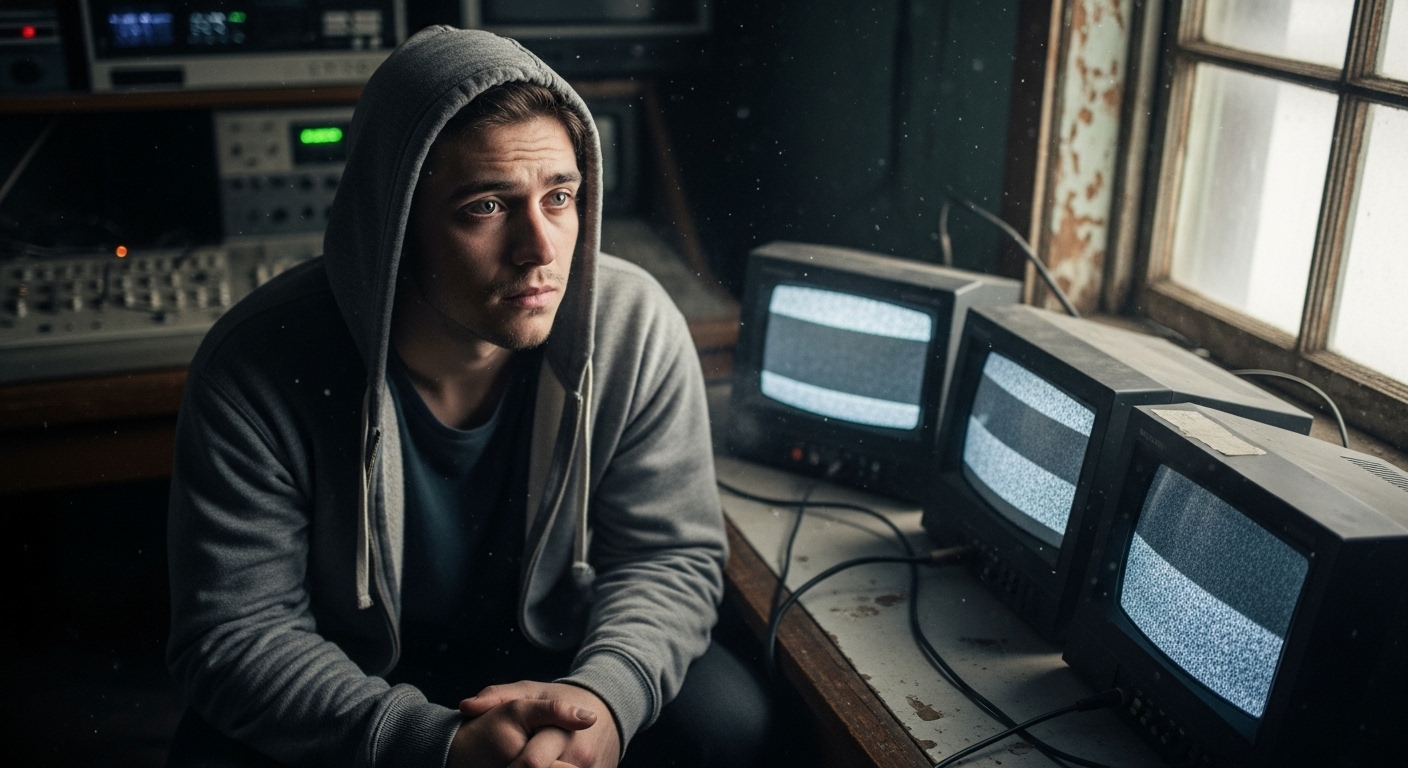
The hum of the old equipment was the only answer, a low, constant vibration that echoed the uncertainty in his own chest, and for a long, cold moment, John didn't know if it was a promise or a warning.
Share This Story


