The Hum of Uncertain Futures
The control room hummed, a low, persistent thrum against the backdrop of an impossibly bright spring day outside. Dust motes danced in the anemic shafts of light that pierced the gloom, illuminating a space crammed with ancient technology and the stale odour of lukewarm coffee. This was not the glamorous world of broadcast media, but the gritty, overlooked reality of community television, a place where dreams went to slowly pixelate and fade. Maggie, barely past her twentieth year, found herself tethered to a swivel chair, her gaze fixed on a screen that had just delivered an unwelcome jolt to the fragile ecosystem of their humble operations.
The email, terse and devoid of pleasantries, stared back at Maggie from the monitor. Its subject line, 'Station Re-evaluation and Operational Adjustments,' shimmered with an almost malevolent indifference under the flickering fluorescent light. Her finger, stained faintly with the lingering residue of last night's microwaved pasta sauce, hovered over the delete key, a nervous twitch that did not belong to her usual, unflappable self. She had seen these missives before, in other dead-end jobs, always preceding the polite yet brutal cull. A restructuring. A re-imagining. Always a prelude to less, to nothing.
The air in the control room, thick with the smell of old plastic and dust, suddenly felt heavier, pressing down on her shoulders. Outside the grimy window, a defiant robin tugged at an earthworm in the station's patch of unkempt lawn, oblivious to the bureaucratic death knell being sounded within these walls. Maggie rubbed her temples, the dull ache behind her eyes intensifying. Twenty years old, barely, and already she felt the weight of impending obsolescence.
She pushed her swivel chair back, the industrial wheels grating against the linoleum, a sound akin to a rusty protest. Her worn canvas shoes, scuffed at the toes, felt suddenly heavy. The memo was from 'Central Management.' A new entity, it seemed, one that had replaced the benevolent, if largely absent, local council oversight. This felt bigger, colder. She reached for her lukewarm mug of instant coffee, its ceramic surface rough beneath her fingertips, and took a sip. Bitter. Perfect.
The door to the main studio creaked open, admitting George, the station manager, a man whose permanent state of being hovered somewhere between weary resignation and profound irritation. His grey tweed jacket, a perpetual fixture, looked even more dishevelled than usual, slung over his narrow frame like an ill-fitting shroud. He ran a hand through his sparse, salt-and-pepper hair, his gaze sweeping over Maggie and the screen with a practiced, weary assessment.
"Morning, Maggie," he said, his voice a low rumble, devoid of its usual morning gruffness. There was a new strain in it, a tautness that betrayed a sleepless night. "You've seen it then, have you? The… communique?"
Maggie nodded, indicating the screen with a slow, deliberate gesture. "It arrived precisely at 07:00 hours. A rather ominous beginning to a Tuesday, wouldn't you say?"
George sighed, the sound a deflating bagpipe. He settled onto a stool beside the main soundboard, his eyes scanning the flickering levels, as if seeking solace in the predictable rhythm of electrical signals. "Ominous, indeed. A particularly anodyne turn of phrase for what I suspect is a thinly veiled threat to our very existence."
Just then, Steffi, the station's self-appointed creative director and host of the local 'Art Beat' segment, swept in, a whirlwind of dramatic intent. Her vibrant fuchsia scarf billowed behind her, a splash of aggressive colour in the monochromatic room. She clutched a printed copy of the memo like a sacred, yet deeply offensive, text.
"This," Steffi declared, her voice pitched for an audience, "is an abomination. A bureaucratic cudgel aimed squarely at the heart of community expression! How dare they speak of 'optimising content streams'? Do they envision us as mere conduits for pre-digested pap?"
Maggie suppressed a wry smile. Steffi’s histrionics, while occasionally tiresome, were at least predictable. A sense of the theatrical was as ingrained in her as the fear of being truly ignored. "Perhaps, Steffi," Maggie offered, her voice carefully neutral, "they envision us as a fiscal liability that needs to be… ameliorated."
George grunted, a sound of agreement and despair. "The girl has a point, Steffi. While your impassioned rhetoric is, as always, commendable, the brutal reality of the ledger often triumphs over the artistic impulse."
"Brutal reality!" Steffi gasped, her hand pressed dramatically to her chest. "Is that what we have become, George? Mere accountants of the airwaves? We are artists! We are the voice of this town!"
"The voice of a town," George countered, his tone hardening, "that, regrettably, prefers to consume its content via handheld devices and international streaming services, rather than tune into 'The Morning Chronicle' or 'Art Beat'. We have, by all measurable metrics, a viewership that could comfortably convene in my living room, with room for several additional guests."
A scuffling sound announced the arrival of Karl, the station's perpetually unflappable technical wizard. He was an anomaly in the small, emotionally charged crew – calm, methodical, and rarely given to outbursts. He carried a small, chipped ceramic mug, the rim of which he often worried with his thumb. His gaze was fixed on the memo Steffi held aloft, a flicker of something almost like concern in his usually placid eyes.
"The memo implies a shift in programming focus," Karl stated, his voice quiet, matter-of-fact. "A move towards 'digital-first engagement models.' This likely means more short-form content, possibly even… user-generated."
Steffi dropped the memo onto the console, the papers scattering. "User-generated? Are we to become a mere repository for cat videos and poorly lit culinary exploits? Our esteemed documentary series on local mushroom foraging… is that to be supplanted by TikTok dances?"
"One does suspect," George mused, leaning back on his stool, which groaned under his weight, "that the esteemed documentarians of fungal life would find themselves in direct competition with a plethora of amateur mycologists online, with far greater reach."
Maggie watched them, a small part of her observing the spectacle as if from a distance. The theatricality of their despair, the grand pronouncements, the clinging to a dignity that, she suspected, had long since eroded. She saw the dust motes still dancing in the thin sunlight, oblivious. The outside world, bright and full of new growth this spring, felt miles away from the stale air of this studio.
"Perhaps," Maggie ventured, her voice cutting through the melodramatic laments, "we should consider the precise wording. 'Leveraging emerging platforms.' This could signify an opportunity, rather than an outright capitulation. A chance to redefine 'community television' for a new epoch."
Steffi whirled, her fuchsia scarf once again a blur. "Redefine, Maggie? Or dissolve entirely into the cacophony of the digital ether? The essence of our endeavour is long-form, thoughtful, locally pertinent narratives. Not… ephemeral snippets designed for fleeting attention spans!"
"And yet," Karl interjected, pushing his glasses up his nose, "fleeting attention spans are precisely what dominate the contemporary media landscape. To ignore this, George, would be to hasten our inevitable demise."
George pushed himself off the stool, walking over to the glass pane that separated the control room from the empty studio beyond. He gazed into the cavernous space, the set for 'The Morning Chronicle' standing lonely, draped in a thin layer of dust. "Demise, you say? Perhaps it is a dignified conclusion we seek, rather than a humiliating transmogrification into something we are not. We have, after all, upheld a certain standard. A beacon, however dim, of journalistic integrity."
"Integrity," Steffi scoffed, hands on her hips, "does not pay the electricity bill, George. Nor does it entice the attention of the younger demographics who, let us be frank, are the future of… well, of everything. We must adapt! We must innovate! I propose a bold, radical pivot. We shall embrace the absurd. We shall become… viral."
Maggie felt a shiver, not of excitement, but of genuine dread. Viral. The word itself felt tainted, associated with the desperate, the performative, the utterly disposable. She thought of the careful segments she had produced, the local craftspeople, the quiet activists, the overlooked histories. Would these be sacrificed on the altar of internet virality? Her stomach churned, a mild protest against the escalating absurdity.
"Viral?" George turned from the window, his voice dangerously low. "Are you suggesting we debase the very principles upon which this venerable institution was founded? We are not some internet sideshow, Steffi. We are broadcasters!"
"Broadcasters without an audience, George!" Steffi retorted, her voice rising in pitch, her theatricality now edged with genuine frustration. "What good is a broadcast if it falls upon deaf ears? We need engagement! We need views! We need a reason for Central Management not to simply… pull the plug!"
Karl cleared his throat, a small, almost imperceptible sound. "The memo also mentioned potential redundancies. Operational streamlining. Fiscal efficiencies."
The words hung in the air, cold and sharp, puncturing the dramatic tension with a dose of harsh reality. The arguments, for all their performative flair, were suddenly grounded in something far more terrifying: job loss. Maggie felt a sudden tightness in her chest. Redundancies. That was the word that truly mattered.
Steffi's theatricality deflated somewhat, her shoulders slumping. "Redundancies… they truly mean to dismantle us, piece by piece."
George, too, seemed to shrink, the fight draining from him. He moved back to his stool, picking up a stray cable and idly coiling it. "The writing, it would appear, has been on the wall. Or, rather, in the email. Our quaint little endeavour, our beloved community station, is simply an anachronism in this new, unforgiving landscape."
Maggie's gaze drifted from the three figures, each wrestling with their own form of denial or desperate ambition, to the monitor again. The stark white text of the memo seemed to pulse, a silent, insidious threat. She thought of her own small aspirations, the quiet satisfaction of editing a well-paced segment, the subtle power of telling a local story with integrity. Was it all just… an anachronism? A misplaced dream in a world that valued only the loudest, most fleeting noise?
She picked up her coffee mug, now completely cold, the bitter residue sticking to the bottom. The hum of the server rack persisted, a constant, low thrum. It was the only unchanging sound in the room, a heartbeat of old machinery, oblivious to the human drama unfolding around it. The spring light outside was fading, the defiant robin long gone. Soon, the blue glow of the monitor would be the brightest light in the room, illuminating only the uncertain future.
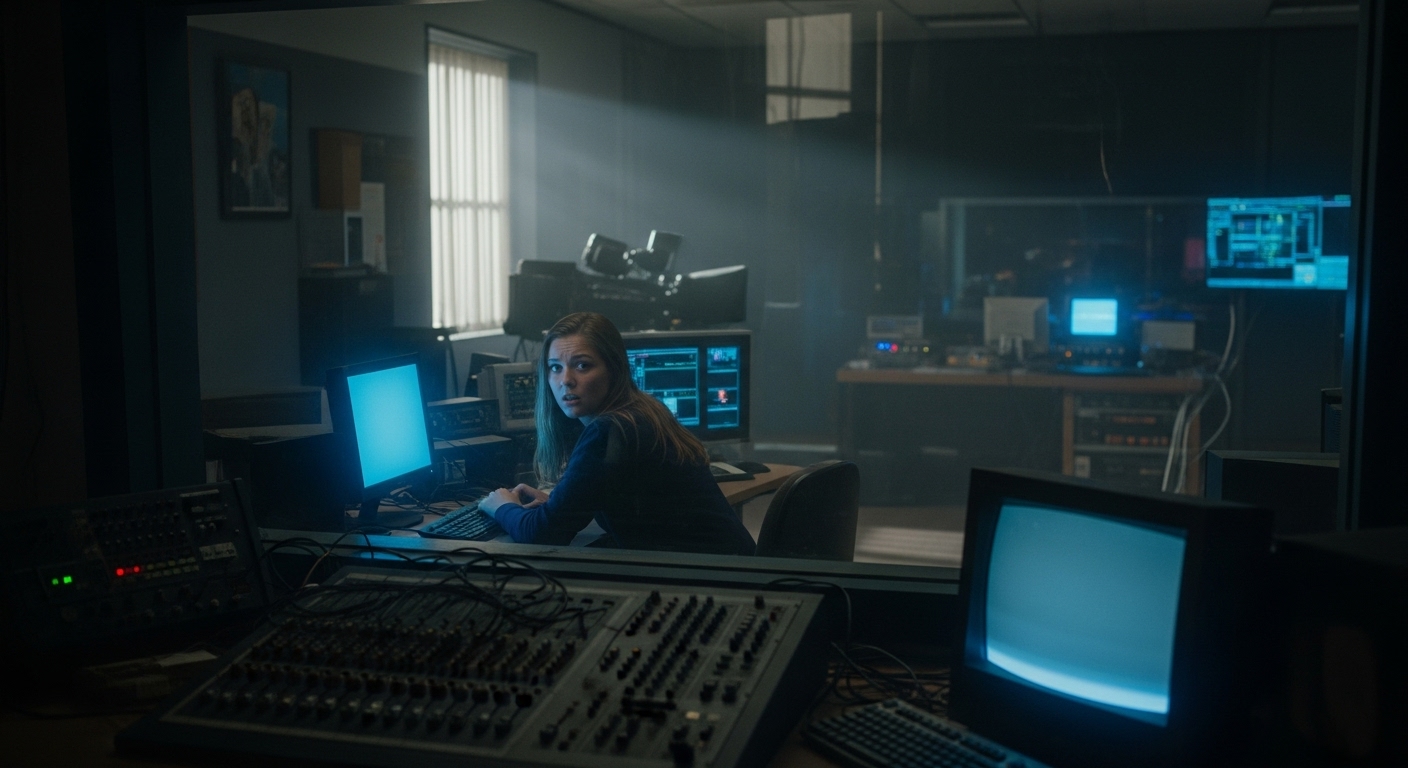
The hum of the old server rack felt suddenly oppressive, a physical manifestation of the unresolved tension, leaving Maggie suspended between the crumbling ideals of the past and the uncertain, chaotic demands of a future she wasn't sure she wanted to inherit.
Share This Story


