The Economics of Scrap Metal
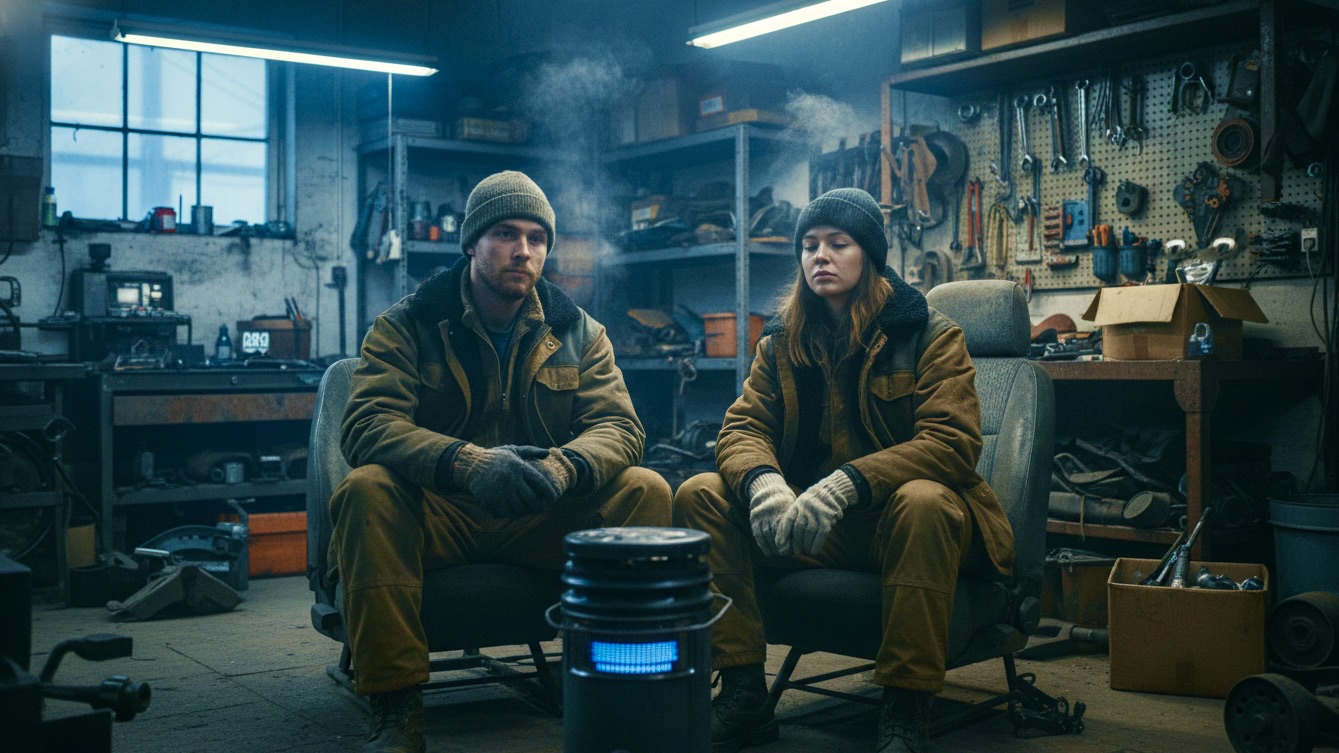
A cluttered, uninsulated mechanic's garage converted into an art studio during a severe cold snap in 2025.
The sculpture, a three-hundred-pound monstrosity of welded rebar and stolen shopping cart casters, didn't want to move. It wanted to stay exactly where it was, rooted to the concrete floor of the garage like a stubborn rusted weed. Bode shoved his shoulder against the jagged flank of the thing, his boots slipping on a patch of oil-slicked frost. He grunted, a sound that was less human effort and more structural failure.
"Pivot it," Marnie said. She was standing on the other side, wearing three hoodies layered like an onion, clutching the upper armature with gloved hands that looked too big for her arms. "Don't shove. You have to pivot."
"I am pivoting," Bode snapped, though he wasn't. He was shoving. The cold had settled into the marrow of his bones about an hour ago, and now his patience was fraying faster than the duct tape holding the handle of his welding torch together. "It’s the casters. The grease is frozen. Physics doesn't work at thirty below."
"Physics works fine. You’re just mad because the jury said your artist statement was 'too derivative'."
"Low blow." Bode heaved again. The metal screeched—a sound like a fork dragged across a chalkboard amplified through a distortion pedal—and the sculpture lurched three inches toward the bay door. "And they didn't say derivative. They said 'lacking regional specificity'. Which is rich, considering I made this out of actual trash from the Dryden dump."
They paused, breath pluming in the air between them. The garage was technically heated, in the sense that there was a propane heater in the corner that hissed and rattled and did absolutely nothing for the air more than five feet away from it. The space smelled of burning copper, stale Tim Hortons coffee, and that specific, sharp scent of cold dust that settles in old buildings during a northern winter. It was a smell Bode associated with failure.
"Regional specificity," Marnie muttered, letting go of the metal to shake her hands out. The thick workman's gloves made a dull clapping sound. "They want you to weld a moose. Or a pine tree. If you welded a pine tree holding a hockey stick, they’d give you the grant tomorrow."
"I'm not welding a moose, Marnie."
"Then pivot the damn sculpture so we can get it in the truck."
They went back to it. It took another ten minutes of grunting, slipping, and one very close call where a serrated edge of rebar nearly took out the side mirror of Bode’s rusted Ford F-150, but they managed to wrestle the beast into the truck bed. The suspension groaned in protest. Bode slammed the tailgate, the metal ringing out like a gunshot in the quiet, snow-muffled afternoon.
He leaned against the truck, panting. The air burned his throat. The sky above was that flat, impenetrable white that meant snow was coming, or maybe it was already snowing and the light just couldn't be bothered to differentiate. It was 2025, and the weather had only gotten weirder, sharper, more vindictive.
Marnie sat on the rear bumper, kicking her heels against the tire. She pulled a vape pen from her pocket, looked at it, realized the battery was dead, and shoved it back with a sigh that was fifty percent exhaustion and fifty percent existential dread.
"So," she said, staring at the grey horizon of pine trees that lined the edge of the property. "If we get this to Thunder Bay by six, and if the gallery actually hangs it, and if someone actually buys it... what’s the net?"
Bode did the math in his head. He’d done it a thousand times, usually at 3:00 AM when the anxiety woke him up. "Materials were mostly free, minus the gas for the torch and the wire. Gas to get there and back is... let's say a hundred bucks, considering the price spike last week. Entry fee was fifty. If it sells for the asking price? I clear maybe four hundred dollars."
"Four hundred," Marnie repeated. She picked at a loose thread on her outermost hoodie. "That’s almost rent. For a week."
"It's exposure, Marnie. The currency of the future."
"Exposure is what you die of out here," she said dryly. She hopped off the bumper and headed back toward the garage. "Come on. I brewed a fresh pot of sludge. Let's warm up before we hit the highway."
Inside, the garage felt marginally warmer, mostly because the wind was blocked. They sat on a pair of bucket seats ripped from a dead Cavalier, positioned reverently in front of the propane heater. Bode poured coffee into two mugs that were stained brown on the inside. He handed one to Marnie.
She wrapped both hands around it, closing her eyes. "I got the rejection email from the Toronto residency this morning."
Bode stopped mid-sip. He looked at her over the rim of his mug. He didn't say 'I'm sorry' because 'I'm sorry' was a useless currency between them. They collected rejections like other people collected points on loyalty cards. "Standard form letter?"
"Worse," she said, opening her eyes. "Personalized encouragement. The curator said my prose was 'hauntingly stark' but that they were looking for voices that 'celebrate the vibrancy of urban connectivity'. Urban connectivity, Bode. I live in a town where the internet goes out if a raven lands on the line too hard."
Bode snorted. "Vibrancy. That means they want happy stories about subways. They don't want stories about how the grocery store ran out of lettuce again because the transport truck jackknifed on Highway 17."
"Exactly. It's..." She gestured vaguely with the mug, liquid sloshing dangerously close to the rim. "It feels like we're shouting into a void, but the void isn't even listening. It has noise-canceling headphones on. It’s listening to a podcast about productivity hacks."
Bode took a long drink. The coffee was bitter and tasted faintly of iron, likely from the water pipes. "Maybe we're just obsolete. You know? Two analog glitches. Look at us. I'm welding scrap metal in a world that wants seamless, AI-generated biomorphic furniture. You're writing short stories about isolation in a world that wants fifteen-second dopamine hits."
"Don't start with the doom spiral," Marnie warned, though she smiled faintly. "I can't handle the doom spiral until I've had at least one cookie. Do we have cookies?"
"We have stale soda crackers."
"Pass the crackers."
Bode retrieved a sleeve of crackers from the workbench, brushing off a layer of metal filings before handing them over. They ate in silence for a moment, the only sound the rhythmic thrum-thrum-thrum of the heater and the wind picking up outside, rattling the corrugated metal roof.
"My dad asked me yesterday when I was going to 'pivot' to a trade," Bode said, chewing dryly. "He sent me a link to a heavy equipment operator course. Said the lithium mines up north are hiring. hundred grand a year to start. Camp life. Two weeks on, two weeks off."
Marnie looked at him. "You'd go crazy. You'd be welding stick figures onto the excavators within a week."
"Would I?" Bode stared at the blue flame of the heater. "Hundred grand, Marn. I could fix the truck. I could buy a house that has insulation. I could buy actual canvas instead of painting on plywood scraps. I could... eat vegetables that aren't frozen."
"But you wouldn't have time to paint. Two weeks on, two weeks off? The two weeks off you're just recovering. You're sleeping. You're drinking to forget the two weeks on. I’ve seen it. My uncle did it for ten years. He has a boat and a skidoo and a liver the size of a football, and he hasn't read a book since 1995."
"Is that worse than this?" Bode gestured around the garage—the piles of rusted junk, the unfinished canvases leaning against the wall, the layer of grime that coated everything. "We're twenty-four, Marnie. We're living like we're in a post-apocalyptic novel, but without the cool outfits. I have forty dollars in my bank account until that sculpture sells. If it sells."
Marnie broke a cracker in half with precise, deliberate force. "It’s not worse. It’s just... different bad. That’s the choice, right? The trap. You can have money and no soul, or soul and no money. It’s a binary system designed to crush you either way."
"Satire isn't helping today," Bode muttered.
"It's not satire. It's observation. It’s journalism." She leaned forward, elbows on her knees. "Look, the world in 2025 is a joke. We know this. The climate is broken, the economy is three hedge funds in a trench coat, and culture is just an algorithm chewing on its own tail. But..." She hesitated, looking down at her boots. They were duct-taped at the toe.
"But what?"
"But here, at least, it’s real," she said quietly. "The cold is real. That ugly jagged thing in your truck is real. When I write a sentence here, I know it’s true because there’s nothing else to do but tell the truth. There’s no audience to perform for. There’s just... us. And the snow."
Bode looked at her. Her face was pale, framed by the dark wool of her hood, her eyes tired but fierce. He felt a sudden, sharp ache in his chest that had nothing to do with the welding fumes. It was affection, terrifying and heavy.
"Real doesn't pay the hydro bill, Marnie."
"No," she admitted. "But maybe we don't need to win the game. Maybe we just need to refuse to play by their rules. We stay here. We make our weird, gritty, 'regionally unspecific' art. We become the hermits of the highway. We grow potatoes in the summer and freeze in the winter and we leave something behind that proves we were here, that we didn't just... consume content and die."
Bode cracked a smile. It felt rusty. "Hermits of the Highway. Sounds like a bad folk band."
"I'd listen to them."
He sighed, leaning back in the bucket seat. The vinyl was cold against his neck. "I'm just tired, Marn. I feel like I'm waiting for a bus that was cancelled three years ago."
"I know," she said softy. "Me too."
They sat there for a long time. The light outside began to fail, the white sky turning a bruised purple. The heater sputtered, coughed, and died. Silence rushed back into the room, heavy and cold.
"Out of propane," Bode said, not moving.
"Great," Marnie said. "Perfect narrative timing."
"We should go. If we leave now, we beat the plow on the pass."
"Or we get stuck behind it doing forty all the way to Raith."
"Optimism, Marnie. Remember?"
They stood up, stiff and groaning like old machinery. Bode grabbed his keys. He looked around the darkening garage one last time. It was a dump. It was a freezer. It was a trap. But Marnie was right. It was theirs. There was a specific dignity in the grime, a resistance in the refusal to be polished.
"Hey," Marnie said at the door. She was pulling her scarf up over her nose. "If it doesn't sell... if nobody buys the sculpture..."
"Yeah?"
"We drive it to the marina and dump it in the lake. Let the future archaeologists figure it out. They’ll think it was a ritual effigy to the God of Tetris."
Bode laughed, a real laugh this time. "Deal."
They walked out into the biting wind. The snow had started—huge, fat flakes drifting down in the stillness before the storm. The truck was a dark shape in the driveway, the sculpture in the back looking like the skeleton of some prehistoric beast unearthed from the ice.
Bode climbed into the driver's seat. The engine turned over once, twice, sluggish and complaining, before roaring to life with a rattle that shook the dashboard. He turned on the headlights, cutting two yellow cones into the swirling white.
Marnie hopped in the passenger side, slamming the door hard to get it to latch. She rubbed her hands together over the vents, waiting for heat that wouldn't come for another twenty kilometers. "Route 102 or the main highway?"
"Main highway," Bode said, shifting into gear. "I want to see the lights at Kakabeka. Remind myself civilization exists."
"Civilization is overrated," she muttered, but she buckled her seatbelt.
The truck crunched over the hard-packed snow of the driveway and turned onto the road. The tires hummed against the ice. Bode gripped the wheel, feeling the weight of the truck, the weight of the art in the back, the weight of the girl beside him who refused to let him weld a moose. It was a heavy load. But the road was open, and the tank was half full, and for now, that was enough.
"Put on some music," Bode said. "Something loud. Drown out the wind."
Marnie plugged her phone into the aux cord. A moment later, distorted, fuzzy bass filled the cab. It wasn't a symphony. It wasn't a tapestry of sound. It was just noise—raw, unpolished, and loud enough to rattle the windows.
They drove into the dark, two specks of heat in a frozen landscape, heading toward a city that probably didn't care, armed with nothing but scrap metal and bad poetry.
They drove into the dark, two specks of heat in a frozen landscape, heading toward a city that probably didn't care, armed with nothing but scrap metal and bad poetry.
Share This Story


