Dust and Deadlines
The air in the small office hummed with the strained silence that followed a shouted exchange. Dust motes, disturbed by the sudden movements, danced in the weak, autumn light that struggled through the smudged windowpane. Outside, the last stubborn leaves of the maple tree across the street clung to their branches, a defiant splash of ochre against a bruised sky. Inside, the battle for 'Local Lens' was far from over, each person in the room stiff with a mixture of anger, frustration, and a profound, quiet exhaustion.
"…and what exactly is ‘community value’ when the community itself is watching cat videos on their phones?" Owen's voice was a low growl, barely cutting through the whir of the ancient air conditioning unit that always smelled faintly of old paper and something vaguely metallic. He ran a hand through his thinning grey hair, the gesture more habit than genuine frustration, though the frustration was plain on his face. He sat hunched over the main desk, a fortress of documents and discarded coffee cups, his weight settling into the groaning office chair. Jessie watched the worn vinyl on the armrests, cracked in places, showing the yellowed foam beneath, a detail he’d stared at a thousand times during these endless, circular meetings.
Jessie shifted, the old wooden floorboard beneath his scuffed trainers giving a faint, familiar squeak. He’d been standing by the window, ostensibly looking out at the rust-coloured leaves clinging to the maples, but mostly just trying to find a space that wasn't directly in Owen's line of fire. "It’s about giving people a voice, Owen. Stories they won’t get anywhere else. Like Mrs. Peterson’s prize-winning dahlias. Or the council meetings no one else bothers to cover." He tried to keep his voice steady, but he could feel a tremor starting in his chest. He was twenty-three, and this station, this dying flicker of local broadcast, felt like the only thing tethering him to Port Blossom. The thought of it fading… it was a cold knot in his stomach.
Karen snorted, a sharp, disbelieving sound. She was perched on the edge of the filing cabinet, a legal pad balanced precariously on her knee. Her dark, sleek bob didn't move as she shook her head. "Jessie, with all due respect to Mrs. Peterson’s dahlias, they pulled three viewers last week. Three. And one of them was Mrs. Peterson herself. We are bleeding money. The board is looking at a hard cut. We need to be realistic." Her pen tapped a staccato rhythm against the pad, a nervous, persistent beat. Her gaze, usually so clear and direct, seemed to skirt his, lingering instead on Owen's grim profile.
"Realistic?" Jessie pushed off the wall, the peeling paint cool against his palm. "So we just… become another YouTube channel? A glorified blog? Is that the future, Karen? Selling out the only independent voice this town has?" He knew he was being dramatic, but the words felt true, heavy with the weight of something he couldn’t articulate, a fear that went beyond job security. He scraped a hand through his own close-cropped hair, a nervous habit. The smell of damp moss and old coffee hung heavy in the air, a scent that was almost synonymous with the station itself, especially in autumn.
Owen finally pushed a hand through the papers on his desk, sending a few stray flyers for the annual pumpkin festival fluttering to the floor. "Look," he said, his voice softer now, tired. "It's not about selling out, Jessie. It's about surviving. The board wants a viable proposal for the next fiscal year, or they're pulling the plug. End of story. And 'Local Lens' as it is? It's not cutting it." He picked up a crumpled sheet of paper, smoothing it out. "Our budget is being slashed by another thirty percent. Thirty. Do you know what that means?" His eyes, usually sharp with a dry humour, were shadowed with something close to defeat. He leaned back, the chair groaning in protest.
Karen leaned forward, her voice dropping, a conspiratorial edge to it. "It means we need to adapt. We go hybrid. We find sponsors. We push for interviews with the new mayor, the businesses that are actually doing something. Not just…" She paused, searching for the right word, her gaze flicking to Jessie, then away. "Not just quiet community pieces. We need engagement. We need viewers who aren’t already our grandmothers."
Jessie felt a hot flush creep up his neck. "So, we chase numbers. We become everything we tried not to be." He felt a strange combination of anger and profound sadness. He loved this place, this rambling, slightly decrepit building where he’d practically grown up, learning the ropes from Owen. The way the light hit the dusty lenses of the old cameras in Studio A, the faint hum of the servers downstairs, the endless piles of tapes. It was home, more than his rented room above the bakery. And Karen, his best friend since high school, the one who’d convinced him to really dive into this whole messy, wonderful thing. To hear her talk like this, it felt like a betrayal. He knew she was right, in a practical sense, but the truth tasted bitter.
"It’s not selling out, Jessie, it’s… evolving," Karen insisted, her voice tight. "It’s making sure we still exist to tell any stories at all. Do you want this place to shut down? Because that’s the alternative. The board said it clear as day. Next meeting, they want a new direction. A new pitch. Something that shows we understand the economic realities. And that’s in two weeks."
Two weeks. Jessie's stomach clenched. Two weeks to reinvent a show that had been the heartbeat of this station for twenty years, a show he’d poured his entire young adult life into. He ran a hand over his face, feeling the stubble, the weariness. He hadn’t slept properly in days. The autumn evenings, drawing in earlier and earlier, felt like a constant reminder of things ending, of light fading.
"We could do a segment on the new cider mill," Jessie offered, almost to himself, trying to pull something, anything, from the creative well that felt like it was drying up. "They’re doing a big opening, lots of local produce. Good visuals. That appeals to… everyone, right?" He hated the sound of his own voice, desperate and weak.
Owen sighed, a long, drawn-out sound. "Good visuals don't pay the hydro bill, son. The board wants a concrete plan for revenue generation. Not just… a pretty picture of apples."
"We could run ads for the mill," Karen interjected, her pen already scribbling on the pad. "Native advertising. Integrate it into a feature on local agri-tourism. We'd charge them a fee for production and placement. We brand it 'Port Blossom Flavours' or something. It still feels local, but it's clearly sponsored content. And we expand our social media push, get analytics, show them real data."
Jessie stared at her, a cold shock running through him. "Sponsored content? Are you serious? So our 'local voice' becomes… an infomercial?" He couldn't believe she was saying this, that the person who’d once preached about the integrity of public interest broadcasting was now talking about selling airtime like it was a commodity, like just another product. He knew they needed money, but this felt like surrendering the soul of the place.
"It’s a stepping stone!" Karen retorted, her voice rising, losing its careful control. "A way to keep the lights on so we can still do the stuff we care about. How are we going to interview the local fisherman if we don’t have cameras that work? Or a studio that isn’t leaking when it rains? It’s pragmatism, Jessie, not a betrayal."
"Pragmatism has a price," Jessie muttered, turning back to the window. The leaves outside shivered, then a small gust of wind tore a few free, sending them spiralling down to the damp pavement below. The chill from the windowpane seeped through his shirt, raising gooseflesh on his arms. He squeezed his eyes shut for a second, a fleeting image of the vast, quiet expanse of the lake, grey under a grey sky, passing through his mind. A place he went when everything got too loud, too much. Now even that felt distant.
---
He pushed open the heavy steel door to the main studio, the creak echoing in the cavernous space. The studio was dark, the massive lights suspended from the grid above like sleeping giants. The air in here always smelled different, less of dust and paper, more of old plastic, electronics, and faint stage makeup. He walked past the main set, a ridiculously cheerful backdrop of Port Blossom’s harbour, hand-painted on plywood, a little chipped at the edges. One of the studio cameras, a behemoth from the early 2000s, sat under a tarp, patiently waiting for a shoot that might never come. He ran his hand along the cool metal of its tripod leg, feeling the vibration of the station's distant hum.
His thoughts were a tangled mess. Karen was right. Financially, she was probably right. They couldn't keep operating on fumes and goodwill. But the idea of 'Port Blossom Flavours,' of turning their carefully cultivated journalistic integrity into thinly veiled advertisements, made his stomach churn. What was the point, then? Why not just get a marketing job? Why bother with the endless hours, the minuscule pay, the constant uphill battle, if they were just going to become another cog in the commercial machine?
He walked to the control room, a smaller, darker space filled with blinking lights and screens. The main mixing board was a relic, its sliders sticky, some of its buttons barely responsive. He remembered sitting here late into the night, learning the intricacies of sound, the subtle art of transitions, the thrill of bringing a story to life. Owen, patient and gruff, showing him how to cue the music, how to fade out the town councilor's droning voice just so. This place had given him everything. A purpose. A skill. A reason to stay.
"Jessie?"
He nearly jumped. Mary-Anne, their new intern, stood in the doorway, a stack of freshly labelled tape cassettes in her arms. She was barely out of high school, her eyes wide with a mixture of apprehension and bright-eyed enthusiasm that felt both refreshing and deeply, profoundly unsettling in this place. She looked so young, so eager. The station, in its current state, felt like a betrayal of that eagerness.
"Oh. Hey, Mary-Anne," Jessie said, trying to sound casual, to tamp down the storm still brewing inside him. He leaned against the console, trying to appear relaxed, though he could feel his jaw clenching. "Just… checking the equipment."
Mary-Anne nodded, a few strands of dark hair falling across her forehead. She pushed them back with her free hand. "Owen said to label these for the archives. Old 'Community News' segments. There’s one from 1998 about the town bridge. Before they rebuilt it." She hesitated, then added, her voice quiet, "My nan always used to watch 'Local Lens.' Said it was the only way to know what was really happening."
A strange wave of warmth, fragile and unexpected, spread through Jessie. Nan. He remembered his own grandmother, her small living room, the fuzzy picture on the old CRT TV, her rapt attention as he, a clumsy teenager, stumbled through his first on-air report about the high school football team. It wasn’t just Mrs. Peterson. It was generations of Mrs. Petersons. It was people like Mary-Anne's nan, quiet, unassuming, relying on them for a window into their own world. He felt the weight of that trust, the unspoken contract.
"It was," he managed, his voice a little rougher than he intended. "It still is. Or… it should be." He looked at Mary-Anne, really looked at her. Her youthful face, serious, expectant. This was who they were doing it for. Not some amorphous board. Not advertisers. But people. He saw a faint stain on her oversized hoodie, a tiny, almost invisible speck of what looked like old paint, a detail that grounded her, made her real, in this moment of abstract crisis.
Mary-Anne gave a small, uncertain smile. "I think it's important. To have something like this. Something that's just… ours." She clutched the tapes a little tighter, as if protecting them.
Her words, so simple, so unadorned, cut through the noise in Jessie’s head. Just ours. That was it. That was the core. The feeling of belonging, of ownership over their collective narrative. It wasn’t about numbers, not really. It was about connection. He knew it was idealistic, maybe even naive, but it felt right. He pushed himself off the console, a sudden burst of energy sparking within him.
"You're right," he said, meeting her gaze. "It is important." He almost laughed, a dry, slightly hysterical sound. Important, yes, but how to make that tangible to a board obsessed with spreadsheets? He didn't know. But the fire had been rekindled, however faintly.
He left Mary-Anne to her archiving, the metallic tang of the old tapes mingling with the lingering scent of ozone from some long-dead piece of equipment. He walked back towards the office, the urgency growing. He could still hear Karen and Owen’s voices, muffled now, but distinct enough to tell the argument was still simmering. The air outside was turning colder, the scent of burning leaves carried on a crisp breeze. Autumn was fully here, stripping things bare.
He pushed open the office door. Karen was still on the filing cabinet, Owen at his desk, both looking weary. The low, golden light from the window had softened, stretching long shadows across the dusty carpet. The faint hum of the air conditioning still persisted. It was late. The streetlights outside had already flickered on, casting an orange glow on the damp pavement.
"Alright," Jessie said, his voice clearer now, more resolute than he’d felt a moment ago. He tried to ignore the slight tremble in his hands, the knot still tight in his gut. "Two weeks. Fine. We come up with something. Something that works. Something that’s… us. But also something they can't say no to." He looked from Karen to Owen, a challenge in his eyes, but also a plea. A desperate hope for solidarity. He didn’t know if this was supposed to feel… anything. Warm? Comforting? He just… didn’t feel alone, not for a second. His knees felt a bit wobbly, like he'd been standing too long, and he gripped the doorframe, steadying himself. He could feel the splintering wood under his fingers, rough and familiar. He hated this feeling of being suspended, of standing on the edge of something collapsing.
Karen met his gaze, her expression unreadable. She closed her legal pad with a decisive snap. Owen just sighed again, scrubbing at his temples. The silence stretched, thick and heavy, punctuated only by the faint, insistent hum of the building itself. The station, a living, breathing entity, seemed to hold its breath with them, waiting. Jessie knew they were far from a resolution. But for now, for this brief, flickering moment in the deepening autumn twilight, they were together, staring into the unknown, a thin, fragile thread connecting them.
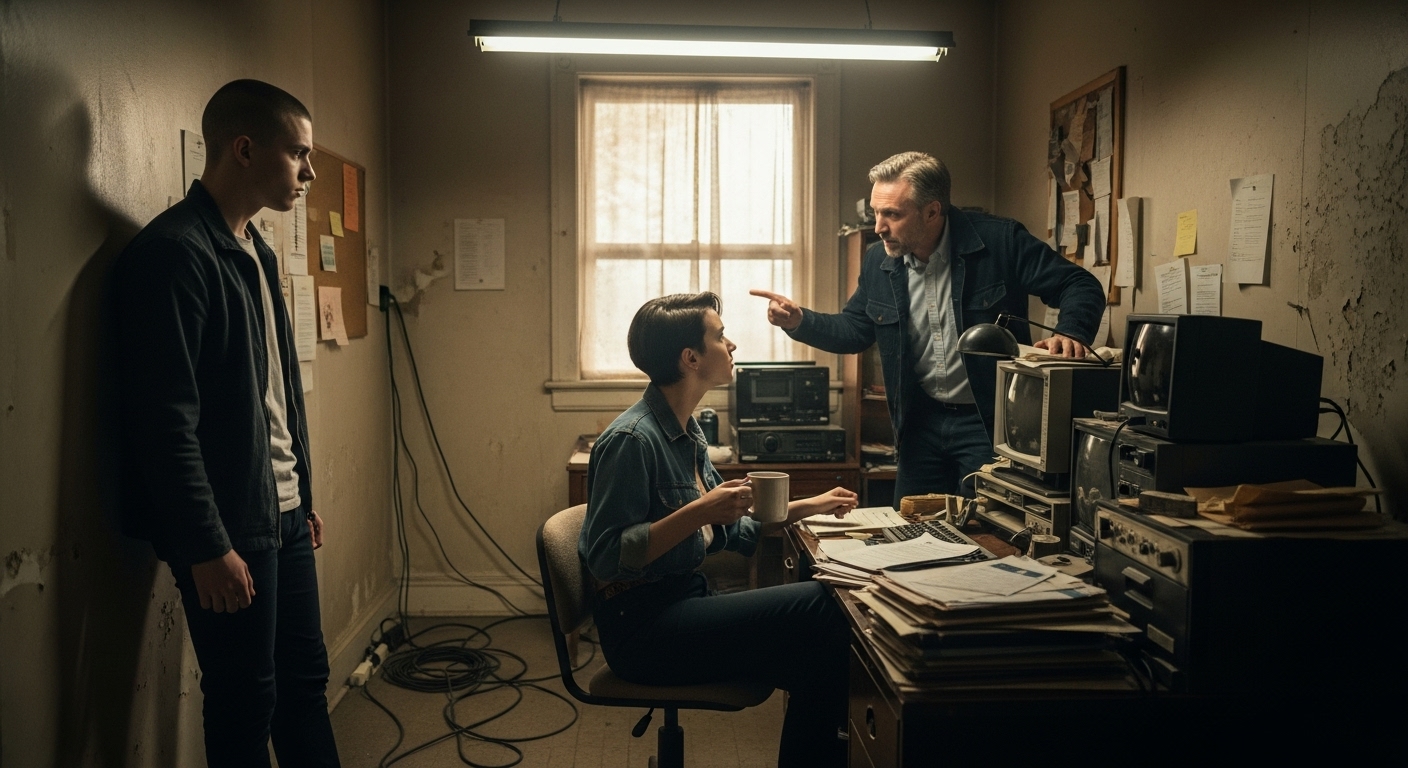
He knew, with a dull throb in his chest, that they hadn't fixed anything. Not really. But in the quiet hum of the old server, as the autumn darkness pressed against the station windows, a flicker of something stubborn, something almost desperate, held on. It wasn't hope, not exactly. More like the last breath before diving into something unknowable, a shared silence that felt, for the briefest moment, like a promise.
Share This Story


