Cobwebs on the Tinsel Box
The kitchen was always the coldest room, even with the oven on, a lingering chill that sank into the marrow. Outside, the early December sky was a bruised plum colour, already fading into a thick, starless night. Inside, the only sounds were the low thrum of the ancient refrigerator and the soft, almost apologetic drip from the tap. A half-eaten plate of toast sat abandoned on the counter, crumbs scattered like tiny, meaningless promises.
Moe watched Irena from the doorway, leaning a shoulder into the cool frame. She was at the chipped ceramic sink, rinsing a mug under a thin stream of water, her back a tight, unyielding line. Her hair, the colour of wet sand, was pulled back in a loose, struggling ponytail. The water, even after a full minute, never quite ran warm. He knew that. Knew the precise, irritating cold bite of it against knuckles that had gone numb from the draught.
"Still no hot water?" he asked, his voice rougher than he intended. It always was, these days. Like his throat was lined with grit.
Irena didn’t jump, didn't even flinch. Just kept scrubbing at a phantom stain on the inside of the mug. "No. Didn't expect it to be. You know Mum never got around to fixing the boiler properly. Just... bandaids." Her voice was flat, without inflection, yet every syllable carried the weight of something else, something much heavier than a faulty boiler.
He grunted, pushing off the frame to shuffle closer. The linoleum felt like ice through his threadbare socks. The scent of stale coffee and Irena's herbal tea, something minty, hung in the air. A forgotten banana peel, darkened to almost black, sat by the fruit bowl. He should toss it. He wouldn't.
"So," Irena began, finally turning, the mug clutched in both hands. Her eyes, the same muted grey as his, were carefully blank. "Are we... going to do anything this year?"
Moe knew what she meant. He just didn't want to say it. The question hung there, thick and unmoving, like the low-lying fog that often choked the marshlands down by the old bridge. He looked at the window, where a faint condensation had started to bloom at the bottom edge. Outside, the neighbour's dog barked, a mournful, rhythmic sound.
"Anything? About what?" He knew that was a stupid question. He heard the petulance in his own voice and hated it. Hated that he couldn't just say the words, even to her, especially to her.
Irena sighed, a small, barely audible puff of air that still managed to prickle his skin. "Christmas, Moe. Are we going to put up anything? Or just... pretend it isn't happening? Like last year? And the year before that?"
The words hung there, tiny ice shards. Last year had been a blur of cheap whisky and too much silence. The year before, an even deeper, more profound quiet, punctuated by the sharp, grief-stricken sounds of their father smashing the old ceramic angels they'd always put on the mantelpiece. The angels hadn't been Mum's favourite, not really, but they had been theirs. Part of the ritual.
Moe ran a hand over his stubbled chin. The electric shaver had given up the ghost weeks ago. He hadn't bothered to replace it. "What's the point, Irena? It's just... stuff. More clutter." He waved a dismissive hand, encompassing the entire, faintly dusty kitchen, the stack of unread mail on the counter, the sad, drooping spider plant in the corner.
"It's not just stuff," she countered, her voice gaining a fragile edge. "It's tradition. It's... something. You know. We always had... a certain way of doing things."
He closed his eyes, saw the flicker of fairy lights against a frosted windowpane, heard the tinny, off-key carols playing from a cheap radio. Smelled pine and Mum's terrible, overly sweet fruitcake. The weight of those memories pressed down on him, a physical ache in his chest. "Yeah, well, things change, don't they? People change. Or they don't. And then it just feels... wrong."
Irena took a shaky breath. She moved to the cupboard above the stove, rummaging for something. Her movements were precise, economical, honed by years of living in a house where everything had its place, even if that place was often chaos. "The box, Moe. The one from the attic. Is it even still up there? After everything?"
He opened his eyes, watched her. The box. Of course. The heavy, faded cardboard box, smelling faintly of mothballs and attic dust, packed with mismatched ornaments, brittle tinsel, and the lopsided star Mum had always insisted on putting on top of their scrawny, artificial tree. He remembered the year the star had finally snapped in half, and Mum, despite her usual stoicism, had cried. A single, silent tear, quickly wiped away. He'd never forgotten it.
"Probably," he mumbled, rubbing at his temples. "It should be. Unless Dad..." He let the sentence trail off, unspoken, unfinished. They both knew what 'unless Dad' meant. Another fit of rage, another purge of memories too painful to look at, too close to the bone. They'd lost half of Mum's old garden gnomes that way, and her collection of antique thimbles.
Irena finally pulled out a small, dented tin, the kind old biscuits came in. She opened it, revealing a tangle of old, dried-up elastic bands. She sorted through them, her fingers surprisingly steady. "I just... I want to try. Just for a little while. One day. Like it used to be. Not... not all of it, maybe. But something."
The raw honesty in her voice, so rare these days, caught him off guard. It was like a shard of glass, unexpected and sharp. He could see the faint tremor in her lower lip, the way her shoulders were pulled in tight. She was trying to hold herself together, and he, in his own misery, was making it harder. He was making everything harder.
He pushed off the counter, suddenly feeling restless. The cold was getting to him, seeping into his bones. "It's a lot of work, Irena. For... what? More disappointment? You know what it does to us. Every year."
"It also... used to be good," she whispered, her gaze fixed on the wilting spider plant. "Before. When she was here. It used to be... bright. And loud. And full of bad singing."
He gave a faint, humourless huff of a laugh. The bad singing. Mum, always tone-deaf, belting out 'Jingle Bells' with an enthusiasm that defied all musicality. Dad, trying to play along on his old, slightly out-of-tune guitar. Irena, a tiny thing, banging on a saucepan with a wooden spoon, utterly delighted. He remembered the feeling of warmth, of safety, of being utterly contained within that small, brightly lit world. The memory was a siren's call, beautiful and dangerous.
"You were too young to remember the really bad ones," Moe said, his voice flat. "The fights. The silent treatments that lasted for days, even on Christmas Day. When she'd pretend nothing was wrong, even though her eyes were puffy and red."
Irena shook her head, a slow, deliberate movement. "I remember enough. I remember the good, too. You just... choose not to. Or can't, maybe." She carefully put the tin of elastic bands back, the small thud echoing in the quiet kitchen. "I need that box, Moe. From the attic. I'm going up."
He watched her. His sister, all five feet nothing of her, her spine stiff with a determination he hadn't seen in years. A small scuff on her right trainer, just above the toe. The way her hands, usually so restless, were now clasped tight. It was a foolish quest, a painful one. But he couldn't stop her. He probably shouldn't. Part of him, a small, hopeful, terribly naive part, wanted to believe that maybe, just maybe, digging out those ghost lights might not be such a bad idea.
"Be careful," he said, the words a strained rasp in his throat. "Mind the loose floorboards. And don't trip over Dad's old fishing gear."
She nodded, a slight, almost imperceptible dip of her head. Then, without another word, she was gone, her footsteps echoing on the stairs as she ascended towards the dark, dust-filled unknown of the attic, towards the past they both dreaded and desperately longed for. He stood there, alone in the cold kitchen, listening to the creaks above, wondering if she'd find what she was looking for, or merely unleash another wave of the cold, relentless memories they’d been trying to outrun.
---
The Unpacking of Regret
The attic door groaned open, a drawn-out, protesting sound that always reminded Moe of an old, dying animal. Irena flicked on the single bare bulb, its weak light struggling against the pervasive gloom. Dust motes, thick as tiny snowdrifts, danced in the anemic glow. The air was thick and still, heavy with the scent of aged wood, forgotten paper, and something faintly metallic. A spider's web, gossamer thin, brushed her face, making her flinch back. She hated spiders. Always had.
She scanned the cluttered space. Boxes, stacked precariously, loomed like silent sentinels. Old furniture draped in stained sheets looked like sleeping giants. The faint outline of her father's fishing rods lay against one wall, just as Moe had warned. And there, tucked away under a yellowed tarpaulin, was a familiar shape. A large, worn cardboard box, its seams taped with layers of discoloured masking tape. The word 'XMAS' scrawled on it in Mum’s distinctive, looping handwriting, already faded to a pale ghost of its former self.
A tight knot formed in Irena’s stomach. This was it. The vessel of all the years, good and bad. She approached it slowly, each step a deliberate act. The floorboards creaked under her weight, a symphony of forgotten protests. Her hand trembled as she reached for the box. The cardboard was surprisingly cold beneath her fingertips, despite the stuffy attic air. She knelt, the movement stiff, her knees clicking in protest. Her old jeans stretched tight. She shouldn’t have worn these, she thought, a totally irrelevant detail flitting through her mind. They were too thin for the cold.
She ran her fingers over the faded 'XMAS'. It was still Mum’s writing. Unmistakably. A sudden, sharp memory of her mother, humming off-key while packing these very ornaments away, came unbidden. A slight smile, a dusting of flour on her apron. A moment of pure, uncomplicated joy. The memory was so vivid it hurt.
She tugged at the masking tape. It peeled away with a dry, ripping sound, like old skin. Inside, nestled amongst layers of crumpled newspaper, were the ornaments. She pulled out the first one: a small, chipped ceramic snowman, its carrot nose glued back on crookedly after a fall from the tree years ago. She remembered Moe, then just a lanky teen, trying to repair it with too much superglue, getting it all over his fingers, cursing under his breath. Mum had laughed, a deep, resonant sound that filled the entire house.
Irena’s breath hitched. She hadn't realized how much she missed that sound. The house had been too quiet for too long. Too many empty spaces where laughter used to be. She dug deeper, past the snowman, past a tangle of tarnished silver tinsel that looked like dried cobwebs. Her fingers brushed against something soft, feathery. The angel. The one with the real feather wings. Mum’s favourite, despite its slightly singed wing from an unfortunate encounter with a flickering candle.
Holding the angel, Irena felt a wave of conflicting emotions. A deep, aching sadness for what was lost, but also a fragile flicker of warmth. A whisper of hope. Maybe Moe was wrong. Maybe some things could still be salvaged. Or at least remembered, properly. Not just the pain, but the moments of simple, messy happiness. She remembered Mum saying, "Every scratch, every broken piece, that's just another story, Irena. It means it was loved."
She carefully placed the angel on top of the open box, its singed wing pointing towards the grimy attic window. She thought of Moe downstairs, alone in the cold kitchen, probably pretending not to care, probably listening to every creak and rustle from above. He cared. He always had. His grief was just a different beast, more internal, more corrosive. She understood. She did. But understanding didn't make the silence any easier to bear.
Irena reached for the last item in the box, buried beneath a handful of dried pine needles. It was a small, crudely carved wooden bird, unpainted, missing one leg. Dad had made it for Mum one year, when money was tight. It was ugly, truly, utterly ugly. But Mum had treasured it, placing it front and centre on the tree every Christmas. Irena remembered the faint sawdust smell that clung to it for weeks. She remembered Dad, looking so proud, even though the bird looked like a child's art project.
She held the bird, her thumb tracing the rough, unfinished wood. And then, at the very bottom of the box, beneath a final sheet of newspaper, she saw it. Something small, glinting. Not an ornament. A photograph. Tucked face down. A chill, colder than the attic air, snaked down her spine. She hesitated, her fingers hovering. She knew, instinctively, that whatever image lay beneath that paper, it held a key to the Christmas pain, perhaps even more than the broken angels or the ugly wooden bird. It was the one Mum always tried to keep hidden, the one that sparked the arguments, the one that made Dad's face go grey with a cold, terrifying anger. The one that, every year, cast a long, unforgiving shadow over the festivities.
She wanted to leave it, to pretend she hadn't seen it. But a strange, morbid curiosity, combined with a sudden, fierce need to finally understand, compelled her. Her hand trembled as she reached for the paper, slowly, carefully, flipping the photograph over.
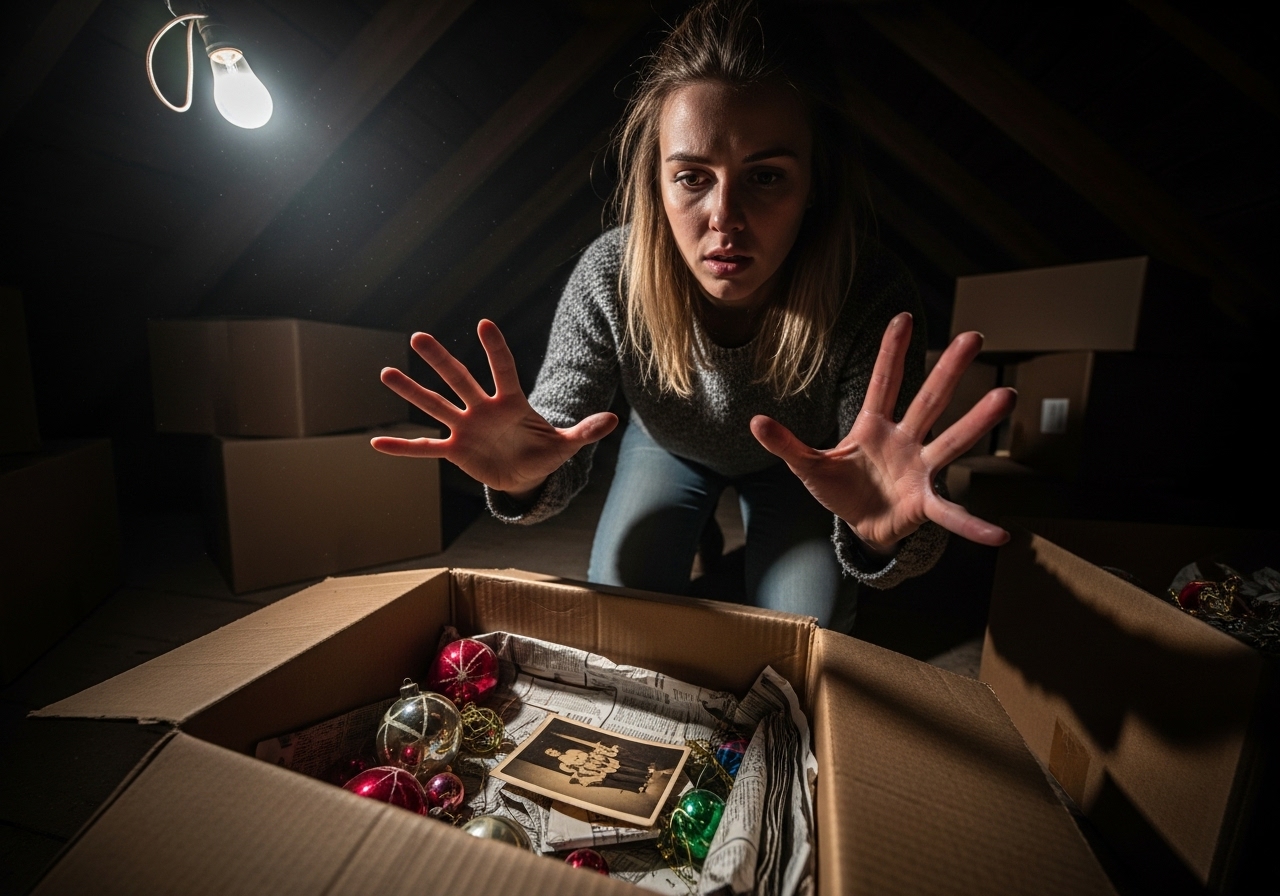
As the faded image was revealed in the dim attic light, Irena gasped, a small, choked sound. The photograph was of a place she vaguely recognised, a place shrouded in winter snow, but it was the figure standing there, small and indistinct in the distance, that made her blood run cold, confirming a forgotten, dreadful truth that lay at the heart of their family's fractured Christmases.
Share This Story


