The Weight of Ghost Lights
The chill of December had seeped into the old house, clinging to the threadbare upholstery and the dust motes dancing in the faint light. Outside, a late afternoon snow began to fall, soft and insistent, muffling the already quiet street. Inside, the silence was a different kind of heavy, punctuated only by the distant, rhythmic hum of the ancient refrigerator in the kitchen. It was Christmas Eve, a day that felt less like a celebration and more like a carefully maintained truce with sorrow.
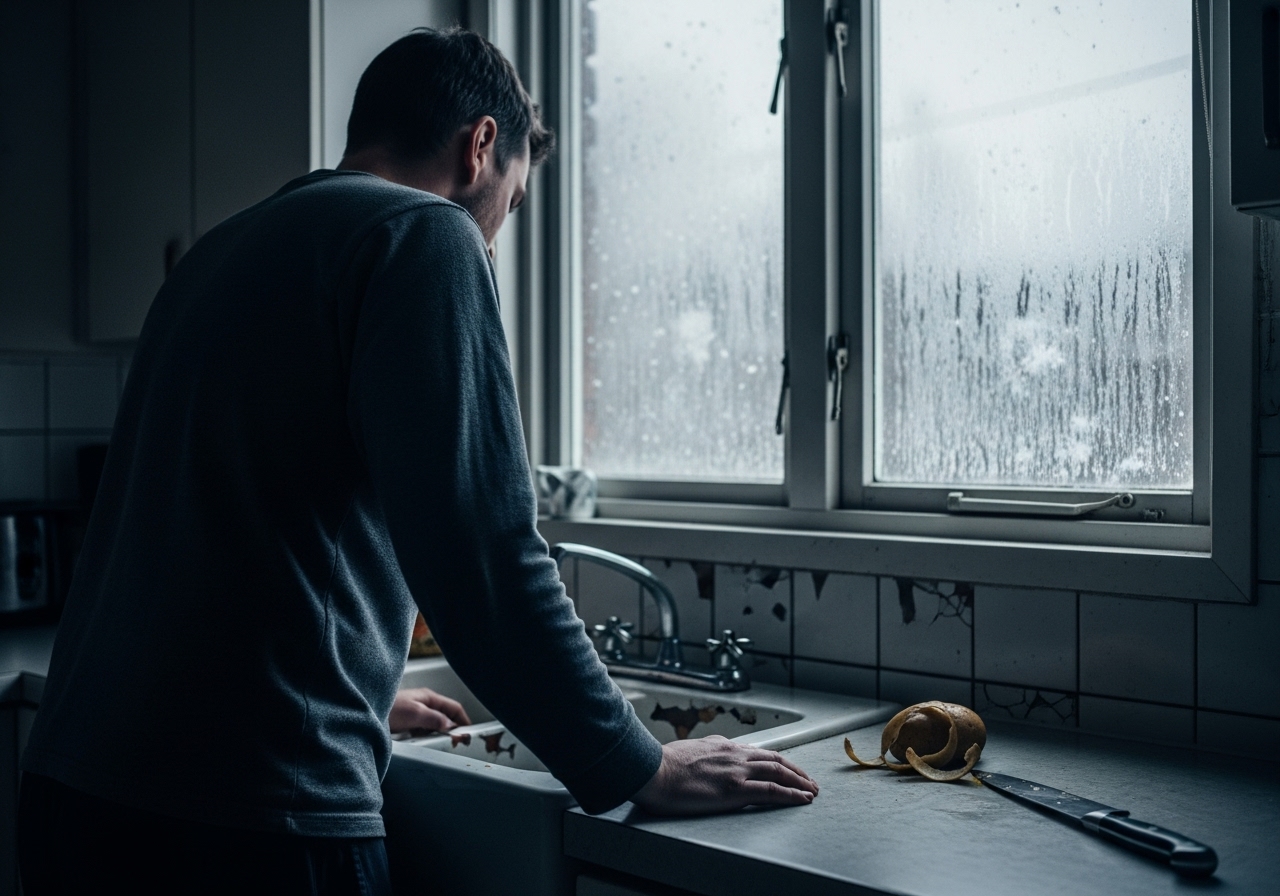
The knife felt cold and awkward in Leo's hand, slick with potato starch. He watched a thin curl of peel drop into the ceramic bowl, joining the growing pile. The potatoes, lumpy and unforgiving, seemed to mock his attempts at a smooth, even cut. Everything felt clumsy this year, like his hands had forgotten how to do simple things, or maybe, more accurately, how to care enough to do them right. His father had always loved roast potatoes, crisp and golden, glistening with duck fat. He'd insist on doing them himself, grumbling good-naturedly about Leo's 'butchery'.
A faint scent of rosemary, pulled from a wilting pot on the windowsill, did little to cut through the faint metallic tang of old cutlery. He’d found the pot shoved behind some forgotten tins of soup, somehow still clinging to life. It reminded him, dully, of himself. Or maybe that was too dramatic. Probably just the plant.
The living room was dark, save for the blue-white flicker of the television, muted and ignored. He hadn’t bothered with lights. No tree, no tinsel. Just the silent, waiting house. His mother would have had the place aglow by now, a dizzying array of tiny, coloured bulbs strung with meticulous precision. He remembered one year, a fight over a tangled string, her voice rising in a tight, thin scream that echoed long after the argument had supposedly ended. The lights had stayed dark that night. It had been Christmas Eve then, too.
He pressed the flat of the knife against a half-peeled spud, watching the dull shine on the blade. The window above the sink was almost opaque with condensation, but he could just make out the swirling dance of snowflakes outside. Heavy, wet flakes, settling on the barren branches of the oak tree in the garden. Each one, a tiny cold whisper.
---
Echoes in the Stillness
The phone, vibrating on the kitchen counter, startled him. He nearly dropped the potato. His heart gave a sickly lurch, a familiar anxiety tightening his chest. He didn't recognise the number at first, a foreign prefix, but then the name bloomed across the screen: Michael. His brother. Leo hadn’t spoken to him properly since the funeral, a curt exchange of pleasantries across the coffin, both of them too raw, too guarded to say anything real.
He let it ring. Once. Twice. Then he swiped, a tremor running through his fingers. "Hello?"
A pause, static-laced. "Leo? It's… Michael." The voice sounded rougher than he remembered, a bit deeper, like a stone dragged over gravel. No, not gravel. More like concrete. Harder. Less forgiving.
"Yeah, I saw," Leo mumbled, dropping the knife with a clatter that made Michael flinch, he could hear it, almost. A tiny intake of breath. "What's… up?"
"Just… calling. Christmas Eve." Michael’s voice was strained, like he was forcing the words out. There was always a forced quality to Michael's efforts at connection, an awkwardness that only seemed to highlight the vast, unbridgeable gulf between them. A chasm carved out of silence and unspoken grievances.
Leo leaned against the counter, the cold Formica seeping through his worn t-shirt. He could feel the small, almost imperceptible tremor in his own hand, still gripping the half-peeled potato. "Right. Merry Christmas, I guess."
Another silence stretched, thin and brittle. He imagined Michael, miles away, probably in some sterile, high-rise flat, holding a phone with the same sense of duty. No, not duty. Resignation. Michael always had resignation down to an art form.
"Look, about…" Michael started, then trailed off. Always 'about'. Never anything concrete. Always vague, hovering just outside the orbit of actual feeling. "Mum and Dad… it’s… been a year."
A year. A year of quiet, a year of things going unsaid, a year of Leo living in the house alone, the echoes of their parents’ arguments still vibrating in the floorboards. He looked around the kitchen, at the chipped mug on the draining board, the calendar still stuck on last January, a picture of a snow-covered cottage, saccharine and utterly unlike any Christmas they’d ever actually had.
"Yeah," Leo said, his voice flat. He kicked at a loose floorboard. It didn't respond. "It has."
"You… you doing okay?" Michael asked, the words sounding hollow, rehearsed. He didn't wait for an answer, didn't actually want one. Leo knew the drill. This was the ritual. The surface-level enquiry, the box ticked, the obligation met.
"I'm peeling potatoes, Michael. It’s a riot." He tried for sarcasm, but it just came out as tired.
Michael chuckled, a short, brittle sound. "Right. Good. Listen, I should go. Got… things."
"Sure." Leo didn't ask what things. He knew it didn’t matter. It was never anything he’d be a part of.
"Okay then. Take care." And then, with a click, the line went dead. No goodbyes. Never goodbyes. Leo held the phone for a moment, staring at the blank screen, then slowly lowered it to the counter. The potato felt heavier now, impossibly so.
---
Ghosts at the Table
He threw the last potato into the pot, a dull splash. The kitchen was growing colder. He should turn the heating up, but the thought of the familiar rattle of the ancient boiler, struggling to churn out warmth, felt like too much effort. He preferred the quiet chill, the sort that settled deep into your bones and made you remember what it felt like to actually feel something, even if that something was just cold.
His mind drifted, unbidden, to a Christmas ten years ago. He’d been sixteen, Michael twenty. Their father, drunk on cheap sherry, had smashed his favourite ornament, a fragile glass reindeer, against the fireplace. Their mother had screamed, a high, piercing sound that made Leo’s ears ache. Michael had just stood there, impassive, watching the glitter cascade to the hearth rug, before quietly slipping out of the house. Leo had spent the rest of the night trying to glue the pieces back together, a futile, sticky endeavour, the reindeer’s delicate legs never quite matching up, always askew. He’d hidden it away, a broken thing, a monument to a shattered holiday.
He missed that reindeer. He missed the naive hope that he could fix things, that he could smooth over the cracks, make everything alright. Now, all he felt was the exhaustion of knowing some things just stayed broken. No amount of glue, no matter how strong, could make them whole again.
A car pulled up outside, the crunch of tyres on fresh snow. He hadn’t heard the text message alert. Sarah. Good. He needed Sarah. She was a different kind of quiet than the house. Hers was a comforting, solid silence, not the hollow, echoing kind. She knew how to sit with him, to just be, without needing to fill the void with empty words or forced cheer.
He rinsed his hands under the cold tap, scrubbing at the potato starch. His knuckles were red and chapped. He hated the winter. Hated the way it forced you inside, forced you to confront the shadows that lurked in corners. Summer, at least, offered the illusion of escape, long bright days stretching out, promising warmth and forgetfulness.
A soft knock at the door, tentative. He dried his hands on a tea towel that smelled faintly of lemon and old damp. As he walked through the darkened living room, the reflection of the TV screen ghosted over his face, making him look pale, drawn. He pushed the heavy wooden door open, letting in a gust of icy air, scented with pine and wet earth.
Sarah stood on the porch, wrapped in a thick wool coat, her cheeks flushed pink from the cold. Her breath plumed out in little white clouds. She held a brown paper bag, a bottle of cheap sparkling wine clinking faintly inside. Her eyes, warm and brown, met his. No pity, no forced jollity. Just… understanding. A quiet, steady calm.
"Hey," she said, her voice soft, a little hoarse from the cold. She didn't move to hug him, just offered a small, hesitant smile. "Thought you might be in need of a proper bottle opener. And, you know, company. I brought shortbread."
He managed a weak smile in return, a muscle in his jaw protesting the effort. "Come in," he said, stepping aside. "It's… it's really cold out here."
She stepped over the threshold, bringing with her a faint, comforting scent of woodsmoke and a lingering trace of whatever floral soap she used. She paused just inside, looking around the dim hallway, her gaze sweeping over the unadorned walls, the silent spaces. She didn't comment on the lack of decoration, the absence of any festive cheer. She never did. She just nodded, a small, knowing dip of her head.
"Smells like… rosemary," she observed, looking towards the kitchen. A small, almost imperceptible tremor ran through her, but she quickly composed herself. He knew she remembered. She’d been there for some of those holidays, a quiet observer to the chaos, a steadfast presence in the aftermath. Their shared memories, a complex, fragile web woven through the years. The thought brought a strange mixture of comfort and a sharp, aching sadness. He watched her peel off her mittens, revealing slightly reddened fingers, the kind that spoke of real, cold exposure, not just the house's internal chill. The shortbread, he realised, was probably still warm, wrapped in tin foil at the bottom of the bag. A small, imperfect gesture of warmth in a cold, unforgiving season. He found himself, for a fleeting moment, almost grateful.
He watched her as she moved towards the kitchen, her steps light, purposeful. The silent house, for the first time in hours, didn’t feel quite so empty. But the quiet hum of the fridge, a persistent, mechanical whisper, seemed to mock the fragile peace, reminding him that some things, some deep, cold echoes, would always remain, just beneath the surface, waiting for another Christmas to bring them back to life. He wondered if this year, finally, he would break the reindeer out of its box, or if it would stay, perpetually shattered, in the attic darkness.
---
As Sarah turned to offer him a piece of shortbread, a faint, almost imperceptible flicker in the living room caught Leo's eye – a shadow that seemed too deep, too still, hinting that the ghosts of Christmases past might not be confined to memory after all.
Share This Story


