Forgotten Corners and Bleeding Histories
Four teenagers explore the decrepit, moldering basement of their town's old Civic Hall, once a bustling hub, now a forgotten monument to decay. Autumn’s chill seeps through broken windows, mingling with the stench of damp earth and forgotten paper. They are artists, reluctantly collaborating on a local history exhibit, and their artistic differences are as sharp as the chill in the air.
The beam from Sam’s phone cut through the thick, settling dust, making it dance like agitated spirits. It painted fleeting paths across peeling paint and rusted pipes, revealing enough grime to make Lucie gag, a soft, choked sound swallowed by the cavernous silence of the old Civic Hall’s sub-basement. A thin layer of silt, fine as ancient ash, clung to everything, disturbed only by their reluctant footsteps. Lucie shivered, pulling her oversized, paint-splattered hoodie tighter around her, the fabric catching on a loose nail in the wall.
“This place,” she managed, her voice a reedy thing, “smells like wet concrete and the kind of disappointment you can’t scrub off.” She kicked at a loose chunk of plaster, sending a small cloud of white debris into the already murky air. “Are we seriously doing this? Like, an exhibit on… the slow, agonizing death of municipal bureaucracy?”
Kai, already halfway into a shadowed alcove, his breath fogging visibly, spun around, a dramatic gesture that sent his long, dark coat swirling. “No, Lucie. It’s ambience. It’s a canvas of decay. This is perfect. Imagine, a gallery dedicated to the town’s unquiet past. The whispers in the walls, the cold spots that aren’t just drafts. It’s immersive.” He swept an arm grandly, nearly knocking over a stack of desiccated record ledgers that had slumped against a brick pillar for decades. The ledgers, bound in cracked leather, shifted with a low, groaning sigh.
“Or,” Sam muttered, his gaze fixed on his phone, the screen flickering on the last sliver of battery, “it’s a lawsuit waiting to happen. Tetanus, mold spores, structural collapse. My phone’s at three percent, by the way. How are we supposed to document the ‘unquiet’ without a functioning camera? Or, you know, a pulse?” He tapped the phone against his forehead, as if willing it back to life. He was supposed to be the pragmatic one, the one who documented their 'creative process' for the school board. Instead, he mostly documented their descent into absurdity.
Bea, always the quietest, knelt beside an overturned wooden crate, her fingers tracing the faded, almost illegible stenciling on its side. She wore a thick, hand-knitted scarf, even indoors, a personal shield against the omnipresent chill. Her dark hair fell across her face, obscuring her expression, but her posture suggested a cautious fascination, a quiet curiosity that often led them into deeper trouble than Kai’s grand pronouncements. She pushed the crate over with a soft grunt, sending up a tiny plume of dust that made her sneeze, a surprisingly loud, wet sound in the echoing space.
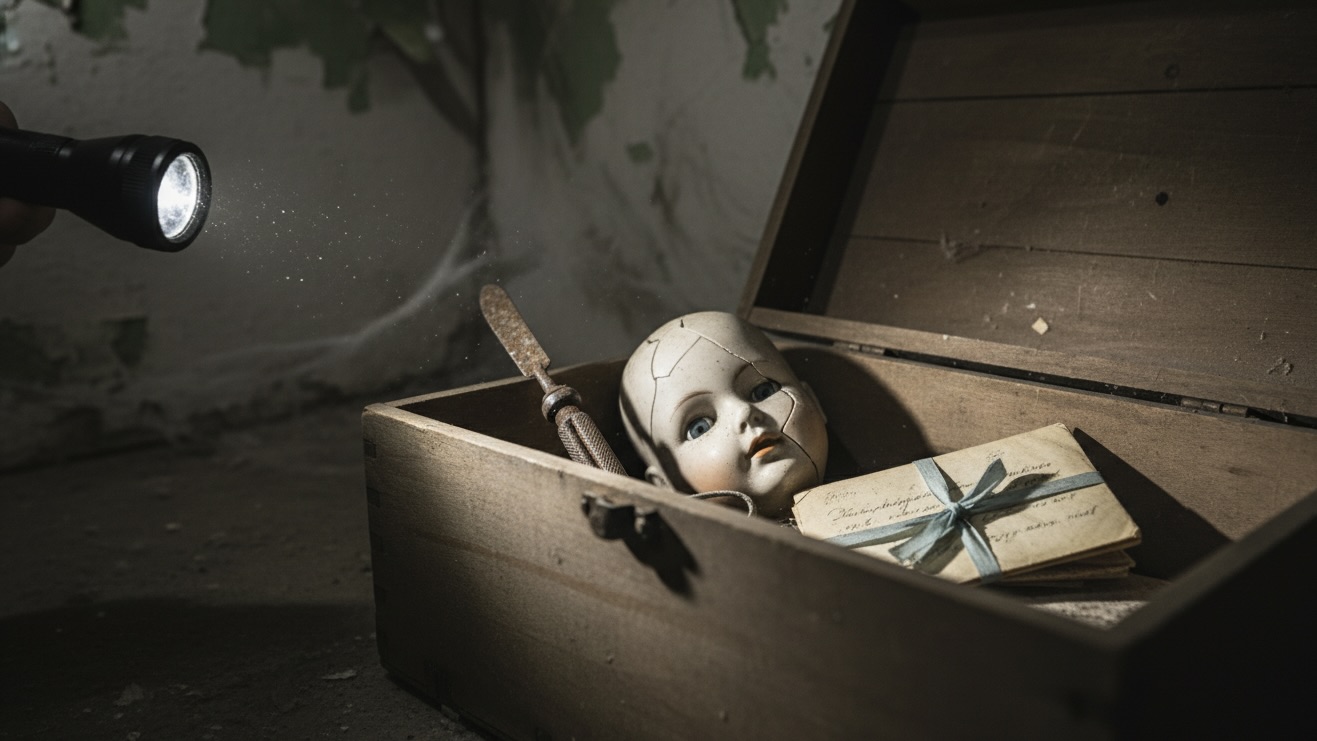
Inside the crate, nestled amongst brittle straw and what looked like fossilized cobwebs, was a collection of bizarre objects. A single, cracked doll’s head with one glassy eye missing. A rusty, blunt surgical tool. A bound sheaf of letters, their paper so yellowed it was almost brown, tied with a faded ribbon. And a small, wooden box, meticulously carved, but with a clasp that appeared to have been forced open long ago, its contents long gone, leaving only the faint, sweet-and-sour scent of old potpourri and something else… something like dry earth and regret.
“What is all this stuff?” Bea whispered, her voice barely audible over the distant drip-drip-drip of water somewhere deeper in the hall’s forgotten guts. “It’s… not records. This is personal.”
Kai was there in an instant, dropping to his knees, his face alight with a morbid glee that was both unsettling and infectious. “Personal? Bea, this is gold. This isn’t history, it’s trauma. Perfect. Forget the town charters. We’re doing a found-object installation. ‘Echoes from the Unseen Lives’.” He picked up the doll's head, turning it slowly in his gloved hand, admiring its grotesque emptiness. “This is the kind of stuff people pay good money to be disturbed by.”
Lucie, who had drifted over, peered closer at the surgical tool. “Is that… for teeth? It looks like something from a medieval torture museum.” She poked at it with the toe of her boot. “Could be a statement. ‘The Town Hall: Extracting Your Taxes, One Tooth at a Time’.” A low, humorless chuckle escaped her, bouncing off the damp walls.
Sam, ever the pragmatist, shook his head. “We’re supposed to be showcasing local artists. Not curating a serial killer’s attic sale. My proposal was for a multimedia presentation on how the town developed from a sleepy agricultural hub to a… slightly less sleepy, slightly more indebted suburban sprawl. With drone footage. Which I can’t get if my phone dies.” He gestured wildly with the phone, nearly dropping it into the dusty crate.
“Drone footage? Sam, darling,” Kai said, rolling his eyes, “that’s a documentary. We’re doing art. We’re invoking the spirit of the age. The spirit of this age, specifically. The one that’s been trapped down here since… whenever this place closed its doors.” He sniffed the air theatrically, then winced. “Okay, maybe the spirit needs a shower.”
“The letters,” Bea murmured, carefully extracting the yellowed bundle. She blew gently, dislodging a cascade of dust motes. The ribbon, once crimson, now looked like dried blood. “They’re handwritten. Faint ink.” She held them up, trying to decipher the elegant, almost spidery script. “Something about… ‘the long darkness’ and ‘the silent watchers’. And… ‘her laughter from the walls’.” Her voice trailed off, a strange note of unease entering it.
Lucie snatched a letter, holding it closer to the weak glow of Sam’s phone. “Laughter from the walls? Sounds like a bad horror movie. Or Kai on a Tuesday.” She squinted, then burst out laughing, a sharp, unexpected sound that made them all jump. “Wait, listen to this! ‘My dearest Agatha, the civic duties are piling up like so many neglected corpses. The town council insists on paving the old willow grove path, despite the rumors of what lies beneath.’ Ha! Bureaucracy and ancient curses, all in one paragraph. This is the exhibit. A darkly comedic exposé of municipal ineptitude and its supernatural consequences.”
“A darkly comedic… Lucie, you’re a genius!” Kai clapped his hands, sending up another cloud of dust. “We’ll call it ‘Paving Over the Past: A Bureaucratic Haunting.’ We’ll frame the letters, put the doll’s head on a pedestal, maybe tie the surgical tool to a giant invoice. It’s perfect!” He looked around, his eyes shining with a manic excitement that bordered on derangement.
Sam sighed, running a hand through his already messy hair. “My drone footage of the new bypass construction will look great next to a haunted doll, I’m sure. Real seamless narrative flow.” He shook his head, a faint, almost imperceptible tremor running through him. “And what are these ‘rumors of what lies beneath’?”
Bea, still holding the letters, looked up, her face pale in the dim light. “The old records. I found a reference… in the town archives. A disease. Not common. They called it ‘The Lingering Fever’. Mostly affected the children. From the late 1800s. A whole generation… gone. They built the Civic Hall right over the old paupers' cemetery. The willow grove was where they planted saplings for each child lost.” Her voice was quiet, but it held a chilling weight, like ice settling on stagnant water.
A heavy silence descended, broken only by the incessant drip-drip-drip. Lucie’s laughter died in her throat, replaced by a grimace. Kai’s theatrical grin faltered, replaced by a look of genuine, if slightly thrilled, horror.
“Okay,” Lucie said, her voice a little too bright, a little too strained. “Okay, so ‘Paving Over the Past’ just got a lot darker. And funnier, if you have a really messed-up sense of humor. Which, let’s be honest, we all do. We’re artists.” She tried to laugh again, but it came out as a brittle cough. “So, instead of just bureaucracy, it’s bureaucracy plus child ghosts. Extra grim. Extra marketability.”
“Marketability is not the goal, Lucie,” Sam said, rubbing his temples. “Sensitivity, maybe? Historical accuracy? Not… exploiting dead children for a school art project?”
“No, no, Sam, she’s got a point,” Kai interrupted, his morbid enthusiasm returning with a vengeance. “It’s about confronting the uncomfortable truths! The town buried its past, literally. We’re digging it up. With flair. And a doll’s head. This is profound! We could do a performance piece. Someone dressed as a town councilman from 1890, arguing with a spectral child. Too much? No, never too much.”
Bea, meanwhile, had found another box, smaller and heavier than the crate. It was made of dark, polished wood, slightly warped, and smelled faintly of lavender and something metallic, like old blood. She fumbled with the clasp, which was stiff and unyielding. “I think… this might be it.” She tugged harder, a small grunt escaping her. The clasp gave way with a sharp, resonant crack that echoed through the silence, making them all flinch.
Inside, on a bed of faded silk, lay a single, perfectly preserved lock of dark, human hair, tied with a black thread. Beside it, a small, silver locket, intricately engraved with a single, unblinking eye. And underneath, a faded daguerreotype: a stern-faced woman, her eyes wide and haunted, holding a vacant-eyed child wrapped in grave clothes. Her lips, in the old photograph, seemed to curve into a faint, unsettling smile.
A sudden, inexplicable gust of wind swept through the sub-basement, though no windows were open, kicking up a whirlwind of dust and forgotten papers. The loose pages of the old ledgers rustled violently, sounding like a thousand whispered laments. Sam’s phone, now completely dead, emitted a final, dying click. The last sliver of light vanished, plunging them into absolute, suffocating darkness.
Lucie let out a small, terrified squeak. Kai, usually so composed in his morbidity, actually stumbled backward, bumping into a cold, unseen wall. Bea, however, remained rooted, the open box held delicately in her trembling hands, her eyes fixed on the photograph, an unnerving silence about her. The metallic scent intensified, sharp and coppery, clinging to the sudden cold.
“Anyone else just feel a really cold hand brush against their neck?” Sam whispered, his voice cracking, filled with a raw, undeniable fear. “Because I did. And it wasn’t Bea.”
“It was the spirit of ironic critique, Sam,” Kai said, trying to inject bravado into his voice, but it came out thin and reedy, like a stretched string. “It approves of our darker vision.” But even he shivered visibly, his teeth chattering slightly. “Or it thinks my idea for the councilman and the spectral child is derivative.”
Lucie, fumbling blindly for a wall, tripped over something unseen, landing with a soft thud and a choked gasp. “I don’t care what it thinks, Kai! I just want out of this… this… crypt. I’m pretty sure something just breathed on me, and it smelled like formaldehyde.” She scrabbled on the floor, trying to find purchase, her breath coming in ragged gasps. The darkness pressed in, not just an absence of light, but a physical weight.
Bea, still holding the box, found her voice, a fragile thread in the oppressive black. “The letters… they mention a caretaker. A ‘Collector of Sorrows’.” Her voice was eerily calm, almost detached. “He believed that by gathering the last tangible remnants of the lost children—a lock of hair, a favorite toy—he could keep their spirits from wandering alone. He thought he was helping them, giving them a ‘final resting place’ within the walls of the Civic.”
“So, he was just… a creepy hoarder of dead kid stuff?” Lucie asked, her voice tight with a mixture of revulsion and a dawning, terrible realization. “That’s… still pretty dark for an exhibit, Bea. We’re not aiming for a ‘Most Unsettling Hoarder’ award.”
“No, Lucie, you don’t understand,” Bea replied, her voice gaining an unsettling cadence, almost a monotone. “The letters say… he tried to keep them. Not just their things. Their essence. He thought the building… the very foundations of the Civic Hall… could house them. A permanent collection.” The words hung in the suffocating darkness, each one a drop of ice.
A distant, scraping sound echoed from deeper within the building, not like wood or metal, but something akin to stone against stone, dragging, rhythmic, deliberate. It was too regular, too heavy, to be a trick of the wind or old pipes settling. It grew louder, closer. A tangible presence, not just imagination.
Kai's breath caught in his throat. Even Sam, the perpetually skeptical, let out a terrified whimper. The faint metallic scent grew stronger, mixed now with something else, something sharp and cold, like turned earth and a hint of something sweetly rotten. The air seemed to grow heavy, thick with unseen pressure, making it hard to breathe. They were no longer simply exploring.
Bea, her hands still clutching the wooden box, turned towards the scraping sound, her face, barely visible in the faint ambient light seeping from a high, unreachable crack in the ceiling, suddenly devoid of its usual quiet introspection. Her eyes, wide and unnervingly bright, seemed to stare into an abyss only she could see. A faint, almost melodic, high-pitched whirring began, a sound like dried leaves skittering across a long-dead marble floor, but deeper, more resonant, vibrating through the stone beneath their feet.
“It says here,” Bea’s voice was a whisper, but it cut through the encroaching dread like a shard of ice, “that he would… sometimes… rearrange his collection. To make sure they were still… comfortable.”
The scraping sound stopped, directly above them, then started again, a slow, deliberate series of thuds, as if something incredibly heavy was being moved, foot by agonizing foot, across the floor directly over their heads. The whirring intensified, a sound of dry, brittle motion, and the air grew colder still, as if every particle of warmth had been sucked out of the room. A soft, almost childish giggle echoed through the sub-basement, high and thin, not from any of them. It seemed to come from everywhere and nowhere, a cold, playful sound that promised eternal, inescapable games.
“Oh, God,” Lucie whimpered, pressing herself against the damp wall, “it’s not funny anymore, Kai. Nothing is funny.”
But Kai wasn’t listening. He was staring upwards, towards the source of the thuds, his mouth slightly open, a strange mix of terror and utter, profound fascination twisting his features. A single, distinct clink, like ceramic on stone, reverberated through the floorboards above them, followed by another. The sound of something round, perhaps, rolling slowly to a stop. Then, silence. A heavy, pregnant silence, broken only by their own frantic, shallow breathing and the distant, eternal drip of water.
The subtle, sweet smell of forgotten potpourri from the empty wooden box Bea held intensified, now overlaying the coppery tang, almost cloying. It was the scent of preservation, of something kept long past its natural life, of memories clung to with a desperate, unyielding grip. A memory, perhaps, of a small hand holding a toy, a small voice humming a forgotten tune. A tiny, faint scratching began then, directly beneath their feet, insistent and relentless, as if something trapped below was trying to dig its way back to the surface, claw by agonizing claw.
They would learn, later, that the Civic Hall was built not just over a pauper’s cemetery, but specifically over a charnel pit, a mass grave for the fever-stricken children of that long-forgotten autumn, where bodies were simply piled and covered, the ground still soft and unsettlingly yielding in places. They were, in essence, standing on a ceiling of bones, a flimsy barrier between them and the 'Collector’s' most permanent, and perhaps most active, exhibit.
And the silence that followed the rolling object, the whirring, the scratching from below, felt less like an ending and more like a breath held, an audience gathered, waiting for the main act to begin.
A tiny, faint scratching began then, directly beneath their feet, insistent and relentless, as if something trapped below was trying to dig its way back to the surface, claw by agonizing claw.
Share This Story


