The Studio of Shifting Light
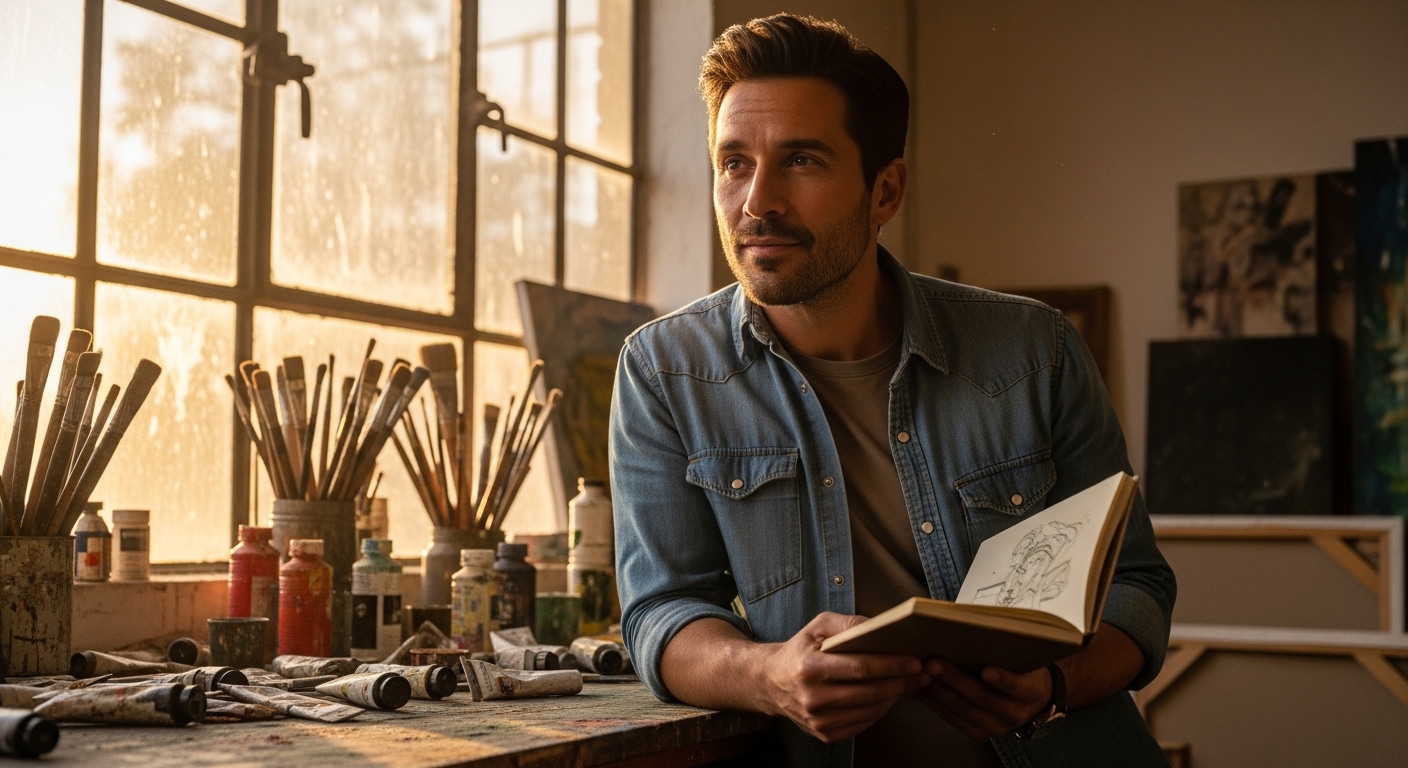
The air, crisp with the lingering scent of damp leaves and distant woodsmoke, pressed against the windowpanes of Jesse O'Connell's studio, a space perpetually suspended between order and vibrant chaos. Betty Sinclair stepped into the room, her sensible leather boots scuffing on the painted concrete floor, a faint tremor of autumn chill still clinging to her coat. Her journalistic facade was firmly in place, a meticulous mask over the coiled tension of her true purpose. Sunlight, fractured through the grimy glass, caught the floating dust motes and illuminated the layered history of the room, each paint smear and discarded brush a testament to restless, inventive hands. It was the perfect stage for a conversation, and for the delicate dance of subterfuge.
"Rather a dramatic entrance, wouldn't you say, for an editor?" Jesse O'Connell's voice, a rich baritone laced with the comforting burr of the west coast, pulled Betty from her internal assessment of the studio's egress points. He gestured with a charcoal-stained hand towards the heavy, oak door that had groaned shut behind her.
Betty, ever composed, offered a small, knowing smile. "One aims for impact, Mr. O'Connell. Especially when traversing the hallowed, if somewhat paint-splattered, halls of artistic genius." She allowed her gaze to sweep over him, a quick, professional appraisal – mid-thirties, slightly dishevelled, but in a deliberate, artistic manner. His indigo eyes, though warm, held a flicker of something perpetually distant, as if constantly processing an unseen colour palette. A faint smudge of cadmium red adorned his cheekbone, a badge of creative combat. Her initial dossier notes had described him as 'unconventional, potentially volatile, yet remarkably perceptive.' So far, the assessment held true.
"Jesse, please," he corrected, a flash of genuine amusement in his eyes. "'Mr. O'Connell' makes me feel like I should be teaching algebra. And you are, if I'm not mistaken, Betty Sinclair? Your reputation precedes you, even into this rather dusty corner of the creative world." He extended a hand, calloused and strong, smelling faintly of turpentine and something sharp, almost metallic. Not 'ozone,' she noted with an internal sigh, but something far more industrial, like a faint electric current after a storm, mixed with the earthy tang of raw linen.
"Indeed. Betty," she confirmed, her grip firm, professional. She let her gaze linger for a beat longer than strictly necessary, observing the subtle tightening of the muscles in his forearm, the minute shift in his pupils. Nothing. Just a friendly handshake. Her mission, however, was rarely straightforward, and Jesse O'Connell was proving to be a deliciously complex equation.
"Well, Betty, welcome to the madhouse," he chuckled, withdrawing his hand and sweeping it across the room. "Coffee? Tea? I’ve got some rather excellent Earl Grey, if you're feeling particularly British this afternoon." The studio itself was a symphony of organised chaos: canvases stacked against the exposed brick walls like dormant titans, brushes of every conceivable size bristling from ceramic pots, tubes of paint exploding in vibrant spectrums across a distressed wooden workbench. An enormous digital display, the kind reserved for serious design work, dominated one wall, currently displaying a complex, almost architectural rendering of organic forms. Through the tall, arched window, she could glimpse the riot of autumnal leaves across the street, burning gold and crimson against a pewter sky.
"Earl Grey would be perfect, thank you." Betty allowed herself a small, almost imperceptible nod of approval at his choice of tea. A detail, perhaps insignificant, yet every detail built the profile. "I'm told your work is challenging the boundaries of digital art, Jesse, particularly with your recent explorations into AI-generated elements." She retrieved her slim notebook and a fountain pen from her elegant handbag, a prop carefully chosen for its unassuming yet classic air. "My column, 'Three Questions for the Creative Future,' aims to delve into the minds shaping tomorrow. You've been highly recommended."
Jesse busied himself with a vintage kettle on a small hotplate, the rhythmic click of porcelain against ceramic a counterpoint to the city hum filtering in. "Highly recommended, eh? Usually means I’ve offended someone in a fascinating new way, or my latest exhibition was just provocative enough to warrant a polite inquiry." He poured steaming water into two delicate, mismatched mugs. "So, the three grand questions. Lay them upon me, Betty. Let's see if my artistic ramblings can survive the scrutiny of print."
"They always do, in my experience," Betty replied smoothly, accepting a mug. The warmth spread through her fingers, a momentary anchor in the peculiar dance of observation and veiled intent. The tea smelled of bergamot and something faintly metallic from the old mug, another irrelevant detail her brain meticulously catalogued. "Let's start with the perennial: Why, in an age where information inundates us, where virtual realities offer endless escapism, and the very fabric of truth feels… negotiable, does storytelling still matter? Why does the human compulsion to weave narratives persist?"
Jesse leaned back against a paint-splattered stool, cradling his mug, his gaze drifting towards the immense digital screen. "Ah, the big one right out of the gate. Excellent." He took a slow sip, his eyes narrowing slightly in thought, almost as if he were composing a complex visual in his mind. "Storytelling, Betty, is the original algorithm. It's how we've always made sense of the chaos, long before we had microchips or quantum computing. It's the framework we impose on the bewildering, the frightening, the magnificent. Without stories, we’re just… atoms bumping into each other. Meaningless collisions."
His hands, still holding the mug, began to subtly gesticulate, not wildly, but with an almost contained energy. "Think about it. We’re wired for narrative. From the first cave drawings, depicting the hunt, the hero, the survival, to the sprawling epics of Homer, to your latest Netflix binge. It's all pattern recognition. Cause and effect. Character and consequence. It’s how we teach, how we learn, how we empathise. It builds bridges between individual experiences, reminding us that we're not so utterly alone in our triumphs or our fears. A common thread, you see? A grand, invisible stitching that holds humanity together, even when it feels like we’re tearing at the seams."
Betty nodded, her pen poised. "So, it’s a form of collective consciousness, a shared reality?" She watched his expression, looking for any nuance, any deviation from the open, thoughtful artist persona. His posture was relaxed, yet there was a subtle tension in his jaw, a sign of deep concentration, not deceit. She mentally filed it.
"Exactly!" Jesse's eyes brightened, a spark of genuine passion igniting them. "And in this age of fractured attention and manufactured realities, it matters more than ever. Authentic stories, human stories – even if they’re fantastical – anchor us. They remind us of what's real, what's enduring. They give us a vocabulary for our own internal worlds. Without that, we're adrift, at the mercy of whatever ephemeral trend or outrage cycles through our feeds." He took another sip, the Earl Grey steam momentarily obscuring his face. "It’s a quiet defiance, Betty. To keep telling stories. To keep listening."
---
The Canvas of Code
Betty scribbled furiously, her precise penmanship belying the rapid assessment occurring in her mind. Jesse’s answers were articulate, impassioned. Too impassioned, perhaps, for someone merely waxing poetic about art. Or, exactly as expected for a genuine creative. The ambiguity was a known occupational hazard. She glanced around the studio again, her eyes lingering on the faint outlines of wires snaking behind the digital screen, the almost invisible hum of high-end computing. There was a faint scent, too, almost imperceptible, of something hot and electronic, like a circuit board working overtime, not 'ozone,' but the distinct smell of stressed plastic and heated metals. It was a detail she couldn't ignore, a tiny prickle of unease.
"That brings us beautifully to our second question," Betty began, shifting slightly on her uncomfortable wooden chair, a faint ache already starting in her lower back. She crossed one leg over the other, subtly adjusting her small microphone, ensuring it was still discreetly pinned beneath her lapel, its minuscule lens pointed towards Jesse. "The elephant in the digital room: AI. Many fear it's the death knell for human creativity, a mechanical mimicry that will render us obsolete. You, however, seem to embrace it. How can technology, specifically emerging AI tools, support, rather than overshadow, human expression?"
Jesse's smile held a touch of wry amusement. "Ah, the Terminator of brushstrokes. I hear that one often." He gestured towards the digital display. "Look, the fear is understandable. Humans have a long history of fearing the next big thing, especially when it challenges our perceived unique capabilities. But AI, for a genuine artist, is not a replacement. It's a colossal, incredibly powerful tool. Think of it like a new set of brushes, or an entirely new colour you never knew existed."
He stood, walking over to his workbench, his movements fluid and unhurried. He picked up a small, intricate circuit board, turning it over in his fingers. "For me, AI liberates. It takes away the tedious, the repetitive, the purely mechanical aspects of creation. I can feed it concepts, raw data, sketches, and it can generate variations, explore avenues I might never have considered in a lifetime of drawing. It accelerates the ideation process exponentially. It’s like having an army of highly skilled, tireless interns, but with a neural network instead of a coffee addiction." He chuckled, and the sound was genuinely light, open.
"But isn't there a risk of losing the human touch? The emotional nuance?" Betty pressed, her voice calm, inquisitive. Her eyes, however, were scanning the circuit board in his hand. Standard issue. Nothing unusual. She had to remind herself to focus on the conversation, not just the 'mission critical' details.
"That's where the artist comes in, Betty," Jesse replied, setting the circuit board back down amongst a tangle of wires. He picked up a heavy, old-fashioned paint palette, its surface caked with layers of dried pigments. "The AI is a prodigiously talented apprentice, but it has no soul. It can't feel. It can't truly understand longing, or joy, or sorrow. It can only process data points associated with those emotions. The human artist is the conductor, the curator, the one who imbues the generated elements with true meaning, with the spark of authentic experience. It's about collaboration, not abdication. I generate hundreds of images, millions of data points, but I choose the ones that resonate, the ones that carry a piece of my intention, my story. The brushstrokes might be virtual, but the hand that guides them, the heart that feels, remains utterly human."
He walked back to his stool, his expression earnest. "It democratises creation, too. Think of all the brilliant storytellers, the visual poets, who are limited by technical skill, or access to expensive traditional tools. AI lowers that barrier. It empowers people to translate their complex inner worlds into something tangible, something sharable, without years of formal training. It gives a voice to those who might otherwise be silenced by circumstance. And that, Betty, is profoundly powerful."
---
Weaving New Threads
Betty found herself genuinely intrigued, despite the professional distance she maintained. His arguments were compelling, delivered with a conviction that felt utterly sincere. He wasn't just an artist; he was a philosopher of the digital age, a cartographer of the emerging landscape. She noted the way a stray lock of dark hair kept falling across his forehead, and how he'd instinctively brush it away with a paint-stained finger, a small, unconscious tic. These were the details that built a picture of a man, not just a target. The autumn light, now softer, almost diffused, made the studio feel less like a workspace and more like a sanctuary.
"Democratisation," Betty echoed thoughtfully, her pen scratching against the paper. "A compelling point. Which leads us to our final question, Jesse. What does this mean for future creators? For the next generation of storytellers, artists, filmmakers? What responsibilities do we, as cultural gatekeepers, have in nurturing this new paradigm?"
Jesse leaned forward, his elbows on his knees, his hands clasped around his mug. He looked out the window, at the vibrant tapestry of autumn leaves swaying gently in the cooling breeze, a perfect visual metaphor for the ongoing cycle of change. "Responsibility… that’s a heavy word, isn't it?" He sighed, a soft, almost imperceptible sound. "I think the biggest responsibility is to embrace curiosity over fear. To teach critical thinking, not just technical proficiency. Future creators need to understand how these tools work, yes, but more importantly, they need to understand themselves. What makes them uniquely human? What stories only they can tell?"
His gaze returned to Betty, direct and unwavering. "The future of creation isn't about human versus machine. It's about human with machine. It's about leveraging these incredibly powerful systems to amplify our own unique voices. It means nurturing a generation that isn't afraid to experiment, to fail, to push boundaries. We need to create safe spaces for creative exploration, where the 'human touch' isn't a quaint relic, but the ultimate value proposition."
"And for those gatekeepers, as you called them," he continued, a slight, almost imperceptible hardening around his mouth, "the editors, the curators, the critics… their role shifts. They become filters, guides. They become even more crucial in discerning authenticity, in championing the genuinely novel and meaningful amidst the potential noise. Their responsibility is to protect the integrity of human expression, even as its forms evolve. To ensure that the narrative remains truly human-centric, even if parts of it are rendered by algorithms."
Betty felt a jolt of something akin to recognition. His words, though ostensibly about art, resonated deeply with her other life, the one hidden beneath the neatly pressed blazer and the carefully neutral expression. Discern authenticity. Protect integrity. These were the tenets of her real work, too. She realised, with a slight internal tremor, that Jesse O'Connell was far more perceptive than his dishevelled artist persona suggested. Or perhaps, she was simply projecting her own anxieties onto his thoughtful musings. Either way, the information was proving valuable, if not in the way her briefing had intended.
The conversation flowed for a while longer, meandering into the ethics of attribution in AI art, the concept of digital ownership, and the role of beauty in a world increasingly preoccupied with utility. Jesse’s whimsical analogies, comparing AI to a digital muse or a particularly obedient if unfeeling, pet, kept the tone light, yet his underlying arguments were weighty. Betty, meanwhile, continued her covert observations, noting the absence of any security cameras, the lack of any significant paper documents, the clean, almost sterile corners of the otherwise messy studio.
As the afternoon waned, painting the studio in long, golden streaks that softened the edges of everything, Betty felt the subtle cue from her internal clock. Time to wrap up. She put away her notebook, clicking her pen shut with a definitive snap.
"Jesse, this has been… enlightening. Truly. Your insights are precisely what my readers crave." She rose, adjusting her coat, the heavy fabric rustling softly. "Thank you for your time, and for sharing your unique perspective."
"The pleasure was all mine, Betty," Jesse said, rising as well. He offered another warm, open smile. "It's not often I get to pontificate to such an attentive, and discerning, audience. I look forward to reading the piece."
"You will," she promised, her gaze flicking one last time around the studio, lingering on a small, unobtrusive device tucked away on a high shelf amongst a collection of ceramic bowls. It was a weather sensor, she noted, but its design was unusually robust, almost industrial. An odd choice for an art studio. Her instincts, honed over years of parsing the insignificant from the crucial, prickled. Just a weather sensor, she repeated internally, forcing herself to dismiss it. But the detail remained, a tiny, glittering anomaly in the otherwise vibrant chaos.
She walked towards the door, Jesse holding it open for her. The crisp autumn air bit at her cheeks, carrying the sharp tang of burning leaves from a neighbour's yard. The street outside was quiet, bathed in the soft, fading light of the late afternoon. She took a deep breath, inhaling the season’s chill, the scent of damp earth and distant woodsmoke, feeling the subtle shift from the warm, contained world of the artist’s studio to the vast, uncertain expanse of her own clandestine reality. Her mind was already replaying the interview, sifting through Jesse's every word, every gesture, searching for the unsaid, the hidden currents beneath the witty banter.
A flicker of movement from the corner of her eye, something not quite right among the autumn leaves caught on the sill, made her pause. She saw nothing, of course. Just the wind, she told herself, but the unease settled deep, a cold stone in the hollow of her chest, reminding her that even in the whimsical world of art, shadows stretched long and hungry.
A flicker of movement from the corner of her eye, something not quite right among the autumn leaves caught on the sill, made her pause. She saw nothing, of course. Just the wind, she told herself, but the unease settled deep, a cold stone in the hollow of her chest, reminding her that even in the whimsical world of art, shadows stretched long and hungry.
Share This Story


