The Geometry of Frozen Branches
The world had shrunk to the colour of bone and the sound of wind. Snow, driven hard and fine like sand, scoured the grey bark of the cottonwoods lining the creek. It was a cold that didn't just bite; it gnawed, finding its way through the threadbare wool of a boy's coat and settling deep in his marrow.
My fingers don't feel like my fingers anymore. They're just sticks at the end of my hands, clumsy and stupid. I try to curl them in my pockets but the cloth is thin and the wind goes right through. Everything is white or grey. The sky is grey, the snow is white, the trees are a darker grey. The man is grey, too. His coat is the colour of a dead mouse and his beard is full of ice.
He hasn't looked at me. Not really. He saw me when I stumbled down the creek bank, and he grunted, a sound like stones rubbing together. He just shifted a bit to make room for me by his fire. The fire isn't much. It's mostly smoke, and the sticks are wet and they hiss and spit little orange sparks that die before they hit the snow.
I shouldn't be here. Ma would have a fit. But I couldn't stay in the cabin. Not with the quiet. The quiet was louder than Pa yelling, and he hasn't yelled in two days.
The man pulls a piece of jerky from a pouch. It's dark and hard as wood. He chews on it for a long time, his jaw working slow under the beard. He doesn't offer me any. That's fine. My teeth hurt from the cold anyway.
"You ain't sayin' much," he says. His voice is a surprise. It's not a grunt. It's low and rough, like a file on rusted metal. It sounds like it hasn't been used in a while.
I just shrug. My shoulders are stiff under my coat.
"Running from something, or to something?" he asks, still not looking at me. He's watching the fire, or maybe something in the fire.
"Neither," I say. My own voice sounds small and thin.
He spits a bit of jerky onto the snow. It's a dark stain on the white. "Most folks out in this are one or the other." He finally turns his head and his eyes are pale blue, like frozen water. They're old eyes. They look tired. "Or they're the thing bein' run from."
I don't know what to say to that. I pull my knees up to my chest and watch a line of ants try to cross a patch of snow near my boot. They'll freeze. They don't know it, but they will.
---
The silence gets long. The only sounds are the wind and the hissing fire. It isn't a bad silence, not like the one at the cabin. This one is just empty. It's the world's silence, not a person's.
"Knew a man once," the old trapper says, his voice pulling me out of my thoughts. "He was always running. Never knew if it was to or from. Maybe he didn't either. Name was Cormac."
He pauses, pokes the fire with a stick. A plume of white smoke billows up and the wind snatches it away.
"He wasn't a big man. Wiry. Had hands that were all knuckle and scar, and a way of lookin' at you that made you feel like he could see the back of your skull. He wasn't mean, not by nature. But this land… it files a man down. Sharpens some parts, wears others right down to nothing."
I listen. It's better than thinking about the cabin, or about how my toes have stopped hurting, which Ma says is a bad sign.
"Cormac, he'd hired on with a cattle baron name of Sterling. A man who owned a whole valley and figured that gave him rights to the sky above it and the water below. Sterling was a kind of man who smiled while he was starving you out. Paid Cormac to be his 'regulator.' That's a nice word for a man with a fast gun and no questions."
Devon leans back against the trunk of a deadfall pine. "Winter came early that year. Hard. Like this one, maybe harder. Snow so deep it buried the fences. Cattle started wanderin', lookin' for forage. Some of 'em wandered onto the holdings of the homesteaders Sterling was tryin' to squeeze out. Small folks. Families."
"Sterling told Cormac to go get 'em back. And to make an example. Said they were rustlers. But Cormac knew. He'd seen their children, faces pinched with hunger. He'd seen their stock, bony things shivering in lean-to sheds. Stealing was a long way from what they were doing. They were just surviving. The cattle came to them."
The Weight of a Single Bullet
"So Cormac rode out. The blizzard was so bad you couldn't see the horns on your own saddle. Just a world of white. He finds the first homestead. A little soddy dug into a hill. Smoke coming from the chimney pipe, looking thin and desperate. And there in a makeshift pen are maybe five of Sterling's cattle, chewing on what little hay the family had."
The old man stops. He pulls out his piece of jerky again and gnaws on it. I wait. The wind howls, and for a second it sounds like a person screaming.
"The homesteader comes out. Not a fighter. A farmer from back east, still soft in some ways. He's holding an old fowling piece, shaking so bad the barrel makes little circles in the air. Behind him, in the doorway, his wife is standing with two little ones hiding in her skirts."
"Cormac just sits on his horse, the snow piling up on his hat and shoulders. He can feel the cold of his Colt against his leg, right through the leather and the wool. A heavy feeling. He looks at the farmer, and the woman, and the kids. And he thinks about Sterling, warm in his big house with a fire you could roast an ox in."
"Sterling told him to make an example. Sterling paid him good money to do what he was told. That's the bargain. Your soul for a warm bed and a full belly."
My own stomach gives a little rumble. I press my arm against it.
"What did he do?" I ask. The words come out in a puff of white air.
Devon looks at me. Really looks at me this time. His pale eyes are hard to read. "What does a man do? When the right thing is the hardest thing? When doing the right thing means you lose everything—your pay, your safety, the only place you got? When doing the wrong thing means you can live with yourself, but only by becoming something you hate?"
He's not asking me, not really. He's asking the fire, the trees, the grey sky.
"Cormac got down off his horse," Devon says, his voice quieter now. "He walked toward the farmer. The farmer raised the shotgun. Cormac didn't even look at it. He just kept walking. He stopped right in front of him, close enough to feel the man's shaky breath on his face. He reached out, real slow, and pushed the barrel of the shotgun down toward the snow."
"'You feed your family,' is all Cormac said. Then he turned around, got on his horse, and rode back into the blizzard. Rode right back to Sterling's ranch."
My hands are shoved deep in my pockets. They're starting to ache again, a dull throb. That's good.
"And Sterling?" I ask.
"Sterling was waiting for him. He knew Cormac's heart wasn't hard enough for the work. Some men are like iron. You can heat 'em and beat 'em and they just get harder. Others are more like stone. They look hard, but you hit 'em just right and they break all at once. Cormac was the second kind. They had words. Then they had more than words."
"Did… did Cormac shoot him?"
Devon throws the last of his jerky into the fire. It sizzles for a second and then is gone. "A man like Sterling doesn't get shot face to face. Not by the men he hires. Cormac left that night. With nothing but his horse and what he could carry. Sterling put a bounty on him. Not for murder. For theft. Said Cormac stole a horse. His own horse. That's how men like Sterling work. They don't just beat you. They make the world think you deserved it."
---
He doesn't say any more after that. The story is over. He pulls his hat down low and hunches into his collar, a grey lump against a grey tree. The fire sputters and shrinks. The wind seems to have died down a little, but the cold is deeper now. It's the kind of cold that feels permanent.
I think about Cormac, riding out into the snow. I wonder if he was cold. I wonder if he was scared. Doing the right thing didn't make him warm. It didn't feed him. It just made him right. I'm not sure if that's enough.
I look over at the old trapper. The firelight flickers on the bits of ice in his beard. He looks like a part of the winter, something that grew here, like a gnarled old root. He smells of woodsmoke and pine and something else, something sad and old, like damp earth.
He never said what happened to Cormac. Maybe he doesn't know. Or maybe he just didn't want to tell me the end. Maybe some stories don't have ends. They just stop. And the people in them just keep on walking, or riding, until the cold gets them, or they find another fire to sit by for a little while.
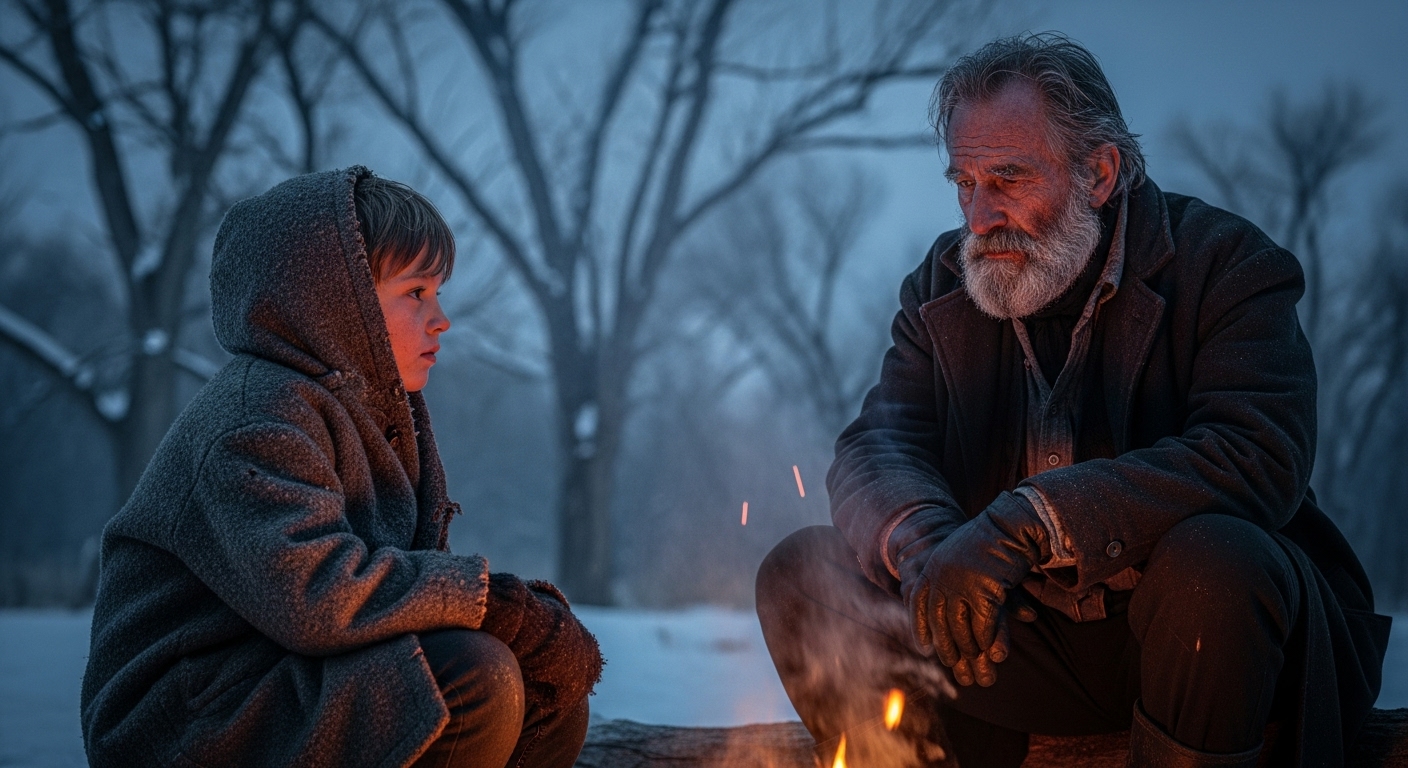
He never said what happened to Cormac. Maybe he doesn't know. Or maybe the story wasn't about Cormac at all. I look at the old man's scarred knuckles, resting on his knee, and for the first time, I feel a different kind of cold.
Share This Story


