The Frozen Veins of Gamma
The air itself was a memory, a ghost of warmth clinging to the outer layers of Oswald’s coveralls. Here, deep beneath the Conglomerate’s lowest accessible levels, the cold bit with a ferocity that defied the official temperature readings of the upper sectors. It was an ancient cold, born of leaking pipes and long-dead heat exchangers, a perpetual winter that had seeped into the very bones of the infrastructure. The metallic tang of decay, thick with the scent of stagnant water and ozone's less cliché cousin – burning copper – clung to everything, a constant reminder of the slow, inevitable entropy at work.
The air itself was a memory, a ghost of warmth clinging to the outer layers of Oswald’s coveralls. Here, deep beneath the Conglomerate’s lowest accessible levels, the cold bit with a ferocity that defied the official temperature readings of the upper sectors. It was an ancient cold, born of leaking pipes and long-dead heat exchangers, a perpetual winter that had seeped into the very bones of the infrastructure. The metallic tang of decay, thick with the scent of stagnant water and something like burning copper, clung to everything, a constant reminder of the slow, inevitable entropy at work.
My breath plumed, thick and white, just beyond the beam of my utility light. It tasted of old metal and the dry, metallic residue of fear. Every scrape of my heavy boots on the uneven, grimy floorboards echoed, a lonely sound in this colossal, forgotten space. The conduit stretched before me like a monster’s gullet, a cavernous tunnel designed for titans, now choked with defunct wiring and the skeletal remains of what were once vital systems. Water dripped from unseen cracks high above, splashing onto the metal grates, each ping a morbid countdown. My shoulders hunched further, not just against the chill, but the weight of it all: the sheer scale of the dereliction, the unspoken lie of 'maintenance', the whole rotting edifice of the Conglomerate’s control.
This was Sector Gamma’s atmospheric processor conduit. Or what was left of it. The main artery, they called it, a laughably optimistic descriptor for a system that had been haemorrhaging for years. Now, it wasn't just leaking; it was bleeding out. The official prognosis from Central was 'critical structural instability, imminent system failure.' Unofficially, it was: 'Get down there, try to put a bandage on a gunshot wound, and don’t bother calling for extraction.'
My fingers, thick in their insulated work gloves, fumbled with the clasp on my toolbox. The metal was so cold it stung, a sharp, almost electrical ache that shot up my arm. The tools within clanked together with a dull resonance, like bones in a coffin. This was my life, now. My entire existence distilled down to the futile task of delaying the inevitable, one rusted bolt, one sparking wire at a time. The absurdity of it all sometimes threatened to crack through the melancholic haze I’d cultivated, but mostly, it just added another layer to the general, pervasive ache.
I took another step, my boot sliding on a slick patch of what might have been frozen condensation, or something far worse. My ankle twisted, a sharp, familiar jab, and I caught myself on a massive, pitted pipe that ran parallel to the walkway. It hummed faintly, a deep, resonant thrum that vibrated through my gloved hand, a sign of what little life still pulsed through this dead place. This, I knew, was the main coolant line, its skin blistered and corroded. It was supposed to be warm, radiating heat into the conduit. Now, it was just another conductor of the crushing cold.
My eyes, or rather the beam of my light, scanned the intricate mess of pipes and conduits disappearing into the gloom. The air grew heavier, the metallic scent sharper. The low, distant growl of the atmospheric processor itself was a constant, unsettling presence, a beast in its death throes, somewhere ahead. Every vibration in the floor, every subtle shift in the air pressure, felt like a premonition. I traced the path ahead, the walkway narrowing to a single metal beam, then widening again, the entire structure testament to an engineering era long since abandoned for cheap, disposable fixes.
A Frozen Descent
“You’re early, Oswald. I thought you’d be trying to talk them into giving us hazard pay for this.” Cecilia’s voice, sharp and surprisingly clear, cut through the din. It had a familiar, cynical edge, a sound I’d come to associate with her particular brand of gallows humour. Her own light bobbed into view, a brighter, more focused beam than mine, casting a halo around her sturdy, bundled form. Her breath plumed just as dramatically as mine.
“They offered extra rations of nutrient paste,” I replied, pushing myself off the pipe. My back cracked, a series of dull pops. “Said it was a ‘privilege to serve.’ I countered with an actual blanket. Negotiations stalled.”
She snorted, a dry, mirthless sound that echoed the metallic ping of water droplets. “Always the optimist. They’ll just give you a faster collapse. Same result, less paperwork.” She moved with an efficient grace I often envied, despite the cumbersome gear. Her short, dark hair, usually a wild halo, was flattened under her thermal cap, stray wisps escaping at the temples. Her face, smudged with what I assumed was the usual conduit grime, was a mosaic of fatigue and sharp intelligence. Her eyes, usually quick to amusement, held a deeper, almost weary resignation tonight.
“They’re hoping we’ll fix it before it becomes Central’s problem,” I continued, falling into step beside her. The sound of our boots in unison felt less lonely. “A quick, quiet disappearance of a few lower-level technicians, much easier to explain than a Sector Gamma wide oxygen deprivation event.”
“Or, you know,” Cecilia mused, her light momentarily fixing on a particularly grotesque cluster of rust stalactites hanging from an overhead pipe, “a quick, quiet freezing of a few hundred thousand citizens. But who’s counting, right? We’re just the… 'utility consultants.' Sounds important, doesn't it?”
“Critically important, until we’re critically frozen.” I pulled my scarf tighter, feeling the scratch of wool against my chin. “Any word on the structural integrity reports they mentioned?”
She kicked at a loose piece of rebar, sending it clattering into the oily water below. “The ones that conveniently vanished? No. But the tremors have increased by thirteen percent since yesterday. My readings aren’t ‘official,’ of course, but the floor’s practically doing a jig. Not exactly the tango, more like a death rattle.”
“Charming.” We approached a section where the conduit opened up into a truly massive chamber, the growl of the processor now a palpable vibration in the air. The colossal machine stood like a petrified leviathan, its ancient metal casing a patchwork of crude repairs and weeping rust. Frost bloomed in intricate, crystalline patterns on every exposed surface, turning the dying beast into something eerily beautiful, a frozen monument to technological hubris. The scale of it was always humbling, a reminder of the sheer, unthinking power that had once been wielded.
The atmospheric processor. Its official designation was AP-7. Designed to filter and recirculate air, regulate temperature, and maintain breathable atmospheric conditions for the entire Gamma Sector. Now, its exhaust vents coughed out sickly white plumes of super-chilled air, and the main coolant lines, which crisscrossed the chamber like grotesque veins, groaned under immense, irregular pressure. A low, rhythmic clang reverberated from somewhere deep within its guts, a sound like a giant’s hammer striking an anvil made of despair.
Cecilia pointed her light towards a catwalk high above us, a flimsy-looking structure that seemed to defy gravity with rusted bolts. “Main intake manifold. That’s where the pressure is building. The system’s trying to compensate for the breach, but the regulators are slagged. We need to get up there and manually cycle the emergency override, if it even still works.”
I ran a gloved hand over the cold, slick surface of a console panel, its display screen flickering erratically, showing scrambled data. “If. That’s a big ‘if’ for anything down here. You think they even left us enough lubricant for the old ‘jammed valve’ trick?”
“I brought my own. A special blend of ‘hope and desperation,’ mostly,” she said, her voice dropping a little as she peered into a dark recess. “And a bigger wrench. Just in case ‘hope’ isn’t enough.”
---
Echoes of Collapse
The climb to the catwalk was an exercise in slow, deliberate self-preservation. Each rung of the ladder was coated in a thin layer of ice, requiring careful scraping with my boot sole before I dared put my weight on it. My muscles, already stiff from the cold, protested with every upward movement. The higher we climbed, the more pronounced the machine’s groaning became, a deep, resonant rumble that shook the very air around us. It felt like standing inside a dying beast, listening to its final, laboured breaths.
“Think of it as a vertical challenge,” Cecilia said, her voice strained but still present just above me. She was leading, always faster, always more agile. “Keeps the blood pumping. Or at least, the frozen sludge that used to be blood.”
“My blood feels less ‘pumping’ and more ‘crystallising’,” I muttered, pulling myself onto the catwalk. The metal grated under my weight, a protest from the ancient structure. The air up here was even colder, swirling with super-chilled vapour from a gaping fissure in the main manifold. A sharp, almost painful scent of something like static electricity permeated everything.
We shuffled along the narrow catwalk, my hand gripping the flimsy railing that felt more decorative than supportive. Below, the floor of the chamber was a distant, dark pool, reflecting the erratic lights like a broken mirror. The scale was dizzying. Ahead, the intake manifold was a twisted, grotesque mouth, its metal skin torn and disfigured. I could see the shimmering, turbulent air within, churning with a terrifying, contained energy.
“Alright, Oswald, the manual override valve is just to the left of the main pressure gauge,” Cecilia directed, her voice now tight with a new urgency. “It’s that rusted wheel. You’ll need to turn it counter-clockwise, slowly. I’ll try to stabilise the primary regulators from this control panel here. Wish me luck with the ‘burnt out’ circuits.”
I stared at the valve. It was a massive, ancient thing, coated in layers of rust and grime, looking more like a prop from an archaeological dig than a functional piece of machinery. One of the spokes was bent at an alarming angle. This wasn't just a repair; this was a desperate prayer. My stomach churned with a familiar mix of dread and acid. “Slowly, you say? What’s the consequence for ‘too fast’?”
“Implosion,” Cecilia replied, without looking up from the sparking console she was prying open with a screwdriver. A shower of green light flickered around her hands. “Or explosion. Honestly, it’s a toss-up. Either way, messy.”
I took a deep, shuddering breath that did little to warm my lungs. My hands, despite the thick gloves, felt clumsy, numb. I gripped the bent spoke of the valve, the metal cold and rough beneath my fingers. It wouldn’t budge. Not an inch. My boots slipped on the icy catwalk. I leaned into it, putting all my weight, all my tired desperation, into the turn. The valve creaked, a sound like tortured metal, but still held fast.
“It’s stuck,” I grunted, my voice thick with effort. “Properly fused, I think. This thing hasn’t been moved in decades.”
Cecilia swore, a short, sharp expletive that echoed in the vast chamber. “Decades is an understatement. Try ‘since before the Collapse’. Give it a good… persuasion. I’m getting dangerously high pressure readings on my end. This console is barely responding.”
I braced myself, planting my feet as wide as the catwalk would allow. I imagined the faces of the people in Gamma Sector, shivering in their hab-units, hoping their power didn't completely die, unaware of the frozen abyss beneath them. The weight of that thought, the sheer unfairness of it all, fuelled a sudden, desperate surge of strength. I pulled, twisted, and pushed, gritting my teeth. My knuckles scraped against the rust, a sharp pain, but I barely registered it. The metal shrieked, a sound that cut through the processor’s hum, and the valve gave way with a sudden, sickening lurch. A spray of frigid, pressurised air blasted from the pipe, stinging my face through the sparse gaps in my hood.
“Got it!” I yelled, through the sudden torrent of cold. My body vibrated with the effort, muscles screaming. I began the slow, arduous process of turning it counter-clockwise, the wheel fighting me every inch of the way. Each revolution was a battle against corrosion, a tiny victory against the entropy that sought to reclaim this place.
Below us, the clang inside the processor escalated. It wasn't rhythmic anymore. It was frantic, irregular, like a heart giving out. A high-pitched whine began to cut through the air, growing in intensity, a sound that made my teeth ache. The entire catwalk began to sway, subtly at first, then more pronounced. Dust, thick and ancient, rained down from the ceiling, catching in the beams of our lights.
“Oswald! The secondary pressure manifolds are spiking! I can’t get the override to engage!” Cecilia’s voice was high, strained, a raw edge of panic cutting through her usual composure. The console in front of her was now a furious tempest of sparks and frantic, strobing lights. “It’s destabilising! The primary failsafe isn’t responding!”
My hands, still clamped to the valve, tried to turn it faster, but the resistance was immense. It was a losing fight. The very air felt alive with a terrible, building pressure. The structure of the chamber itself was starting to complain, faint groans of stressed metal joining the processor’s death throes. I could feel the cold radiating from the fissures, intensifying, a deeper, bone-chilling cold that seemed to suck the warmth from my very core. My breath came in ragged gasps.
“Keep going!” I shouted back, though my voice felt thin and reedy against the escalating mechanical wail. “Just a little more! Maybe it’s just a surge!” But I knew it wasn't. This wasn't a surge; this was the last gasp. The desperate, final flutter of a dying machine. The Conglomerate had pushed it too far, starved it of resources, and now we were here, trying to resurrect a corpse. A pointless, brutal act of final sacrifice.
A sharp, deafening CRACK ripped through the chamber. It wasn’t from the processor. It was from the ceiling above, a sound of massive rock and metal tearing. A cascade of debris, ice, and chunks of corroded pipe rained down, shattering on the metal floor below with terrifying force. The catwalk lurched violently, nearly throwing me off balance. My heart hammered against my ribs, a frantic, desperate rhythm.
“Oswald! Look out!” Cecilia screamed, her voice barely audible over the roaring crescendo of the machine and the falling rubble. Her light beam, still frantically sweeping, caught a fresh, immense fissure appearing directly in the wall beside the manifold, just meters from where I stood. Water, dark and impossibly cold, began to gush from it, a torrent that swelled instantly, engulfing the lower sections of the processor. The sound was like a thousand waterfalls roaring at once, a terrifying, unstoppable deluge.
My eyes darted to Cecilia. She was fumbling with something on her console, her face stark with terror and a desperate, grim determination. Her body was tense, ready to spring, but where? There was nowhere to go. The water rose with impossible speed, a churning, dark tide that brought with it more debris, the sounds of snapping metal, and the sickening grind of concrete. The catwalk was now vibrating so violently it was almost impossible to stand. The valve, forgotten for a moment, was still. My hands were frozen to it, the cold a searing pain.
I saw her look at me, a fleeting glance across the chaos, her eyes wide, resolute. A shared understanding passed between us in that fraction of a second: this was the end. The pressure gauge on the manifold, cracked and half-obscured, shattered completely, sending shrapnel whistling past my head. The roaring of the water was now so loud it was a physical force, pressing against my ears, against my very being. The air, heavy with the scent of pulverised rock and super-chilled vapour, became impossible to breathe.
The entire structure groaned, a tortured cry of metal, stone, and ice, as the floor bucked beneath us. The light, our only tether to the world, flickered, then died, plunging us into a black so absolute it felt like a physical blow. The roar of the rupture swallowed all thought, all sound, all sense, leaving only the crushing weight of the rising water and the certain, terrible knowledge that this was it.
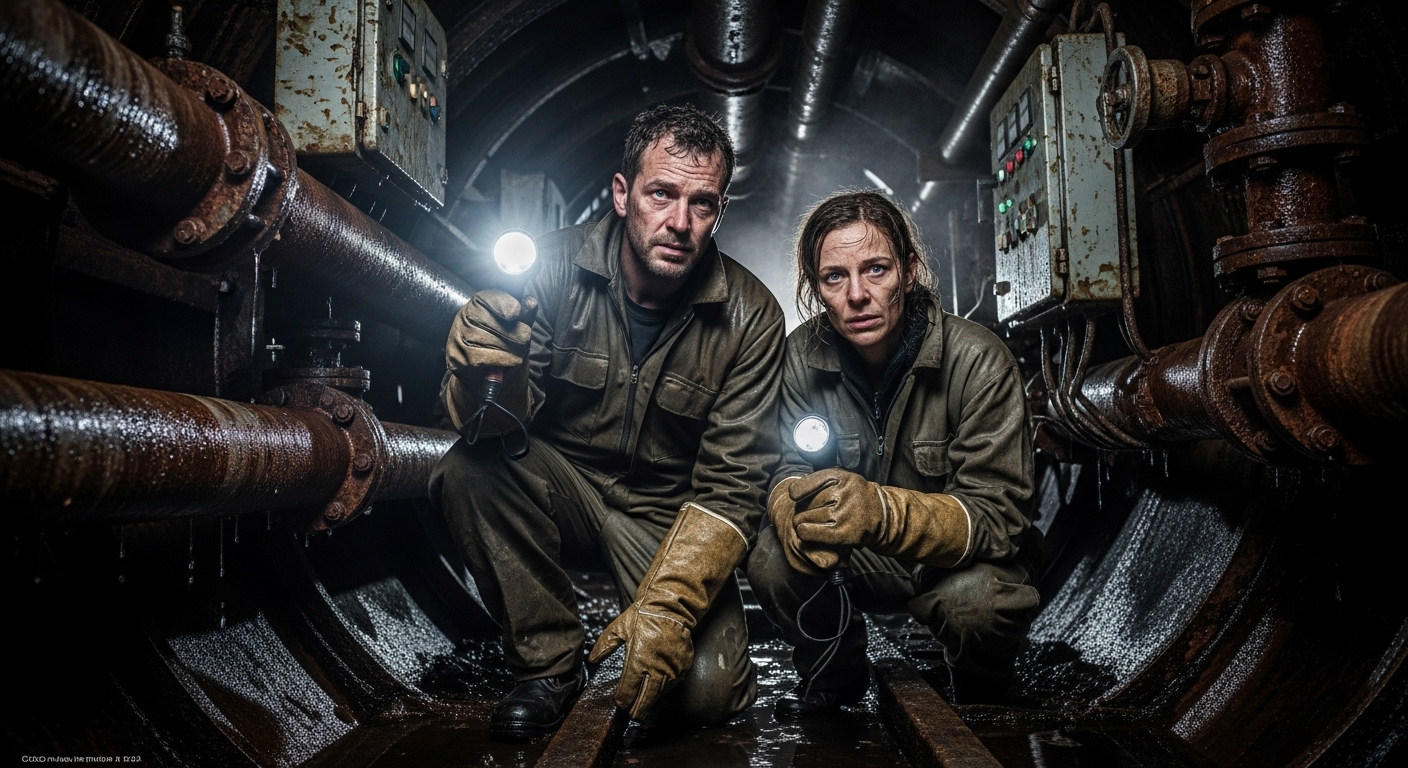
The entire structure groaned, a tortured cry of metal, stone, and ice, as the floor bucked beneath us. The light, our only tether to the world, flickered, then died, plunging us into a black so absolute it felt like a physical blow. The roar of the rupture swallowed all thought, all sound, all sense, leaving only the crushing weight of the rising water and the certain, terrible knowledge that this was it.
Share This Story


