The High Cold Room
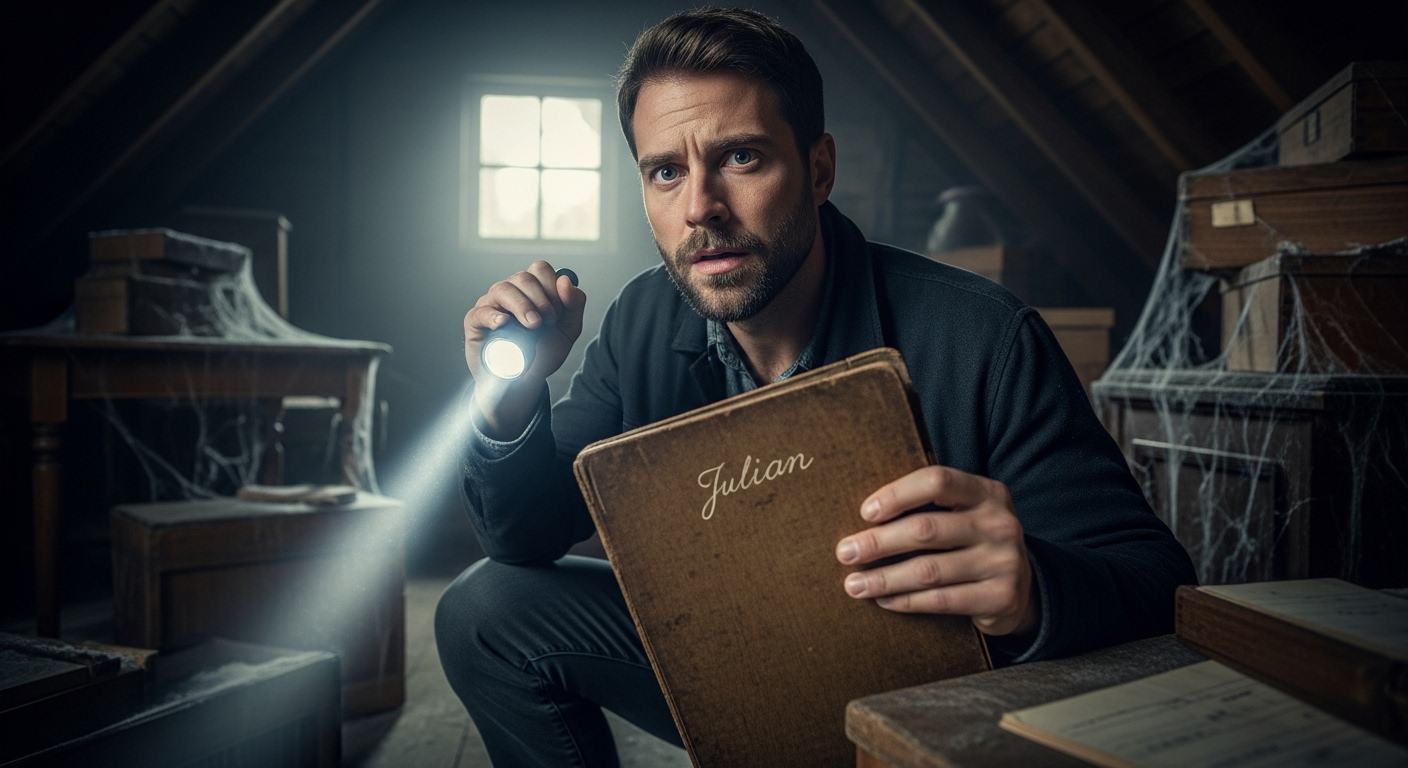
A biting autumn chill permeates the ancient, dusty attic of the Blackwood estate. Jared, driven by an unsettling premonition, searches through generations of forgotten relics, his torch beam a lone probe against the oppressive darkness, as a sense of urgency and unseen eyes press down upon him.
The old floorboards groaned under Jared’s weight. Not a casual creak, but a deep, complaining sigh that seemed to echo through the empty spaces of the attic. He froze, the beam of his torch cutting a nervous circle through the oppressive darkness. Downstairs. A faint thud. A door closing, perhaps? His heart hammered, a frantic drum against his ribs. He swore under his breath, a thin stream of cold vapour escaping his lips. Autumn had bitten hard this year, even indoors. The estate house, always a chill repository of family grudges, felt colder still since Father’s latest ‘arrangement’.
He was thirty-eight, too old to be skulking in a cobweb-draped attic, but the note—his mother’s frantic, barely legible scrawl shoved into the spine of her favourite novel, weeks after the funeral—had been clear enough: 'Look upstairs. The high cold room. Before your father settles everything.' Settle everything. The phrase had tasted like ash in his mouth. What exactly did Frederick settle? Always a debt, always a secret, always something buried deeper than the last.
The air smelled of damp moss and rotting pine needles from the draughts, overlaid with the stale scent of forgotten camphor and dry rot. A moth, wings like crumpled parchment, fluttered past his face, startling him. He swatted at it, then cursed his own jumpiness. His jeans felt too tight across his knees as he crouched, the chill seeping into his bones through the thin denim. He squinted through the dust that filmed every surface, scanning the shadowed corners. He moved towards the far wall, where a low, gabled section met the main roofline, half-hidden by a stack of mouldering canvas-backed portraits of stern-faced ancestors.
His fingers brushed against the rough, splintered wood of an old packing crate. He remembered this section. As children, he and Edna had imagined a secret passage here, a bolt-hole from Frederick’s booming pronouncements. He felt along the timber, his hand scraping against a raised knot. Not a knot. A faint, almost invisible seam. He pressed. Nothing. He pressed harder, a dull ache starting in his shoulder. The wood gave slightly, a minuscule shift, then caught again.
He pulled out his small, tarnished penknife, its blade dull from years of disuse, and carefully worked it into the hairline gap. A thin sliver of wood cracked, the sound loud in the oppressive quiet. He winced, listening. Still nothing from downstairs. He leveraged the knife. With a groan of ancient timber, a section of the panelling swung inwards, revealing a shallow, dark cavity. It wasn’t a passage, just a hiding place. A human-sized recess, long and narrow.
Inside, nestled amongst yellowed newspaper clippings dated decades ago, was a small, leather-bound ledger. And beneath it, a stack of envelopes, tied with a brittle, faded ribbon. He grabbed the ledger first. It was heavier than it looked, its leather cover slick with a thin film of dust. The paper inside was a thick, creamy stock, filled with neat, spidery handwriting in pallid ink. Dates, names, sums. Not a financial ledger. Something else. The names weren’t familiar, not directly, but a few of the places mentioned – old mills, forgotten holdings – resonated with fragments of stories he’d overheard as a child, hushed whispers from aunts and uncles when they thought he wasn’t listening.
He slid the ledger into his rucksack, the sudden bulk a cold weight against his spine. The letters. He picked up the tied stack. The top envelope bore his mother’s elegant script. His mother. She’d been gone almost a year, a sudden, brutal collapse in the garden, and even now, the grief was a raw, tender thing. But her note had shaken him from his stupor. What had she known? What had she been afraid of?
A sharper sound this time. Definitely a door. Closer. The library door, maybe? Or the boot room? He could hear the distinct crunch of gravel outside the window, then fading. Someone had left the house, or perhaps, arrived. Frederick. It had to be. Always coming and going at odd hours. Jared pressed back into the recess, the cold wood biting into his shoulder blades, holding his breath until his lungs burned. He waited. The silence stretched, thick and cloying.
Then, footsteps on the main staircase. Slow. Deliberate. They weren't Frederick’s heavy tread. Lighter. Edna. Her presence in the house was a constant, unsettling shadow since their mother’s death. She rarely left, rarely spoke, simply drifted through the cavernous rooms, her eyes like chipped porcelain.
A Glimmer of Movement
He heard her now, a soft rustle, the barely audible creak of the attic door hinge. He tensed, muscles aching. The torch, still in his hand, felt dangerously heavy. He didn’t dare move. Didn’t dare breathe.
Edna entered, not with a torch, but with the faint, cold glow of her mobile phone. Its pale light danced across the jumbled piles, illuminating the familiar shapes of ancestral detritus: a headless mannequin, a child’s rocking horse with one missing eye, trunks bursting with moth-eaten velvets. She moved slowly, her gaze sweeping, not frantic, but methodical. Searching. For what?
She paused near the entrance, her head tilted, listening. Her breath was a soft, ragged sound in the quiet. He could make out the faint, intricate pattern of the shawl she always wore, even indoors. A faint scent—lavender, perhaps, mixed with old paper—wafted towards him. He tried to think, to anticipate. Was she looking for him? Or for something specific?
Her phone light drifted, a slow arc, across the wall where he was hidden. He pressed further back, his chest tight. He felt a bead of sweat trickle down his temple, itching. The light continued past him, then returned, slower this time, lingering near the stacks of portraits. His heart seized. Had she seen the disturbed panel? The opened recess? He felt a sudden, irrational urge to sneeze, a tickle building in his nose from the dust.
She stopped, right in front of the portraits. Her silhouette, thin and stark against the faint glow, seemed to vibrate with a suppressed energy. She reached out, her fingers brushing the canvas of an unknown, severe-looking great-aunt. And then, she spoke. Barely a whisper. “Jared?”
He didn’t move. Couldn’t. His breath hitched. It was a question, not a statement. Hopeful? Fearful? He couldn't tell. He remained a statue, praying the silence would convince her she was alone, that the creaking had been nothing but the old house settling.
She sighed, a sound that seemed to carry the weight of all their shared, unspoken history. Then, slowly, she turned, the phone light sweeping the room one last time before she moved back towards the attic door. The hinges groaned again. The door clicked shut. Silence. A deeper, more profound silence now.
---
He waited five full minutes, counting the slow, deliberate ticks of an imaginary clock, before he finally allowed himself to exhale. The air tasted stale, metallic. His legs cramped as he straightened, a sharp jab of pain. He stumbled, catching himself on a stack of forgotten hatboxes. The small, embarrassing clatter felt deafening. He hurried towards the dormer window, tucked away in another corner, obscured by a heavy, moth-eaten tapestry.
The window was old, stiff. The latch, corroded with age, resisted his efforts. He fumbled with it, his fingers numb with cold and a tremor he couldn’t suppress. Finally, with a sharp click, it gave. He pushed the casement outwards. A gust of biting autumn air, sharp with the smell of wet leaves and woodsmoke, hit his face. Relief, cold and immediate. The night sky was a bruised purple, clouds scudding quickly across the moon, momentarily plunging the grounds into inky darkness, then bathing them in pale, fleeting silver.
He eased himself through the narrow opening, scraping his hip on the frame. He dropped lightly onto the flat, slate roof of the conservatory below, the cold, wet tiles slick under his worn boots. One misstep, and it would be a nasty fall onto the flagstones below. He made his way carefully across the moss-slicked slates, then down the wobbly trellis that hugged the west wall, its ancient roses now brittle and thorned with the season.
His feet hit the damp earth of the overgrown flowerbeds with a soft thud. He paused, scanning the grounds. The sprawling gardens were a maze of skeletal shrubs and weeping beeches, their bare branches like gnarled fingers against the autumn sky. The main house loomed, dark and silent, a formidable silhouette against the horizon. No lights in Edna’s room. No sign of Frederick’s car in the gravel drive. He was alone. For now.
He walked quickly, not towards his own small cottage on the edge of the estate, but deeper into the surrounding woods, his boots crunching loudly on the fallen leaves. The chill seeped further into his jacket, a persistent ache. He found an ancient, gnarled oak, its massive trunk a familiar, comforting presence from childhood. He slumped against it, pulling out the ledger from his rucksack, his fingers clumsy in the cold.
The pages, when he opened them, seemed to hum with a quiet dread. The names, once just fragments, started to coalesce. Land deals. Property transfers. But the sums… they were too small for the actual value of the land, and the dates were too close to known 'accidents' or 'disappearances' in the local papers from decades past. He flipped further, the paper brittle, almost translucent.
One entry, near the middle, made his breath catch: a piece of land, a small farm on the riverbend, signed over to the Blackwood Trust. Dated a week before the farmer, a Mr. Douglas Miller, vanished without a trace. His mother’s mother had always told him Miller was ‘driven off’ by the family. He’d dismissed it as old wives’ tales, a country rumour. But here it was. In precise, pallid ink. And a series of small, almost imperceptible symbols drawn in the margin next to the entry. A strange, almost glyph-like mark. He hadn't seen anything like it before, yet it felt... significant.
The cold wasn’t just outside him now. It was inside, a spreading ice. This wasn’t just about property. This was about… something far more dangerous. His mother’s note. Her fear. He looked up at the moon, momentarily free from the clouds, casting long, stark shadows through the bare branches. A lone owl hooted, a mournful, distant cry. He shivered, pulling his jacket tighter. The ledger felt heavy, a burden. He didn't know what he was looking at, not entirely, but he knew one thing. Whatever this was, it wasn’t over. Not by a long shot. And Edna, silent Edna, knew more than she ever let on. Much more.
He clutched the ledger, the faint scent of old paper and something else – something metallic and unsettling – rising from its pages. The symbols in the margin seemed to shift, almost writhe, in the dim light. He felt a sudden, profound sense of being watched, not by Edna, not by Frederick, but by something older, colder. Something that had been waiting in these woods, in this house, for a long, long time. The autumn wind picked up, rustling the dry leaves, sounding like a thousand whispering voices. He was holding something that could unravel everything. And that thought, more than the cold, made him afraid.
He clutched the ledger, the faint scent of old paper and something else – something metallic and unsettling – rising from its pages. The symbols in the margin seemed to shift, almost writhe, in the dim light. He felt a sudden, profound sense of being watched, not by Edna, not by Frederick, but by something older, colder. Something that had been waiting in these woods, in this house, for a long, long time.
Share This Story


