The Glass Cold on Her Hand
The wind howled a sustained, predatory sound, rattling every pane in the old Devereaux manor. Outside, the world was a study in stark white and grey, an endless canvas of falling snow that had already swallowed the distant treeline and was working its way up the ancient stone walls of the house. Inside, the air hung heavy and still, smelling faintly of old woodsmoke and damp earth, a scent that clung to everything despite Cynthia’s relentless efforts. Every creak of the floorboards, every groan of the stressed timber, felt amplified in the suffocating quiet.
Edith watched the snow through the double-paned window, her reflection a pale, indistinct smudge against the white chaos. The glass was cool, almost icy, beneath her fingertips. Seventy years had taught her the precise nuances of a Devereaux winter, but this one felt different. Heavier. More intent on isolation. The road, a winding track up from the valley, would be impassable by now. Good. Less chance of someone else finding their way in. Less chance of someone finding their way out.
Behind her, the low thrum of the ancient generator in the cellar occasionally sputtered, then caught again, a mechanical heart struggling to beat. Cynthia, bless her soul, had managed to keep it going for three days now, but Edith could hear the strain in its rhythm. The lights flickered, a subtle dip in the harsh yellow glow of the standing lamps, before recovering. Each flicker sent a microscopic jolt through Edith’s spine. A reminder of fragility. Of dependence.
A heavy sigh broke the quiet. Clive, her eldest, slumped into the worn leather armchair by the unlit hearth. He rubbed his temples, a habit he’d picked up from his father, though Morton’s version had always been more of a thoughtful caress, less of a frustrated grind. Clive looked… sallow. The pale winter light did him no favours, accentuating the faint blue veins under his eyes.
“Still no signal, Mother,” he said, his voice flat, a little rough. “The landline’s dead too. Must be the ice on the lines.” He didn’t look at her, instead staring at the cold ashes in the grate as if seeking answers there. Or perhaps just distraction.
Edith didn’t turn. “Of course not. It always goes in a proper storm.” She’d seen worse, much worse, in this house. She’d weathered storms here that felt like the world was ending, alone, with a crying child and a husband off on one of his ‘business trips’. This was just… another Tuesday, if Tuesdays were coated in three feet of resentful snow.
“Right. And the car?” Clive pushed himself up, walked to another window, squinted through the frost-ferns clinging to the edges. “Don’t tell me the Range Rover’s completely buried.”
“Cynthia went out to clear it this morning, before the worst of it. Said it was no good. Too much fresh drift. Didn’t want to risk her getting stuck, or worse.” Edith finally turned, a slow, deliberate movement. Her gaze was steady, unwavering, a familiar weight on Clive.
He flinched, just a fraction. “So we’re cut off. Completely. With Father… like he is.” His voice dropped on the last phrase, tinged with a bitterness that had nothing to do with concern and everything to do with inconvenience.
A Frozen Tableau
The ‘like he is’ referred to Morton, sequestered in his study, a room he now rarely left, even for meals. His memory, once a steel trap for numbers and grievances, was fraying at the edges. Not gone entirely, but like a moth-eaten tapestry, flashes of brilliance interspersed with gaping holes and confusing, nonsensical patterns. Edith had accepted it, resigned herself to it. Clive, however, saw it as an impedance. A final, cruel joke from a man who had always controlled everything, even his own decline.
Audrey entered the drawing-room then, a wisp of a woman, perpetually bundled in a shawl despite the decent heat Cynthia coaxed from the ancient boiler. Her eyes, wide and perpetually worried, darted between Edith and Clive. She carried a tray with a teapot and three cups, the china clinking delicately as she navigated the Persian rug. The tea smelled of lavender, a futile attempt at calm.
“I gave Father his broth,” Audrey murmured, setting the tray on the low table. Her hands trembled slightly as she poured. “He… he seemed more lucid this time. Asked about the snow.”
Clive snorted. “Lucid? He asked me if the war was over and if he’d missed his train. Again.” He took a cup, didn’t even glance at the tea, just cradled the warmth.
“He did, yes, but then he talked about… the ledger. And the safe.” Audrey looked from Clive to Edith, her brow furrowed with concern. “He kept saying, ‘The ledger, the ledger, it must be put right.’ Then he mentioned that new safe, the one in the study wall.”
Edith’s hand, which had been resting on the windowsill, tightened. The new safe. Morton had had it installed himself, after one of his recent, inexplicable bouts of paranoia. He’d barely shown anyone where it was, much less the combination. A new security measure, he’d called it. Another way to keep his secrets under lock and key, even from his own family.
“What about it?” Clive asked, finally taking a sip of his tea. His gaze sharpened, a flicker of something almost predatory in his eyes. Money. That was what always got Clive’s attention. The potential inheritance, the family assets, the estate that was draining them dry year by year.
Audrey wrung her hands. “He just kept repeating it. The ledger. The safe. And he looked so… distressed. Like he was trying to tell me something important, but the words just wouldn’t come.”
---
The lights flickered again, longer this time, a deeper dip. For a heart-stopping second, the room plunged into an inky blackness, a suffocating void. Edith felt a cold sweat prickle on her neck. Then, with a lurch and a whine from the cellar, the power surged back, brighter than before, before settling back to its previous, struggling glow.
Silence descended, thicker than before. The wind outside seemed to hold its breath. And then, Edith heard it. A faint, almost imperceptible hum. Not the generator. Something else. Something higher pitched, like a distant, struggling appliance.
“Did you hear that?” Audrey whispered, her eyes wide, like a frightened rabbit’s. Her tea sloshed slightly in her cup.
Clive frowned, listening. “Hear what? The generator dying?”
“No. Something else. Like… a static charge. Or a very, very small motor.” Edith felt a knot tighten in her stomach. It was coming from the direction of Morton’s study.
She stood, her movements brisk despite her age. “Morton.”
She walked purposefully towards the study, her posture rigid. Clive and Audrey, after a beat of hesitation, followed. The hum grew marginally louder as they approached the closed, heavy oak door. It wasn’t a steady hum. It pulsed, almost imperceptibly, like a dying heartbeat. Edith reached for the brass handle, expecting it to be locked, as it always was when Morton was inside, or had just left. He was meticulous about his privacy.
Her fingers closed around the cold metal. It turned, easily. Too easily.
The door swung inward with a soft creak. The room was dark, save for the faint light spilling in from the hallway. And Morton… Morton was not there. His favourite armchair, where he usually sat poring over old documents, was empty. His spectacles lay discarded on a stack of invoices, glinting in the dimness. The scent of pipe tobacco, usually thick in the room, was absent. Only the ghost of that strange, pulsing hum lingered in the air.
“Father?” Audrey breathed, her voice trembling. She peered into the shadows, clutching her shawl tighter.
Clive pushed past Edith, striding into the room. His gaze swept the familiar chaos of books and papers, then settled on the far wall. The wall where the new safe had been installed. It was a recent addition, a sleek, digital panel set into the mahogany panelling, almost invisible when closed.
“The safe…” Audrey gasped, pointing. The small, illuminated keypad was a stark blue against the dark wood. It was open. Not just unlocked. The heavy steel door was slightly ajar, a sliver of blackness visible around its edge. And the hum… it was stronger here, directly from the safe’s interior.
“What in God’s name?” Clive muttered, his voice edged with something akin to panic. He reached out, pushed the safe door fully open. It was empty. Completely. No ledgers, no documents, no family heirlooms. Nothing but the dull, metallic gleam of bare steel and that persistent, electric hum.
Edith felt a chill colder than any winter wind. She stepped into the study, her eyes raking the room. Nothing was overtly disturbed, no obvious signs of a break-in. Yet the safe was open, Morton was gone, and the heavy, leather-bound ledger, the one that held the true, terrifying history of their family’s finances, the one Morton had been so obsessed with, was undeniably missing.
“Someone was here,” Clive said, turning to face them, his face pale, eyes wide. “Someone knew. And they took it.” He looked from Audrey to Edith, then back, a new, ugly suspicion hardening his features. “Or one of you did.”
“Clive! Don’t be ridiculous!” Audrey cried, her voice cracking. “I just brought him broth! He was here!”
“Was he? Or did he slip out while you were ‘comforting’ him?” Clive snapped, his gaze drilling into his sister.
Edith raised a hand, her voice a low, dangerous rumble. “Enough. Both of you.” Her eyes, sharp and clear, cut through the tension. “This is not the time for accusations. Morton is gone. And whatever was in that safe… is gone too.” She looked at the open safe, then back at the empty armchair. “And that humming…” The sound suddenly stopped. The silence that followed was immense, crushing, as if the house itself were holding its breath.
A shard of ice, dislodged by the relentless wind, rattled against the windowpane. It sounded, for a chilling moment, exactly like a single, hesitant knock.
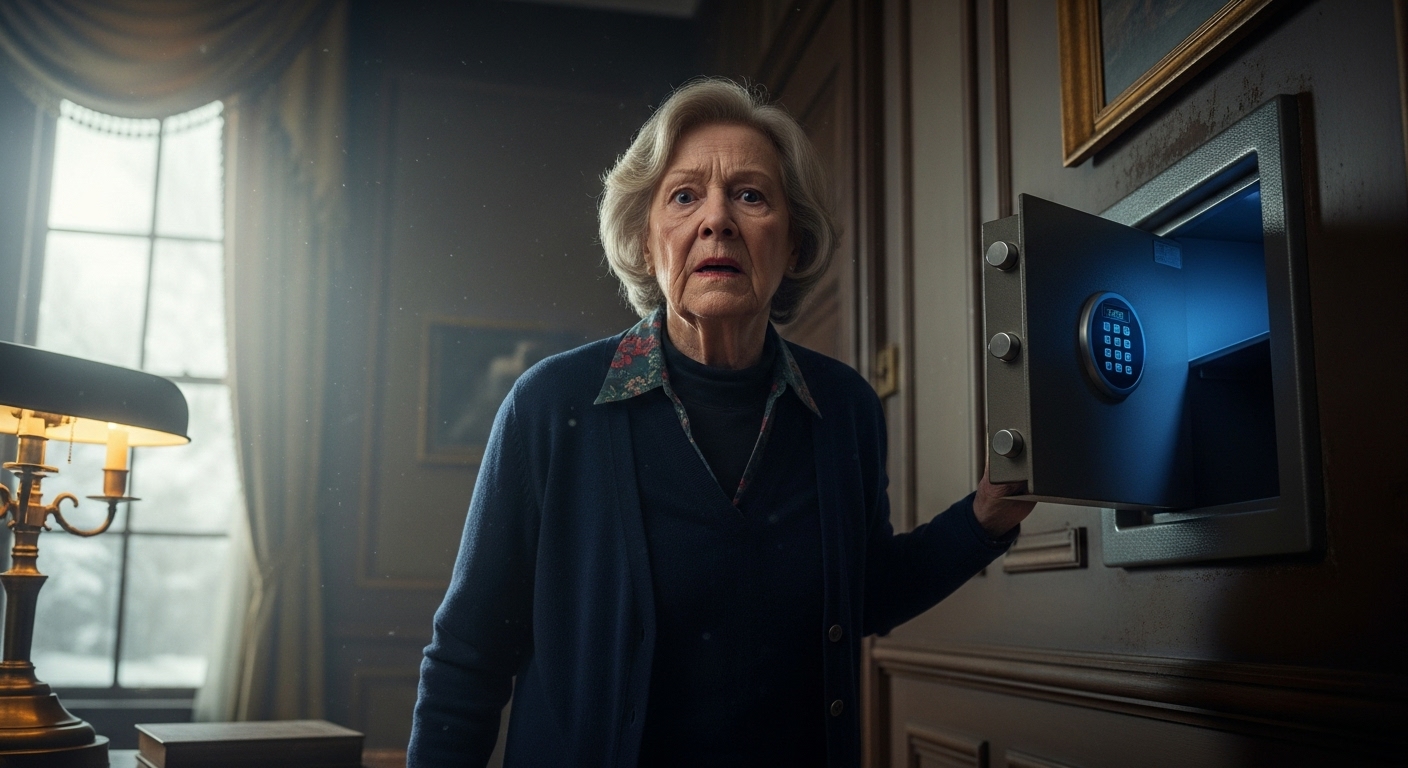
The hum died, leaving behind a silence more profound and terrifying than any noise. The house, cut off, now felt less like a refuge and more like a trap, its ancient walls holding not just a family’s secrets, but a new, unseen threat that had just announced its arrival.
Share This Story


