The Unblinking Eye of the Prairie Sun
The kitchen window, usually just a frame for grey spring skies and slush, now glows with an impossible, sickly orange. A child, Abraham, watches the distorted light consume the familiar Winnipeg street, his small world shrinking under an indifferent, colourful apocalypse.
My chest felt tight, like Mama's old coat after it shrunk in the wash. Not scared, not exactly. Just... squashed. The light outside the kitchen window wasn't right. It was too… orange. Like someone had dipped the whole sky in a bucket of those cheap cheese puffs Papa used to sneak me when Mama wasn’t looking. It was spring, supposed to be grey and slushy, maybe a shy green trying to peek through the mud near the Red River. But today, the mud glowed, an angry, burning amber that made the puddles look like spilled soup.
Mama shuffled past me, her slippers dragging. She didn’t look out. Not anymore. Not since yesterday, when the news channels had started talking about ‘unprecedented atmospheric anomalies’ and ‘rapid solar expansion’. Grown-up words that sounded important but mostly just meant: big, bad stuff. She just squinted at the toaster, which was still doing its job, popping up two slices of rye bread with a cheerful clunk. The old fridge hummed, a low, tired sound that usually meant it was about to give up, just like everything else.
"You hungry, love?" she’d ask, without looking up from the radio, her voice flat, like stale ginger ale. "The world's ending, Abraham. Still gotta eat."
I wasn't hungry. My tummy felt like it had swallowed a rock. A glowing orange rock. I pressed my forehead against the cool glass of the window. The trees, thin and spindly with new buds, looked like black lace against the furious sky. Everything was too bright, too sharp. The colours hurt my eyes, like looking at one of those old 3D movies without the glasses.
Outside, I could hear Mr. Harrison’s lawnmower sputtering – a final, defiant roar against the big orange quiet. Why mow your lawn when the world was folding in on itself? Grown-ups were weird. Mama said Mr. Harrison had always been particular about his lawn. Guess some things just stuck, even when the sun was turning the prairie into a giant marmalade jar.
I shuffled out of the kitchen, past Mama, who was now buttering her toast with a methodical calm that was almost more unnerving than yelling. My rubber boots thumped softly on the linoleum. I needed to see it, properly. Not through the smudged window. I pulled on my thin spring jacket, the one with the torn pocket where I usually kept my smooth river stones. Today, the pocket was empty.
The air outside was still surprisingly cool, even with the impossible warmth of the sky. A contradiction. My breath hitched, a little puff of steam that vanished into the orange. The street stretched out, paved in molten gold. It was beautiful, in a wrong, dizzying way. The crocuses I’d seen pushing through the last patches of snow near Mrs. Debbings’s fence looked like tiny purple wounds on the fiery ground.
---
The Grand Finale of Casseroles
Down the street, the community centre’s lights were on, an insistent yellow beacon against the cosmic inferno. They were having a 'Farewell Fellowship,' Mama had called it. Said it was important to be with people. Said it was important to share what you had. Mr. Harrison’s lawnmower sputtered louder as I walked past his perfectly manicured front lawn. He gave me a vague, distracted wave, a smudge of grease on his cheek. He was still wearing his sensible gardening hat. The sun seemed to pause, waiting for him to finish the last strip.
I pushed open the heavy double doors of the centre. The smell of something burnt and something sickly sweet hit me first. Inside, it was a chaos of folding chairs and people moving too fast, too slow. Mrs. Debbings, her usually neat grey bun now slightly askew, was beaming, holding aloft a truly terrifying-looking Jell-O casserole. It was layered in shades of green, red, and a sort of milky white. My stomach did a flip-flop, not because of the sky, but because I knew her Jell-O usually tasted like old socks.
"Abraham, darling! Just in time!" she trilled, her voice a little too high, a little too happy. "My 'End-of-Days Special'! Got to try it, it’s got… everything!" She gestured vaguely. I could almost hear the 'everything' squelching inside the wobbly layers. A man in a stained suit at a nearby table was loudly debating the merits of canned peaches versus pears with a woman who looked like she’d already given up on the conversation. Another adult was meticulously arranging paper plates into a pyramid, only for it to collapse every few seconds.
"No, thank you, Mrs. Debbings," I mumbled, backing away slowly. My eyes scanned the room. People were laughing too loud, or staring at their hands too hard. Some were just eating, shovelling food in like it was the only thing left to do. It was all so… busy. For the end.
I saw Mama in the corner, talking to Mr. Peterson from down the street, who was surprisingly not wearing his usual grumpy face. They both held paper cups, sipping something that smelled like burnt coffee. Mama looked tired, really tired, the kind of tired that made her eyes look like they had dark smudges painted underneath them. She looked up, caught my eye, and offered a weak smile. I didn’t smile back. My mouth felt too dry.
"Is it… really the last one?" I heard a small voice near me. A girl, about my age, was clutching a faded teddy bear. Her eyes were wide, tracking the orange streaks coming through the centre’s tall windows. Her fringe was stuck to her forehead with sweat, even though the room wasn't warm. She was wearing a sparkly party dress, which felt wrong. Or maybe, for today, it was exactly right.
"Mama said it is," I whispered back. "The sun… it’s doing something new."
She nodded slowly, then pointed at Mrs. Debbings, who was now trying to get Mr. Harrison (who had finally abandoned his lawnmower and come inside, still in his gardening hat) to try her casserole. "That Jell-O looks… interesting." The girl giggled, a fragile, watery sound. It was the first time I'd heard anyone truly laugh today.
---
A Pylon's Resolve
I slipped back outside. The air felt colder now, even as the sky pulsed with a deeper, more violent orange. The red river, visible from the end of our street, gleamed like a slow, thick ribbon of blood. My street, usually so full of the sounds of spring – robins chirping, kids yelling, dogs barking – was quiet. Only Mr. Harrison's lawnmower, now abandoned in his driveway, offered a silent testament to futile order. The engine was still ticking, faintly. It smelled of petrol and hot metal.
I walked across our front lawn, the damp grass squelching under my boots. My gaze fell upon something small, half-buried in the still-melting snow near the porch. It was my favourite plastic soldier, the green one with the broken rifle. I must have left him there weeks ago, after a particularly fierce snow fort battle. He lay on his side, covered in mud and ice, a tiny, determined figure against the overwhelming orange of the sky. His plastic face was grim, unyielding. Nearby, a single, fragile crocus pushed through the half-melted snow, its purple petals already looking a bit wilted, as if the harsh light was too much for it. It seemed small, insignificant. Like me.
I knelt, feeling the wet chill seep through my jeans. The soldier, my small green hero, had faced so many imaginary dangers. Frost giants, mud monsters, the dreaded lawnmower. And now, the actual end. He deserved more than to be frozen and forgotten, his tiny plastic body covered in the last mud of earth. And the crocus. It had tried so hard. It had fought through winter, only to be met by… this.
My hands, clumsy in their rubber gloves, scraped against the hard, cold earth. I dug around the soldier, pulling him free from the frozen grip of the ground. He came out with a schlorp sound, mud clinging to his boots. I brushed him off as best I could, feeling the rough grit against my gloves. Then, with careful fingers, I reached for the crocus, trying not to snap its delicate stem.
Mama wouldn’t care, not right now. But I did. Something tightened in my chest again, but this time it felt different. Not squashed. More like… a stubborn knot. Like something I had to do, even if it was dumb. Especially if it was dumb. The sun was going to go out. The whole sky was going to fizzle into nothing. But not today, not for everything. Not for this. The soldier, the crocus, they were here, right now, and they were still trying.
I stood up, holding them both carefully. The soldier, small but defiant, and the wilting flower, purple against my muddy glove. I looked at the vast, burning canvas above, at the impossible, melancholy beauty of it all. There had to be somewhere safe. Somewhere for tiny heroes and brave, purple flowers to see the end, or maybe… something else. It was a stupid, silly idea. But it was my stupid, silly idea. And the world was ending anyway. What was the worst that could happen?
I turned, walking away from the community centre and its burnt casserole smell, away from Mr. Harrison’s silent lawnmower. My gaze was fixed on the far-off stand of spruce trees, dark against the fire-sky, near the old railway tracks. There was a hollow there, I remembered, tucked away, almost hidden. It seemed like a good place for small things. A good place to wait. A new, ridiculous mission had just begun.
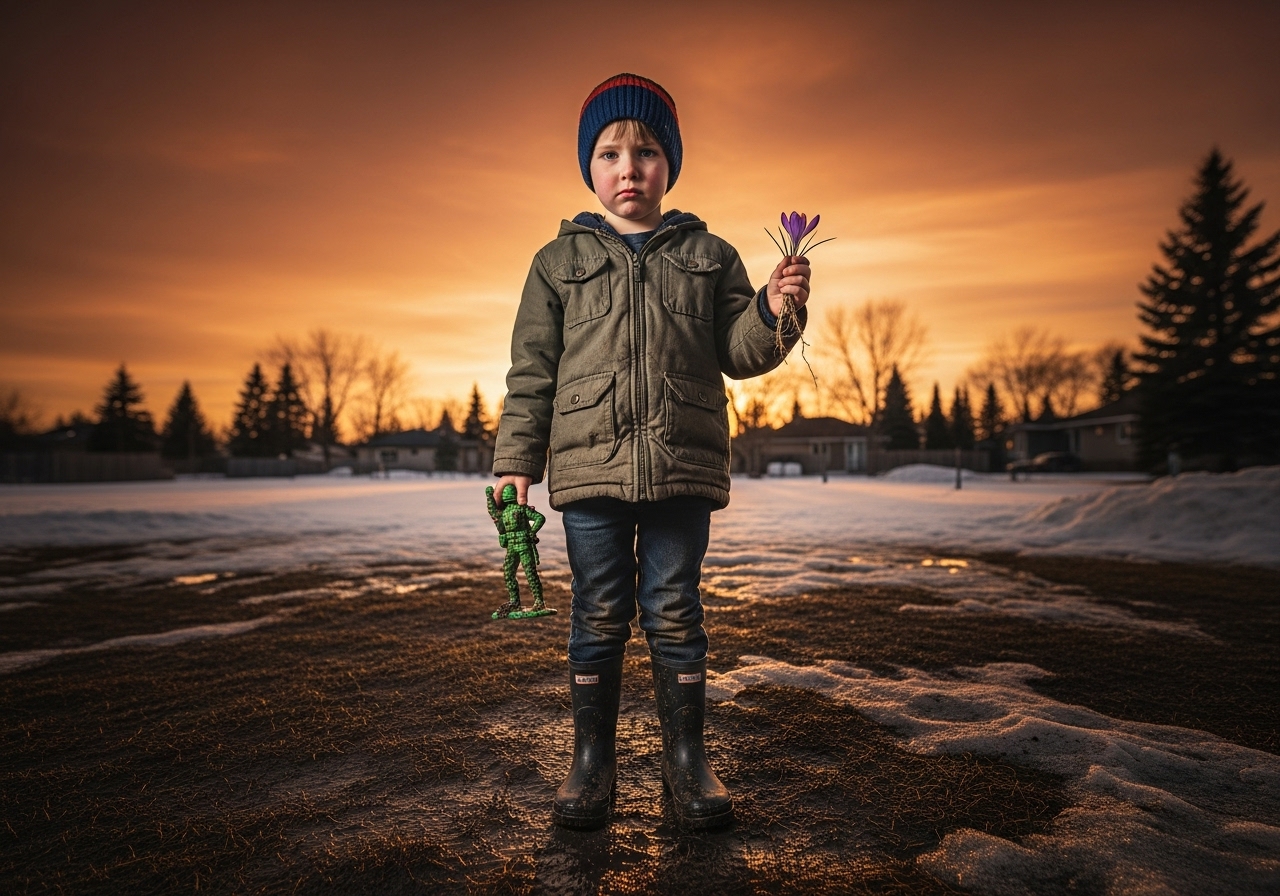
Abraham, clutching a muddy plastic soldier and a wilting crocus, walks towards the dark spruce trees on the horizon, determined to find a secret hollow to shelter them from the sky's final, impossible show.
Share This Story


