A Quiet Observer
Jordan, a quiet teenager, navigates the economically depressed streets of Sprucewood, Northwestern Ontario, his keen observational eye absorbing the town's slow decay. His secret sketchbook, filled with detailed drawings of hands, is his only outlet for expressing his profound sense of disconnection.
May had technically arrived a week ago. Jordan leaned back against the flaking brick of the old hardware store, a place that hadn't sold a decent wrench in years, not since Mr. Henderson packed it in for good and left the 'Closed' sign hanging, sun-bleached and crooked. He could feel the fine grit of mortar dust on his jacket, a cheap canvas thing that was already showing signs of wear at the cuffs. His breath plumed out, a thin, white ghost against the muted grey of Sprucewood’s sky. He pulled his hoodie a little tighter, the drawstring biting into his chin.
Main Street was mostly quiet. Always was. A pickup truck, its engine coughing, rattled past, kicking up a small cloud of wet dust from a pothole near the old diner. The truck was a familiar one, belonged to one of the guys working up at the mill, what was left of it. They ran one shift now, maybe two if there was a sudden order. Not like when Jordan was a kid, when the saw hummed all day and the smell of fresh-cut pine used to drift down to the lake. Now it was just… quiet. A heavy quiet, like the town was holding its breath, or maybe just hadn’t noticed it had stopped breathing altogether.
He traced the faint outline of a crack in the brick with his thumb, the mortar rough and cold. His eyes, usually half-lidded, sharp in a way most people didn’t notice, scanned the storefronts across the street. The ‘Video Palace’ sign, still there, but dark, its letters faded to a faint purple. The ‘Beauty Nook’ next to it, only one curling iron in the window, perpetually unlit. Everything here felt like an echo of something that had already happened, a memory someone forgot to put away. He wondered if he was becoming an echo too.
The quiet suited him, mostly. It meant fewer expectations, fewer people trying to pull him into conversations about hockey scores or whatever new game was tearing through the few other kids still left in town. It meant he could just… be. And watch. He was good at watching. He saw the way Mrs. Patterson, from the bakery, gripped her purse strap, knuckles white, every time she went into the tiny post office. He saw the tremor in Mr. Taylor’ hand as he reached for the local paper, always the same spot, the back page, for the obituaries. He saw all of it, cataloged it, filed it away.
But the watching also brought a sort of hollowness. Like he was seeing through a pane of dirty glass, observing life, but never quite touching it. His own hands, slender, with nails trimmed short, felt restless in his pockets. They wanted to do something. To create. But not here, not in the open. His art was his own, a secret language spoken only between him and the worn pages of his sketchbook.
He pushed off the wall, a faint scuff of brick dust marking his jacket. The sun, a pale, indifferent orb, was starting its slow descent, doing little to warm the grey sky. He kicked a loose stone along the cracked sidewalk. It skittered, made a surprisingly loud noise in the quiet, then spun off into a puddle near the curb. He just kept walking, the rhythmic scuff of his sneakers against the uneven concrete the only sound, besides a very faint, almost imperceptible ringing in his ears, like distant power lines.
His backpack, heavy with textbooks he rarely opened, pressed against his shoulders. Tucked carefully into a side pocket, nestled amongst a few stray pencils and an eraser worn smooth as river stone, was the sketchbook. It was a cheap, spiral-bound affair, the kind with thick, rough paper. The cover was scarred, bent at the corners, charcoal smudged fingerprints all over it. Nobody, not his parents, not his teachers, not the few kids who still bothered to make eye contact, knew what was inside. Nobody knew about the hands.
He’d started drawing them years ago. First, it was just doodles, a way to pass the time in class. But then he’d noticed something, a silent language. The way his dad’s hands, usually rough and steady, would clench into fists when he talked about the mill, about the 'good old days.' The way his mom’s hands, always busy, always moving, would pause, fingertips pressed together, when she was thinking, really thinking, about something heavy. They told stories. More than faces, sometimes. Faces could lie. Hands… hands were honest. They bore the brunt of everything, the hard work, the worry, the quiet joys.
Inside the book, page after page, were hands. Sketch after sketch. A lumberjack’s hands, fingers thick and scarred, holding a steaming mug. His grandmother’s hands, impossibly delicate, still capable of knitting the intricate patterns she’d taught him as a boy. A child’s small, pudgy hand reaching for a bright red toy truck. They were studies in texture, in light, in form. He’d spent hours, just rendering the subtle bulge of a vein, the curve of a nail, the way skin crinkled around a knuckle. Charcoal, graphite, sometimes a little ink for the deeper shadows. He’d tried to capture the feeling of skin, of bone, of life lived.
It wasn’t just about making a pretty picture. It was about seeing. Really seeing. Seeing past the tired eyes or the forced smile, to the deep lines on a palm, the calluses on a thumb, the way fingers curled in repose or stretched in effort. Each line, each mark, was a testament, a biography written in flesh. And Sprucewood, a town full of people who were tired, resigned, slowly fading, was a gallery of these stories.
He passed the old movie theatre, its marquee a rusted skeleton, no letters in sight. Hadn't shown a film in ten years. People just stayed home now, or went to Thunder Bay if they wanted something to do. The thought of Thunder Bay, a real city with real bustle, real choices, made a dull ache settle in his chest. It felt a million miles away. He tried not to think about it too much, tried not to think about what came after high school, what came after Sprucewood. There wasn’t a lot of talk about 'futures' here, not really. Just getting through the day.
His few friends, or what passed for them, were already talking about leaving. Or not talking, really, just an assumed understanding. Larry, who worked at the gas station after school, saving up for a beat-up car and a one-way ticket south. Sarah, who disappeared into her phone, pretending Sprucewood didn't exist, her eyes already on some glossy magazine version of Toronto. Jordan understood. He felt it too, that pull to something more, something… else. But for him, it was a quiet hum, not a roaring engine. He didn't know what ‘else’ looked like. Only what ‘here’ looked like.
He knew he stuck out, even by trying not to. The quiet kid. The one who watched. He saw the quick glances, the way conversations would sometimes dip as he passed. He didn't mind. It reinforced his role, his secret work. He was the archivist of Sprucewood, documenting its slow, quiet decline, one hand at a time. It was a heavy burden, sometimes, this silent observation, this feeling of holding all these untold stories without ever being asked to.
The wind picked up, carrying the faint, metallic scent of the lake and a hint of something else, something stale, like damp concrete and old cooking oil. It was the smell of the diner, ‘The Grill’, a Sprucewood institution of sorts, mostly by default. He felt a familiar pull towards its warmth, the promise of lukewarm coffee and the chance to disappear into a booth, unnoticed.
He pushed through the heavy glass door, the small bell above it jingling a tired welcome. The smell hit him full on: fried onions, stale coffee, and something vaguely chemical from the cleaning products. The air was thick, hazy with the residue of a thousand meals. The familiar hum of the fluorescent lights buzzed overhead, a low, constant companion to the clinking of cutlery and the hushed tones of the few other patrons. The diner was mostly empty, as usual. A couple of old timers were hunched over their coffees at the counter, a family of four squeezed into a booth by the window, their conversation muted, careful. Jordan took his usual booth, the one tucked away in the back corner, where the vinyl was less torn and the window offered a decent view of the half-dead elm tree outside.
He slid in, the pleather sighing beneath him. The table, chipped Formica, was sticky despite having been wiped down recently. He pulled his backpack off, carefully setting it beside him on the seat, making sure the sketchbook wouldn't get squashed. He ordered a coffee and a grilled cheese from Maria, the waitress who’d been working here since his dad was a kid. She moved with a kind of weary efficiency, her steps practiced, her eyes tired. She didn't really look at him, just nodded, took the order, and moved on. That was fine. That was how it usually went.
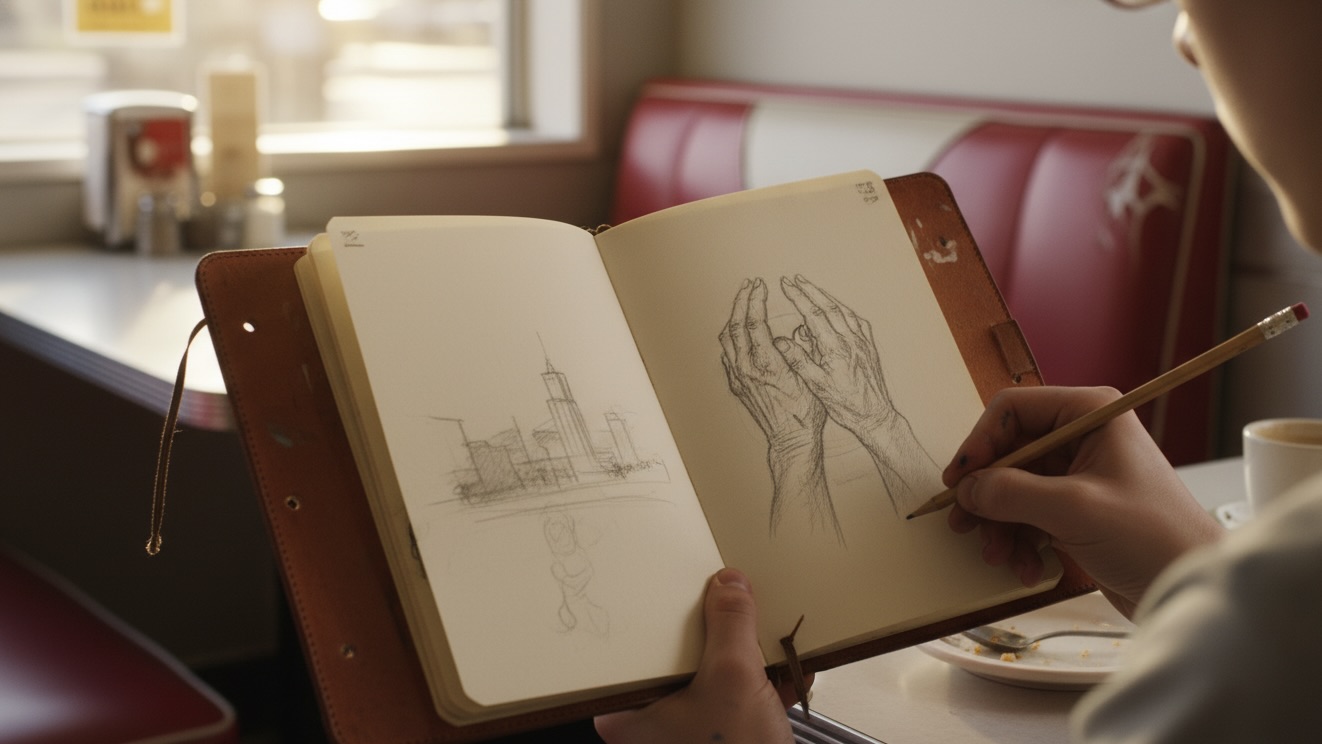
As Maria turned to fill the coffee pot, Jordan subtly unzipped his backpack, sliding out the sketchbook. His fingers brushed against the rough paper. He picked up his pencil, a well-chewed 2B, and began to sketch lightly, almost imperceptibly, on a fresh page. He watched her as she poured coffee for the old timers, her hands moving with an practiced grace, the mug clinking against the saucer. He noted the way her fingers curled around the ceramic, the subtle tremor as she walked, the slight swelling around her knuckles. Her hands were a map, a story of decades of carrying trays, wiping counters, pouring coffee. They were strong, but clearly exhausted, a testament to endless hours on her feet.
He started with the basic shape, the angle of her wrist, the way her palm curved. Then, the fingers, the little dips and ridges of skin, the slightly stained nails. He focused, tuning out the low chatter of the diner, the clinking of plates, the hum of the fridge. For a few moments, the world narrowed to the white page and Maria's hands, moving through the hazy light. He saw the faint purple bruise near her thumb, the small scar on her index finger, probably from a dropped plate years ago. These details, tiny and easily missed, were everything to him. They were the truth.
The grilled cheese arrived, smelling vaguely of burnt butter and cheddar. Maria set it down with a soft thump, her hand briefly resting on the edge of the plate. He caught the fleeting movement, the subtle spread of her fingers, the way the skin stretched taut before she pulled away. He thanked her, a quiet mumble she barely registered. She just nodded again, already halfway to the next table, wiping it down with a damp cloth. Her hands were never still.
He ate slowly, watching her. Sketching between bites. The light from the window, weak as it was, caught the fine hairs on her forearm, the faint wrinkles at her wrist. It was a portrait of labor, of dedication, of a life lived out in the service of others, unnoticed. He felt a profound sense of sadness watching her, watching the town through her hands. He wasn't just drawing; he was documenting. Documenting the slow, relentless erosion of a community, of a spirit, one tired hand at a time. And he knew, with a certainty that settled cold in his stomach, that he was utterly powerless to stop it.
And he knew, with a certainty that settled cold in his stomach, that he was utterly powerless to stop it.
Share This Story


