The Feedback Loop
A group of teenagers and a researcher gather in an aging community center during an autumn evening to discuss a new project.
The noise wasn’t coming from the speakers. It was coming from the walls. A low, vibrating hum, like a giant bee trapped in the drywall, or maybe the ghost of a radio signal from 1994 refusing to die. I stared at the radiator. It rattled against the baseboard, a frantic, metallic shivering that didn’t match the rhythm of the hum. The air in the rec center tasted like burnt dust and floor wax.
"It’s the wiring," Sam said. She didn't look up from her phone. Her thumb scrolled with a rhythmic, hypnotic precision. Swipe. Swipe. Pause. Swipe. "Building’s old. It’s got dementia."
"Buildings don't get dementia," Leo muttered. He was slouched so low in his plastic chair he was practically horizontal, his hoodie pulled up over a toque, creating a double layer of fabric armor against the world. He was chewing on the plastic aglet of his hoodie string. It was a nervous habit. I watched him gnaw on it. "It’s just settling. Thermal expansion. It’s cold outside."
It was cold. That aggressive, biting autumn cold that hits Northwestern Ontario in October and doesn't let go until May. The windows were single-pane and warped; outside, the spruce trees were black jagged shapes against a sky that looked like a bruised plum. Purple, grey, sinking into night.
Sarah, the researcher from the university—or the 'facilitator,' as the grant paperwork called her—tapped the whiteboard marker against the easel. Click. Click. Click. The sound was sharp, piercing the low hum.
"Okay," she said. She looked tired. Not sleepy-tired, but soul-tired. The kind of tired you get from driving six hours on a two-lane highway dodging moose just to talk to a bunch of bored teenagers. "Let's focus. The hum is... atmospheric. Let's use it. We were talking about 'capacity building.' Who remembers what that actually means?"
Silence. Absolute, heavy silence. The radiator clanked again. A moth, fat and dusty, threw itself against the overhead fluorescent light, a tiny kamikaze pilot.
I looked at the words on the whiteboard. YPAR. Participatory. Capacity. Arts-Based. They looked like spell components for a ritual none of us knew how to perform. They felt heavy. abstract. Words that belonged in offices with ergonomic chairs, not here, in a room where the floor tiles were peeling up at the corners like sunburned skin.
"Building... space?" I offered. My voice cracked. Classic. I cleared my throat, feeling the heat rise up my neck. "Like, making room for stuff?"
Sarah capped the marker. "Sort of, Jordan. It’s not just physical space. It’s... muscle. Think of the community as a body. Right now, maybe the arts sector is a bit atrophied. Capacity building is the workout. It’s giving people the skills and the tools to do the heavy lifting themselves, so they don't need someone from the city to come do it for them."
"So we're personal trainers," Sam said. Deadpan. She finally looked up. Her eyeliner was sharp enough to cut glass. "For art."
"In a way," Sarah smiled. It was a tentative smile, like she wasn't sure if Sam was mocking her. Sam was definitely mocking her. "We're using YPAR. Youth Participatory Action Research. That means you guys are the experts. I’m just here to hold the clipboard. You know this town. You know what's missing."
Leo stopped chewing his hoodie string. "Everything," he said. "Everything is missing."
The lights flickered. A sudden, violent strobe effect that turned the room into a jerky stop-motion film. For a second, the whiteboard seemed to jump three feet to the left. The hum in the walls spiked to a high-pitched squeal, then dropped back down to a growl. The smell of copper—hot, electrified copper—hit my nose.
"Whoa," I said.
"Haunted," Sam whispered. She wasn't scrolling anymore.
"Just a surge," Sarah said, but she looked at the light fixture with suspicion. "Okay. Everything is missing. That's a start. That's data. If we're going to support the arts here, we need to know what arts? Who is making things? Who is hiding in their basement painting Warhammer figures because there's nowhere to display them?"
I thought about my sketchbook. It was shoved deep in my backpack, under a crushed gym strip and a bag of dill pickle chips. I drew hands. Just hands. Gnarly, old hands, baby hands, hands holding cigarettes, hands gripping steering wheels. I didn't tell people. It felt... weird. Private. In a town this small, privacy was the only luxury.
"My uncle welds," Leo said. He sat up a little. "Makes these... giant birds. Out of scrap metal from the mine. He puts them in the backyard. Neighbors complain. Say it looks like a junk heap."
"That's art," Sarah said. She wrote Scrap Metal Birds on the board. The marker squeaked. "Why do the neighbors complain?"
"'Cause it’s ugly," Leo shrugged. "And the birds look... angry. Like they're gonna attack."
"Angry art," Sam mused. "I like it."
"This is what YPAR is," Sarah said, gesturing with the marker. "We don't just say 'there is no art.' We investigate. We ask: Why is the art hidden? Why is it angry? How do we build the capacity for your uncle to show those birds somewhere where they aren't considered junk?"
The concept started to settle in my brain, heavy and weird. It wasn't about school. It wasn't about getting a grade. It was about digging. We were archaeologists of the present.
"So we... interview him?" I asked.
"We could," Sarah said. "Or we could do something else. Photovoice. Mapping. We could give cameras to ten people and say, 'take a picture of what keeps you here.' Or 'take a picture of what makes you want to leave.'"
The radiator gave a final, resounding CLANG, loud enough that we all jumped. Then, silence. The hum stopped. The room felt suddenly very empty.
"Break," Sarah announced, checking her watch. "Ten minutes. My brain is melting."
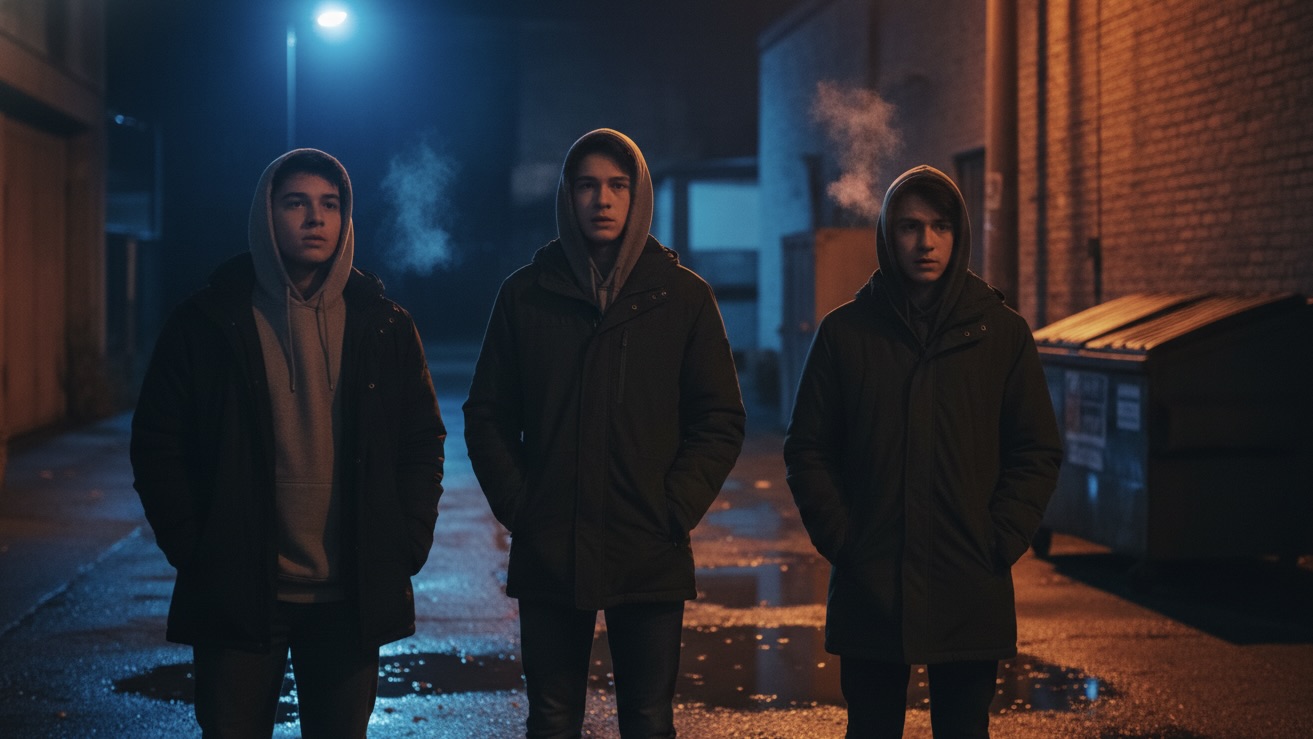
We shuffled out the side door, into the alleyway behind the center. The cold hit us like a physical slap. It was crisp, smelling of woodsmoke and wet asphalt. The gravel crunched under our sneakers—a loud, gritty sound in the quiet town.
The sky was insane. That’s the only word for it. It was a deep, velvety navy, and the stars were so bright they looked aggressive. The Milky Way was a smear of spilled milk across the dark. In the city, the sky is just a backdrop. Here, it’s a ceiling that’s pressing down on you.
Sam leaned against the brick wall, her breath pluming out in white clouds. She fished a pack of gum from her pocket. "You buyin' this?" she asked.
"The gum?" I asked.
"The project. The 'capacity building.'"
I kicked a loose stone. It skittered across the pavement and hit a rusted dumpster. "I don't know. Maybe. Beats sitting at home playing COD."
Leo was staring at a puddle. The streetlamp reflected in it, an orange, oily circle. "It's better than nothing," he said quietly. "My uncle... he really likes those birds. He spends all weekend welding. Sparks flying everywhere. He looks... happy when he does it. But then he covers them up with tarps."
"Why?" Sam asked.
"Bylaw," Leo said. "Town says it's an eyesore."
"That's stupid," I said. The anger flared up, quick and hot. "It's his yard."
"That's the research question," I heard myself say. It sounded weird coming out of my mouth. Adult. "Bylaws vs. Art. Who gets to decide what's ugly?"
Sam looked at me. Her eyes narrowed, assessing. "Okay, Professor. Calm down."
"No, seriously," I said. I felt a weird energy, a buzzing in my chest that matched the earlier hum in the walls. "If we're supposed to be researchers, isn't that what we do? We find the friction. Sarah said to find the friction."
"She said 'find the gaps,'" Sam corrected.
"Same thing." I looked up at the stars again. A satellite tracked slowly across the constellation Cassiopeia. A man-made star watching us. "If we can prove that people want to see the birds... maybe the town changes the bylaw. That's capacity building, right? Changing the rules so the art can breathe."
Leo looked up from the puddle. "Maybe." He pulled his hands out of his hoodie pocket. "I could take pictures. Of the birds. With the tarps on. And then with them off. Like... a reveal."
"Before and after," Sam nodded. "Dramatic. I can record the sound. The welding. The sparks. It’s loud. Industrial. Make people hear it."
The door to the center creaked open. Sarah stuck her head out. "Freezing out here. You guys coming back or did you run away to the circus?"
"We're plotting," Sam said.
"Good," Sarah said. "Plotting is the first step of methodology."
We went back inside. The warmth of the room felt suffocating for a second, then comforting. The smell of floor wax was still there, but now it smelled like... potential. Like a school gym before the big game.
We sat back down. The circle of chairs felt tighter this time. Less defensive.
"Okay," Sarah said, rubbing her hands together. "Phase two. Methods. How do we gather this knowledge without boring everyone to death?"
"Photos," Leo said immediately. "And sound. We want to do a... sensory map. Of the hidden stuff."
Sarah raised her eyebrows. She wrote Sensory Map on the board. "Tell me more."
"The stuff people hide," I said. I was leaning forward now, elbows on my knees. "Like Leo's uncle's birds. Or the garage bands that play on Tuesday nights three streets over. Or..." I hesitated. "Or my drawings."
Sam looked at me. "You draw?"
"Yeah," I said. "Hands."
"Weirdo," she said, but there was no bite in it. She was smiling.
"We map the hidden creativity," I continued, the idea unspooling in my head like a reel of film. "And we ask the question: What is stopping this from being public? Is it money? Is it laws? Is it just... fear?"
"Fear is a big variable," Sarah noted, scribbling furiously. "Fear of judgment. Fear of failure. Imposter syndrome. That's huge in rural communities. We think 'real' art happens in Toronto or Vancouver. We think we're just... practicing."
"We're not practicing," Leo said. His voice was hard. "My uncle isn't practicing. He's making."
The projector glitch happened again. This time, the image on the screen—a generic PowerPoint slide about 'Outcomes'—warped. The blue background bled into a deep, sickly purple. The text melted, dripping down the screen like digital rain. Then, for a split second, a shape formed in the static. It looked like a bird. A jagged, metal bird.
"Did you see that?" I asked.
"See what?" Sarah asked, turning around. The screen was back to normal. Blue. Boring. Outcomes.
"Nothing," I lied. But I looked at Leo. He was staring at the screen, his eyes wide. He had seen it too.
"So," Sarah said, unaware of the glitch in the matrix. "We have a research question. We have a method. We need a timeline. This is participatory research. That means you guys drive the bus. I'm just the mechanic. When do we start?"
"Tomorrow," Sam said. "After school. I'll bring my recorder."
"I'll bring my camera," Leo said.
"I'll bring... my sketchbook," I said.
Sarah looked at us. She looked proud, which was weirdly embarrassing but also kind of nice. "Okay. Tomorrow. We meet here. We start mapping. This is capacity building, folks. It starts with a conversation, and it ends with... well, we don't know yet. That's the point."
We packed up. The ritual of zippering backpacks, putting on coats, wrapping scarves. It felt different than the end of a school day. School was something that happened to you. This was something we were happening to.
We walked out into the night together. The town was asleep. The streetlights buzzed with that same orange frequency as the puddle. Main Street was empty, just a row of dark windows. The hardware store. The diner. The empty lot where the old cinema used to be.
"It looks dead," Sam said, her breath fogging.
"It's sleeping," Leo corrected.
I looked at the empty lot. Weeds were growing through the cracks in the pavement. There was a chain-link fence around it. A sign said FUTURE DEVELOPMENT. It had been there for five years.
"We could put the birds there," I said. I pointed. "In the lot. A sculpture garden. Guerilla art."
"Illegal," Sam said.
"Participatory," I countered.
Leo laughed. A real laugh, rusty and unused. "Participatory trespassing."
"We'd have to document it," Sam said. "For the research."
"obviously," I said.
We stood there for a minute, three teenagers on the edge of a small town that felt like the edge of the world. The cold was seeping through my jacket, numbing my fingers, but my brain was on fire. I could see it. I could see the metal birds rising out of the weeds. I could see photos plastered on the brick walls of the alley. I could hear the music from the garages playing over the PA system.
"See you tomorrow?" I asked.
"Yeah," Leo said. He adjusted his toque. "Tomorrow."
Sam popped a bubble of gum. Snap. "Don't be late, weirdo."
They turned and walked down the street, their footsteps fading into the dark. I stood there for a second longer, listening. The wind rattled the chain-link fence. Clink. Clink. Clink. It sounded like a beat. Like a rhythm waiting for a melody.
I turned and walked the other way, towards home. The town didn't feel so small anymore. It felt like a puzzle we were just starting to solve. And for the first time in a long time, I didn't want to leave. I wanted to see what happened next.
The streetlights seemed to bow as I passed, shedding their orange cones of light like spotlights on a stage. I pulled my sketchbook out of my bag as I walked, risking the frostbite. I opened it to a blank page. I didn't draw a hand this time. I drew a jagged line. A frequency. A bird made of static.
The research had begun.
I opened it to a blank page. I didn't draw a hand this time. I drew a jagged line. A frequency. A bird made of static.
Share This Story


