The Hum of a Crowded Room
A town hall meeting, usually sparse and tense, is unexpectedly packed. A large screen dominates the stage. The air crackles with anticipation and a hopeful, nervous energy as Leo, Sam, and Jordan prepare to present their project.
The folding chairs scraped across the linoleum, a low, nervous rumble. It wasn’t a full house, not exactly, but it was far more than the usual fifteen or twenty stalwarts who came to argue about potholes and zoning permits. Every seat was taken, most of the standing room around the edges of the Sprucewood Community Hall was filled, too. People stood with arms crossed, leaning against the peeling paint of the walls, or shifted from foot to foot near the double doors, a murmur passing through them like a ripple through tall grass.
Jordan clutched the rough edges of her notes, the paper damp with sweat. Her stomach churned. It felt like standing on the edge of a cliff, the kind that dropped straight down into the cold ocean below. This wasn't a school presentation; it was… something else. Bigger. The projector hummed behind them, a soft, mechanical breath in the tense quiet. The large white screen on the stage glowed with a 'Welcome to Sprucewood' graphic, the town's logo a quaint, slightly off-kilter pine tree.
Beside her, Leo wiped his palms on his jeans. He hadn't said much all day, just kept checking the slideshow, adjusting the focus on the projector, a nervous tic. His camera, the one he’d held like an extension of his own arm for months, lay on the small table next to him, a silent sentinel. Sam, on the other side, fiddled with the knobs on a small sound mixer. He had his headphones around his neck, the dark plastic looking heavy, almost like a collar. He looked pale, but there was a spark in his eyes, a kind of coiled energy that Jordan recognized from their late-night editing sessions.
"Okay," Jordan whispered, her voice rougher than she intended. She cleared her throat. "Okay, we got this." It was more for herself than for them. They exchanged quick, shaky nods. The stage lights, too bright and unforgiving, seemed to pick out every dust motes dancing in the air, making the space feel both cavernous and claustrophobic.
A hand settled on Jordan's shoulder. Al. He gave her a firm, reassuring squeeze, his rough palm a grounding weight. He looked different tonight. Less guarded. He’d even shaved, a fresh line along his jaw. He didn’t say anything, just offered a small, almost imperceptible smile, then moved back to his seat in the front row, next to old Ms. Petrie, who peered over the rim of her spectacles with an expression of unwavering curiosity. The quiet hum in the room intensified, a collective holding of breath.
Jordan stepped forward, towards the single microphone, feeling the floorboards creak under her worn sneakers. She looked out at the faces, a sea of them. Neighbors. Teachers. Council members. People who usually only saw her as 'that kid from the old Mill Street house' or 'one of the project kids.' She took a deep breath, the air smelling faintly of stale coffee and old wood polish. "Good evening, everyone," she began, her voice wavering slightly, then gaining strength. "My name is Jordan. These are my friends, Leo and Sam."
A few scattered claps. Mostly silence. They were waiting. They were always waiting in Sprucewood, for the next shoe to drop, the next bad news, the next reason to be cynical. Jordan took another breath. "We're here tonight to present our findings for the 'Sprucewood Ecological Survey,' a project we undertook over the last several months. But it's not just a report. It's… a story."
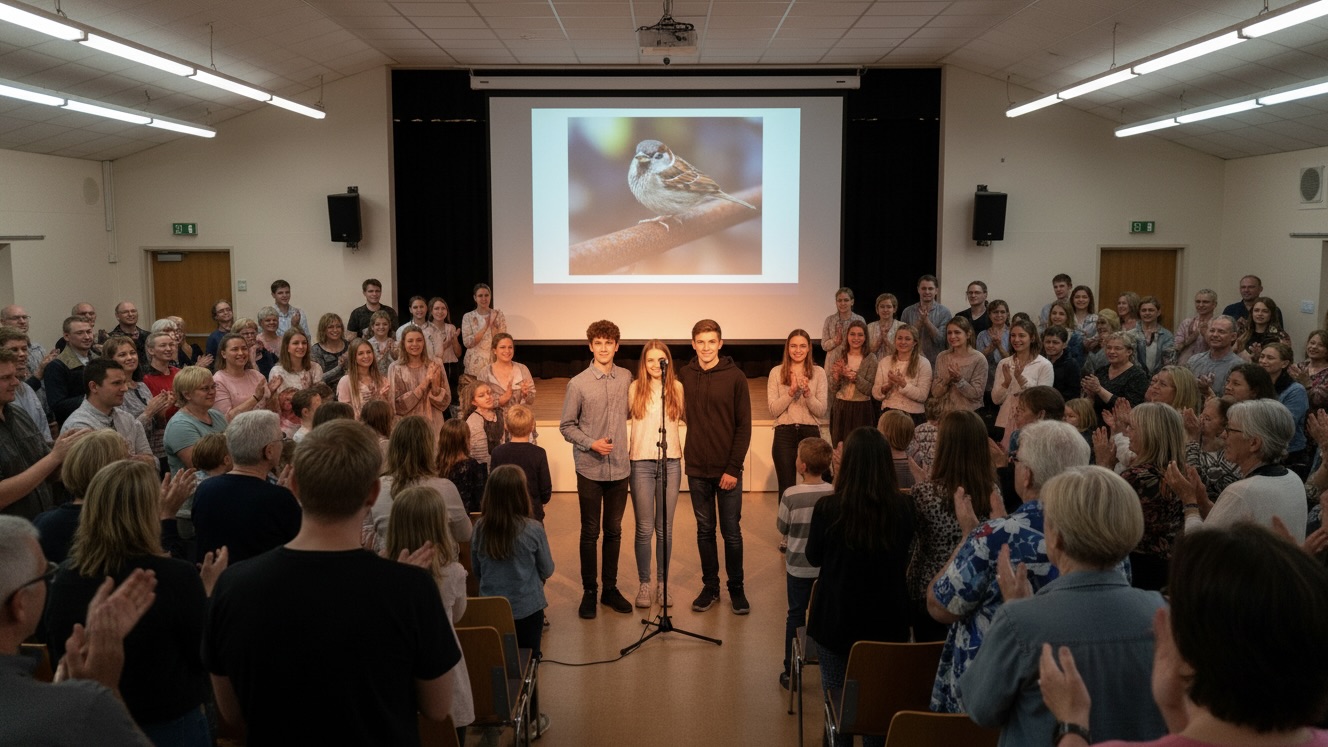
Leo hit the remote. The 'Welcome' screen vanished, replaced by an image so sudden, so stark, it drew a collective gasp from the audience. It was a close-up, pin-sharp, of a sparrow, a common house sparrow, but captured in a way that made it anything but common. Its eye, a tiny bead of obsidian, held a fierce, intelligent glint. The individual barbs of its feathers were visible, each one a testament to delicate, intricate life. It was perched on a piece of twisted metal, a relic from the old mill, its tiny claws gripping tight, a splash of brilliant green moss clinging to the rust-colored surface around its feet. The bird’s beak was open, mid-chirp, a silent cry projected onto the wall.
The room went utterly still. You could hear the faint drone of the projector, the whir of the old ceiling fan. Leo, encouraged by the silence, clicked again. Another bird. A robin, caught mid-flight, a single dewdrop reflecting on a feather near its wingtip. Then a blue jay, its electric blue crest startling against a background of dull winter branches. A cedar waxwing, its soft, masked face tilted as if listening, a crimson berry clutched in its beak. Each photo was a tiny universe, a moment of profound observation, rendered with a clarity that made the birds feel alive, almost breathing on the screen. Leo's work was astonishing. It wasn’t just pretty pictures; it was a revelation.
Jordan felt a surge of pride, a loosening in her chest. This was it. This was why they’d climbed fences, navigated tangled undergrowth, risked getting caught. To show this. To make people see. As Leo continued to cycle through the images, a few whispered comments started, then faded into appreciative murmurs. People leaned forward, some pointing out birds they recognized. The usual defenses and dismissals seemed to melt away under the weight of such simple, undeniable beauty.
Then, Sam nodded to Jordan. His cue. Leo faded out the last photo, and a new dimension flooded the room. Sam’s soundscape began. It wasn't just bird calls; it was an immersive tapestry of Sprucewood itself. The gentle rustle of leaves, the distant gurgle of the creek, the barely-there whisper of wind through pine needles. Then, layered in, the distinct, varied calls of sparrows, chickadees, finches, jays – a chorus of tiny, vibrant voices. Sam had captured the very pulse of the woods behind the old mill, the secret symphony that played out every day, unheard by most.
He’d mixed in the low hum of the mill’s abandoned machinery, too, just a ghost of a sound, a faint metallic groaning beneath the birdsong, a reminder of what once was, and what now was in quiet decay. It was expertly done, subtly shifting from foreground to background, enveloping the listeners. Jordan closed her eyes for a moment, letting the sounds wash over her. It was like standing in the heart of Sprucewood, feeling the damp earth, smelling the rich loam and decaying leaves, even here in the stuffy hall. People shifted in their chairs, some looking around, as if trying to locate the source of the hidden birds.
The soundscape ended, fading out slowly, leaving a stillness that felt heavier, more resonant than before. The room felt different. Quieter, but alive. Jordan stepped back to the microphone. "For weeks," she said, her voice softer now, more confident, "we heard the stories. The town planning meetings. The debates about the old mill site. The idea that nothing lived there anymore. That it was just… unused space. Uninhabited."
She paused, letting the implication hang in the air. "We found out that wasn't true. We found a whole world. A thriving, vital ecosystem, all around us. A world that Sprucewood, as a community, wasn't seeing. And we realized, to make you see it, we had to show you."
Now, a new slide appeared on the screen. Not Leo's professional shots, but something else entirely. Grainy, sometimes off-kilter, occasionally out of focus. Photos taken by the townspeople themselves. The disposable cameras they'd handed out weeks ago, an experiment, a quiet invitation. An older woman’s shaky hand holding a camera, framing a cluster of bright red berries. A child’s perspective, looking up at a squirrel chattering on a power line. A close-up of a spiderweb, each silk strand catching the morning light, strung between two rusted pieces of corrugated iron.
There was a shot of a family of geese waddling across a muddy path, oblivious to a discarded tire nearby. A bird bath, cracked and green with moss, reflecting a slice of sky. The photos were imperfect, raw, human. They weren't art, not in the classical sense, but they were deeply felt, deeply observed. They were the town's own eyes, finally turning to look. Jordan saw Ms. Petrie dab at her eyes with a tissue, a small smile playing on her lips. A burly man with a baseball cap, who usually grumbled about anything new, nodded slowly, thoughtfully.
"These are your photos," Jordan continued, her voice filled with a quiet strength. "The ones you took. The little moments you noticed. The life you found, hiding in plain sight. We didn't just find birds; we found… connection. To the land, yes, but also to each other. To the parts of Sprucewood we’d all forgotten to look at."
She gripped the podium, her knuckles white. "We know we trespassed. We know we went where we weren't supposed to go." A few uneasy shifts in the audience. "But sometimes," she pushed on, her voice rising, "to start a conversation, to see what's truly there, you have to step outside the lines. You have to participate. We called it 'participatory trespassing.' It was an act of urgency. Because the conversations about the old mill, about our future, were happening without acknowledging the full story of this place. Without acknowledging the quiet, persistent life that insisted on flourishing there."
She met the gaze of a council member in the second row, a man known for his rigid adherence to rules. He didn't look angry. He looked… considering. The hope in Jordan’s chest swelled. They weren’t shouting at them. They were listening. Really listening. This wasn't just about birds anymore; it was about the overlooked. The voiceless. The possibility of something better.
"Sprucewood," Jordan said, her voice clear and strong now, cutting through the last vestiges of cynicism, "is more than just a place on a map. It’s a living thing. And it’s dreaming. And if we listen, truly listen, it has so much to tell us about ourselves, about what we value, about the kind of home we want to build."
She stepped back, breathless. The room erupted, not in applause, but in a wave of murmuring, a collective processing. People were talking, gesturing, pointing at the photos still cycling on the screen. It was a buzzing, a vibrant, active sound, unlike the polite, reserved quiet they'd started with.
Then, Al stood. The movement was slow, deliberate. He walked to the microphone, his hands shoved deep into his pockets. He looked out at the faces, a rare vulnerability etched into his usually stoic features. The noise in the room died down, a ripple effect. Everyone knew Al. The quiet artist. The 'weird' one who lived by the mill, always sketching, always observing.
He cleared his throat, a dry rasp. "Uh… I’m Al," he said, and a few people chuckled, a nervous, kind sound. "These kids… they, uh… they opened my eyes. To a lot of things. I’ve always… well, I’ve always painted the birds. They’re my subjects. My… company, I guess." His gaze drifted to the screen, where a particularly vibrant shot of a goldfinch had just appeared.
"But I never… I never really thought about what they meant to everyone else. Or if anyone else even cared. I just… did my thing." He shifted his weight, looking down at his worn boots. "Jordan, Leo, Sam. They made me see that it’s not just my thing. It’s… it's all of our thing. This place. These birds. The quiet life that keeps going, even when we forget to look."
He paused, swallowing hard. "My paintings… I always thought they were just for me. Little glimpses of something nobody else would ever notice. But watching these photos… hearing those sounds… and seeing all of you here, tonight…" He looked up, his eyes shining, not with tears, but with something bright and fierce, a light that had been hidden for years. "It’s not just for me anymore. It’s… it’s for Sprucewood. It’s for all of us. To remember what we have. To remember what we could lose, if we don’t pay attention."
He gave a small, awkward nod, a gesture of profound gratitude and raw emotion, and stepped away from the microphone. The applause started then, not polite, scattered claps, but a genuine, heartfelt roar. It was a cacophony of appreciation, an acknowledgment of his honesty, of his art, of the hidden stories he’d told all these years. People stood, cheering, some wiping their own eyes. Ms. Petrie, utterly overcome, threw her hands up, shouting something Jordan couldn't quite hear over the din.
The council members, the skeptical ones, were on their feet too, clapped along. The transformation was complete. It wasn’t a project report anymore; it was a revival. A town, stirred from its own long sleep, finally listening to the insistent, beautiful frequency of its own hidden heart. The sound of Sprucewood, dreaming, no longer a quiet hum in the forest, but a loud, clear, collective voice, vibrating through the community hall, promising a new dawn.
Leo looked at Jordan, a wide, relieved grin splitting his face. Sam bumped her shoulder, a silent testament to their shared triumph. The feeling that settled over Jordan wasn’t just relief, but a deep, resonant sense of hope. The metal bird had done its job. It had opened eyes, and ears, and hearts. And the conversations, real ones this time, were finally beginning.
The metal bird had done its job. It had opened eyes, and ears, and hearts. And the conversations, real ones this time, were finally beginning.
Share This Story


