A Different Kind of Resonance
The town council meeting, thick with unspoken tension, gives way to a cautious, incremental shift. Later, weeks pass, and the municipal recreation center, once a space of restless anonymity, transforms into a hub of quiet, focused creativity for Jordan, Sam, and Leo.
The air in the council chambers still held a faint, lingering tang of stale coffee and desperation, but something else had been stitched into it, something sharp and insistent. It wasn’t a roar that had brought them all here, not truly, but a chorus of smaller, insistent chirps. The metal bird had done its job. It had opened eyes, and ears, and hearts. And the conversations, real ones this time, were finally beginning.
Councilor Albright, his face a rumpled map of civic exhaustion, tapped a pen against the scarred oak table. He cleared his throat, a dry rasp that seemed to echo the general discomfort in the room. The faces arrayed before him—a few familiar, mostly new—were not the usual faces. Not just the usual petitioners or the usual gripers. These faces held a different kind of expectation, a quiet, almost fierce demand for something… more. They had seen the bird. They had heard the recordings. They had listened, truly listened, to the stories.
“Alright,” Albright said, his gaze sweeping over the assembled townspeople, a nervous tic working at the corner of his eye. He adjusted his tie, the knot suddenly feeling too tight. “We’ve heard… a great deal of input regarding the vacant lot on Elm Street.” He paused, waiting for the expected murmurs of agreement, or dissent. Instead, there was just a heavy, expectant silence. It was unnerving, this united front. Usually, someone would be interjecting, arguing. This time, they just waited.
He continued, a little quicker now. “We understand the… public interest… in utilizing this space for community engagement. The proposal for a temporary public sculpture park, with Mr. Alistair’s… creations… as the inaugural installation, has been reviewed.” He avoided saying ‘birds,’ as if the word itself might summon more unexpected, unruly things. He kept a deliberate, neutral tone, the sort of voice one uses when addressing a potentially volatile situation.
A few people shifted in their seats. Jordan, tucked into the back row between Sam and Leo, felt a slight tremor run through her. This wasn’t a victory yet, not really. It was just the opening of a door, a hesitant crack in the rigid façade of bureaucracy. She watched Albright’s fingers tap, tap, tap, a rhythm that belied the stillness of his expression. He was buying time, she knew. Measuring the room. Deciding how much to give.
“The logistics,” another councilor, a stern woman named Davies, interjected, her voice sharp and precise, “are… considerable. Site preparation, insurance, liability… these are not minor concerns. And the existing bylaw regarding permanent installations in public spaces remains in effect.” Her eyes, cool and assessing, swept over the younger faces in the crowd, landing briefly on Jordan, Sam, and Leo. She was reminding them of the rules, the immovable bedrock beneath their fleeting enthusiasm.
But the tide had turned. Too many people had seen the photos. Heard the audio. Read the articles. The hum had been exposed, not as a technical glitch, but as a symptom. And the metal birds, so stark and beautiful and present, had given voice to the unarticulated longing for something different, something vibrant. A quiet man in the third row, a retired carpenter, stood up slowly. He didn't speak, just stood, his presence a silent, undeniable weight.
Albright sighed. “However,” he said, the word a small concession, a pebble loosened from a dam, “in light of the… overwhelming public sentiment, and given the temporary nature of the proposed installation, the council has agreed to designate the vacant lot on Elm Street as a temporary public sculpture park.” A collective intake of breath in the room. Then, a scattering of hesitant applause, quickly hushed, as if no one quite believed what they were hearing.
“For an initial period of six months,” Davies added, firming up the edges of the concession, “after which the designation will be subject to further review. And as for the bylaw…” she paused, adjusting her spectacles, “the council will form an ad hoc committee to re-examine the existing ordinance regarding public art and community spaces. This committee will include council members and, importantly, representatives from the public.”
It wasn’t a revolution. The bylaw wasn't overturned. It was a compromise, a grudging nod to the collective will. But it was real. A committee. Public representation. A temporary space. Small, almost imperceptible shifts, like the tectonic plates of their quiet town grinding against each other, slow but undeniably moving. Jordan nudged Sam, a silent, almost disbelieving smile breaking across her face. Sam’s eyes were wide, reflecting a mix of triumph and an awareness of the long road ahead.
They walked out into the cool evening air, the weight of the council chamber replaced by the vast, open sky. The streetlights buzzed, a familiar sound, but it no longer felt oppressive. It was just a sound. Jordan found herself looking at the architecture of the old buildings, the way the light caught the brickwork, the subtle decay, and for the first time, she saw possibility instead of just stagnation.
“A committee,” Leo said, shaking his head slightly, a small laugh escaping him. “Who knew a bunch of metal birds could do that?” He reached into his pocket, pulling out his phone, already envisioning angles, light, the faces of the people who would fill that empty lot.
“It wasn’t just the birds,” Sam countered, tucking a strand of hair behind her ear. “It was the noise. The silence. The conversation. Everything. It all… clicked.” She thought of the hours spent sifting through audio, the frustration, the breakthroughs. It wasn’t just about proving a point; it was about amplifying a truth.
The empty lot, usually a forgettable patch of weeds and cracked concrete, suddenly looked different. It wasn’t just empty anymore; it was expectant. The thought of Al's birds, grounded but poised for flight, taking their place there, made a warmth spread through Jordan’s chest. It was a small, fragile thing, this hope, but it was there, solid and undeniable.
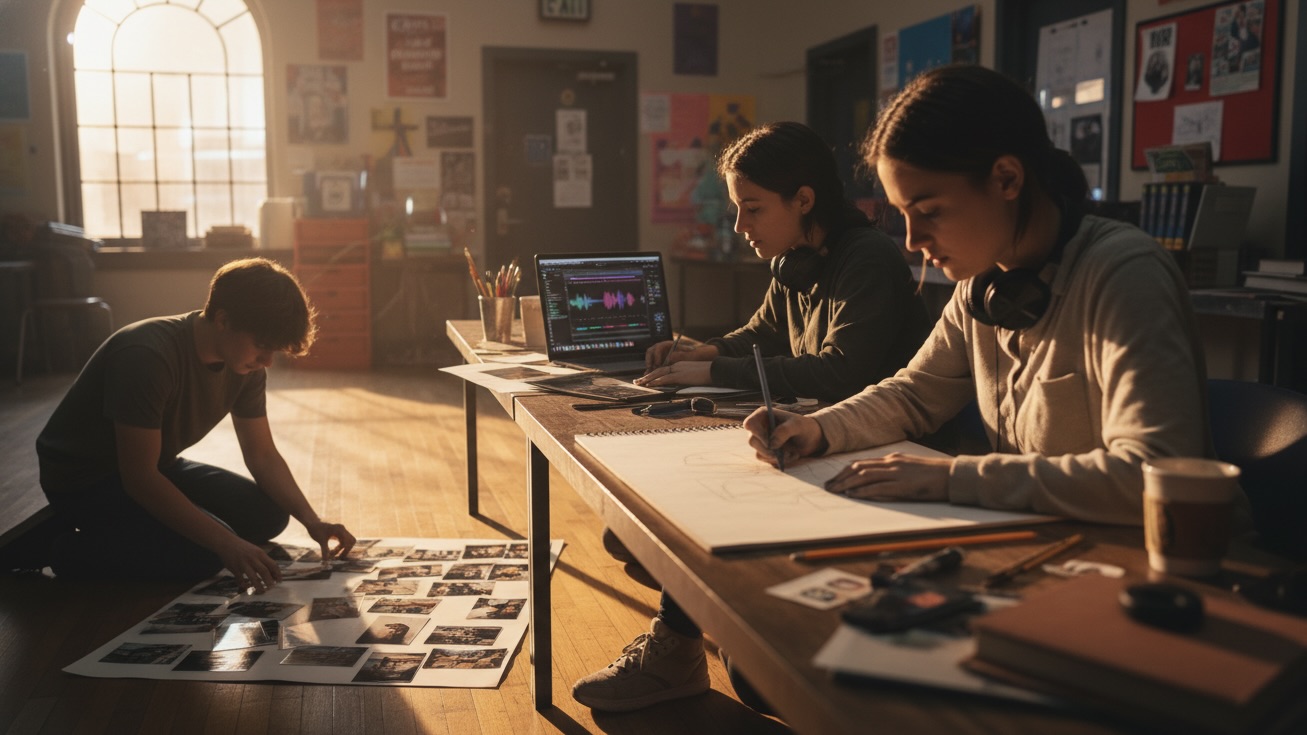
Weeks later. The hum in the rec center walls—that low, almost subliminal thrum that had always felt like a metaphor for the town’s latent discontent—was gone. Or maybe, Jordan thought, it was still there, but they just couldn't hear it anymore, drowned out by something louder, something more resonant. It was the quiet hum of their own creative work. The air smelled faintly of charcoal and something metallic, like fresh solder, a clean, sharp scent.
Jordan was hunched over a large sketchbook, the spine already soft from use. Her charcoal stick moved with an easy, practiced grace, dark lines emerging on the thick paper. She wasn’t sketching abstract shapes anymore, or figures from distant, imagined worlds. She was sketching the town. Not the sterile, postcard version, but the one she had come to see: the weathered faces in the market, the intricate patterns of rust on the old water tower, the shifting light on the sculpture park. Her fingers were smudged with black, a familiar comfort.
A fine dusting of charcoal coated her fingertips, clinging to the ridges of her nails. She blew gently at the page, sending a faint cloud of graphite dust swirling, then used the side of her hand to blend a shadow beneath a gnarled oak tree she was rendering, a specific oak in the corner of the new park. It wasn’t perfect, she knew. The proportions were a little off, the bark texture perhaps too aggressive. But it felt real. It felt like her vision of it, not just a copy.
She leaned back, stretching her neck, a small crick protesting the posture. The soft scratching of her charcoal, the rustle of the paper, these were the sounds that filled her space now. Not the distant, insistent drone of unknown frequencies. She used to draw to escape this town. Now, she drew to understand it, to capture it, to give it back a piece of itself she felt it had forgotten.
From across the table, Sam had her headphones on, her head nodding almost imperceptibly to a beat only she could hear. Her laptop screen glowed, a vibrant array of waveforms scrolling by, green peaks and troughs that danced to the rhythm of a local band she’d stumbled upon. 'The Junction Boys,' they called themselves. A bluesy, garage-rock sound, raw and full of the kind of energy she used to think this town lacked. She'd found them performing at a tiny open mic night, tucked away in the back of a renovated storefront near the old train tracks.
She tapped a key, adjusting a bass line, her fingers flying over the trackpad. The music, even muffled through her headphones, vibrated through the table, a low thrum that was entirely different from the old hum. This was intentional, joyful noise. She'd reached out to the band members after hearing their set, offered to clean up their demo tracks. They were hesitant at first, suspicious of her unsolicited help, but Sam’s quiet persistence, her clear passion for sound, had won them over.
Now, she spent hours meticulously carving out space in their raw recordings, making the drums punch harder, the vocals clearer, polishing the rough edges without losing the grit. It was a tedious process, demanding an almost surgical precision, but it was also deeply satisfying. She was taking something nascent, something true, and helping it find its voice. It wasn't just about technical skill; it was about listening, truly listening, to what the music wanted to be.
She pulled off her headphones, letting the sudden quiet wash over her. “Okay, that mix for ‘Freight Train Blues’ is almost there,” she announced, her voice a little louder than usual after being immersed in sound. She rubbed her temples. The soft scent of Jordan’s charcoal wafted over, grounding her.
Leo, meanwhile, was spread out on the floor, surrounded by an organized chaos of printed photographs. Glossy 8x10s and smaller 5x7s lay scattered on a large white poster board. He was planning the layout for his photo exhibit. Not just photos of Al’s birds, though they featured prominently, but pictures of the faces at the council meeting, the hands that had helped carry the metal components, the children’s eyes wide with wonder as the first bird was lifted into place. He even had a series of shots of the empty lot itself, before and after, capturing the subtle transformation of a neglected space into a place of potential.
He picked up a photo of an elderly woman, her face a web of laugh lines, carefully wiping dust from one of Al’s smaller sparrow pieces. The light in the photo was soft, almost reverent. He held it against the board, then swapped it for another: a wide-angle shot of the lot, mid-installation, a crane silhouetted against a bruised purple sky, two dozen people below, looking up, a sense of collective purpose in their stances. He was trying to tell a story, not just display images.
“What do you think?” Leo asked, without looking up, gesturing vaguely at his sprawling arrangement. “Should this one go here, or should I group all the installation shots together?” His brow was furrowed in concentration, a stray lock of hair falling into his eyes. He pushed it back, leaving a faint smudge of printer ink on his forehead.
Jordan set down her charcoal. “The one of Mrs. Henderson with the sparrow… that needs to be prominent,” she said, her voice thoughtful. “It’s got that… quiet strength.” She walked over, kneeling beside him, peering at the photos. “And I like how you’re mixing the close-ups with the wider shots. It gives it… texture.”
Sam walked over too, pulling up a chair, her headphones dangling around her neck like a heavy necklace. “Yeah, that’s good, Leo. Really shows the before-and-after, and the people in between.” She pointed to a photo of a group of kids, mid-laugh, painting a small wooden bench that would eventually go into the park. “This one. It’s got a good vibe.”
The three of them huddled together, heads close, talking over the arrangement, the sequence, the way the light would hit the prints. This was different from their initial frantic research, their clandestine meetings, their desperate attempts to expose something hidden. This was collaboration, open and acknowledged. This was building. Not just the park, but something within themselves, and within the town.
“I was thinking,” Leo murmured, tracing the outline of a print with his finger, “of calling the exhibit ‘Found Frequencies.’ Because it’s about what we found, you know? What was always here, but we just… weren’t tuned into it.” He glanced up at Jordan and Sam, a flicker of vulnerability in his eyes.
Jordan nodded slowly. “That’s good, Leo. It’s perfect.” She remembered the frustrating, almost painful search for the source of the hum, the way it had seemed to permeate everything. Now, the search felt different. They weren't hunting a problem; they were uncovering potential.
“And the band,” Sam added, a smile playing on her lips. “The Junction Boys. Turns out they’ve been playing in town for years, just… underground. Nobody really heard them. Now, with a little polish, they sound amazing. They’re getting gigs outside of town.” She had helped them set up their first bandcamp page, even designed a simple logo.
The old rec center, with its faded linoleum floors and scuffed walls, had been their refuge, their secret clubhouse. Now, it felt less like a hideout and more like a workshop. The table where they once spread out maps and theories was now covered with art supplies, recording equipment, and photographic proofs. The hum was gone. Not because it had disappeared, but because their own collective energy, their own creative frequencies, had simply become louder, richer, more vibrant.
They hadn’t escaped their town. That had been the initial impulse, for all of them, in their own ways. To get out, to find somewhere bigger, brighter, more… alive. But the journey of the metal birds, the quiet revelations it had brought, had shifted their perspective. They weren’t leaving. They were staying, and they were, slowly, incrementally, making it. They were remaking it, one sketch, one sound byte, one photograph at a time. The work wasn’t finished, not by a long shot. But it had begun, and that was everything.
Jordan picked up her charcoal again, a fresh sheet of paper laid before her. She started a new sketch, a figure of a sparrow, not in flight, but perched, solid and observant, on the branch of a blossoming tree. The details would come later. For now, it was enough to simply block out the form, to feel the familiar grit of the charcoal beneath her thumb, to know that this quiet, insistent act of creation was, in its own way, an act of faith.
The town still had its flaws, its small-mindedness, its inertia. It wasn’t a paradise. But it was theirs, and for the first time, they felt they had a voice in shaping it, a hand in painting its future. The conversations had indeed begun, and they were still unfolding, one soft, hopeful note at a time.
The conversations had indeed begun, and they were still unfolding, one soft, hopeful note at a time.
Share This Story


