The Winter Night's Burden
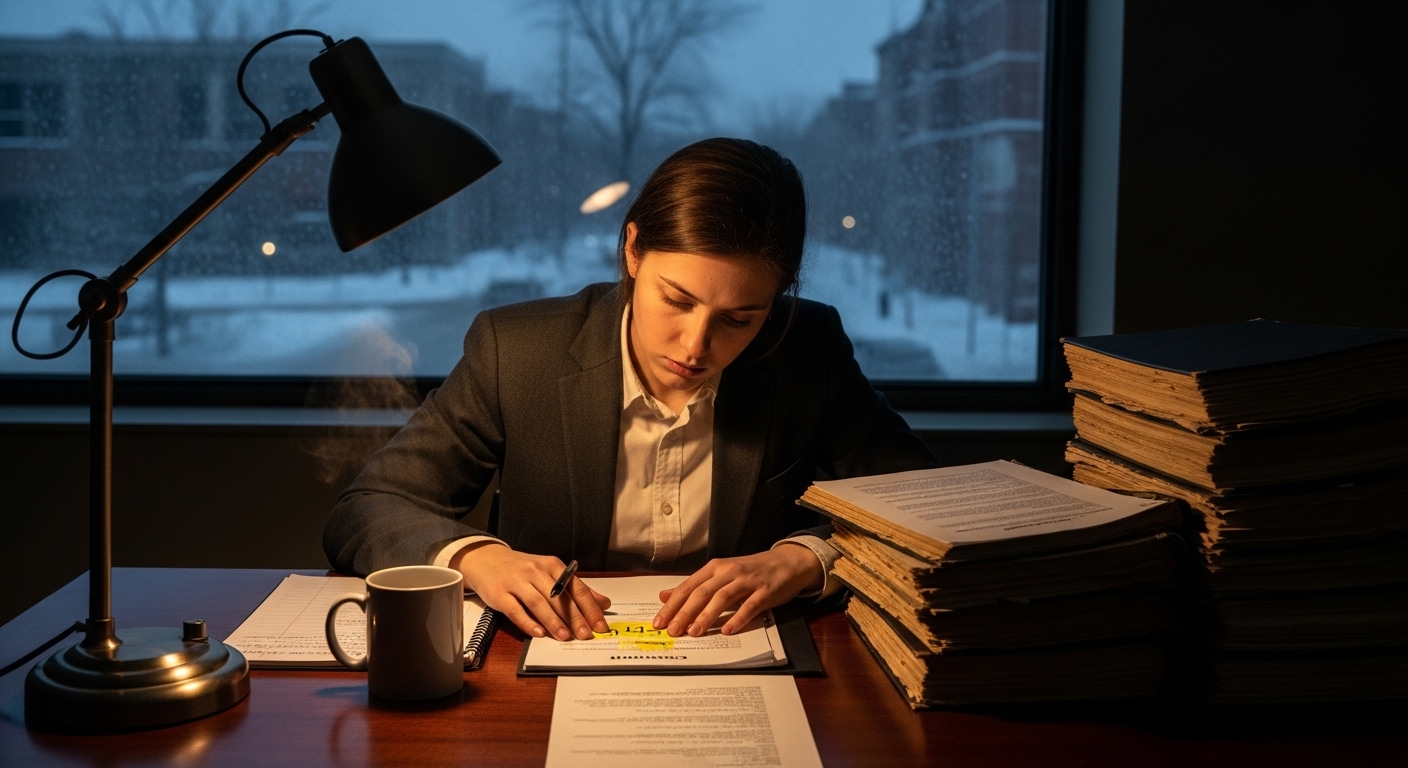
The old building creaked, a symphony of settling timbers and groaning pipes against the relentless winter wind. Outside, the city was a watercolour blur of grey and white, streetlights haloed by falling snow. Inside, the only light came from the pools cast by a brass desk lamp, illuminating the dust motes dancing in the frigid air and the mountainous stacks of legal briefs that dominated the mahogany surface. The faint smell of aged paper and something faintly metallic, like static electricity, hung heavy in the air. Each tick of the grandfather clock in the reception hall felt like a hammer blow against the silence, a stark reminder of the hour.
"Still here?" The voice, sharp but softened by the hour, cut through the quiet hum of the old building. I startled, my grip tightening on the mug, the cooling tea inside sloshing perilously close to the brim. The faint scent of stale coffee followed Mrs. Petersen into the room, clinging to her elegant, wool coat.
"Couldn't sleep," I managed, pushing a wayward strand of hair from my face. My eyes felt gritty, like they'd been rubbed with fine sand. The glow from the desk lamp felt harsh now, outlining the exhaustion beneath my skin. The snow outside intensified, a silent, white curtain against the city's muted glow.
She nodded, her gaze sweeping over the chaos of my desk: the teetering stacks of briefs, the half-eaten biscuit crumbs on a discarded napkin, the red ink annotations bleeding into the dense legal paragraphs. "Elliot's case, I presume." It wasn't a question.
"It's… difficult." The understatement hung in the air, thick with the unsaid weight of the government's pursuit. They wanted Elliot, wanted him bad. Not just imprisoned, but ruined, a public spectacle of betrayal. Treason, they called it. I called it a convenient narrative.
Mrs. Petersen sighed, a soft exhalation that fogged the chilled air for a moment. She moved to the window, her silhouette framed by the falling snow. "The Crown isn't playing fair, Jamie. They rarely do when national security is invoked. This isn't just a legal battle; it's a political one, too." Her voice was low, almost a whisper against the windowpane, the glass beaded with melting flakes.
"I know," I replied, my voice raspy. "But the evidence… it's so circumstantial. A pattern of communications, alleged meetings. Nothing concrete." I tapped a finger against a highlighted section of a transcript. It was a flimsy net, but woven by masters.
"Circumstantial can be enough when the narrative is damning," she said, turning from the window, her face shadowed. "Be careful. They're thorough. And they don't like losing." She paused, her gaze resting on me, a flicker of something I couldn't quite name – concern? warning? – in her usually unreadable eyes. "Go home, Jamie. You're no good to Elliot if you burn out." With a rustle of wool, she was gone, leaving behind only the lingering scent of coffee and the amplified silence.
---
I didn't go home. The idea of my quiet, empty flat, just a few blocks away, felt more suffocating than the mounting pressure of the case. The cold seeped into the old office, a tangible presence. I pulled my worn wool scarf tighter around my neck, the scratchy fibre a familiar comfort. It had been my father's. He’d worn it, even indoors, when he was absorbed in his work, back when his work wasn't a euphemism for something far darker and more dangerous. I remembered him, sat in his study, the air thick with the smell of pipe tobacco and old books, the same determined set to his jaw, the same tired slump to his shoulders.
He'd been an intelligence analyst. That's what he'd said. The careful, measured words he used to describe his day, the way he’d subtly shift the subject when I pressed, had always been part of the landscape of our life. Normal. Or what I thought was normal, until the call. The accident. The ice on the road. The official reports had been so neat, so concise, so utterly devoid of the jagged edges of grief that had ripped through me. I’d been nineteen. Too young to question, too raw to truly push. But now… now I had the tools. The lexicon. The bitter, gnawing certainty that things were rarely as clean as they appeared on paper.
I looked back at the briefs. Elliot, a former operative, accused of selling state secrets. My father, an analyst, dead in a car crash on an unusually clear winter day, months after his forced early retirement. The parallels, once dismissed as my traumatised imagination, were now beginning to gnaw at me, insistent and cold. The ink on the page seemed to shimmer under the lamp, an optical illusion born of fatigue.
---
The detention centre was a brutalist block of concrete and reinforced steel, a stark monument to security and isolation. The air inside hummed with a low, oppressive drone, a constant reminder of electronic surveillance. The guards, impassive and massive, wore no expressions. Every door clanged shut with a finality that echoed in the marrow of my bones. It was colder inside than out, despite the roaring central heating, a coldness of spirit.
Elliot sat across from me in the sterile interview room, his hands clasped on the polished table, knuckles white. He was older than me, but not by much, maybe early thirties. His face was a roadmap of weariness, but his eyes, sharp and unwavering, held a defiance that the state couldn’t quite extinguish. He was wearing a drab grey jumpsuit. The room smelled faintly of disinfectant and despair.
"They offered a deal," I said, my voice deliberately flat. "Reduced sentence. Testify against… others. If you give them something substantial."
He offered a humourless smile, a slight crinkle at the corners of his eyes. "Substantial? They have nothing substantial themselves, only conjecture. What could I offer that wouldn't be a lie?"
"They want a scapegoat, Elliot. Someone to blame for the intelligence failures," I pushed, leaning forward slightly, my elbows on the cold table. "Tell me something I can use. Anything. Your alleged contact, the one who supposedly leaked the files – who is he?"
His eyes, however, didn't meet mine. They drifted to the wall, to a faint, almost invisible scuff mark. "The contact… he liked winter. Said it kept the mind clear. Said it was the best time for… calculations." He paused, a strange, distant look in his eyes. "He knew your father, Jamie. Briefly."
The air caught in my throat. I hadn't expected it. The casualness of the revelation was a punch to the gut. "My father? How? He was… retired. Before all of this." I tried to keep my voice even, professional, but the tremor was undeniable.
Elliot finally looked at me, a flicker of something, perhaps pity, in his gaze. "He saw things. Heard things. Too much, perhaps. Like a ghost in the machine. Your father… he was a good man. Too good for that life." He leaned back, the plastic chair groaning under his weight. "They never forget, Jamie. Those who see too much. They just… let them fade. Or they help them along."
The implication hung heavy, thick and viscous, coating my tongue. My father’s accident. The neatness of the report. The way the subject was always so swiftly closed. I felt a cold dread unfurl in my stomach, not from Elliot’s words alone, but from the echoes they stirred of my own nascent suspicions.
---
Back in the office, the winter night had deepened, the snow now a blizzard, muffling the city's hum to a mere whisper. The cold was less about temperature now and more about the creeping certainty of what I might find. Elliot’s words, a dull throb behind my eyes, replayed. He knew your father. They never forget.
I pulled out the remaining boxes of documents, the ones labelled ‘Peripheral Communications’ – the dross, the irrelevant chatter, the intercepts deemed too mundane to be significant. My fingers, numb with cold and concentration, moved over the stiff paper, the faint scent of old toner clinging to them. My father had taught me to look for the things no one else saw. The pattern in the noise. The missing piece of a jigsaw. He'd called it 'reading between the dust motes,' a phrase that now felt less quaint and more prophetic.
Hours blurred. My eyes, burning, scanned lines of redacted text, dates, times, code names that meant nothing, then everything. A cold cup of tea sat forgotten at my elbow. My focus was absolute, the kind of tunnel vision that erased the world outside the glowing circle of the desk lamp. I was searching for the ghost Elliot had mentioned, or perhaps, the ghost of my father.
Then, a flicker. A date. It was a month after my father's supposed retirement. A communication intercept, buried deep within a file labelled 'Anomalous Data Stream'. It was a simple data exchange, encrypted, between two unknown entities. The location was a general area, a rural stretch of road in the Scottish Highlands. The same area where my father's 'accident' had occurred. But the official report cited a different road, closer to the village, away from any known data infrastructure.
My breath hitched, a sharp intake of the cold, stale air. I pulled out my father’s old, battered day-planner from my satchel, the one I carried everywhere, as if some part of him still resided within its dog-eared pages. His neat, precise handwriting filled the margins. I flipped to the date in question. A single, cryptic entry: "H.L. - review."
Highlands. Review. My father hadn't been retired. He'd been working. Investigating. And he’d been doing it alone. The knowledge hit me like a physical blow, a sudden, jarring displacement of everything I thought I knew. The pieces, once scattered, began to click into place with an unnerving precision.
The government hadn’t just wanted Elliot. They wanted to shut down a trail, a network, a whisper of dissent that perhaps my father had been on to. And Elliot, by sheer bad luck or a desperate attempt at connection, had stumbled onto the same precarious path.
The weight of the brief in my hands felt suddenly monumental, heavier than any legal document should. The faint, almost imperceptible tremor that ran through the paper, through my fingers, felt like the distant thrum of an impending storm, not just for Elliot, but for the quiet, carefully constructed lie that had settled over my father's memory, a lie I was now irrevocably committed to unravelling, no matter the cost.
The faint, almost imperceptible tremor that ran through the paper, through my fingers, felt like the distant thrum of an impending storm, not just for Elliot, but for the quiet, carefully constructed lie that had settled over my father's memory, a lie I was now irrevocably committed to unravelling, no matter the cost.
Share This Story


