A Curious Feather in the Crimson Dusk
The air already held that crisp, almost brittle edge of late October, hinting at the frost that would soon cling to everything. Outside the coffee shop, a solitary red maple clung to its last, most defiant leaves, each one a stark, almost violent splash of colour against the dulling grey sky. Inside, the scent of stale coffee grounds and cinnamon hung heavy, mingling with the low murmur of conversations and the incessant hum of the pastry display fridge. The window, streaked with condensation, offered a distorted view of the street, where puddles reflected the bruised evening light, and the first few streetlights blinked on, casting long, wavering shadows.
I was tracing the condensation on the window, the mug of lukewarm black coffee forgotten beside my elbow, when I saw it. Not through the window, not exactly. It was more like it bloomed into existence just as my gaze drifted to the pile of wet maple leaves huddled against the kerb outside 'The The Cafe on Portage'. Among the sodden, decaying reds and browns, a single, impossibly vibrant feather-like object shimmered. It wasn't a feather, not really. Too stiff, too iridescent, like mother-of-pearl carved by something ancient and patient, yet catching the last weak light of the day with an almost liquid glow. It felt wrong, utterly out of place, a shard of impossible colour amongst the melancholic palette of late autumn.
"Still staring at that leaf, Dusty?" Cathy's voice cut through my quiet observation, sharp and amused, pulling me back to the Formica tabletop. She tapped her pen against a crumpled serviette, a small, impatient rhythm. "You've been at it for five minutes. Is it, like, a sentient leaf now? Does it hold the secrets of the universe?"
"Secrets of the universe, no," I replied, trying to sound casual, but my eyes flickered back to the kerb. The thing was still there, a tiny, glowing anomaly. "Just… a particularly intriguing shade of orange. Or maybe it's purple. It keeps changing."
Benji snorted, a sound like a leaky tap. He was hunched over his phone, scrolling through something that looked deeply uninteresting. "It's just wet. Everything looks weird when it's wet. And covered in street gunk."
"It's not just wet," I insisted, though I didn't elaborate on the scrimshaw-like texture, the impossible sheen. It felt too personal, too strange to share with their grounded realism. "Anyway, we were talking about Christmas. And how we're going to get anyone to actually do anything for it this year. Beyond complaining about how 'commercial' everything is."
Maria, ever the optimistic one, pushed her untidy curls away from her face. "Well, we can't just let it be another year of 'Netflix and existential dread', can we? We need to, like, galvanise the populace. Summon the communal spirit from its slumber."
"Communal spirit?" Benji finally looked up, his expression a masterpiece of weary cynicism. "The last 'communal spirit' I saw was when the neighbourhood council tried to organise that 'Harvest Hoe-down'. Remember? Three people showed up, and one of them was just a delivery driver who got lost."
Cathy rolled her eyes. "Okay, point taken, Benji. The Harvest Hoe-down was a spectacular failure of imagination. But Christmas is different. People want to feel connected around Christmas. They just… don't know how to start."
"Exactly!" Maria leaned forward, almost knocking over her half-eaten scone. "That's where we come in. We become the catalysts. The… architects of festive togetherness!"
"Architects of festive indigestion, more like," Benji muttered, returning to his phone. "People just want their presents and a quiet day. And maybe a few days off school."
"Benji, you're ruining the mood," I said, but a smile tugged at my lips. His gloom was almost dependable. "Cathy's right. There's something in the air. Especially with the way things have been, everyone's a bit… isolated. A bit… faded. We need to do something to bring the colour back."
I thought of the impossible feather outside, its vibrant, almost aggressive shimmer against the muted autumn. Was that what I meant? Bringing a different kind of unexpected brightness?
Cathy picked up a sugar packet, tearing it open meticulously. "Okay, no grand, over-the-top community pageant. No forced carols. Something… genuine. What do people actually miss? What makes them feel like part of something larger than their own living room?"
"Shared stories?" Maria offered, her gaze drifting towards the rain-streaked window, probably conjuring visions of flickering candlelight and heartfelt reminiscences. "Like, a really old-fashioned thing. People writing down their favourite Christmas memory, or a wish, or even just a funny anecdote. And then… we collect them."
"Collect them where? In a giant metaphorical jar?" Benji smirked. "'The Jar of Ephemeral Festive Sentiment'. Sounds like a bad art installation."
"Actually…" Cathy paused, then her eyes lit up. "A jar! Or like, a series of little decorated boxes around town. Each one for a different kind of memory or wish. And then, leading up to Christmas Eve, we could, like, have a reading. Or a display. A 'Community Story Scrimshaw'. People could see how their little moments connect to everyone else's."
The word 'scrimshaw' hung in the air, oddly fitting with the image of the thing outside. Carved, intricate, holding stories within its surface.
"That's… actually not terrible," I admitted, surprised. "It's low pressure. No performance anxiety. Just a chance to share a piece of yourself, anonymously or not."
"And it’s tangible," Maria added. "Something real, not just another social media post. Something you can hold, something that smells faintly of old paper and hope. And maybe a bit of coffee if someone spills on it."
Benji had even lowered his phone, a flicker of something resembling contemplation on his face. "So, we become mail carriers for festive feels? Delivering the emotional mail?"
"Exactly!" Cathy grinned, a rare, unrestrained expression. "And it ties into the whole 'epistolary' thing Miss Higgins keeps going on about in English lit. Communication beyond the immediate moment. Leaving something behind for others to discover."
I imagined people, bundled against the crisp air, pausing by a little wooden box decorated with forgotten autumn leaves, slipping in a folded piece of paper. What kind of stories would they tell? Would there be hope? Regret? Would a child write about a specific toy, or an elder about a long-gone relative? The thought, oddly, felt warm. Like the unexpected heat from a bonfire just catching.
The Fabric of Small Things
We spent another hour hashing out the logistics. Where to put the boxes. What kind of paper to use (recycled, naturally). How to promote it without sounding like we were running a mandatory happiness drive. Benji, to his credit, was surprisingly effective at poking holes in our more outlandish ideas, forcing us to consider the practicalities of rain-proofing and actual participation rates. He had a point: it was easy to get swept up in the romantic notion of community, but the reality was often messy, inconvenient, and sometimes, frankly, a bit awkward.
"What if nobody writes anything?" Benji asked, leaning back, the old plastic chair groaning in protest. "What if we get three notes saying 'I want a PS5' and one drawing of a disgruntled squirrel?"
"Then we get three notes saying 'I want a PS5' and one drawing of a disgruntled squirrel," Maria said, shrugging. "And that's still something. It's still a snapshot. It's still… a communication. Even the silence can be a story, right? The story of what isn't said, what isn't there."
Her words hung in the air, oddly profound for someone whose primary concern ten minutes ago was whether the coffee shop had run out of almond croissants. The silence she spoke of wasn't empty, but layered, like the strata of fallen leaves outside, each one contributing to the overall, quiet hum of the season.
"And what about people who don't want to write?" Cathy mused, stirring the last dregs of her coffee. "Not everyone's comfortable putting things down on paper."
"Maybe there's a different kind of box for them," I suggested. "Like, a 'Community Kindness Log'. People write down a small act of kindness they witnessed, or received. No names, just the act. 'Someone paid for my coffee when I forgot my wallet.' 'My neighbour cleared the snow from my driveway.' Little, almost invisible threads that hold everything together."
"That's… actually quite clever, Dusty," Cathy conceded, a faint smile playing on her lips. "Less about grand gestures, more about the quiet hum of human decency. The everyday magic."
---
The evening deepened, the orange glow of the streetlights bleeding into the purple-grey of the sky. The coffee shop emptied out, the clatter of chairs and distant laughter fading into a quieter hum. We lingered, the half-formed plans for Christmas feeling substantial, almost weighty, in the small, familiar space. The thought of all those anonymous stories, those small acts of kindness floating around, waiting to be collected, felt like a promise. A fragile one, perhaps, but a promise nonetheless.
As we finally gathered our bags, zipping up jackets against the encroaching chill, my gaze went back to the kerb. The strange, iridescent object was gone. Swept away by the wind, perhaps, or collected by some other curious eye. But the spot where it had been seemed to shimmer for a fleeting second, a residual colour clinging to the asphalt, before fading completely into the deepening twilight. I wondered if it had been a precursor, a small, vibrant anomaly hinting at the unexpected connections we were trying to conjure, or simply a trick of the light, a figment of tired eyes. Either way, the emptiness where it had been felt like a space waiting to be filled, a quiet invitation.
"Right," Cathy clapped her hands together, a decisive sound in the suddenly quiet shop. "Operation: Festive Togetherness. Let's make a real list this weekend. No backing out now. Your cynical input, Benji, is officially required."
Benji just grunted, pulling his hoodie tighter. "Yeah, yeah. Just try not to make it sound like a mandatory fun exercise. People hate those."
We stepped out into the cold, the streetlights now fully ablaze, casting long, distorted shadows that danced ahead of us. The air smelled of damp earth and woodsmoke, a bitter tang that promised winter. But beneath it, or perhaps woven within it, I thought I could still catch a faint, almost imperceptible trace of that impossible, iridescent shimmer, a ghost of colour lingering in the autumn night, hinting at stories yet to be told.
---
I walked home, the chill biting at my exposed skin, but a strange warmth settled in my chest. The idea of these collected fragments, these tiny, paper-thin stories, seemed to expand in my mind. Not grand narratives, but the small, often-overlooked moments that stitched a life together, that stitched a community together. It was ambitious, maybe a little naive, but the thought of it felt… right. Like finding a lost piece of something important, something forgotten, tucked away in the everyday. As I turned onto my street, the bare branches of the oak trees rattled above me, and for a moment, I thought I heard a faint, almost melodic whisper carried on the wind, not quite a voice, but something like a memory trying to articulate itself through the fading light.
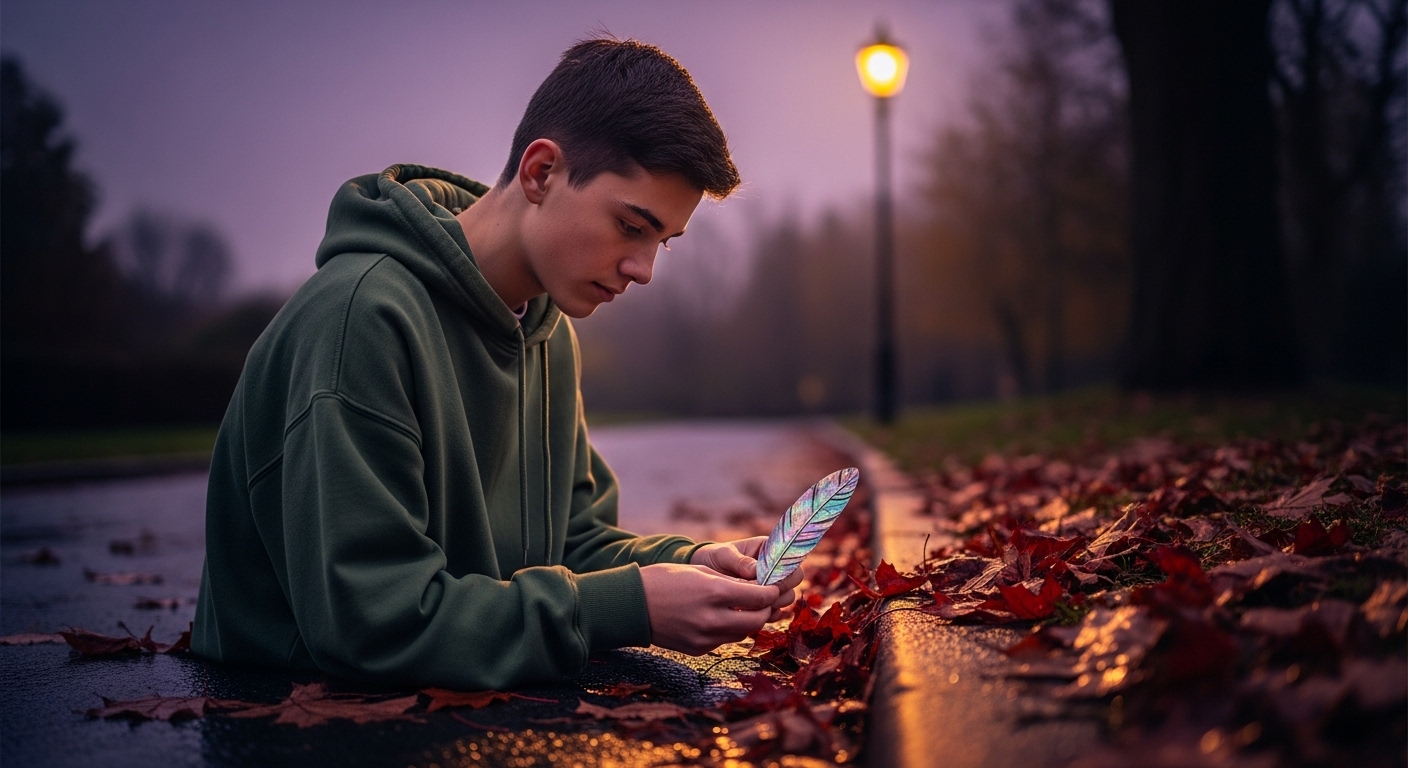
The strange feather-like object had vanished from the kerb, leaving behind only a faint, lingering shimmer in my mind, a subtle discord in the expected tapestry of autumn. Had it been a silent signal, a fragment of an unseen world urging us towards connection, or merely a trick of the waning light, a beautiful anomaly that left only questions in its wake as the real work of weaving community began?
Share This Story


