A Geography of Clay
The heat hit Leo first, a solid, tangible thing. It wasn't the searing blast of a freshly opened kiln, but the deep, baked-in warmth of twenty years of summer sun on a corrugated iron roof. It smelled of dust, dry clay, and something else—the faint, ghost-like scent of Christine’s apricot shampoo. He hadn’t smelled that in a decade, but his memory supplied it instantly, a phantom limb of the senses. The key felt stiff in the lock, groaning as he turned it, a sound of protest from the building itself.
She was already there, of course. Christine, leaning against her beat-up estate car, arms crossed, watching him with an expression he couldn’t quite decipher. It wasn't hostile, not exactly. It was more… geological. Like a landscape that had been weathered into a new shape by his absence.
“Running late,” she observed. It wasn’t an accusation. Just a statement of fact. Her voice was the same, a little rough around the edges like un-sanded bisque.
“Traffic on the A-road,” he said, the excuse sounding lame even to him. He gestured with the key. “Shall we?”
Inside, the space was smaller than he remembered, choked with the detritus of two decades. Shelves overflowed with abandoned student projects—lopsided mugs, terrifying-looking ashtrays. A fine layer of grey dust covered everything, a delicate shroud. In the centre of it all, like a dormant volcano, sat the kiln. Their kiln. They’d bought it with prize money from their first joint exhibition, hauled it here in a rented van, and nearly broken up three times trying to install it.
“Where do we even start?” he asked, the scale of the task suddenly seeming immense.
Christine didn't answer. She walked over to a high shelf and took down a small, cobalt-blue bowl. It was perfect, except for a hairline crack running from the rim.
“Remember this?” she said, tracing the crack with her thumb. “The night of the big thunderstorm. The power went out mid-firing. You were convinced the whole batch would be ruined.”
He did remember. He remembered her calming him down, lighting candles, telling him stories about ancient Japanese potters who embraced imperfection until the power flickered back on. He remembered kissing her in the flickering light, his hands covered in clay, her hair smelling of rain and apricots.
“Wabi-sabi,” he murmured.
“Something like that,” she said, her voice soft. She carefully wrapped the bowl in newspaper and placed it in a box labelled ‘KEEP.’
---
They worked in a rhythm that was surprisingly familiar. He was the brute force, dismantling the heavy wooden shelving, while she was the curator, sorting through years of tools, glazes, and forgotten treasures. The silence between them wasn't always comfortable. It was filled with unspoken questions.
“Find a buyer for the kiln?” he asked, breaking one of the longer silences. He was wrestling with a rusted bolt on the main workbench.
“A school up north. They’re getting a bargain,” she said, not looking up from a box of glaze tests. “I told them it had good bones. Made by people who cared.”
The words hung in the air. Made by people who cared.
“We did, didn’t we?” he said, finally getting the bolt to give way with a loud crack.
“We did,” she agreed. “Until we didn’t.”
And there it was. The heart of it. He’d left. Left the studio, left the town, left her. He’d taken a job designing sterile, mass-produced ceramics for a soulless corporation because he’d been scared. Scared of the financial insecurity, scared of the intensity of their life together, scared that his talent would never be enough.
“Christine, I…” he started, but he didn’t know how to finish.
She stood up and faced him, wiping dusty hands on her jeans. “Don’t, Leo. Not today. Today is about this place. Let’s not… add more ghosts.”
He nodded, grateful.
The Weight of It
The last job was the kiln. It was too heavy to lift, so they had to get it onto a dolly. It took all their combined weight, a dance of pushing and pulling, of shouting instructions and bracing against each other. For a moment, with his shoulder pressed against hers, the smell of her shampoo and the familiar warmth of her, it was like no time had passed at all. They were a team again. The kiln shifted, groaned, and finally settled onto the dolly with a heavy thud.
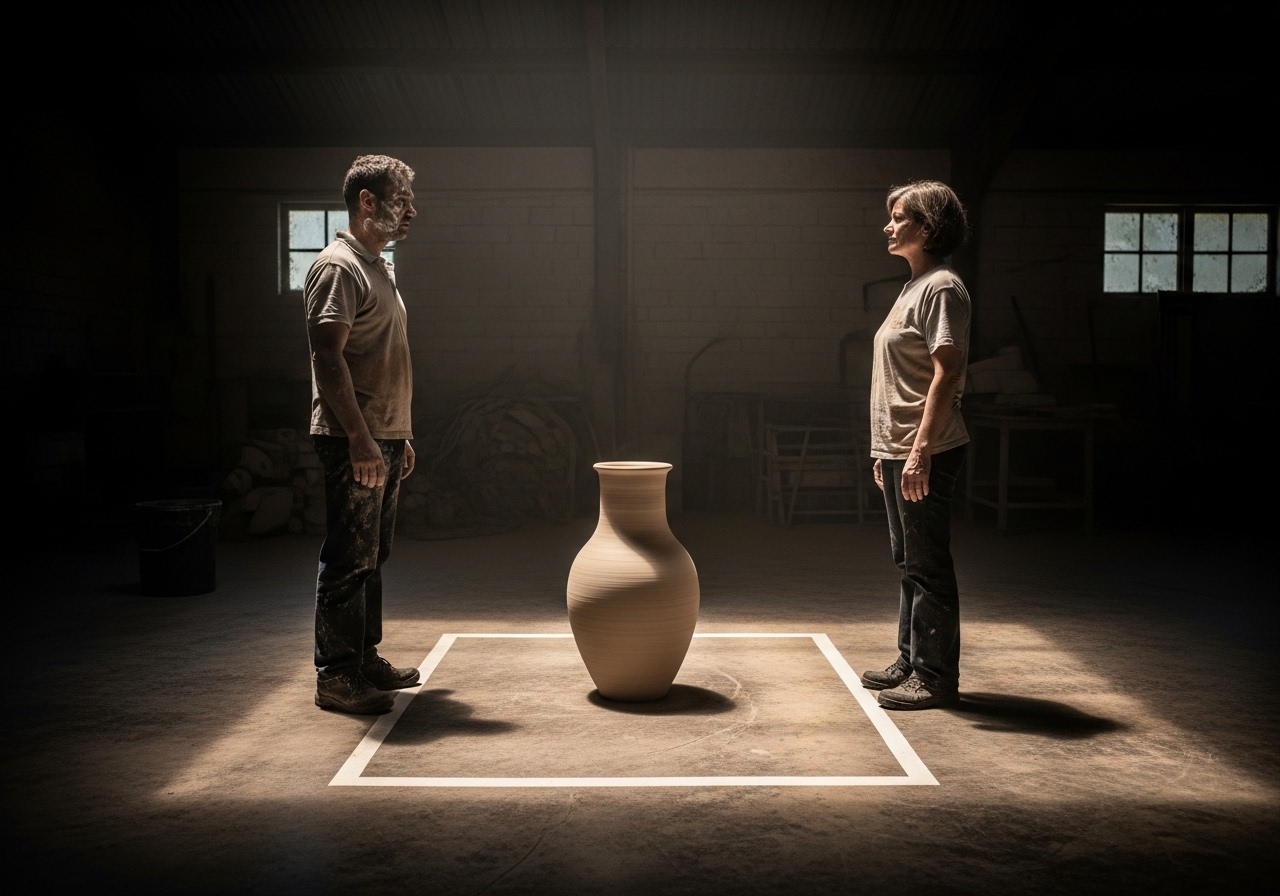
They stood back, panting and sweating in the oppressive heat. The space where the kiln had been was a pale, clean square on the floor, an absence that was more powerful than the presence had been. It was over.
They did a final sweep. The studio was hollowed out, an empty shell. Its soul was packed into cardboard boxes. Christine grabbed her box labelled ‘KEEP.’ Leo picked up a box of old tools he wanted for his garage workshop. At the door, he paused.
“You’re still making good things?” he asked.
She smiled, a real smile this time. It reached her eyes. “The best things,” she said. “I have a new studio. Smaller. Better light.”
He felt a pang of something—not jealousy, but a sad, distant pride. He locked the door. The click of the deadbolt was deafeningly final. They stood on the dusty pavement, the sun beating down, the key in his hand. He held it out to her.
She shook her head. “You keep it. A souvenir.”
He nodded, slipping it into his pocket where it felt heavy and cold. They stood there for a moment longer, on opposite sides of a door that would never open again. There was nothing left to say. Without another word, Christine turned and walked to her car. Leo watched her go before turning and walking the other way, the sound of the cicadas in the long grass screaming into the hot afternoon.
As he walks away, Leo feels the cold weight of the key in his pocket. He stops, pulls it out, and looks back at the studio, then in the direction Christine drove, a flicker of profound, unbearable regret crossing his face before he forces himself to move on.
Share This Story


