A Muffled Bell, A Fleeting Imprint
In the heart of a blustery Winnipeg winter, Silas, adrift after a career upheaval, enters The Portage Coffee House. The familiar warmth and the quiet, perceptive presence of its owner, Cathy, offer a momentary reprieve from his internal turmoil, hinting at deeper, unspoken truths beneath the surface of the mundane.
Silas pushed through the heavy oak door of The Portage, a sharp gust of December air chasing him inside. It smelt, as always, of dark roast and something like old paper, comforting and slightly melancholic, a balm against the biting prairie winter. Snowflakes, tiny and insistent, clung to the shoulders of his worn wool coat, dissolving into dark spots against the damp fabric. He gave his head a quick, jerky shake, dislodging a few stubborn flakes that scattered across the polished but scuffed floorboards near the entrance. The brass bell above the door, tarnished green in places, gave its usual muffled chime, a sound he'd come to associate with a brief, fragile respite from the relentless outside world. His knee bumped against the display stand for local art near the door, a stack of brightly coloured canvases wobbling precariously for a second before settling. He mumbled an apology to the empty air.
Cathy was behind the counter, exactly where she always was, wiping down the gleaming chrome of the espresso machine with a practiced, almost ethereal grace. Her movements were fluid, unhurried, as if time itself bent around her, allowing her to exist in a slightly different tempo than everyone else. She didn't look up immediately, but a faint, knowing smile seemed to touch the corner of her lips, a smile that always appeared just before she acknowledged a regular. Silas found himself staring at the intricate patterns of steam rising from the machine's spouts, mesmerized by the way they twisted and dissolved, momentary sculptures in the air, only to be replaced by new, identical forms. He felt a weird kinship with the steam, appearing and disappearing without a trace.
"Morning, Silas," Cathy's voice was soft, like warm honey over gravel, a sound that cut through the low ambient hum of the cafe without ever feeling loud. "The usual?"
Silas nodded, already reaching for his wallet, his fingers fumbling slightly as he pulled out a crumpled ten-dollar bill. "Please, Cathy. Extra shot today, maybe two. I think I need to outrun my own brain." He managed a weak smile, but it felt thin, stretched, like worn elastic. He hadn't slept well in days. Not since… well, not since the email. His jaw ached from clenching it all night.
Cathy took his money, her fingers brushing his, cool and dry, almost imperceptibly so. She poured the coffee, her gaze flickering over him, not quite meeting his, but somehow taking in everything. She didn't press, didn't pry. That was her gift. She simply observed, her head tilted just slightly, as if listening to something far off, something no one else could hear. He watched the dark liquid swirl into the mug, the crema forming a perfect, temporary crown that swiftly began to dissipate. The scent of it, rich and earthy, did little to settle the nervous knot in his stomach, which felt like a clenched fist just under his ribs. He felt the weight of her unspoken observation, not as judgment, but as a deep, quiet understanding. It was unnerving, sometimes, how much she seemed to see, as if his own thoughts were writ large across his forehead. A low, resonant hum from the old industrial refrigerator behind the counter punctuated the silence.
He took his usual seat by the window, the one where the glass was etched with frost patterns like miniature, fantastical forests. Outside, Portage Avenue was a blur of grey slush and hurried figures, heads bowed against the persistent, spitting snow, their scarves pulled tight around their chins. A city in a constant state of bracing. He watched a trolley bus rumble past, its electric whine a familiar, almost comforting counterpoint to the distant, wailing sirens of an ambulance. He pulled out his phone, unlocked it, scrolled aimlessly through a few apps, then thrust it back into his pocket. The screen felt too bright, the notifications too insistent, the digital world too demanding. He just wanted to disappear into the steam from his coffee.
Cathy brought his coffee over, placing it gently on a thick, woollen coaster that showed signs of many previous spills. "You look like you've been wrestling bears, Silas. Or maybe just the ghosts of futures past, as they say." Her eyes, a colour he could never quite place – somewhere between deep moss and polished river stone – held a glint of something ancient, something that had seen many, many winters. She didn’t smile, not really, but her expression softened.
He laughed, a short, sharp burst that sounded hollow to his own ears. "Something like that. More like, the future I thought I had… just vanished. Poof." He gestured vaguely with his hand, knocking against the edge of the table and nearly sending his coffee mug toppling. He caught it with a clumsy lurch, sloshing a drop onto the saucer. "They… downsized. Restructured. Classic corporate speak for, 'you're out on your ear, pal, after seven years of your life'."
He picked up the mug, the ceramic warmth seeping into his cold hands, though the chill in his bones felt deeper than just the weather. "Seven years, Cathy. Seven years I poured into that firm. The late nights, the weekends, the skipped holidays. All for… for nothing." He took a long, hot sip, the double shot of espresso a welcome bitterness against the dull, sickening ache in his chest. "I had a plan. A proper, adult plan. Mortgage, promotion, the whole predictable, comfortable life. The one you’re supposed to want. And now it's… dust. Just… dust." He imagined his carefully constructed career path, a grand edifice of ambition, simply collapsing into a pile of fine grey powder, blown away by a single, casual email. The shame of it prickled his skin.
He looked out the window again, the world outside a blur of grey and white. He felt like that, blurred and indistinct, his edges softened, his purpose gone. "I don't even know what I want anymore. Or who I am, without that job. It was my identity, you know? 'Silas, the marketing strategist.' The guy with the answers. Now I'm just… Silas." He traced the condensation on the window with a finger, leaving a clear path that immediately began to fog over again, a fleeting mark on a temporary surface. He noticed a tiny crack in the corner of the windowpane, a delicate spiderweb fracture. Had it always been there?
Cathy settled into the chair opposite him, a rare occurrence. Usually, she stayed behind the counter, a silent anchor in the swirling chaos of the city. She pulled a small, worn leather-bound book from her apron pocket, its spine creased and softened with age, flipping through its pages idly. It looked like a very old journal, filled with neat, looping script. She didn't immediately respond, letting the silence hang, thick and heavy, in the space between them. The cafe was quiet this time of morning, a few lone figures scattered amongst the tables, hunched over laptops or lost in books, their faces illuminated by the pale, winter light. The clatter of a spoon from a table across the room, the hiss of the steamer as a new order was prepared – these were the only sounds, woven into the quiet hum of the old building.
The Disappearing Landscape
"Funny thing about plans," Cathy began, her voice a low murmur, almost a whisper against the window's soft groan in the wind. "They're really just maps drawn by someone who hasn't quite seen the territory yet. You think you know the mountains, the rivers, the quickest route. You colour them in, label them. Then you step out, and the whole landscape has shifted. The rivers have changed course, the mountains are gone, or perhaps they were never really there." She paused, turning a page in her book, her thumb tracing faded ink. "I knew a fellow once. Brilliant architect. Had his entire career mapped out, block by block, like one of his blueprints. Every promotion, every project, every retirement party speech, rehearsed in his head. Then the war came. The great one, the big one, you know."
Silas watched her, captivated despite himself. The war? Which war? Her words had a timeless quality, like she was recalling something from last week and last century all at once. "What happened to him?" he asked, his voice softer than he'd intended.
"He was sent overseas," Cathy continued, her gaze distant, fixed on some point beyond the frosted glass, past the grey slush and the hurried figures, perhaps into a past Silas couldn't even imagine. "Came back… different. The plans were gone. The blueprints were just paper, flimsy and meaningless. He couldn't go back to designing grand buildings. Said he'd seen too much of how easily things fall down. How fragile even the grandest structures are." She closed the book with a soft thud that echoed disproportionately in the quiet cafe. "For a long time, he just sat. Stared at walls. The walls of his apartment, the walls of the institutions that tried to help him. Couldn’t build, couldn’t even sketch. Then, one day, he started drawing again. Not buildings. Birds. Small, intricate sketches of sparrows and robins and starlings. Found a kind of peace in it, he told me once. A different kind of purpose. A quieter one. He ended up illustrating field guides for the province. His work was meticulous, full of life, completely removed from the rigid geometry of his past."
Silas frowned, stirring his coffee with a spoon, the clink against the ceramic a sharp, insistent sound that felt too loud in the moment. He thought of his own plans, now crumbled paper. "So, I should start drawing birds?" He knew she wasn't being literal, but his mind grasped for a tangible solution, a new instruction. He felt a desperate need for a new blueprint, any blueprint, to replace the one that had been shredded. His anxiety pulsed, a dull throb behind his eyes.
Cathy chuckled, a dry, rustling sound, like leaves skittering across pavement, or old parchment turning in a forgotten tome. "Perhaps not birds. Perhaps just… allowing the plans to dissolve. To see what's left when the paper gets wet and crumples. What new shapes form." She pushed a stray strand of dark hair from her face, her hands surprisingly delicate, almost translucent in the weak light filtering through the window. "The thing about being lost, Silas, is that you're no longer confined to the path. You're suddenly free to wander. To look up, instead of just ahead, at the path you thought you were on." She gestured subtly towards the ceiling, then the window, encompassing the messy, unpredictable world.
He thought about that. Free to wander. It sounded terrifying. And exhilarating, in a way he hadn't allowed himself to consider. He'd always hated being lost. As a child, getting separated from his parents in a crowded department store had been a core memory of panic, a cold dread that still pricked at him. Now, the entire landscape of his life felt like a massive, uncharted department store, all the signs removed, all the exits hidden. He picked at a loose thread on his cuff.
"But what if there's nothing out there?" he murmured, almost to himself, his voice barely audible above the low hum of the refrigerator. "Nothing I'm good at. Nothing I even like." He felt a sudden, familiar wave of self-doubt wash over him, cold and heavy, making his shoulders hunch inwards. A small, persistent drip from the coffee maker behind the counter punctuated his fear.
"There's always something," Cathy said, her voice firmer now, though still gentle, a steady current in a turbulent stream. "It just might not be what you were looking for. The trick is to stop looking for the old map. To stop searching for the familiar contours you once knew. To start noticing the moss on the rocks, the way the light catches a particular, unassuming branch. The small things that were always there, but obscured by the grand design you were so busy pursuing." She leaned forward slightly, her eyes holding his, a warmth in their depths that seemed to defy the chill of the room. "Sometimes, the biggest fear isn't that there's nothing there. It's that there's something entirely different, something you hadn't dared to imagine, and you'll have to be brave enough to step towards it. To let go of the idea of control, and simply… explore."
---
Silas sat there long after Cathy had gone back to the counter, drawn back into her quiet, eternal rhythm of cleaning and serving. His coffee was cooling, a thin, oily film forming on its surface. He thought about the architect, drawing birds instead of buildings, finding peace in the unexpected. He thought about the shifting landscape, the notion of plans dissolving. The idea of "wandering" still felt like a vast, terrifying abyss, a leap into the unknown, but a tiny pinprick of light had appeared in the gloom. He realized he had been so focused on the loss of his old path, the destruction of his meticulously drawn map, that he hadn't considered the possibility of a new one. Not just a replacement, but something entirely unforeseen, something that might even be… better. Or just different. And different, right now, felt like a desperate necessity.
He finished his coffee, the last sips lukewarm and bitter, but somehow grounding, a final, deliberate act. He pushed his chair back with a soft scrape against the floorboards, a sound that seemed to echo in the quiet cafe. Cathy glanced over from behind the counter, her smile gentle, a silent question in her eyes.
"Feel better, bear wrestler?" she asked, her voice light, almost teasing.
Silas managed a genuine, albeit small, smile this time, the first honest one in days. "Maybe… a little less wrestled. Or maybe I just learned the bear wasn't quite what I thought it was." He nodded, a silent acknowledgment of her unexpected wisdom, then turned towards the heavy oak door. The cold outside still felt daunting, but perhaps, just perhaps, a little less soul-crushing. He didn't have a plan. He didn't know what he was looking for. But for the first time in days, he felt a faint, almost imperceptible tremor of something other than dread. It was curiosity.
As he pushed the door open, letting in another blast of sharp Winnipeg winter air, the muffled chime of the bell fading behind him, he looked back at Cathy. She was already wiping down the counter again, her movements fluid and eternal, her focus absolute. For a fleeting second, just before the door swung shut, he thought he saw her hand pass right through the gleaming steam wand, a shimmering ripple in the air where her fingers should have met metal. He blinked, a quick, involuntary reflex. When he looked again, she was just wiping it, of course. Just wiping it, her hand firmly on the polished surface, her gaze serene.
He stepped out, the snow falling thicker now, coating the grey streets and slushy pavements in a fresh, temporary white. He pulled his collar up against the biting chill, zipped his jacket higher, but he didn't immediately turn left towards home, or right towards the bus stop that would take him to the familiar, if now uncertain, comforts of his neighbourhood. He stood there for a long moment, letting the flakes settle on his lashes, blurring the world into soft-focus. Then, he turned neither left nor right. Instead, he simply began to walk straight ahead, towards the bustling, indistinct heart of the city, with no particular destination in mind, the vast, white canvas of the winter day stretching out before him, utterly blank and terrifyingly open. The feeling of possibility, once a distant, unreachable star, now flickered, closer, though still fragile and uncertain. He didn't know where he was going, or what he would do, or even what he could do, but for the first time, not knowing didn't feel like the end. It felt like… the very raw, unnerving beginning of not knowing. And that, in itself, was something. A quiet, unsettling kind of freedom.
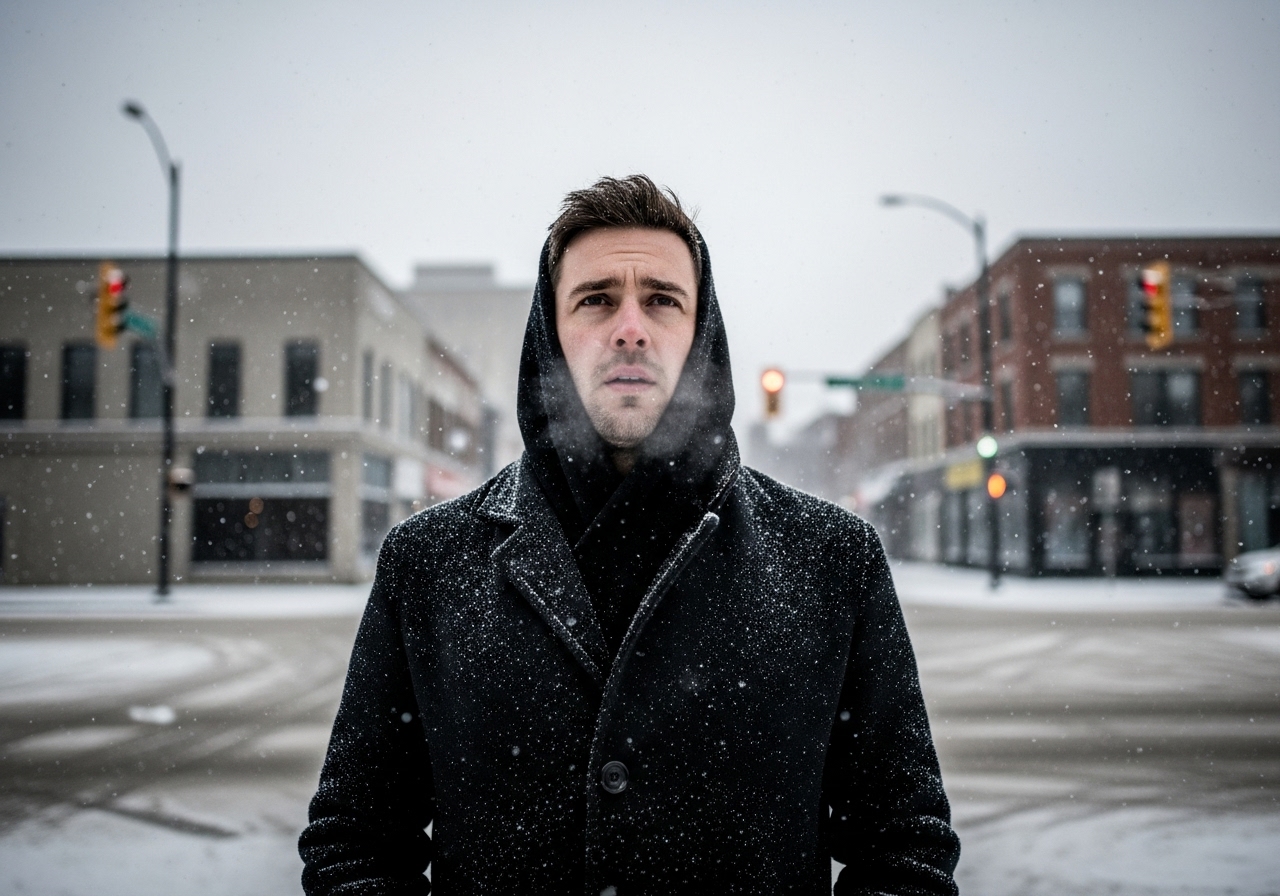
He didn't know where he was going, or what he would do, or even what he could do, but for the first time, not knowing didn't feel like the end. It felt like… the very raw, unnerving beginning of not knowing. And that, in itself, was something. A quiet, unsettling kind of freedom.
Share This Story


