The Topography of a Relapse
The apartment was too quiet. Not peaceful quiet, but the dead, airless quiet that follows a slammed door. I woke up with a jolt, the sheet tangled around my legs, the space next to me in the bed cold. It was 3:17 AM. The blue light of a passing sanitation truck swept across the ceiling, and in that brief, sterile illumination, I knew he was gone.
Panic is a physical thing. It starts as a cold fizz in your stomach and radiates outwards, a sickening bloom that makes your fingers tingle and your teeth ache. I threw the duvet off and stumbled into the living room. His jacket was gone from the hook by the door. His boots were gone from the mat. But his wallet and phone were on the kitchen counter, sitting next to a half-eaten apple.
My blood ran cold. He never went anywhere without his phone. It was a nervous tic, a permanent extension of his hand. Leaving it behind wasn't an oversight; it was a statement. It meant he didn't want to be found. And it meant he didn't need money. Which meant he already had what he was going for.
"Donnie?" I called out, a stupid, hopeful tremor in my voice. The silence that answered was mocking. I checked my phone. No texts. No missed calls. Our last exchange was from earlier, a stupid, escalating argument about laundry that wasn't really about laundry at all. It was about the pressure, the constant, grinding vigilance of his recovery. I'd said something sharp. He'd said something wounding. Then, slammed doors and silence. I had fallen asleep angry.
Now, the anger was gone, replaced by a hollow dread. I pulled on a pair of jeans and the nearest hoodie, not bothering with socks, shoving my feet into my trainers. The night air hit me like a slap. The street was slick with a fine mist, the sodium lamps casting halos on the wet pavement. Where do you even start looking for someone who doesn't want to be found?
Ghosts on Bedford Avenue
I started with the familiar ghosts. Our ghosts. The all-night bodega where we bought emergency ice cream. The bench in McCarren Park where we had our first real conversation. The laundromat where the fight started. Each location was empty, mocking me with its mundane placidity. The city was breathing around me, a vast, indifferent organism, and somewhere in its veins, he was lost.
My steps led me, against my will, towards The Gutter. A dive bar with a bowling alley attached, a place that smelled of stale beer and regret. It had been his favourite haunt in the 'before' times. We had a rule: no Gutter. It was a landmark in a country we were no longer allowed to visit.
The door creaked open into a wall of noise and smoke. A few sad-eyed patrons were hunched over the bar. The bartender, a woman with tired eyes and a tattoo of a spiderweb on her neck, looked up as I approached. She recognised me. Her expression soured.
"He's not here," she said, before I could even speak. Her voice was flat, bored.
"Are you sure? Donnie. Dark hair, grey coat. You would have seen him." My voice sounded thin, desperate.
"Look," she said, wiping the bar with a rag that had seen better decades. "I got a business to run. He's not welcome here, you know that. If he came in, I'd have told him to leave." She wouldn't meet my eyes. She was lying. Or hiding something.
"Please," I whispered, the sound swallowed by the jukebox. "If you see him…"
"I won't," she cut me off, turning her back to me to rinse a glass. The finality in her tone was a door slamming in my face.
---
I stumbled back out into the night, the mist thickening to a drizzle. My mind was racing, flicking through a Rolodex of bad possibilities. If not the bar, then where? The question led me to a place I'd only ever seen from the elevated M train. A handful of blocks under the Williamsburg Bridge, a neighbourhood of low-slung industrial buildings and shadowy doorways.
His dealer's territory. I didn't know the name or the exact spot, but Donnie had described it once, in a moment of pilled-up candour, a place where "you can get anything you want if you know who to stand next to."
Walking down Kent Avenue felt like crossing a border. The trendy boutiques and cafes gave way to warehouses and chain-link fences. The air grew still, the sounds of the city more distant. Every shadow seemed to hold a figure. A man watched me from a doorway, his face obscured by the hood of his sweatshirt. I picked up my pace, my heart a frantic drum against my ribs. My bare ankles were cold and wet.
I didn't know what I was looking for. A face? A transaction? I just had this blind, stupid hope that I would see him, that I could grab his arm and pull him back from the edge. I rounded a corner onto a side street lined with parked lorries. It was dead quiet here. Too quiet.
A figure detached itself from the shadows between two trucks. Not Donnie. This man was taller, broader. He took a step towards me.
"You lost, little girl?" he asked. His voice was soft, but it carried a weight that made my skin crawl.
I didn't answer. I just turned and ran. I didn't look back. I ran until my lungs burned and the stitch in my side was a searing knife. I ran until I was back in the familiar, brightly-lit territory of my own neighbourhood. I leaned against a brick wall, gasping for air, the cold drizzle plastering my hair to my face. I was alone. Utterly and completely alone. And he was still out there, somewhere in the darkness.
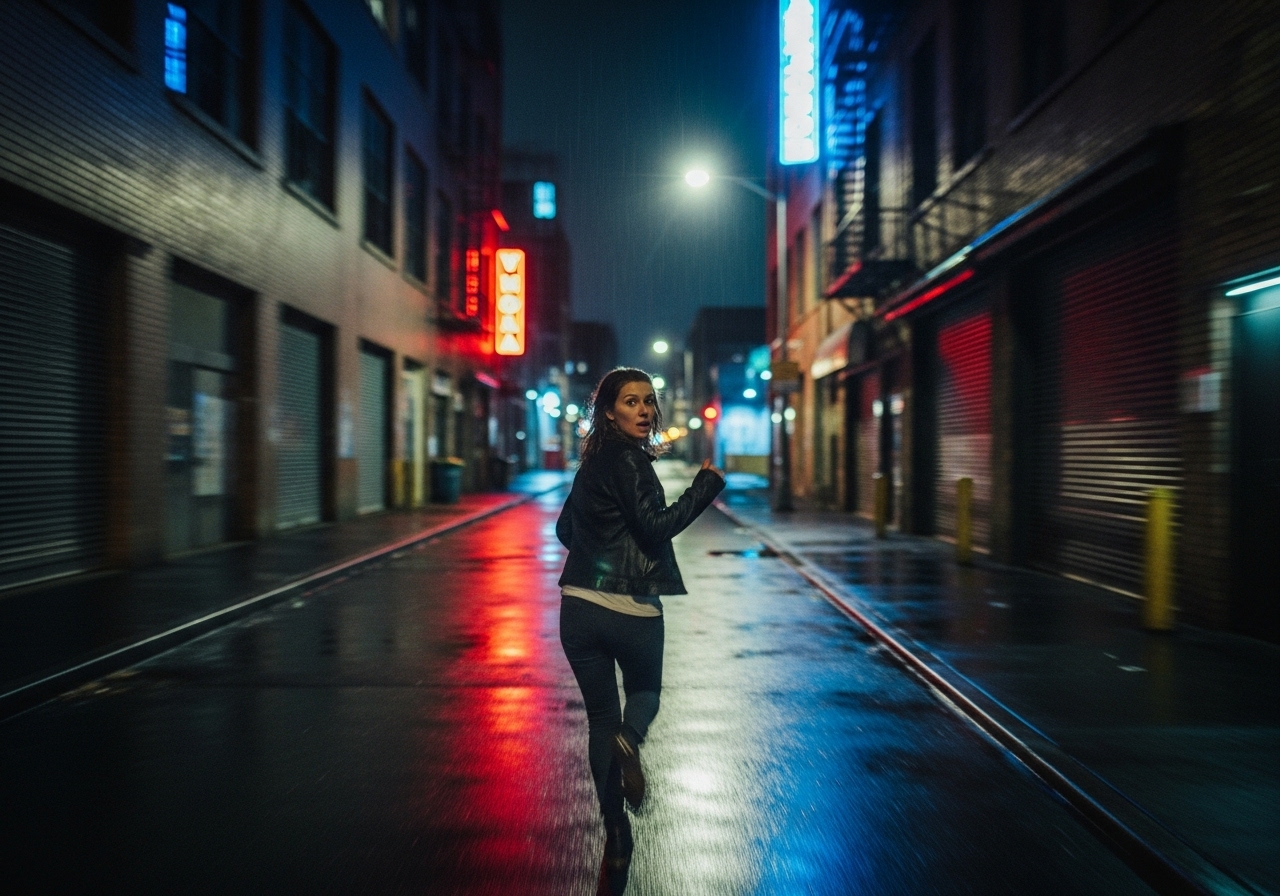
I pulled out my phone and stared at the blank screen, the uselessness of it a perfect mirror of my own. He wasn't lost. I was.
Share This Story


