Porcelain Duties
The question hung in the air, as dry and brittle as the pinned moths in the display case behind him. It wasn't a real question. It was a final seal, a locking of the mechanism before the timer began its silent, inexorable count. Outside, a miserable autumn wind rattled the window frames of the Tamarack Valley Community Museum, carrying the scent of wet, decaying leaves and distant woodsmoke.
"Are the protocols clear, Unit Seven?"
I kept my eyes on the diorama. The tiny painted figures of lumberjacks, frozen mid-swing with their miniature axes, were covered in a fine layer of dust. Their world was silent and safe. "Affirmative, Ma'am. The protocols are clear."
"Recite the exchange parameters."
My voice came out flat. It was the voice I was supposed to use. Not my real voice, the one that sometimes got too high when I saw a dog, but the one they had given me. "Initiation phrase: 'The forecast suggests the rain will worsen.' Expected countersign: 'I have always found the sound comforting.' Any deviation is a termination trigger. I am to abort and egress through the sub-level utility access."
"And the asset?"
"The asset is contained within Exhibit 4-B. The specimen of Turdus migratorius. Third from the left. A micro-cylinder secured within the thoracic cavity."
A dry hand came to rest on my shoulder. Ms. Genevieve’s fingers were like twigs, all bone and paper-thin skin. She never touched me unless it was for emphasis. This was for emphasis. "The Cartographer is a valuable source, but he is sentimental. Do not engage in any unscripted conversation. You are a conduit, Larry. Nothing more. You are the empty space through which the message passes. Do you understand?"
"I understand, Ma'am." I did. I was the space between the words. The pause between heartbeats. The silence in the room.
"Good." The hand lifted. "Take your position. Maintain observational posture until initiation. Report success at the designated time. Out."
I heard the soft click of the staff door closing behind me, and then there was only the low, electric hum of the museum's ancient dehumidifier. It was a Tuesday. The museum was always empty on a Tuesday. The wind howled a little louder, pressing against the old glass. I was alone.
Glass Eyes and Empty Hours
My position was a wooden bench opposite the main entrance, worn smooth by decades of schoolchildren and tired parents. It gave me a perfect view of the door and the reception desk, which was always empty. From here I could also see the reflection of the Ornithology wing in the glass of a large painting depicting the town's founding. It was an imperfect view, distorted and dark, but it would suffice. A direct line of sight was a liability.
I settled onto the bench, letting my legs dangle. They didn't quite reach the floor, a fact that was a constant, low-level annoyance. I tried to look bored. A bored child was invisible. I focused on the details of my surroundings, cataloguing them as I had been taught. The smell of lemon polish and something else, something faintly chemical like formaldehyde. The way the light from the tall windows was a weak, grey colour, filtered through the overcast autumn sky. The floorboards, dark pine, creaked in a pattern I had memorised: two creaks by the door, one by the desk, a long groan in the centre of the room.
An hour passed. Then another. My task was to wait. Patience was a muscle. They had trained ours until it was as hard as stone. I watched a spider build a web in the corner of the window frame, a tiny, perfect engineer. It moved with more purpose than the painted lumberjacks. It was alive. I wondered if it knew about the coming winter.
My stomach made a small noise. I ignored it. Hunger was a distraction. I focused back on the reflection. The birds in the Ornithology wing were stiff, their glass eyes holding a permanent look of mild surprise. Exhibit 4-B was a row of common North American birds. A blue jay, a cardinal, a sparrow, and three robins. Why three robins? It was an aesthetic choice, Ms. Genevieve had said. Redundancy disguised as curation. My target was the third one, the one whose head was tilted at a slightly unnatural angle. Turdus migratorius. The American Robin. Harbinger of a spring that never seemed to quite arrive anymore.
I ran through the contingency plans in my head. If the contact was compromised. If an Auditor entered before the exchange. If the asset was not in place. For every action, there was a pre-approved reaction. It was a dance, and I knew all the steps. There was no room for improvisation. Improvisation was failure.
---
The little brass bell above the door gave a sudden, sharp jingle, cutting through the humming silence. My head snapped up, my heart giving a single, hard thump against my ribs. I immediately softened my posture, letting my shoulders slump, forcing the bored look back onto my face.
A man stood in the doorway, shaking a cheap-looking umbrella. He was older than I expected, with a face like crumpled paper and a thin, grey coat that was dark with rain at the shoulders. He looked tired. He looked unimportant. That was good. He shuffled inside, letting the door swing shut behind him, and spent a long moment wiping his shoes on the mat. He didn't look at me.
He began to wander through the main hall, his footsteps hesitant on the groaning floorboards. He glanced at the lumberjack diorama, the case of local minerals, the wall of sepia photographs. He was playing the part of a tourist with nothing better to do on a rainy afternoon. I was playing the part of a boy waiting for his mother.
He eventually made his way toward the Ornithology wing. My muscles tensed. This was it. The dance was beginning. I slid off the bench and followed, my own footsteps silent. I maintained the prescribed distance—no less than ten metres, no more than fifteen. I stopped at a display of antique farming equipment, pretending to be fascinated by a rusty ploughshare, but watching his reflection in the glass.
He paused in front of Exhibit 4-B. He leaned in, his breath fogging a small patch on the display case. He was looking at the birds.
I moved. I walked past him, as if heading for the next room, and stopped at the adjacent case. I did not look at him directly. I spoke to the glass.
"The forecast suggests the rain will worsen."
My voice was steady. It didn't waver. For a moment, there was only the hum of the dehumidifier and the drumming of rain against the roof. The man did not move.
Then, his own voice, low and raspy. "I have always found the sound comforting."
Countersign correct. The protocol advanced. I turned to face him for the first time. His eyes were pale blue, watery, and filled with a sadness that felt ancient. He gave me a tiny, almost imperceptible nod.
The next part was the most dangerous. The exchange had to be invisible. He reached into his coat pocket and pulled out a small, leather-bound book. A field guide to insects. He opened it and pretended to read, standing directly in front of the lock on the display case. His body shielded my actions from the main hall. He was a living curtain.
I knelt, pretending to tie my shoe. My fingers, small and quick, worked at my laces. Tucked into the double-knot of my left shoe was the key. Not a metal key, but a polymer filament, no thicker than a wire. It would leave no metallic trace if I were to be searched. I palmed it, stood up, and moved to the case, my back to him. My fingers found the keyhole, a tiny pinprick on the underside of the frame. The filament slid in. A quarter-turn, a faint click that was swallowed by the rain.
I gently lifted the glass cover just a centimetre—enough. My hand darted inside. The air was stale, thick with the smell of arsenic and old feathers. I touched the third robin. It was cold, rigid. A small incision had been made beneath its wing, sealed with wax. My fingernail broke the seal. The micro-cylinder was no bigger than a grain of rice. It was cool to the touch. I closed my fist around it.
I lowered the glass. It settled with a soft clink. I turned the filament back, locking it, and pulled it free. The Cartographer had not moved. He was still reading about beetles.
I walked away without looking back. I palmed the cylinder into a small, lead-lined pouch in my pocket and slipped the filament key back into the sole of my shoe. The first part was done. The asset was secured. All that remained was the egress.
A Different Kind of Cold
The staff door was at the back of the Pioneer Life exhibit, behind a dusty recreation of a one-room schoolhouse. I passed the mannequin of the severe-looking schoolmarm, her painted eyes staring into nothing. I was almost there. My hand was on the cold brass doorknob.
Jingle.
The sound from the front of the museum was sharp, violent. It was not the hesitant jingle of a tourist. It was decisive. Authoritative.
I froze. My breath caught in my throat. I couldn't run. That was the first rule of an unexpected encounter: do not alter your behaviour. I forced my hand to drop from the doorknob. I turned around, slowly, and pretended to look at the schoolhouse display, my heart now a frantic drum against my ribs.
I heard the footsteps. Heavy. Rhythmic. Not the tired shuffle of the Cartographer, but the measured, confident tread of a predator. The floorboards didn't groan; they submitted.
I risked a glance at the reflection in the schoolhouse window. A figure stood in the centre of the main hall. Tall, slender, wrapped in a long, perfectly tailored grey coat. An Auditor. Their face was obscured by the dim light, but I didn't need to see it. I could feel their presence, a sudden drop in the temperature of the room. It was a different kind of cold than the autumn air outside.
The Cartographer was gone. He must have slipped out as the Auditor entered. Protocol. He had done his part. Now I had to do mine.
I needed to wait. The Auditor would perform a sweep and leave. They were methodical. If I remained calm, if I remained a bored child, I would remain invisible. I fixed my eyes on a slate board covered in chalk equations.
The footsteps started again. They were coming closer. Not sweeping the room, but moving with a specific destination. Moving toward me.
I didn't dare look. I focused on the chalk. On the dust motes I wasn't supposed to see. I recited multiplication tables in my head. Seven times seven is forty-nine. Seven times eight is fifty-six. The footsteps stopped, right behind me.
The silence stretched, thin and tight. I could feel eyes on the back of my neck. The air was thick, heavy. I could smell clean wool and something antiseptic.
Then, a voice. It was smooth, calm, and utterly devoid of warmth. "Lost, little one?"
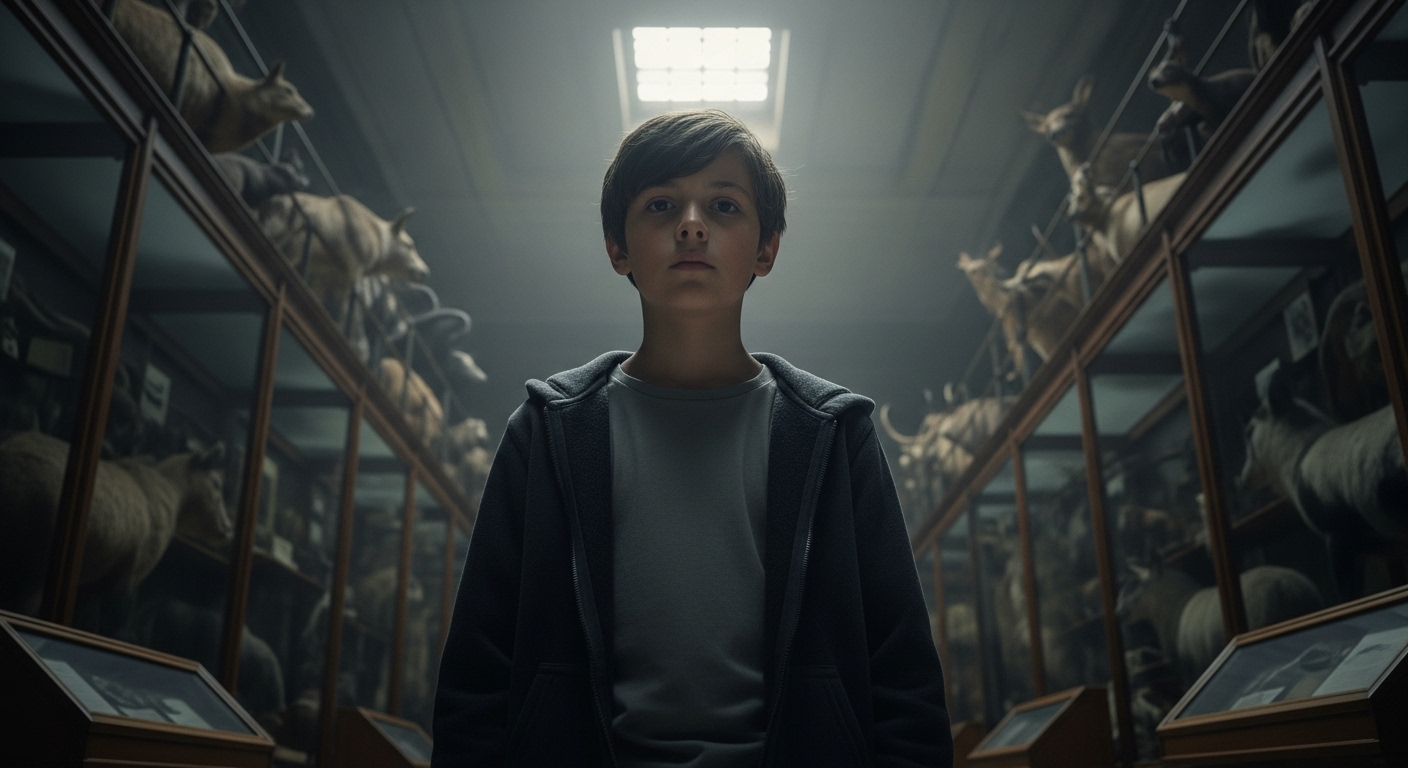
The Auditor's voice was a blade of ice in the silent museum. I stood frozen, my back to the figure in grey, the micro-cylinder in my pocket suddenly feeling as heavy as a collapsed star. They knew.
Share This Story


