Chalk Dust and Cold Corners
The air in the community centre's meeting room always felt thin, tasting faintly of institutional cleaner and stale coffee. Tonight, a particular chill clung to the corners, despite the faulty thermostat, making the usual drone of budget discussions feel heavier, more opaque. Silas, hunched over his sketchbook, felt an inexplicable prickle on his neck, his mind drifting from the mundane agenda to the unsettling sensation that he wasn't truly alone, or rather, not alone with the living.
The fluorescent lights above hummed a flat, relentless tune, vibrating deep in Silas's skull. He gripped the graphite pencil tighter, the cheap wood rough under his thumb. Another ten minutes of 'Q3 expenditures' and his eyes might just glue themselves shut. He really wanted to be anywhere else. Maybe down by the old bridge, sketching the way the dying light caught the rust on the girders, or back in his cramped room, coaxing life into the sprawling urban landscape on his canvas.
“...and while the funding for ‘Youth Expressions’ is, shall we say, stagnant,” Eleanor, the chairwoman, continued, her voice a dry, reedy whisper that rarely modulated, “we are confident that with a few… strategic adjustments, we can revitalise interest.” She tapped a long, bony finger on a laminated sheet. The sound was surprisingly dull, like wood hitting felt.
Silas shifted on the plastic chair, which let out a mournful squeak. The room smelled of old paper and something else, something vaguely floral but utterly synthetic, like dried potpourri from a forgotten era. He glanced up, forcing a polite nod. Eleanor’s eyes, deep-set and shadowed, seemed to pierce through him, not quite seeing.
He’d been coming to these monthly board meetings for ‘ArtReach Collective’ since he’d first started submitting his work. At seventeen, he was the youngest, the token ‘youth voice,’ which mostly meant he sat quietly, drew in his sketchbook, and occasionally muttered an opinion that was then politely ignored. He found it hard to connect with these people. They were… from another time, it felt like. Not just old, but old.
Mr. Davies, seated to Eleanor’s left, wore a tweed jacket that looked like it had survived a war and several moth infestations. He cleared his throat, a dry, rasping sound. “Indeed, Eleanor. We must consider the spirit of the collective. Its founding principles.” His gaze drifted to the framed, yellowed photograph on the wall – the original founders, circa 1920, all stern faces and serious moustaches. The resemblance to Mr. Davies was uncanny, a trick of the light, perhaps.
Silas’s pencil slipped. A tiny, almost imperceptible tremor ran through the air. He frowned. Was the heating playing up again? A sudden cold draught, sharp and clean, ghosted across his left cheek, raising goosebumps on his arm. The window was shut, he was sure. He’d checked earlier, trying to catch a glimpse of the streetlights flickering to life.
“The youth,” Ms. Albright piped up from across the table, her voice thin as parchment. She wore a high-necked lace blouse that seemed impossibly white for its apparent age. “They require… guidance. A steady hand. Our generation understood the value of discipline in artistic pursuit.” She smiled, a brittle, colourless affair that didn't quite reach her eyes. Her fingers, long and unnaturally pale, rested on a stack of neatly bound reports. Silas noticed they didn’t quite press into the paper, but merely lay there, weightless.
He watched, mesmerised, as her hand twitched, and for a fleeting, sickening moment, it looked as if the light from the overhead tube passed through her index finger. Like a ripple in water. He blinked, hard. The illusion was gone. Her hand was solid, pale, resting innocuously on the reports. Just tiredness, he told himself. Too many late nights sketching.
He took a nervous sip from the lukewarm paper cup of water he’d been nursing. The plastic crinkled, a loud, intrusive sound in the quiet. He felt a blush creep up his neck. Everyone’s gaze, or what felt like it, turned towards him. They didn't seem annoyed, just… expectant. Like he’d disturbed a very old, very fragile echo.
A Shift in Perception
Dr. Chen, who had remained silent until now, cleared his throat. He wore a heavy, dark suit that seemed to absorb all available light. “The community outreach programme, for instance, could benefit from a fresh perspective. Perhaps a… less tangible approach.” He spoke slowly, deliberately, as if each word was being retrieved from a great distance. His eyes were dark, like polished obsidian, and didn’t seem to blink.
Silas’s heart gave a sudden, uncomfortable lurch. Less tangible? What did that even mean? He looked around the table. Eleanor’s face was unlined, smooth as porcelain, despite the historical cut of her tweed skirt. Mr. Davies’s skin had a faint, almost translucent quality, and the light didn’t quite reflect in his spectacles. And Ms. Albright… her hair, pinned back in a severe bun, had an odd, static quality, as if each strand was suspended in still air.
He tried to focus on the agenda, on the dull numbers, the pie charts that Eleanor was now pointing to with her long, wooden pointer. He felt a sudden, inexplicable coldness in his palms. His hands were damp, not from sweat, but from a profound chill that seemed to radiate from within. He rubbed his arms, trying to discreetly warm himself, but it was useless.
“Silas, your thoughts on the mural project downtown?” Eleanor’s voice, though quiet, cut through his growing unease. He flinched, almost dropping his pencil. He hadn't been paying attention. Not really.
“Um…” He cleared his throat, his voice a little shaky. “I think… it’s good to engage with the community. Get their… stories. What they want to see.” He gestured vaguely with his pencil, then let it drop to the table with a quiet clatter. He didn't pick it up.
Ms. Albright nodded, a barely perceptible movement. “Stories are important. Especially those that transcend time.” Her eyes flickered to Dr. Chen, who gave a slight, almost imperceptible incline of his head. A silent communication, ancient and knowing.
And then it hit him. Not a jolt, not a shock, but a slow, creeping dread, like watching a photograph develop, one detail at a time, until the whole horrifying image was clear. The way the light didn’t quite catch their clothes, but seemed to pass through the fabric in certain places. The utter lack of warmth emanating from them, even when he could almost feel the coldness they brought. The way they spoke, not with the natural pauses and inflections of living breath, but with an eerie, steady cadence, like old recordings.
His breath hitched in his throat. He wanted to shout, to stand up, to overturn the table and run. But his limbs felt heavy, anchored to the chair by some unseen force. He was stuck. With them.
---
The Weight of Unreality
“The annual gala,” Mr. Davies announced, his voice surprisingly robust for a man who looked like he hadn’t eaten in decades, “will, as always, be held in the old council chambers. A venue rich with history.” He smiled, a thin, almost skeletal stretching of his lips that didn’t quite reach his eyes. His gaze, too, drifted to the old photograph on the wall, lingering on a particular figure in the background, a man with a similar tweed jacket and the same faint, knowing smile.
Silas felt a wave of nausea. He looked at the photograph, then back at Mr. Davies. The man in the photograph was Mr. Davies. Or rather, Mr. Davies was the man in the photograph, impossibly preserved, impossibly present. A cold sweat broke out on Silas’s forehead, mingling with the chill that had settled deep in his bones.
He forced himself to breathe, slow and shallow. Don’t panic. Don’t let them see. If they were… what he suspected, then drawing attention to himself was the worst possible thing. He needed to be invisible. He needed to leave.
“Excuse me,” he mumbled, pushing his chair back a fraction of an inch. It scraped loudly on the linoleum. “I just… I need to check something. Outside. My… my bike lock.” A flimsy excuse, he knew, but his mind was scrambling, grasping at anything.
Eleanor’s head tilted slightly. Her eyes, those dark, unblinking pools, fixed on him. “Is everything quite all right, Silas?” Her voice was softer now, tinged with a subtle curiosity that sent a fresh wave of terror through him. It was the first time she’d ever used his name with that particular inflection.
“Yes. Fine. Just… it’s a new lock. Can be tricky.” He stammered, feeling his face flush. He started to push himself up, slowly, deliberately, as if trying not to startle a predator.
As he rose, Ms. Albright reached out a hand, ostensibly to steady a teetering stack of pamphlets. Her hand passed clean through the corner of a promotional flyer for 'Summer Art Camp,' which remained perfectly upright. Her fingers, ethereal and translucent in the harsh light, simply… weren't there for a second. Then they solidified again, resting on the empty air where the pamphlet had been.
Silas froze, his breath caught in his throat. He saw it. Plain as day. There was no denying it now. They weren’t just old. They weren’t just eccentric. They were… not here, not truly. And they knew he knew.
Dr. Chen leaned forward, a faint, almost imperceptible smile touching his lips. “You have a keen eye, young artist. A very keen eye indeed.” His voice was a low rumble, devoid of any human warmth, and it seemed to vibrate the very dust motes in the air, or perhaps it was just the humming of the old lights playing tricks on his frayed nerves.
Silas didn’t move. He couldn’t. The cold in the room was no longer a draught; it was a palpable pressure, surrounding him, pressing down. The board members, now all looking at him with those vacant, ancient eyes, seemed to grow subtly, their forms gaining a faint, shimmering outline. He could almost smell the dust of centuries, the quiet stillness of long-gone lives.
He was trapped in a room with the ghosts of the ArtReach Collective, and it felt very much like they had been waiting for him.
Eleanor’s lips parted, a silent question forming, or perhaps a command, as the doorknob behind Silas began to slowly, deliberately, turn inwards.
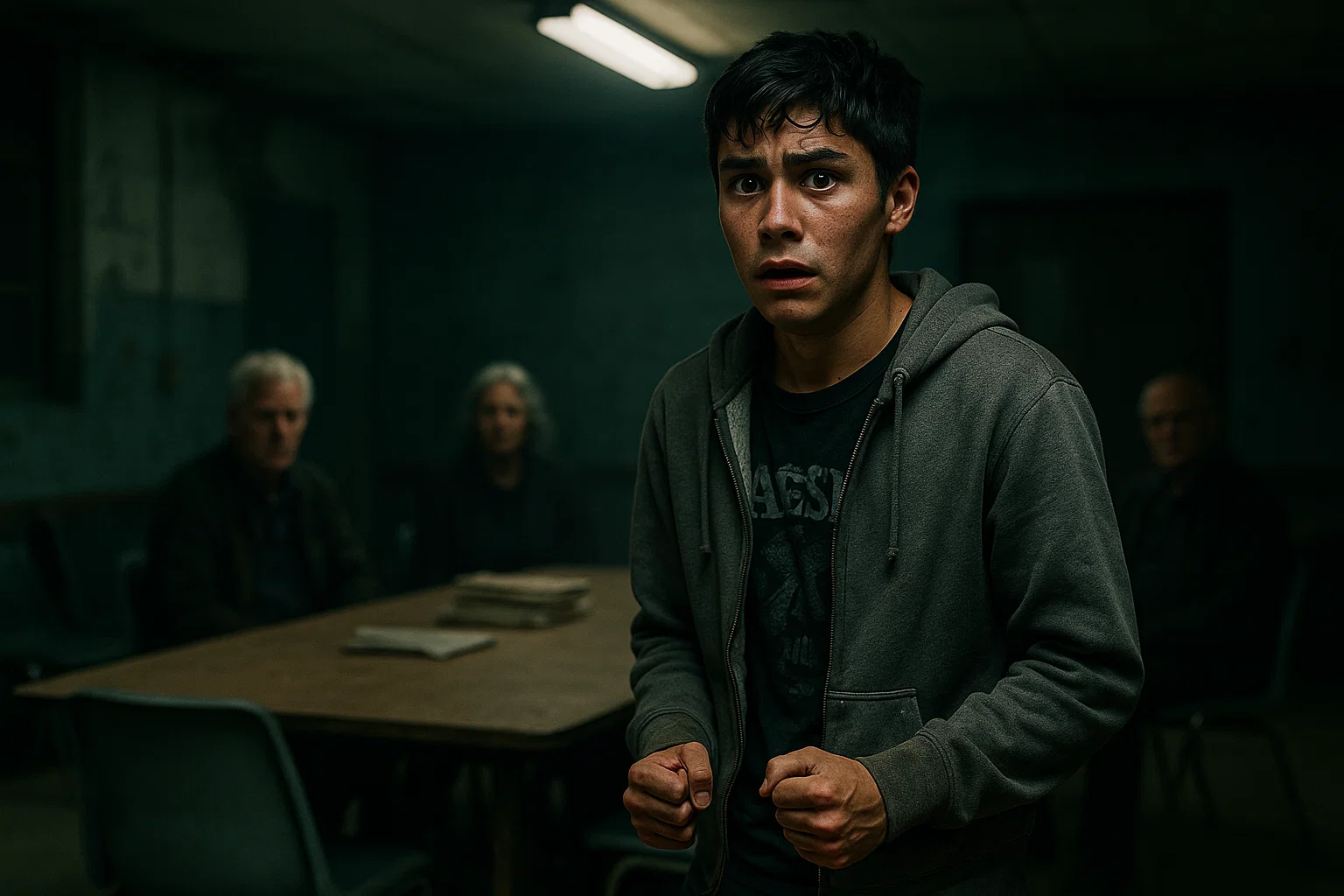
Silas was trapped in a room with the ghosts of the ArtReach Collective, their ancient eyes now fixed on him, and just as the terror truly set in, the doorknob behind him began to turn, signalling a new, unknown presence.
Share This Story


