The Kitchen Table
A group of youth and community members are at a kitchen table, excitedly brainstorming plans to convert an old, disused recreation hall basement into an arts and culture space, while an underlying sense of mystery and unease slowly builds for one of them.
The glare off the lake, even through the smudged kitchen window, made Edmund squint. He’d seen the beat-up green Ford Ranger parked just off the gravel shoulder for the third time this week. Always the same spot, half-hidden by a tangle of wild raspberry bushes that were just starting to hang heavy with unripe fruit. No one around. Just the truck, its paint dulled to the colour of pond scum, sitting there. He rubbed at his right eye, a phantom grit persisting, then shifted his weight on the hard oak chair, the wood groaning a tired protest beneath him.
“—and I’m telling you, it’s not just the damp. It’s the smell. Like… old socks and resentment,” Mateo was saying, gesturing with a half-eaten oatmeal cookie. Crumbs dotted his chin. His voice, usually a booming thing, was slightly muffled by the cookie. Edmund hadn't heard the beginning, caught up in the green truck’s silent vigil.
Sage, across from Mateo, pushed a stray curl of dark hair behind her ear, her brow furrowed. “Resentment, Tey? That’s a bit much, even for that place. It’s just… forgotten. Like everything else.” She picked at a loose thread on the worn denim of her shorts, a nervous habit. The air in Mrs. Battiste’s kitchen was thick, not just with the humid summer heat pressing in from outside, but with the lingering scent of coffee, toast, and the fainter, cloying sweetness of the cookies Mateo was systematically destroying. A fly, sluggish from the warmth, buzzed lazily against the screen door.
Mrs. Battiste, who always looked a little like a benevolent hawk – sharp eyes, a quick, almost imperceptible tilt to her head – cleared her throat from the head of the table. She ran a hand over the checkered oilcloth that had probably been on that table since Edmund was in grade school. “It’s got potential, kids. Everything does. You just gotta see it.” Her gaze, however, flickered towards the window, not quite meeting Edmund’s, but in its general direction. Had she seen the truck too? Edmund couldn't tell. He tried to catch her eye, but she was already turning back to the crumpled sketches spread across the table, drawings of what the recreation hall basement could be. A space. A place. Something more than just forgotten.
“Potential, yeah. Like my algebra grade,” Sage muttered, but a small smile played at the corner of her lips. She always threw out those self-deprecating jabs. It was her way of keeping things real, keeping herself grounded. Edmund, still feeling the residual prickle of the sun-drenched window, the faint image of that truck burned into his retina, dragged himself back to the conversation. He picked up one of the sketches. It was an ambitious tangle of lines and arrows, proposing a layout for a small gallery, a performance area, some sort of workshop nook. On the back, in faint pencil, someone had doodled a crude, smiling sun.
Mateo leaned over. “No, seriously. The old rec hall basement. It’s just… so basement. Like a horror movie set before the jump scare. All that exposed piping. And the smell. You know it. That specific scent of old concrete that never quite dried out properly, mixed with decades of mothballs and bad decisions.” He shivered theatrically, making Sage roll her eyes. “And the water stains, man. Remember that one in the corner that looked exactly like a screaming face? Or was it just me?”
“It was just you, Tey. You’re always seeing things,” Sage said, but she glanced at the sketch of the proposed performance area, her fingers tracing the edge of the paper. “But he’s not wrong about the vibe. It’s heavy. All those years of… nothing. Just dust settling on dust.”
Edmund cleared his throat. He hated how easily he drifted sometimes. It was like his brain had its own current, pulling him away from whatever was happening right in front of him. “The smell can be fixed. Good ventilation, some industrial-strength cleaner. That’s easy. The structural stuff… Mrs. Battiste, you talked to Mr. Henderson about the building’s integrity, right? Before we even started dreaming up these… these grand designs?” He tapped the sketch with his index finger. The paper felt thin, insubstantial, under his touch.
Mrs. Battiste nodded, her silver hair catching the dull kitchen light. “Of course, Edmund. Mr. Henderson said it’s structurally sound. Old, but solid. Built to last, unlike some of the newer builds around here that go up in six months and start shedding siding by year two.” She paused, a wry smile. “He did mention a few things about the drainage, though. Said it’s always been a bit… temperamental. Especially with the spring melt. But nothing a proper French drain and a good sump pump couldn't handle.”
“Temperamental drainage,” Mateo repeated, his voice taking on a singsong, mocking quality. “That’s Henderson-speak for ‘expect a foot of water in there every April.’ And we’re talking about putting electronics down there? Art? Actual people?” He took another bite of cookie, chewing loudly, the crumbs doing their silent, chaotic dance down his shirt front. “Look, I’m all for this. Seriously. I just… I’ve seen that basement. It’s like something out of a documentary about forgotten Soviet bunkers. Full of discarded wrestling mats and a broken ping-pong table missing half its legs. And that one weird, stained armchair that no one dared touch.”
“Exactly!” Sage suddenly sat up straighter, her eyes brightening. “The wrestling mats! We could cut them up, repurpose the foam for sound dampening in the performance space. And the ping-pong table? With new legs, maybe it becomes a communal work table. The armchair… okay, maybe the armchair goes. But it’s not just a basement, Tey. It’s a canvas. A really, really grimy, damp canvas. But a canvas nonetheless.” She picked up a pencil, her earlier despondency replaced by a spark. She began to rapidly sketch on the back of Mateo’s cookie-stained proposal, quick, confident lines of what looked like a multi-level stage.
Edmund watched her, a knot in his stomach loosening a fraction. Sage had a way of seeing past the immediate grime to the potential. He admired that. He tended to get bogged down in the grit, the practicality, the little things that could go wrong. Like a green truck sitting too long on the shoulder. He shook his head, pushing the image away. Focus, Edmund. Focus.
“Okay, so, sound dampening from old wrestling mats,” he said, trying to organize the chaos. “That’s… efficient. And cheap. Which is good, because ‘cheap’ is our middle name right now.” He glanced at Mrs. Battiste, who was nodding encouragingly. “But what about the walls? They’re just rough concrete block. We can’t hang paintings on that. It’s gonna look like a prison breakout.”
“Drywall, obviously,” Mateo said, wiping his mouth with the back of his hand, a smear of chocolate chip remaining. “But then we need to frame out the walls. Which means studs, insulation, then the drywall. And mudding. And sanding. And painting. God, the sanding. I hate sanding.” He groaned dramatically. “That’s a full month of weekends right there, just for the walls.”
“Or,” Mrs. Battiste interjected, her voice calm amidst Mateo’s dramatics, “we embrace the concrete. Not everywhere. But maybe a feature wall. Or we hang big, rough-hewn boards, stained dark, for a more rustic, gallery feel. Something that ties into the natural elements of the area. Pine, cedar.” She gestured around the kitchen, as if inviting the rough beauty of the surrounding woods inside. The window behind her, still holding the faint image of the green truck, seemed to gleam mockingly.
“Oh, I like that! The rustic thing,” Sage said, already incorporating it into her furious sketching. “Imagine, like, a big slab of polished driftwood for a reception desk. Or a coffee bar. We could do a small, local coffee thing. Hand-roasted beans from that guy down by the river. What’s his name? Old Man Silas? No, that’s not right…” She trailed off, tapping her pencil against her chin, lost in thought.
Mateo leaned back, stretching his arms high above his head, cracking his knuckles. “Okay, so we’re getting somewhere. Walls. Floors. Lighting. That’s another thing. Those bare bulbs strung from the ceiling like a torture chamber. We need proper track lighting, spotlights for the art. And ambient stuff. Mood. You know, make it feel less like… well, a basement.” He dropped his arms, his posture deflating slightly. “That’s gonna cost a fortune, though. Electricity isn’t exactly free, even with a grant.”
“Grants are the key, Mateo,” Mrs. Battiste said, her tone firm. “There are grants for community arts initiatives. For youth engagement. For heritage preservation, even. That old hall is a landmark, even if it’s been ignored for twenty years. We just have to make a compelling case. Show them we’re serious. Show them it’s not just a pipe dream.” She looked at each of them in turn, her gaze lingering on Edmund, a silent question in her eyes.
Edmund felt the weight of it. He was usually the one who brought the plans, the spreadsheets, the cold, hard numbers. He was the anchor. He felt a pressure building behind his eyes, a kind of internal hum that sometimes accompanied his anxiety. The green truck, unseen but felt, was a distant thrumming in his peripheral vision. He shook his head again, trying to dislodge the image, the feeling. “Okay. So we need a proper proposal. A budget. A timeline. Volunteers. And a name. Something catchy. Not ‘The Old Rec Hall Basement Art Space.’ That sounds like a bad band name.”
Sage giggled, a bright, surprising sound. “How about ‘The Subterranean Scene’? Or ‘The Undercurrent Gallery’?” She liked wordplay. Her quick sketches were already transforming the page from a mess of lines into something resembling an actual architectural concept.
“Undercurrent Gallery,” Mateo mused, chewing on his lip. “I kind of like that. It’s got a bit of… mystery. A bit of edge.” He leaned forward, eyes gleaming. “We could have a grand opening. Local bands. Food trucks. You know, make it an event. Get everyone in the community down there, even the old folks who just remember it as the place where they had their high school dances.”
The conversation exploded then, like a firecracker. Everyone talking at once, ideas tumbling over each other. Sage was drawing feverishly, Mateo was gesticulating wildly, nearly knocking over Mrs. Battiste’s coffee mug. Mrs. Battiste, surprisingly, was not trying to rein them in, but was interjecting her own ideas, her voice rising in pitch, a surprising passion in her normally measured tones. She was talking about workshops for kids, pottery classes, a small theatre group for storytelling. Mateo was already imagining a mural on one of the concrete walls, a massive, vibrant piece that depicted the lake, the forest, maybe even a few of the iconic local landmarks. Sage was envisioning open mic nights, acoustic sets, poetry slams. Edmund felt a surge of energy, a genuine, undeniable excitement that pushed back the lingering unease of the green truck. This was real. This was happening. It felt good. It felt important.
“We need a logo!” Mateo shouted over the din, eyes wide. “Something with a bass fish, but like, an artistic bass. Or a birch tree. A stylized birch tree peeling back to reveal… art!”
“No, no, a loon,” Sage countered, not looking up from her drawing. “A modern loon. With a paint palette instead of a fish in its beak. Or a microphone!”
“What about the acoustics for the performance space?” Edmund interjected, trying to bring them back to practicalities, but his voice was almost lost. “If we’re gonna have live music, we need to think about soundproofing. And egress. Fire codes. All that boring stuff.”
Mrs. Battiste, however, caught his eye. Her smile was wide, genuine. “All in due time, Edmund. For now, let’s just… dream a little. We have to see the possibility before we tackle the reality.” She looked at the frenzied drawing on the table, the passionate, overlapping voices filling her kitchen, and her eyes held a spark Edmund hadn't seen in her for years. It was a spark of fierce, protective hope.
The kitchen felt alive, vibrating with their shared vision. The clatter of spoons, the rustle of paper, the low hum of the old refrigerator, all faded into the background. Edmund leaned back, taking it all in, a small, involuntary smile spreading across his face. He watched Sage add intricate details to a conceptual stage, Mateo passionately argue for a specific shade of teal for the gallery walls, Mrs. Battiste jotting down names of potential donors on a napkin.
Then, a sudden, almost imperceptible shift. A shadow, not from the low summer sun, but something else, fell across the window. Edmund’s head snapped up. It was gone, if it had ever been there. Just the shimmering heat haze off the gravel, the tall pines swaying in a barely-there breeze. But then, a faint, metallic clang, like something hitting metal, echoed from somewhere distant, beyond the raspberry bushes where the green truck had sat.
His smile faltered. He scanned the horizon, the dense tree line. Nothing. Just the quiet hum of the summer afternoon, suddenly not quite so benevolent. He took a slow breath, the air feeling heavy, tasting vaguely of burnt sugar and something else, something metallic and sharp, like static electricity before a storm. The enthusiasm around the table continued, but in Edmund’s ears, it had taken on a slightly frantic, desperate edge, like laughter in a too-dark room. He looked at the window again. The green Ranger was still there, or it was gone. He couldn't be sure anymore. His heart gave a hard, hollow thump. A chill, completely out of place in the humid July air, ran down his spine. He knew, with a certainty that iced his blood, that the basement wasn't the only thing with an undercurrent.
He watched Mrs. Battiste, her face flushed with excitement, sketching a rough floor plan. Her movements were quick, her hand firm. But as her pen reached the edge of the paper, it faltered, a tiny, almost invisible tremor. She looked up, her eyes meeting his, and for a fleeting moment, the fierce hope in them was replaced by a flicker of something much older, much darker, a fleeting recognition of a threat that had always been lurking just beyond the edge of their little, dreaming world, waiting.
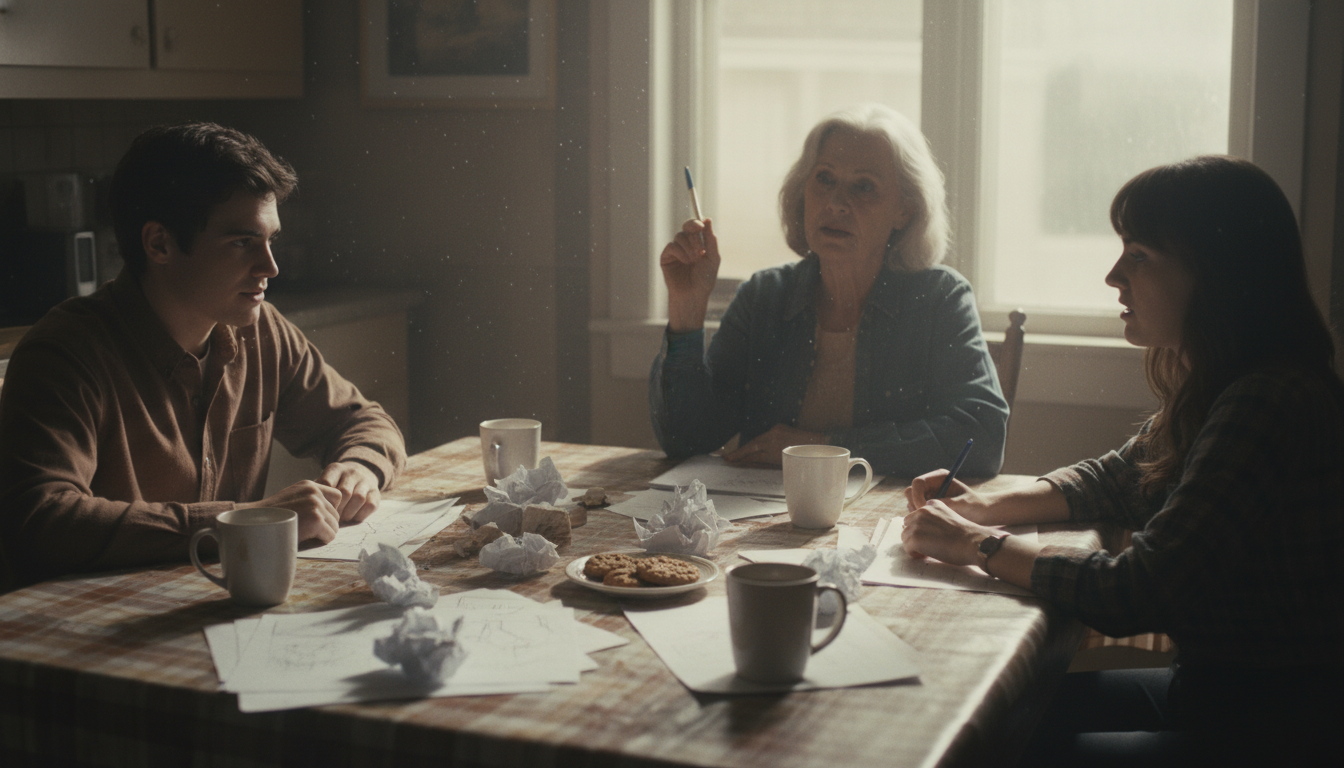
He watched Mrs. Battiste, her face flushed with excitement, sketching a rough floor plan. Her movements were quick, her hand firm. But as her pen reached the edge of the paper, it faltered, a tiny, almost invisible tremor. She looked up, her eyes meeting his, and for a fleeting moment, the fierce hope in them was replaced by a flicker of something much older, much darker, a fleeting recognition of a threat that had always been lurking just beyond the edge of their little, dreaming world, waiting.
Share This Story


