The Concrete Patio
David arrives at a secluded, high-end property during a stifling summer night to meet an estranged friend, intending to resolve a dangerous conflict.
The heat was not merely a temperature; it was a physical aggressor. It pressed against the back of David’s neck like a wet wool blanket, heavy and smelling of sweet rot and exhaust. Down here in the ravine, where the humidity collected in a stagnant pool, the air felt chewable. The cicadas were screaming—a frantic, metallic saw-blade noise that seemed to vibrate in the hollow spaces behind his teeth. It was the kind of sound that made silence feel like a threat.
David adjusted the collar of his shirt, which was already damp and clinging to his skin. He hated this neighbourhood. He hated the way the driveways were too long, curling away from the street like secrets, hidden behind walls of manicured cedar and wrought iron. The pavement under his sneakers was still radiating the day’s violence, baking the soles of his feet. He checked his phone again. No service. Of course. The signal always died near the river, choked out by the density of the maples and the sheer indifference of the geography.
The gate to the property was unlatched. That was the first thing that made his stomach turn over—a slow, sickly rotation. Jeff never left the gate unlocked. Security was a religion in this house, a fortress of glass and poured concrete designed to keep the world out, or perhaps to keep the rot within. David pushed the metal. It swung inward with a heavy, oiled silence that was more unnerving than a squeak would have been. He stepped onto the aggregate stone of the driveway.
"You’re late," a voice called out, slicing through the drone of the insects.
David looked up. Jeff was standing on the upper balcony, a dark silhouette cut out against the light pollution of the city sky. He was leaning over the glass railing, looking for all the world like a gargoyle dressed in linen.
"Bus was slow," David lied. His voice cracked, just a fracture, but he knew Jeff heard it. "Traffic on the Parkway."
"Traffic," Jeff repeated, dragging the word out, tasting it. "On a Tuesday night. Sure. Come round the back. The front door is alarmed, and my dad will have an aneurysm if you trip it again."
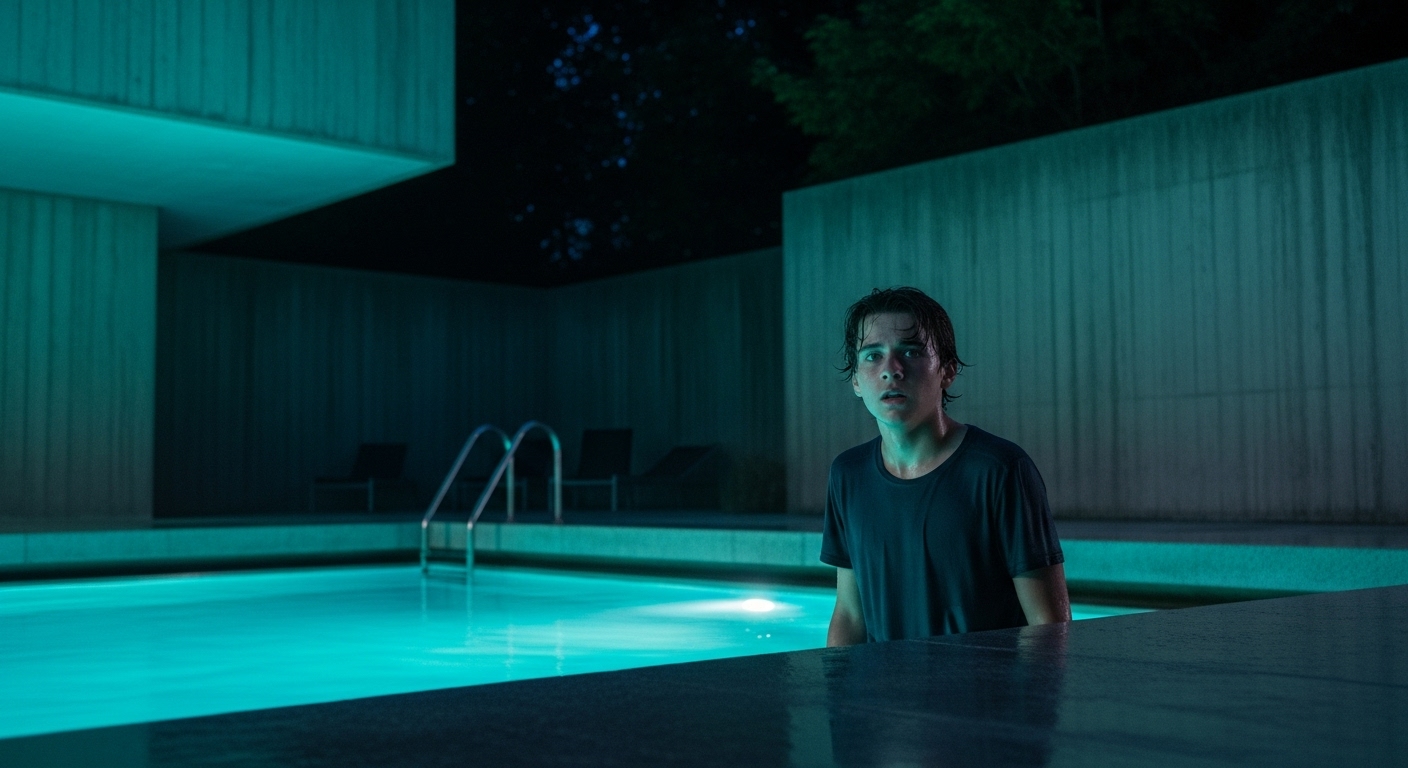
David walked around the side of the house, his shoes crunching on the decorative white gravel. The smell of chlorine hit him before he saw the water—sharp, chemical, and strangely comforting in its sterility. It cut through the organic funk of the river mud. The backyard was a masterpiece of stark, expensive minimalism. A rectangular pool, lit from within by turquoise lights, glowed like a radioactive jewel in the darkness. The rest of the patio was shadow and hard angles.
Jeff was already downstairs, lounging on one of the teak sunbeds, a glass of something amber sweating in his hand. He didn’t get up.
"You look terrible, Si," Jeff said, flashing a smile that was all teeth and no warmth. "Like you’re attending a funeral for a hamster. Or maybe your own dignity?"
"It’s thirty degrees out, Jeff. We can’t all be climate-controlled," David shot back, trying to keep his hands from fidgeting. He shoved them into his pockets, fingers brushing against the lint and the keys he was gripping too tight. "You wanted to talk. I’m here. Let’s do the thing."
Jeff took a sip of his drink, the ice clinking with a sound like small bones breaking. "'Do the thing'. You make it sound like a drug deal. Relax. Sit down. You’re making the feng shui nervous."
David didn’t sit. He stood near the edge of the pool, looking down at the water. It was perfectly still, a slab of blue gelatine. Then, a ripple broke the surface. A pale arm emerged, water sluicing off the skin, followed by a head of wet, sleek hair. Bea. She pulled herself up onto the coping, gasping for air, her mascara smeared under her eyes like war paint.
"Jesus," David breathed, stepping back. "I didn’t know she was here."
"Hello to you too, David," Bea said, her voice raspy. She didn't look at him. She was staring at her own feet, watching the water drip from her toes onto the hot concrete. "Don't worry. I'm not really here. I'm just part of the scenery. Like a potted plant. Or a gargoyle."
"She’s the witness," Jeff said lazily, gesturing with his glass. "Can't have a peace treaty without a witness. Otherwise, it’s just two liars in the dark."
David felt a fresh wave of sweat prickle his hairline. "Peace treaty. Is that what this is? keeping in mind that the last time we were all together, you threatened to ruin my life if I said a word about the car."
"And you didn't say a word," Jeff pointed out. He set his drink down on the limestone table. The condensation left a perfect wet ring. "Which is why we’re here. To formalize the arrangement. To... exhale."
---
The Offering
Jeff stood up. He was taller than David remembered, or maybe David had just shrunk under the pressure of the last three weeks. Jeff walked over to a backpack resting on a chair—David’s backpack. The one he’d left in the trunk that night.
"I brought your stuff," Jeff said, nudging the bag with his foot. "Laptop. Sketchbook. Even that weird inhaler you don't use anymore. It’s all there."
David stared at the bag. It looked like a trap. It looked like it was going to explode.
"Just like that?" David asked. "You’re giving it back?"
"I’m decluttering," Jeff said, a smirk playing on his lips. "My therapist says I need to let go of the past. Holding onto your geometry homework felt... petty. Plus, it smells like your basement. Musty. Like despair and old carpets."
"My basement smells fine," David muttered, defensive despite himself. He stepped forward, reaching for the strap.
"Ah," Jeff said, intercepting him with a hand on his chest. The contact was shocking—Jeff’s palm was cold from the glass, damp and firm. "Not yet. We have to drink on it. It’s tradition. Ancient laws of hospitality and all that rubbish."
"I don't want a drink, Jeff."
"It’s ginger ale, you paranoid wreck," Bea said from the pool edge. She was wringing out her hair, the water pattering onto the stone. "He’s not poisoning you. He’s too narcissistic for murder. He’d miss the audience."
Jeff laughed, a sharp bark of a sound. "She knows me so well. It’s touching, really. Come on, Si. One drink. To moving on. To forgetting the dent in the bumper and the... unfortunate noise it made."
David felt the blood drain from his face. The noise. The crunch of plastic and metal. He looked at Bea. She was shivering, despite the heat. She knew. She had been in the backseat.
"Fine," David whispered. "One drink."
Jeff turned to a cooler by the lounger and pulled out a can of soda. He popped the tab—a sharp hiss that echoed off the concrete walls—and handed it to David. The can was freezing cold. It hurt to hold.
"To amnesty," Jeff proposed, raising his own glass.
"Amnesty," David echoed, lifting the can. He didn't drink. He just held the cold metal against his lip, letting the condensation run down his chin.
The garden was too quiet now. The cicadas had paused, as if holding their breath. The only sound was the hum of the pool filter and the distant, low roar of the highway across the ravine.
"You know," Jeff said, sitting back down and crossing his legs. "I was worried about you. I thought you might crack. You have that look. The 'I'm going to confess to a priest' look. But you surprised me, Si. You held the line."
"I didn't do it for you," David said, his voice gaining a fraction of strength. "I did it because I didn't want my mom to find out I was in the car."
"Motives are irrelevant. Results are what matter," Jeff waved a hand dismissively. "And the result is, we are in the clear. The car is fixed. The paint is fresh. The universe has reset."
Bea made a sound—a choked, wet cough. "Reset," she muttered. "Right."
David looked at the backpack again. "So I take this, and we're done? We go back to... what? Ignoring each other in the cafeteria?"
"Preferably," Jeff said. "I mean, we can't be friends, David. You're too... porous. You absorb guilt like a sponge. It makes you tedious to be around. But we can be... neutral. Like Switzerland, but with better landscaping."
David knelt and grabbed the strap of his bag. It felt heavy. He unzipped the main compartment. His laptop was there. His sketchbook. He riffled through the pages. The drawings were untouched. He felt a sudden, crushing wave of relief, so intense it made his knees weak.
"Everything seems to be here," David said, zipping it back up.
"Told you," Jeff said. "I'm a man of my word. When it suits me."
David slung the bag over his shoulder. The weight was grounding. "Okay. Amnesty. I'm leaving."
"Don't forget to write," Jeff called out, raising his glass again. "Or actually, please don't."
Bea didn't say anything. She just watched him, her eyes dark holes in her pale face. As David turned to walk away, she slipped back into the water, sinking below the surface without a splash, like a stone dropping into a well.
---
The Long Walk
David walked back down the driveway, his heart hammering a frantic rhythm against his ribs. He wanted to run, but he forced himself to walk. Running was an admission of guilt. Running attracted predators. He focused on the sound of his shoes on the gravel. Crunch. Crunch. Crunch.
He reached the gate and pushed it open. The metal groaned, louder this time. He stepped out onto the street. The air here was just as hot, just as thick, but it felt different. Less controlled. Less watched.
He started walking up the hill, towards the bus stop. The relief was beginning to curdle into something else—suspicion. It had been too easy. Jeff didn't just give things back. Jeff exacted prices. He traded.
David stopped under a streetlamp. The bulb was buzzing, a dying yellow light that cast long, distorted shadows. He swung the backpack around and unzipped it again. He needed to be sure. He pulled out the laptop. It was his. scratches on the lid, the sticker from the skate shop. He opened it. Dead battery. Fine.
He pulled out the sketchbook. He flipped through it again. Sketches of trees, of his dog, of the school. And then he stopped.
On the very last page, the paper was different. Thicker. It wasn't his paper. It was a photograph, taped onto the sheet.
David leaned closer to the dim light. It was a photo of a house. His house. Taken from the street, at night. Recently. He could see his mom’s car in the driveway. And in the window—his bedroom window—there was a silhouette. Him.
A cold horror, sharper than the ice in Jeff's glass, pierced through his chest. Under the photo, in Jeff's neat, architectural handwriting, was a single line of text:
Collateral.
David slammed the book shut. His breath was coming in short, jagged gasps. It wasn't a peace treaty. It was a leash. Jeff wasn't giving him his life back; he was showing him that he owned it.
He shoved the book back into the bag and started to walk, faster now, almost jogging. The cicadas were deafening, a roaring chorus of judgment. The shadows of the trees seemed to stretch and grab at his ankles.
He turned the corner onto the main road, hoping for the lights of a bus, for people, for anything normal. The road was empty. Just a long ribbon of black asphalt shimmering under the heat haze.
Then he saw it.
Parked fifty metres down the road, tucked into the shadow of a large oak tree, was a dark sedan. The engine was off, but the parking lights flicked on as soon as David appeared. It wasn't Jeff's car. It was older, nondescript. A car you wouldn't notice unless you were looking for it.
David froze. The car sat there, idling now, a low purr that vibrated in the soles of his feet. The windows were tinted dark, impenetrable. He gripped the strap of his backpack until his knuckles turned white. He had thought he was leaving the trap, but the cage was just bigger than he realized.
The car rolled forward, inching out of the shadows, turning its nose toward him. David took a step back, the gravel slipping under his heel.
The flashlight beam cut through the humidity like a solid bar of light, catching the license plate of the car parked just down the road—a car that definitely hadn't been there when David walked in.
Share This Story


