A Failure of the Grid
The new subdivision was a ghost town of good intentions. Skeletons of half-built houses stood against the bruised purple sky, their windows empty sockets. The only finished things were the roads, perfect black ribbons of tarmac that went nowhere, and the electrical substation, a huge, caged beast crouched at the edge of it all, humming its single, monotonous note into the thick, humid air of the last night of August.
“It’s just induction,” Simon said for what must have been the tenth time, his voice sounding overly loud in the quiet. He straddled his bike, one foot on the pavement, the other on a pedal, ready to flee. “The fence isn’t electrified. You might feel a tingle, a little static discharge. That’s it. Basic physics.”
Maria didn’t reply. She was sketching in her notebook, the soft scratch of her pencil a counterpoint to the substation’s oppressive hum. She wasn’t drawing the substation itself, but the negative space around it: the stark, geometric shapes the transformers and wires cut out of the twilight sky. It was all sharp angles and menace.
The hum was the worst part. It wasn’t just a sound; it was a feeling. It vibrated in your teeth, in the bones of your skull. It had been the soundtrack to their summer, the bassline to their boredom. And the dare had been Simon’s idea, a final challenge before his dad’s job relocated them to Calgary. ‘The Fence,’ they called it, as if it were a mythical beast.
“Are you even listening?” he asked.
“I’m listening,” she said, not looking up. “You’re using science to be brave. It’s your coping mechanism.”
“It’s not a coping mechanism, it’s a fact. The fence is grounded. It’s a Faraday cage. We’re in more danger from the mosquitoes.” He slapped his neck to prove the point.
She closed her sketchbook. The drawing was good. It captured the feeling of the place: lonely and dangerous. “Fine. Let’s do it. Then can we go get Freezies?”
“Deal.” He dropped his bike on the grass verge and walked to the ten-foot-high chain-link fence. The warning signs, with their stark red lightning bolts and block letters, seemed to vibrate with the hum.
Maria followed, leaving her own bike next to his. The air felt thicker closer to the fence, charged with energy. She could feel the fine hairs on her arms standing up. Simon was right, it was probably just static, but her lizard brain didn’t care about Faraday cages. Her lizard brain was screaming at her to run.
“Together?” Simon asked. His voice had lost some of its scientific certainty. His face was pale in the fading light.
“Together,” she agreed.
He held out a hand. His palm was sweaty. She took it.
“On three,” he said.
“Okay.”
“One.”
The hum seemed to get louder, to focus directly on them.
“Two.”
She squeezed his hand. This was it. The last stupid, pointless, perfect thing they would do together.
“Three.”
---
They reached out with their free hands and pressed their fingertips to the cool, diamond-patterned steel of the fence.
There was no jolt. No tingle. No shock.
Instead, the hum stopped.
It didn’t fade or wind down. It cut off, instantly and completely. The sudden, absolute silence was a physical blow. It was more shocking than any amount of electricity could have been. In the wake of the noise, Maria’s ears rang with a high, thin whistle.
And in the same instant, the lights went out.
The single streetlamp at the subdivision’s entrance. The distant lights of houses. The soft glow on the horizon from the city proper. Everything. Gone. They were plunged into a darkness so profound it felt like a blanket had been thrown over the world. The only light was the sliver of a crescent moon, which did little more than turn the clouds from black to a deep, bruised grey.
“Simon?” Maria’s voice was a tiny, trembling thing in the vast silence.
“I’m here.” His hand was gripping hers with painful force. “What happened? A blackout? A transformer must have blown.” He was talking fast, his rational mind scrambling for purchase on the smooth, terrifying surface of the impossible.
“Did we do that?” she whispered.
“No! Of course not. Don’t be stupid. It’s a coincidence. A massive, city-wide power failure that just happened to occur at the exact second we touched the fence of the main substation. It’s… a coincidence.” Even he didn’t sound convinced.
The silence pressed in. There were no crickets. No distant traffic. No hum of anything. The world had been muted. The air was dead.
They stood frozen for a full minute, hands still pressed against the fence, as their eyes slowly adjusted. The hulking shapes of the transformers inside the compound were just black monoliths against a slightly less black sky.
Then they heard it.
It was a sound from inside the fence. A sound that did not belong.
It was a heavy, rhythmic, dragging sound. The sound of something thick and dense being pulled across gravel. Scrape. Pause. Scrape. Pause.
“Is that a generator?” Simon whispered, his voice cracking.
“Generators don’t sound like that,” Maria breathed.
The sound was slow, deliberate, and it was moving. It was getting closer to the front of the compound, closer to the main gate.
They pulled their hands from the fence as if it had suddenly become white-hot. They backed away, stumbling over the uneven grass.
The dragging stopped.
The silence rushed back in, deeper and more menacing than before. They stared at the dark shape of the main gate, a solid steel rectangle fifty feet away.
A loud, metallic groan echoed through the dead air. It was the sound of old, un-oiled hinges taking a great weight.
The gate was opening.
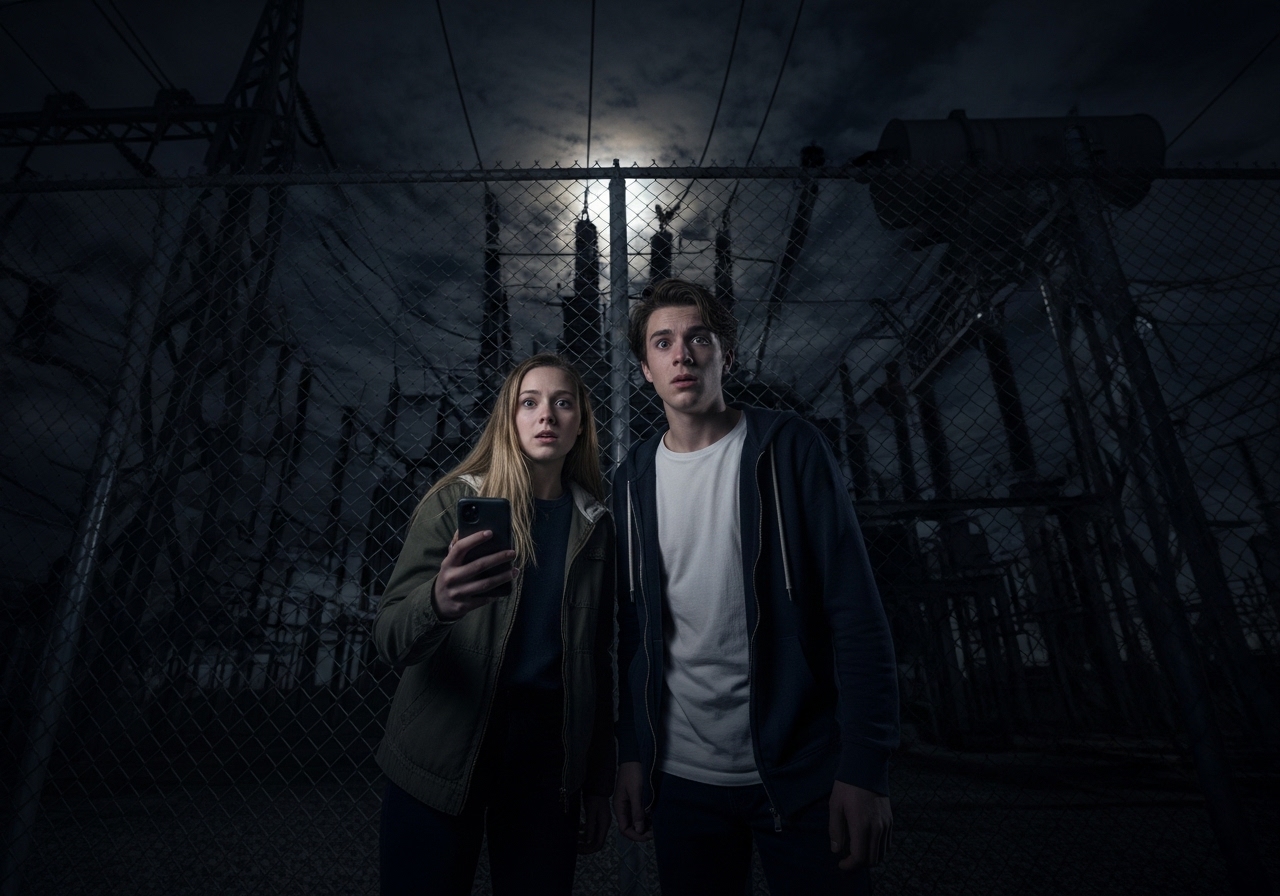
Slowly, a gap of pure blackness appeared as the massive gate swung inward, into the compound. And from the profound silence, a new sound emerged—a soft, wet, shuffling noise, and it was coming towards them.
Share This Story


