The Glass and the Salt
The tide was on its way out, leaving the beach a mess of kelp and glistening stones. The late August sky over the Moray Firth was the colour of slate, and a hard wind whipped in from the sea, carrying the scent of salt and cold distances. It was a day for walking with your head down, shoulders hunched, and your thoughts turned inward.
“Anything?” Lennie’s voice was snatched by the wind. He was twenty paces ahead, his lanky frame a dark silhouette against the churning grey water.
Isla shook her head, even though he wasn’t looking. She scanned the shingle, her eyes tracing patterns in the chaos of pebbles and seaweed. They were looking for sea glass, their final collection before he left. It was a ritual they’d had since they were small, but today her heart wasn’t in it. Her pockets remained empty. The beach felt scoured, unwilling to give up any treasures.
He was leaving on Saturday. Four days. The fact of it was a smooth, cold stone in her gut. He was going to Glasgow, to live with his dad and go to a new college. He talked about it like an escape. To Isla, who had never wanted to be anywhere but here, in their small town wedged between the hills and the sea, it felt like a betrayal.
“Just rocks and rubbish,” she called out. The wind threw the words back in her face.
Lennie had stopped. He was crouched near a tangle of fishing nets and driftwood, partially buried in the wet sand. When she caught up, he was brushing sand off a dark green bottle.
“Now this is something,” he said, a rare spark of excitement in his voice. He worked it free and held it up. It wasn’t a modern bottle. The glass was thick and imperfect, full of tiny bubbles, the shape of it old-fashioned, like something a pirate in a storybook would have.
“Look,” he said, turning it over. A cork was jammed tightly in the neck, sealed with a thick coat of dark wax.
“A message in a bottle?” Isla said, the words feeling childish and hopeful.
“Has to be.” Lennie’s grin was wide. He took a flat piece of slate and began chipping away at the wax seal. It was brittle, flaking off in dark red pieces. He worked the cork back and forth, and it finally came free with a soft pop.
He tipped the bottle, and a small, tightly rolled scroll of paper slid into his palm. It was tied with a piece of faded twine. Isla’s heart beat a little faster. For a moment, the bleakness of the day receded. For a moment, there was magic.
With clumsy, cold fingers, Lennie untied the twine and carefully unrolled the paper.
He stared at it. His smile faded.
“What is it?” Isla asked, leaning closer. “A map? A letter?”
“It’s… nothing.” He turned the paper towards her. It was thick, yellowish parchment, but it was completely, utterly blank.
---
The disappointment was sharp, followed by a familiar sense of foolishness. Of course it was blank. The world wasn’t a storybook. It was just a stupid, empty bottle.
“Some prank,” Lennie said, disgustedly. He crumpled the paper and tossed it. The wind caught it and sent it tumbling down the beach. “What a waste of time.”
He made to throw the bottle into the waves, but Isla stopped him. “Wait.”
“What for? It’s junk.”
“It’s beautiful glass,” she said, taking it from him. “I want to keep it.”
The bottle was cold, heavier than it looked. As her fingers closed around the imperfect glass, a strange sensation prickled up her arm, like pins and needles, but deeper, colder. The sound of the waves and the wind seemed to fade, replaced by a low hum that was coming not from the air, but from inside her own head.
And then she saw it.
It wasn’t a thought or a memory. It was a place. A narrow, sun-beaten alley, crammed with people. The smell of spices she didn’t know the names for—sharp and earthy—and the scent of roasting meat. The clatter of a language she couldn’t understand, a rhythmic, musical tongue. A woman with a bright yellow scarf haggled over a pile of red fish, her hands moving in a blur. A boy, no older than ten, dodged through the crowd, carrying a basket of bread that steamed in the hot, dry air. The light wasn’t the pale, watery light of Scotland; it was a fierce, white-gold glare that made the colours of everything—the fruit, the fabrics, the painted doorways—vibrant to the point of hurting.
It lasted only three seconds, but it was more real than the beach around her. When it was gone, the sudden return of the wind and the grey sea was a physical shock. She stumbled back, the bottle slipping from her grasp and landing softly in the sand.
“Whoa, you okay?” Lennie was looking at her, his annoyance replaced with concern. “You look like you’ve seen a ghost.”
“I…” She struggled for breath. “I saw something.”
“Saw what? There’s nothing out there but gulls.”
“In the bottle. When I touched it.” She tried to explain, the words feeling clumsy and inadequate. “A place. A market. It was so hot, and there were all these smells, and a woman was buying fish…” She trailed off, seeing the scepticism return to his face.
“Isla, you just… spaced out for a second.”
“No, it was real,” she insisted, her voice trembling slightly. “I could smell it, Lennie. I could feel the heat.”
He knelt and picked up the bottle, holding it cautiously. He turned it over and over in his hands. “I don’t feel anything. It’s just a cold bottle.”
“Let me try again.”
She reached for it, her hand shaking. He hesitated, then passed it to her. She took a deep breath, braced herself, and wrapped her fingers around the glass once more.
Nothing. Just the feel of cold, inert glass against her skin. The wind, the waves, the distant cry of a curlew. No vision. No humming. Nothing.
A flush of embarrassment crept up her neck. Maybe he was right. Maybe she’d just had a weird dizzy spell, a waking dream triggered by the cold.
“See? Nothing,” Lennie said, his voice gentle now. “Come on. Let’s head back. It’s getting dark.”
She nodded, but she couldn’t let go of the bottle. She clutched it to her chest as they started the long walk back along the darkening beach. She felt Lennie’s sideways glances, felt the distance opening up between them, a gulf wider than the four days until he left. He thought she was crazy. Maybe she was.
But she couldn’t forget the clarity of it. The yellow scarf. The steam rising from the bread. The specific, sharp scent of an unknown spice. It wasn’t a dream. It was a memory. But it wasn’t hers.
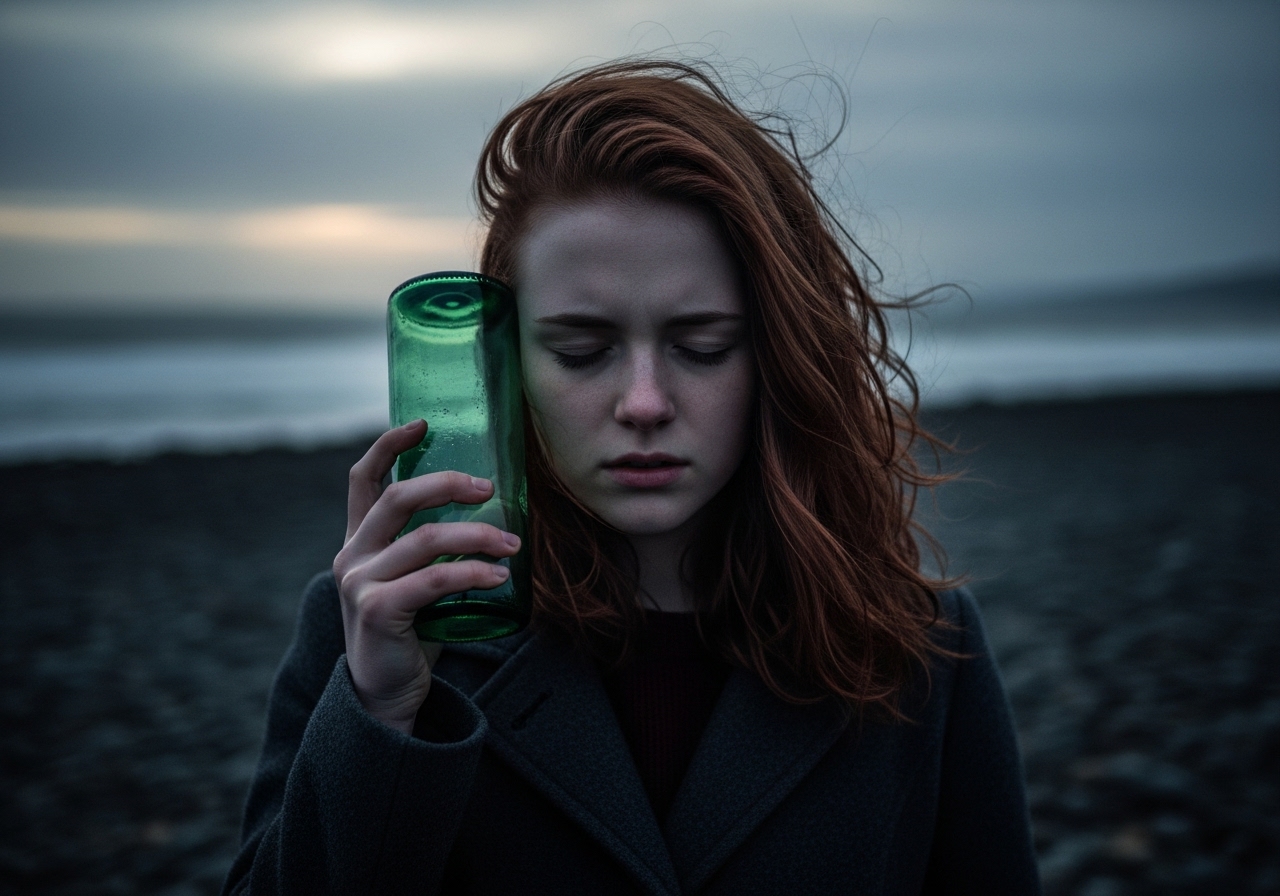
As the last of the light bled from the sky, Isla stopped walking. She looked down at the bottle in her hands, its green glass almost black in the twilight. She had to know. Ignoring Lennie’s call, she closed her eyes and pressed the cold glass to her temple.
Share This Story


