An Art Lesson Interrupted
A group of cynical teenagers are in a dilapidated cyberpunk classroom with their eccentric professor, discussing the abstract concept of art in a technologically advanced, corporately controlled, and socially decaying city. Their academic discussion is suddenly interrupted by a violent corporate lockdown, hinting at a hidden secret.
The ferrocrete cracked under Zach’s worn-out combat boots, a spiderweb pattern spreading wider with each hurried step. Not a good sign. The whole block, Sector 7-C, hummed with a low, sick drone, a sound that crawled under the skin and settled in the molars. Overhead, a web of power conduits, thick as a synth-boa, pulsed with sickly blue light, casting the alley in stuttering, shadow-play movements. It was summer, technically, but the air never really tasted clean here, just a constant metallic tang, thick with exhaust fumes from automated delivery drones that zipped through the canyons of the mega-towers. She pulled the collar of her augmented jacket higher, the chipped chromework on the right sleeve catching a brief, unwanted gleam from a passing sanitation bot.
“You’re late, Zach-Unit 404. Proceed with expedited velocity. Professor Ennings expects full attendance.” The voice, flat and synthesized, chirped from her wrist-comm. It was the school’s automated attendance system, Glitch, always tracking, always judging. Zach bit back a retort, a familiar sour taste rising in her throat. ‘Zach-Unit’ felt less like a name and more like an inventory tag. She sped up, her knees protesting. The heat from the broken exhaust grates along the building’s base was oppressive, smelling faintly of burnt copper and old cooking oil. A small, black drone, no bigger than her fist, detached from a wall-mounted sensor and hovered, its single red eye blinking, following her. Always following.
She finally burst through a scarred, steel door, the automatic lock hissing loudly behind her. The corridor beyond was mercifully cooler, but smelled of stale synth-coffee and ozone-scrubbers fighting a losing battle against the city’s inherent funk. Her destination: Classroom Beta-9, a relic of pre-Collapse architecture, now repurposed. It was one of the few rooms left where the holo-screens didn’t flicker with corporate ads every thirty seconds. A small victory, maybe. The door hissed open again, revealing the room. Professor Ennings stood at the front, her posture as rigid as the skeletal art installation behind her – a tangled mess of reclaimed circuit boards and discarded data cables, shaped vaguely like a weeping angel.
The professor, a woman whose face bore the etched lines of too many system crashes and too few real sunsets, watched Zach with an unnervingly calm gaze. Her hair, once probably a vibrant shade, was now streaked with more grey than actual color, pulled back in a severe bun. She wore a simple, unadorned tunic, a stark contrast to the logo-plastered, light-up gear everyone else favored. Three other teens were already there, slumped in the ergonomic seats that still smelled faintly of disinfectant. Hiro, who always looked like he'd just woken up from a particularly vivid dream or nightmare, was picking at a loose thread on his sleeve. Lucy, whose cyber-optic implants glowed a soft amethyst, was meticulously polishing them with a microfiber cloth. And Kai, forever staring at the rain-streaked window, probably mentally calculating the odds of a structural integrity failure.
“Zach,” Professor Ennings said, her voice a low thrum that managed to cut through the room’s ambient hum. “Precisely seven minutes and twelve seconds late. Your bio-rhythms indicate elevated stress. Anything… stimulating happen on your transit?”
Zach shrugged, trying to catch her breath. “Just the usual. A rogue sanitation drone tried to calibrate my trajectory. And Glitch got chatty.” She slid into the nearest chair, the cold synth-leather a shock against her clammy skin. She avoided eye contact, instead focusing on a stubborn brown stain on the ceiling panel, wondering if it was old nutrient paste or something worse.
Professor Ennings’s thin lips twitched, almost a smile. “Ah, Glitch. Our ever-present digital chaperone. A true connoisseur of punctuality. And a rogue drone… a new form of urban ballet, perhaps?” She paused, letting the absurdity hang in the air, a peculiar scent mixing with the room’s staleness. It was supposed to be a humorous tone, Zach knew. But it always felt… heavy. Like a joke told by someone who’d forgotten the punchline centuries ago.
“Alright, class. If we can call it that. Our last session for the summer cycle. Today, we delve into a topic many consider… archaic. Primitive, even. The arts.” Professor Ennings gestured vaguely towards the circuit-board angel, then to a blank holo-screen that should have been displaying corporate-mandated educational modules. “In a world optimized for data streams, for efficiency, for predictable output, where does the chaotic, the inefficient, the purely aesthetic fit? What, if anything, is its positive impact?”
Hiro finally looked up, blinking slowly. “Professor, with all due respect, my father says art is… inefficient data. A waste of processing power. He says it’s for… the recreational units. The bots that clean the Sector 4 parks, they have programmed ‘aesthetic appreciation’ subroutines. For the humans, it’s just more algorithms.” He fiddled with his sleeve again, his gaze drifting to the weeping angel, as if trying to decipher its hidden code.
Lucy, without looking up from her polished implants, murmured, “It’s just another market, isn’t it? Corporate art, designed by algorithms to evoke specific consumer responses. Like the emotional conditioning in the new Neo-Corp ad campaigns. They even have a 'nostalgia-wave' generator, calibrated to trigger… lost childhood memories.” Her voice was flat, devoid of real emotion, as if she were reciting a data log. The amethyst glow of her eyes pulsed slightly.
Kai, still staring out the window, finally spoke, his voice a low monotone. “The Mega-Corp ‘Visionaries’ exhibit last cycle. It was just a re-rendering of ancient pre-Collapse propaganda posters. Repackaged as ‘critical commentary.’ Priced at thousands of credits per holo-frame. Positive impact for who? The shareholders, probably.” His shoulders slumped slightly, a barely perceptible shift.
Zach watched them, a knot tightening in her stomach. They weren’t wrong. Not really. Most art she knew was either propaganda, luxury commodity, or some niche subculture’s rebellion that would inevitably be co-opted and sold back to them. Yet, a tiny part of her, a part she rarely acknowledged, still felt something when she saw the graffiti tags under the bridge, the ones that glowed with illicit bioluminescent paint, shifting colors in patterns too complex for any corporate bot. Or the fractured synth-tunes that sometimes leaked from the underground 'glitch-bars,' full of dissonant harmonies and raw, unpolished static. She wondered if Professor Ennings knew about those. Probably not. The professor operated in a different layer of reality.
“These are… astute observations,” Professor Ennings conceded, her gaze sweeping across their faces, lingering slightly on Zach. “And you’re not wrong. Much of what is branded ‘art’ today is indeed a product, a tool, a distraction. But what of true creation? The act itself? The impulse?” She walked over to a worn-out data slate on her desk, its casing cracked, held together by what looked like industrial-strength tape. She tapped it, and a grainy, flickering image appeared on the main holo-screen: a black and white photograph of a young woman, her face smudged with charcoal, intensely focused on a canvas Zach couldn’t see.
“This,” Ennings began, her voice softening, losing some of its classroom formality, “is a memory-fragment. From a time before the Great Optimization, before the data-crunchers determined human creativity was simply an inefficient algorithm. This woman… she was a street artist. Unpaid. Undirected. She painted what she saw. What she felt. Her art never made it to a corporate gallery. It was impermanent. Often painted over within days. But for a brief moment, it existed. And for those who saw it, felt it… perhaps it offered something.”
Hiro yawned, covering his mouth. Lucy clicked her cyber-optics, adjusting their focus, as if analyzing the image’s pixel density. Kai merely sighed, a gust of air that carried the faint smell of old plastic. Zach, though, felt a weird pull. The woman’s eyes in the image, even through the digital decay, were fiercely alive. A spark. Like the sudden flash of a short-circuit, dangerous and beautiful. She imagined the smell of the charcoal, dusty and earthy, the rough texture of the canvas, the scrape of it under fingernails. She imagined the wind on the woman’s face, not the recycled, filtered air of their sectors, but real, open-sky wind.
“What did it offer?” Zach found herself asking, surprising even herself. The words felt raw in her throat, a little too loud in the quiet room. She hated how easily her voice betrayed her moments of genuine curiosity. Glitch probably just tagged it as 'query protocol: initiated'.
Professor Ennings turned to her, a flicker of something, perhaps hope, in her tired eyes. “Escape, Zach. A moment of pure, unadulterated human connection. A reminder that there was, is, something beyond the endless cycle of production and consumption. A voice that isn’t dictated by profit margins. Think of the pre-Collapse poets, the musicians, the storytellers. They weren’t optimizing. They were… expressing. And in that expression, they found shared humanity. They built bridges of understanding across vast cultural divides.”
“Bridges that probably got blown up during the Resource Wars,” Kai muttered under his breath, still watching the window, but now with a cynical glint in his eye. “Or paved over for new transit lines. Humanity’s good at that. Destroying bridges.”
“Indeed,” Ennings agreed, not missing a beat. “But the memory of the bridge remains. The blueprint. The idea. That is the resilience of art. It persists in the collective subconscious, awaiting rediscovery. Like a buried data chip, waiting for the right current to reactivate it.”
Lucy finally removed her cloth from her implants. “The neural pathways are simply re-routed, Professor. The ‘collective subconscious’ is just a network of shared memory caches. Easily manipulated. Corporate entities do it all the time. They reactivate ‘nostalgia protocols’ to sell synth-snacks from your childhood. Is that art? Or just effective marketing?” She stared at the professor with her glowing amethyst eyes, challenging, but without malice. Pure data analysis.
“The intent is different, Lucy,” Professor Ennings insisted, her voice gaining a touch of urgency. “The soul behind the creation. One is designed to elicit a predictable response for profit. The other… the other is an offering. A vulnerability. A shared experience that defies commodification.” She paced the small space between her desk and the students, her fingers fiddling with the antique data slate. “Consider the primal need. Before sophisticated tech, before even organized language, humans etched symbols onto cave walls. Why? Not for commerce. Not for efficiency. But to capture a moment. To communicate a feeling. To leave a mark that said, ‘I was here. I felt this.’ That, Zach, is the core positive impact. It affirms existence.”
Zach shifted in her seat. Affirming existence. That sounded… heavy. And a little terrifying. Most days, she just tried to survive it. But the graffiti tags under the bridge, the glitch-tunes… they did feel like someone yelling, ‘I was here!’ in a world that mostly wanted everyone to be quiet, to be compliant. She remembered a specific tag: a neon green eye, staring out from a crumbling support pillar, so bright it hurt to look at. It had made her feel seen, somehow, even as she scurried past, anonymous. It had, for a fleeting second, felt like a warning, or a conspiratorial wink. It wasn't an algorithm. It was something else. Something messier.
“So, you’re saying art is… like, a human error?” Hiro offered, a faint trace of humor in his voice. “A bug in the system that makes us feel… less like robots?” He actually cracked a small smile, showing teeth Zach hadn't realized were there. It was almost jarring.
Professor Ennings stopped pacing, a genuine, if weary, smile spreading across her face. “Precisely, Hiro. A glorious, magnificent bug. A beautiful inefficiency. It’s what reminds us we are not simply data processors. We are… sentient chaos. And that chaos, when channeled, can create something truly profound.” She looked around the room, at the slumped shoulders, the glowing implants, the distant gazes. “It fosters empathy. It challenges perspectives. It gives voice to the voiceless, even in a world where voices are increasingly filtered, processed, and monetized.”
A distant siren, thin and reedy, sliced through the air, momentarily disrupting the drone of the city. Kai flinched, his head snapping towards the window. Lucy’s implants glowed brighter, cycling through different shades of amethyst. Hiro’s smile vanished, replaced by a familiar weariness. Zach felt a familiar tightening in her chest. Sirens rarely meant anything good. Especially in Sector 7-C.
“What do you call those underground songs, Professor?” Zach asked, trying to steer the conversation away from the ever-present threat outside, back to this fragile bubble of art discussion. “The ones that… don’t have a clear melody, just sounds? Scratches and hums.”
“Noise music, perhaps? Glitch-hop? There are many sub-genres that emerged from the urban decay,” Ennings replied, her eyes thoughtful, as if sifting through forgotten archives. “They reflect the fragmented reality, the static in the signal. They are, in their own way, incredibly honest expressions of the human condition in a post-digital age.”
Suddenly, the entire room flickered. The holo-screen glitched, briefly displaying a cascade of binary code before dying completely. The overhead lights pulsed, dimming to a sickly yellow, then brightening erratically. A heavy thud vibrated through the floor, followed by another, closer this time. It sounded like something large hitting the building’s exterior. Or something entering.
“What was that?” Hiro whispered, his voice tight, all traces of his earlier humor gone. He pushed himself upright, eyes darting nervously towards the steel door.
Professor Ennings’s composure, usually unshakeable, fractured. Her eyes widened, a rare glimpse of fear. “Stay calm. It’s likely just a localized grid fluctuation. The summer surges are… unpredictable.” But her voice lacked conviction. The building groaned, a deep, metallic shriek that made the circuit-board angel tremble on its stand. Dust, fine and grey, drifted down from the ceiling panels.
A new voice, deeper and more authoritative than Glitch, boomed from the building’s internal comms system, overriding all other frequencies. “Attention, Sector 7-C inhabitants. Unauthorized data infiltration detected. Security protocols initiated. All non-essential personnel are advised to shelter in place. Remain calm. Corporate assets are securing the perimeter.” The voice repeated the message, its calm tone chilling. Corporate assets. That always meant trouble. Trouble for anyone who wasn’t corporate.
Lucy finally lowered her hand, her implants still glowing fiercely, no longer just polishing. “Perimeter securing… that usually means a lockdown. Or worse.” Her voice was still flat, but the underlying tension was palpable. She scanned the room, then the darkened holo-screen, as if searching for a data leak she could patch with her mind.
Kai was no longer looking out the window. He was staring at the professor, his face pale. “Professor… do you think this is about… the archive?” His words were barely a whisper, but in the sudden, tense silence, they resonated like a clang of metal.
Professor Ennings flinched, a sharp intake of breath. The name of the 'archive' was usually spoken in hushed tones, almost a myth. It was supposed to be a clandestine collection of pre-Collapse art, literature, and music, hidden from the corporations who sought to monetize all culture. If it was real, and if it was here, then they were in serious trouble. Her gaze met Zach’s, a silent message passing between them: this is no drill.
The steel door to Classroom Beta-9, the one that had just hissed shut behind Zach, began to vibrate. A low, rhythmic thudding started, growing louder, more insistent. Like a battering ram. Or something with heavy, metallic fists. The sound swallowed the ambient hum of the city, swallowed the distant siren, swallowed the frantic beating of Zach’s own heart. Her mind raced, the abstract beauty of art suddenly a distant memory, replaced by the very real, very present threat of corporate enforcers. She looked at the circuit-board angel, its weeping form now seeming less mournful and more terrified, as if it too understood the meaning of that relentless, approaching sound. They were trapped, a handful of teenagers and a professor, in a room full of forgotten dreams, and the corporations had finally come knocking, not for art, but for the archive, and whatever secret it held.
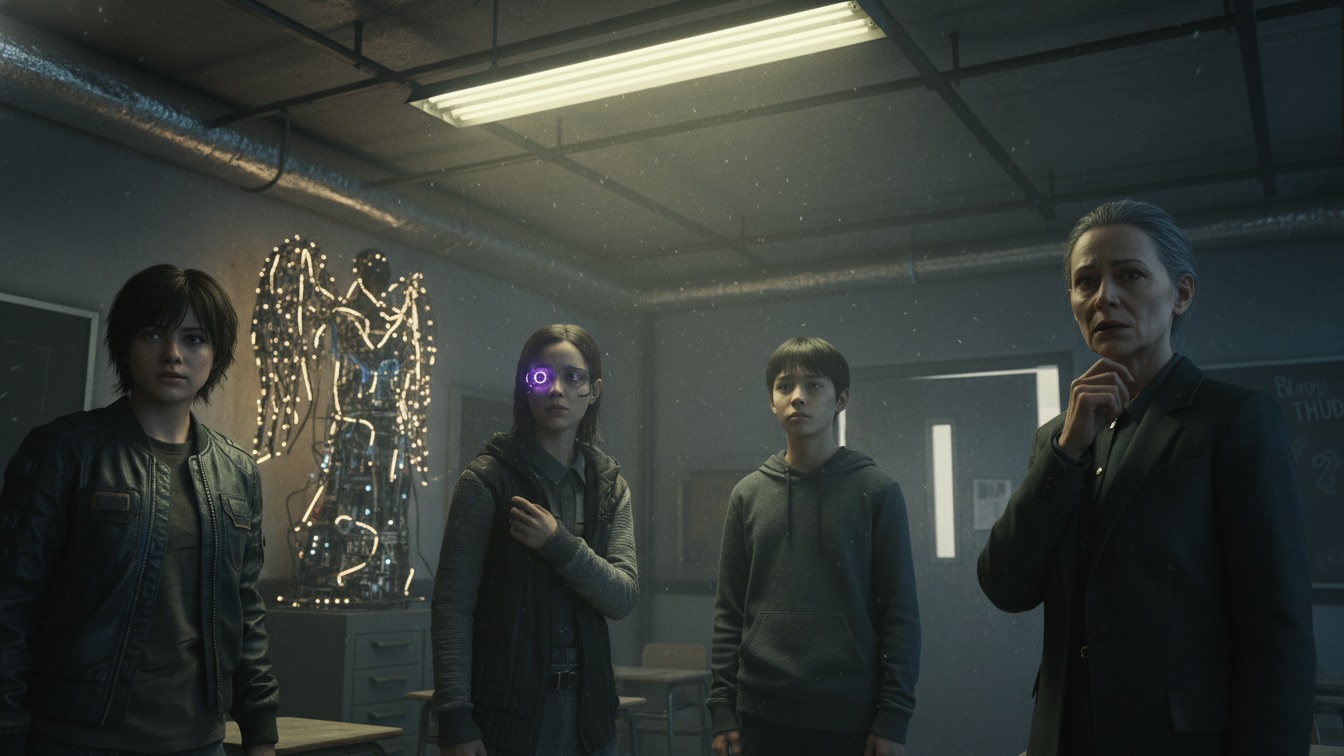
She looked at the circuit-board angel, its weeping form now seeming less mournful and more terrified, as if it too understood the meaning of that relentless, approaching sound. They were trapped, a handful of teenagers and a professor, in a room full of forgotten dreams, and the corporations had finally come knocking, not for art, but for the archive, and whatever secret it held.
Share This Story


