The Burn in the Gate
The attic smelled of time. Not the musty, decaying smell of forgotten things, but the sharp, clean scent of old paper, cedar planks, and the faint, almost metallic tang of hot dust on the single bare bulb. A fan in the corner stirred the thick, soupy air, doing little more than rearrange the heat. Projected on the slanted ceiling, a grainy, silent image of their town’s main street flickered, a ghost from fifty years ago.
“Look, there’s your dad,” Julie said, pointing a finger that bisected the projector’s beam, her shadow dancing on the ceiling. “God, the hair. That is a truly criminal moustache.”
Noah laughed, adjusting the focus knob on the old Bell & Howell projector. “It was the eighties. Moustaches were a legal requirement.” He watched the flickering image of his father, impossibly young, trying to win a coconut at a sideshow stall. This was their project: ‘The Town That Was.’ A final collaboration before Julie left for theatre school in Toronto. A collection of forgotten moments, captured on decaying acetate, curated by him, narrated by her.
“It’s weird seeing them all like this,” Julie said, her voice softer now. She had tucked her knees up to her chin, her face washed in the projector’s flickering light. “Like they had whole lives before we existed.”
“That’s the point,” Noah said. “Every town is a haunted house.” It was a line he was proud of, one he’d already decided they would use in the film’s opening.
He let the reel run out. The film leader flapped rhythmically in the projector gate, a sound like a tired heart. He switched off the lamp, and the attic plunged back into dim, dusty reality. “That’s the last of the labelled ones. The ‘Founder’s Day’ box is done.”
“What’s in that one?” Julie gestured to a small, metal film canister resting on a stack of old magazines. Unlike the others, this one had no faded label, no scrawled date.
“I don’t know,” Noah admitted. “It was at the bottom of the chest. Could be anything. Could be nothing. Probably my grandparents’ trip to Niagara Falls.”
“Only one way to find out,” she said, her eyes gleaming with curiosity. “Thread it, filmmaker.”
---
The film was brittle with age. Noah handled it with practiced care, his fingers deftly guiding the celluloid strip through the projector’s complex path. He switched on the motor, then the lamp. Click-clack-click-clack.
Light flared on the ceiling again. The image was shaky at first, overexposed. Then it settled. It was another Founder’s Day, but a different one. Newer. The clothes were less dated, maybe early nineties. The footage was in colour, a faded, washed-out palette that made everything look like a dream.
The camera panned across a crowd of familiar faces, younger versions of the people they saw every day at the grocery store, the post office. There was Mayor Thompson, not mayor then, flipping burgers. There was Mrs. Gable from the library, winning a teddy bear nearly as big as she was.
“Hey, stop,” Julie said suddenly. “Go back a bit.”
Noah stopped the projector and carefully reversed the film by hand. “What is it?”
“There. By the bandstand.”
He found the spot and let the film play forward in slow motion. The camera was unsteady, zooming in on the makeshift stage where a local band was playing. But just to the left of the stage, half-hidden by a striped tent flap, stood a man.
He was old, wearing a dated but well-kept suit and a fedora. He wasn't watching the band; he was scanning the crowd.
“Do you know who that is?” Julie asked, her voice low.
Noah leaned closer to the projected image. The man’s face was distinctive. High cheekbones, a sharp nose, deep-set eyes. He looked familiar, like a photo from the town’s historical society. “He looks like… old Mr. Abernathy,” Noah said slowly. “The one they named the park after. The town benefactor.”
“Exactly,” Julie said. “And when did old Mr. Abernathy die?”
Noah’s blood ran cold. He knew the answer. Everyone in town knew the story. “Nineteen eighty-seven. A fire at his workshop.”
“Right,” she whispered. “And this footage, judging by the cars and the clothes, is what? Ninety-two? Ninety-three?”
They stared at the flickering image of the man who shouldn't be there. He was as solid as anyone else in the frame, casting a shadow, interacting with the world. A gust of wind lifted the brim of his hat.
“It’s not him,” Noah said, shaking his head, searching for a logical anchor. “It’s someone who looks like him. A relative, maybe.”
“He had no relatives,” Julie said. “He was the last Abernathy. That was the whole point. He left everything to the town because there was no one else.”
As they watched, the impossible figure of Mr. Abernathy moved. He stepped out from behind the tent, his eyes finding something in the crowd. The amateur cameraman seemed to follow his gaze, panning clumsily across the sea of faces.
The camera settled on a little girl, maybe five or six years old, holding a pinwheel. She had dark, curly hair and was wearing a red dress. Abernathy walked towards her. He knelt down, so his face was level with hers. They couldn’t hear what he was saying, but he smiled.
Then he reached into his jacket pocket and pulled something out. It was small, dark, and caught the light strangely. It was impossible to tell what it was. He pressed it into the little girl’s hand.
The little girl looked up at him, then down at the object. Then she looked directly, unnervingly, at the camera.
Noah’s breath caught in his throat.
“Oh my god,” Julie breathed beside him. “Noah. That’s me.”
He stared at the face of the child on the ceiling. The same dark eyes. The same turn of her mouth. It was undeniably, impossibly her. He had no memory of this. He didn’t remember Mr. Abernathy. He certainly didn't remember being given a strange object by a dead man.
“That’s not possible,” he stammered. “You… this is… it’s a mistake.”
“Look at the dress,” Julie said, her voice strained. “The red one with the white collar. There’s a photo of me wearing that at my fifth birthday party.”
They were both silent, the only sound the steady click-clack of the projector. They watched the tiny ghost of Julie close her hand around the object from the ghost of Mr. Abernathy. The camera zoomed in, shakily, on their clasped hands.
At that exact moment, the film jammed. The image stuttered, froze. The whirring of the projector grew strained. A bright, intense spot of light appeared in the centre of the frame—on their hands—and began to grow, turning brown at the edges.
“No, no!” Noah lunged for the projector, fumbling with the switch. The smell of burning celluloid, acrid and chemical, filled the attic.
He turned off the lamp just as the film popped and broke, but it was too late. A perfect, melted hole had been burned through the image, obliterating the very thing they needed to see.
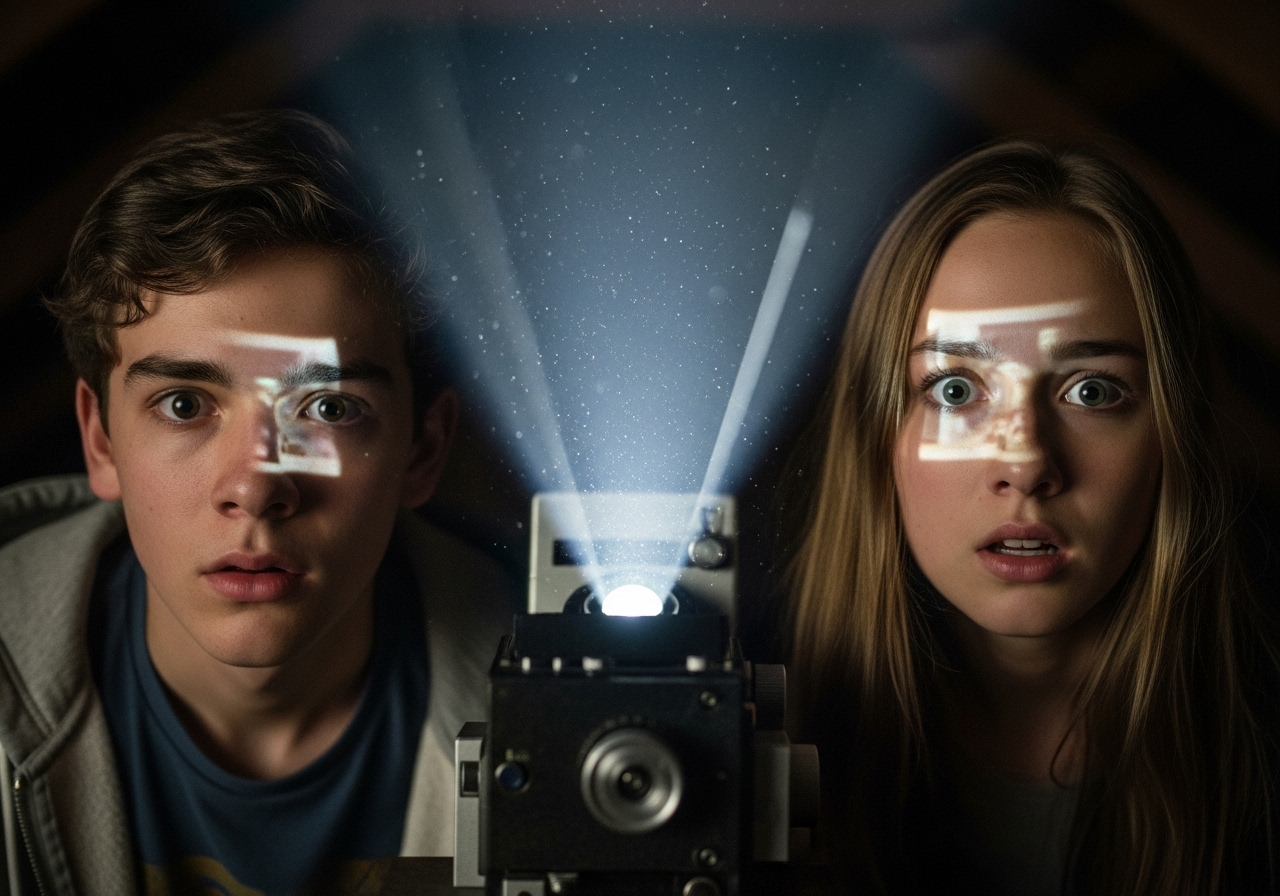
They were left in the dark, with only the afterimage of the burned frame on their retinas and the toxic smell of melted history hanging in the hot, still air of the attic.
Share This Story


