The Hum Beneath the Grey Sky
The lift shuddered, an old metal beast groaning against its cables, hauling me upwards through the belly of a building that had seen better centuries. Outside, the perpetual autumn drizzle blurred the already distorted reflections of corporate towers against the grime-streaked glass, a watercolour smear of neon and grey. A familiar scent—wet concrete, burning copper, and the faint, sweet tang of decay—clung to the recycled air, a signature of this lower sector. My jacket felt heavier than usual, saturated with the city's damp, its synthetic fibres clinging. This was Oliver's world, far from the polished towers of OmniCorp where my data-slate and moral compromises resided.
The elevator cage rattled, a rusted contraption protesting its duty to ascend. Each jolt sent a jolt through my teeth, a dull echo of the city's ceaseless, grinding hum. Outside the grime-caked window of the shaft, the higher towers of OmniCorp gleamed, impossibly clean, their polished façades reflecting a sky that promised more rain, an endless autumn deluge. My assigned interview subject, Oliver, had chosen a studio in the old industrial quarter, a deliberate statement, I suspected, against the sterile, chrome-plated cubicles where most 'creators' now churned out algorithmically-optimised content.
My ankle ached from the climb up the three flights of stairs I'd opted for, the lift feeling too much like a metal tomb. The hallway reeked of stale synth-smoke and something vaguely organic, like forgotten food waste or damp wood. Number 307. The door was scratched, painted a colour that had long since surrendered its original hue to time and neglect. No fancy biometric locks, no glowing data-pads. Just a standard, physical keyhole, and a buzzer that looked older than I was.
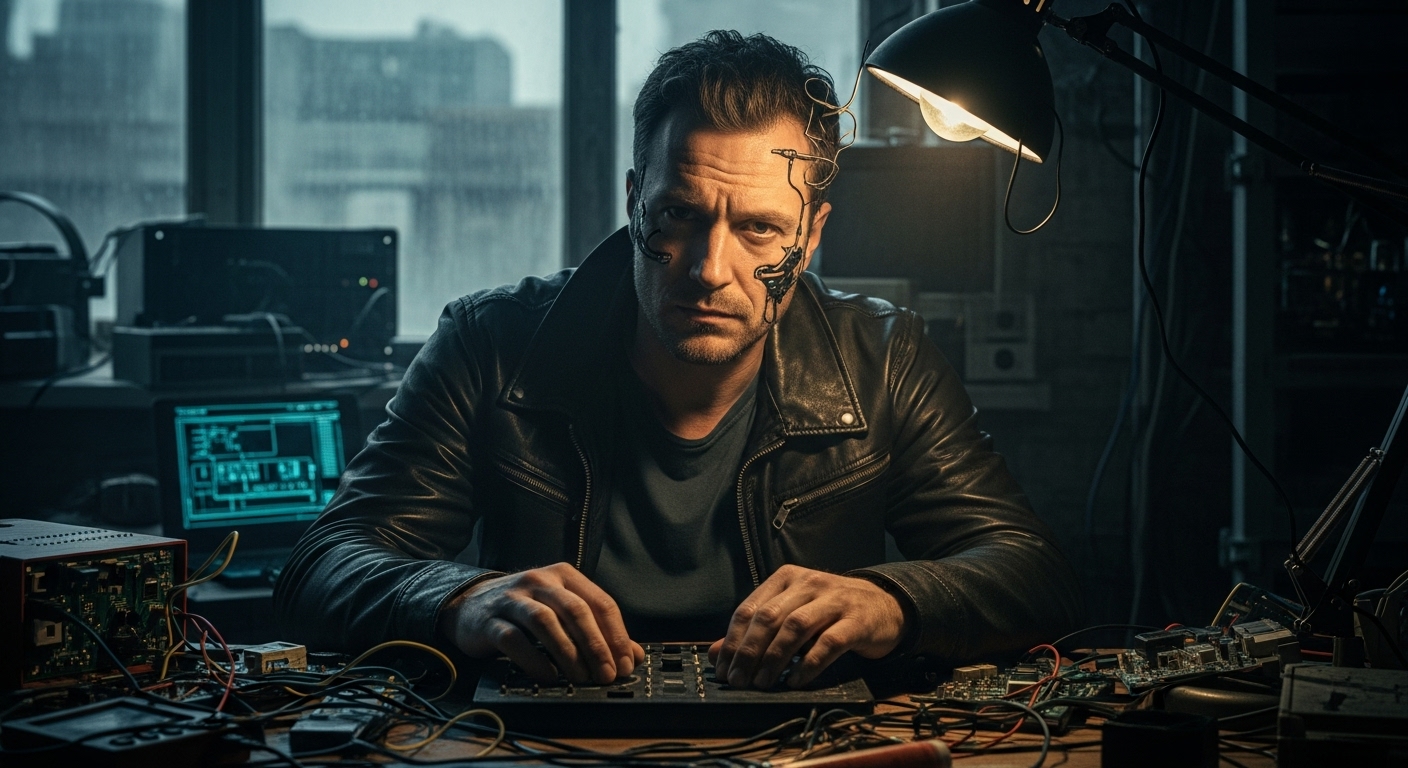
I pressed it. A faint, almost imperceptible hum from within, then a click. The door opened slowly, revealing a silhouette against a backdrop of flickering holographic light. Oliver. Taller than I’d expected, and broader in the shoulders. His hair, a dark, unkempt mess, framed a face etched with what looked like chronic exhaustion, or perhaps just the deep lines of someone who spent too much time staring at screens. He wore a faded work jacket over a tattered shirt, the fabric stained with what I hoped was paint.
"Sutton, isn't it?" His voice was a low rasp, like gravel scraping against something softer. Not a question, more a statement of fact. His eyes, the colour of deep moss, held a weariness I recognised. We were both older now, past the idealistic twenty-somethings who thought they could change the world with words or images. He stepped back, a gesture of welcome that felt more like a concession.
"Oliver." I nodded, stepping inside. The air was thick with the scent of soldering flux, warm synth-leather, and something metallic. Not 'ozone,' but the sharp, clean burn of an overloaded circuit board, like static clinging to the back of my tongue. The studio was a cavern of organised chaos. Wires snaked across the floor like digital vines, connecting ancient, repurposed monitors to sleek, cutting-edge haptic interfaces. Half-finished sculptures, some digital, some physical, shimmered or sat inert on workbenches. The place was a monument to making, to the messy, tangible effort of creation.
"Coffee?" he offered, gesturing towards a cracked synth-brew machine that looked like it had been salvaged from a scrap heap. "It's… potent."
"Black, if you have it." I pulled my data-slate and a slim audio recorder from my bag, placing them on a rickety metal table between us. The table was covered in faint, iridescent smudges, remnants of some past project. The chair he offered me creaked under my weight, its fibre-optic cushioning long past its prime. I could feel a loose spring digging into my lower back.
He watched me, his expression unreadable, as he poured two mugs of the dark, viscous liquid. The steam rose, carrying a bitter aroma that cut through the metallic tang of the room. He didn’t offer sugar or cream. Good. I hated fuss. He settled into a chair opposite me, its synthetic covering worn smooth in places. His gaze, however, was sharp, analytical. He’d seen my type before: the corporate scribe, sent to extract meaning, package it, and sell it.
"So, 'Three Questions,'" he began, a faint, cynical curl to his lip. "About storytelling. In this age. Original."
I allowed myself a small, tight smile. "Originality is a luxury, Oliver. Information is currency. Your perspective on 'why storytelling still matters' is what OmniCorp wants. It's what the readers want. Or, rather, what we tell them they want."
He just grunted, taking a slow sip of his coffee. The silence stretched, filled only by the distant thrum of the city and the faint whir of a cooling fan from one of his older rigs. It wasn’t an uncomfortable silence, more like a challenge, a test of who would speak next, who would break first. My gaze flickered to a large, half-finished digital canvas projected onto the far wall – a sprawling, melancholic cityscape, rendered in greens and purples, impossibly detailed yet deeply unsettling. It looked like a city devouring itself.
"Alright," I said, breaking the quiet, my voice perhaps a touch too brisk. "First question: In a world saturated with information, with algorithms spitting out narratives tailored to every individual whim, why does human storytelling still hold any power? Why bother with the messy, imperfect human voice at all?"
He set his mug down with a soft clink, the sound surprisingly loud in the dim studio. He leaned forward, elbows on his knees, his hands clasped, the knuckles pale. "Because a perfect story, a flawlessly tailored one, is a lie." His voice was still a rasp, but there was an unexpected depth to it now, a quiet conviction that cut through the cynicism. "What the algorithms give you, Sutton, is a reflection. An echo chamber. It confirms what you already believe, already feel. It’s comfortable. And comfort… comfort is where art goes to die."
His eyes, though tired, held a surprising fire. "Human stories, true ones, are meant to disrupt. To unsettle. To show you a perspective you didn't know existed, to make you feel something you didn't ask for. They're not clean. They're not efficient. They're like this city, beautiful and broken, full of contradiction. And that, paradoxically, is what makes them powerful. In a world of perfect fakes, the authentic scar, the genuine tremor in a voice… that's what we crave."
I took a sip of my coffee. It was strong, bitter, tasting of burnt caramel and something else, something I couldn't quite place. I could almost feel the rough, uneven texture of the mug against my lips. He was right, of course. My own internal monologue often felt like a series of fractured, contradictory thoughts, certainly not the neat paragraphs I was paid to produce. Yet, the cynic in me wondered if this wasn't just another performance, another carefully constructed narrative for an editor from OmniCorp.
"So," I countered, "you're saying the very flaw of human narrative is its strength? That our inability to craft the 'perfect' story is what makes it resonate?"
"Precisely." He nodded, a slow, deliberate movement. "Because 'perfect' is often just a synonym for 'safe.' For 'predictable.' And nobody truly remembers the predictable. They remember the jarring chord, the unexpected turn, the moment a character does something utterly illogical but profoundly human. AI can mimic. It can extrapolate. But can it authentically create a moment of raw, illogical human vulnerability? Not yet. Not without a human hand guiding it, imbuing it with that… spark of imperfect truth."
He picked up a small, smooth piece of polished obsidian from his table, turning it over in his fingers. The light caught its dark surface, making it gleam like a liquid shadow. "Consider the noise of the city, Sutton. All those competing signals, the data streams, the advertisements screaming for attention. A human story, even a whispered one, can cut through all that because it carries the weight of a lived experience. It's a connection. A moment of recognition in the overwhelming static."
The silence returned, but this time it felt heavier, filled with the unspoken implications of his words. He was talking about more than just stories; he was talking about resistance, about the tenacious hold of individuality in a system designed to homogenise. I shifted in my creaking chair, the spring digging deeper, a minor irritation that grounded me in the moment. The rain outside seemed to intensify, tapping a dull rhythm against the window. I felt a chill despite the warmth of the coffee.
"Which brings me to my second question," I said, adjusting my posture, trying to appear less affected than I felt. "Technology. Digital tools. AI. For every artist who embraces them, there's another who fears them, sees them as a threat to true creativity, a tool of commodification. How do you, as someone who clearly navigates both worlds, believe technology can support, not overshadow, human expression?"
Oliver smiled then, a small, weary curve of his lips that didn't quite reach his eyes. "Fear is a natural response to the unknown, Sutton. Or to the known, if the known is powerful enough to render you obsolete." He paused, his gaze drifting towards the sprawling digital cityscape on the wall. "But to fear the tool is to misunderstand the hand that wields it. Technology, AI especially, is a mirror. It reflects our intentions, our biases, our capacities. It doesn't inherently create; it processes. It optimises. And in optimisation, there can be liberation."
He leaned back, his chair groaning in protest. "Think of it this way: how many voices have gone unheard because the traditional gates were too high? The publishers, the galleries, the corporate studios. Now, with generative tools, with open-source platforms, a kid in a forgotten sector, with nothing but a chipped data-slate and an idea, can conjure worlds. They can prototype, iterate, find their voice without needing a million-credit grant or a degree from an exclusive art academy."
He gestured broadly around the room, encompassing the tangle of wires and screens. "This is not about replacing the artist. It's about empowering the potential artist. It’s about democratising the means of production. It's about giving more people the brush, the pen, the lens, even if that 'brush' is a sophisticated prompt algorithm. The human will to create, to connect, to make meaning… that remains. The tools just amplify it."
His words resonated with a faint, dangerous truth that prickled at the edges of my corporate-mandated narrative. OmniCorp, after all, made its fortune from controlling information, from curating what the masses consumed. His vision of decentralised creation ran counter to everything they stood for. I found myself gripping the warm mug tighter, the ceramic almost biting into my palm. The idea of millions of unregulated, uncurated voices emerging into the digital cacophony… it was both exhilarating and terrifying.
"But what about the quality?" I pressed, trying to inject some of my professional scepticism into the conversation. "When everyone can 'create,' doesn't it just drown out the truly exceptional? Won't we be buried under a mountain of… digital detritus?"
He chuckled, a dry, raspy sound. "Perhaps. But that's always been the case, hasn't it? For every masterwork, there were a thousand forgotten attempts. The challenge shifts from making to finding. From gatekeeping to curating. The human element becomes crucial not just in creation, but in discernment. In choosing what resonates, what truly matters, amidst the noise. It forces us to refine our own critical faculties, to define what 'exceptional' even means in this new landscape."
He reached across the table, picking up a small, translucent data chip. It was almost invisible against the dark wood. "The true artists of the future won't just be those who create the raw output. They'll be the visionaries who can prompt the machines to express something profoundly human, who can blend their unique perspective with the machine's endless capacity. Or the ones who can find the signal in the static, who can present the human truth even when it's buried under a mountain of AI-generated fluff."
---
The Future's Architects
A faint scent of something like petrichor drifted in from the street, carried on a gust of wind that rattled the windowpanes. The thought of stepping back out into that cold, damp autumn world already felt heavy. I could hear the distant wail of a synth-siren, a mournful sound swallowed by the city's concrete canyons. My internal processors, however, were still grinding through Oliver's words. He was less an artist, more a philosopher, or perhaps a revolutionary in a worn work jacket.
"So, for my final question, Oliver," I said, my voice feeling a little hoarse now, "what does all this mean for future creators? What becomes the defining characteristic of a 'storyteller' when the line between human and machine output blurs, when the tools themselves are capable of generating narratives from scratch?"
He smiled again, that same weary, knowing smile. "The future creator, Sutton, will be an architect of meaning. A whisperer to algorithms. A cartographer of the soul." He picked up a stylus from his desk, a sleek, black cylinder, and began to absently tap it against the table. The soft, rhythmic tap-tap-tap filled the momentary silence.
"Their genius won't be in the flawless execution of a drawing, or the perfect syntax of a sentence, though those skills will always have their place. Their genius will be in the intent. In the ability to pose the right question to the machine. To define the emotional core, the thematic resonance, the specific human dilemma they want to explore. The machine provides the hands, the endless iterations. The human provides the heart, the messy, illogical, brilliant spark."
He leaned forward again, his eyes locking onto mine, a sudden intensity in their mossy depth. "Consider an architect. They don't lay every brick. They don't pour every slab of concrete. But they conceive the structure, they imbue it with purpose, with form. The future storyteller will be the same. They'll be the ones who understand how to sculpt the digital clay, how to whisper the right prompt into the machine's ear to bring forth something truly new, truly resonant. Something that speaks to the shared human condition, not just an individual’s curated preferences."
He pushed the small data chip he’d been holding across the table towards me. It spun once, then settled. "Here. A fragment. A conceptual narrative I’m working on. It’s… a collaboration. Me and the algorithm. See if you can tell where one ends and the other begins."
I picked up the chip, its smooth, cool surface a stark contrast to the worn table. It felt impossibly light. A collaboration. The term hung in the air, loaded. Was it truly a collaboration, or just a new form of delegation? My mind, ever the cynic, conjured images of corporate think-tanks already patenting these 'collaborative' processes, finding new ways to extract value from human ingenuity, even when it manifested through machine interfaces.
"What about the danger of losing that human touch entirely?" I asked, my voice barely above a whisper. "The fear that the machine's voice will eventually drown out ours, making the 'architect' obsolete, too?"
Oliver slowly shook his head. "That's a choice, Sutton. A human choice. If we choose to become passive consumers, if we stop valuing the messy, difficult, authentic voice, then yes, we risk being drowned. But if we fight for it, if we continue to define our humanity through our ability to create and connect, then the machine simply becomes another tool. A powerful one, yes. But a tool nonetheless."
He paused, his gaze drifting once more to the rain-streaked window, to the blurring lights of the lower city. The autumn air in the studio felt heavy, thick with unspoken anxieties and a fragile hope. The coffee had grown cold in my mug, a bitter film clinging to the ceramic. I felt the familiar weight of my assignment, the pressure to distil his complex, subversive ideas into a neat, palatable package for OmniCorp's readers. They wanted reassurance, not revolution.
"The real danger," Oliver continued, his voice softer now, almost contemplative, "isn't that the machines will take over. It's that we'll willingly cede our creative spirit, our capacity for genuine connection, for the comfort of algorithmic perfection. It's an internal battle, not an external one. The technology is just the arena."
My eyes landed on a faded, framed photograph on a shelf amidst the tech. A younger Oliver, his face less lined, standing in front of what looked like a much simpler, perhaps even rural, landscape. A stark contrast to the grey sprawl outside. It was a fleeting, personal detail in a room dominated by circuitry and cold light. I wondered about the story behind that photo, a story no algorithm could ever fully generate or truly understand.
I closed my audio recorder. "Thank you, Oliver. This has been… illuminating." It was a standard, corporate platitude, but for once, it felt somewhat genuine. He nodded, a slight, almost imperceptible movement, his eyes still fixed on the window. He picked up his own mug, turning it slowly in his hands. He looked like a man who had been fighting a long war, and wasn't sure if he'd won, or if the fight would ever truly end.
As I stood to leave, he offered a final thought, his voice barely a whisper, almost lost to the city's hum. "Remember, Sutton. Even the purest algorithm has a ghost in the machine. A bias. A fingerprint. You just have to know where to look. Or who to ask."
I looked down at the data-slate in my hand, the screen still glowing faintly from the file transfer. It was a fragment, a digital seed from his work, and as I finally registered the tiny, almost imperceptible watermark in the bottom corner, a cold dread snaked its way up my spine. It was a corporate mark, not Oliver’s, and it belonged to OmniCorp, the very entity he claimed to defy.
I looked down at the data-slate in my hand, the screen still glowing faintly from the file transfer. It was a fragment, a digital seed from his work, and as I finally registered the tiny, almost imperceptible watermark in the bottom corner, a cold dread snaked its way up my spine. It was a corporate mark, not Oliver’s, and it belonged to OmniCorp, the very entity he claimed to defy.
Share This Story


