Rusting Canopies and Hollow Vows
The autumn air in District 7 hung heavy, tasting of ozone and wet decay, clinging to the skeletal remains of what was once a grand market. Rain, a ceaseless, fine mist, slicked the pitted plasteel and rusted rebar, painting the ground in oily sheens of grey and dull amber. Below a fractured dome that once boasted holographic advertisements for luxuries long defunct, three figures, barely more than children, moved with a practiced, almost unsettling silence, their breath misting faintly in the perpetual twilight of the fallen city. The omnipresent hum of the Grid, a distant, oppressive thrum, vibrated through the very ground, a constant reminder of the unseen, unyielding authority that watched over their precarious lives.
The 'Grid-Eye' drone, a bloated metallic beetle, whirred past Pip’s hiding spot with a sound like a distant, angry wasp. Pip, barely breathing, pressed her small frame flatter against the cold, corrugated plasteel of a fallen street stall. Her heart hammered against her ribs, a frantic drum against the silence of her effort. The metal tasted of old oil and something else, something metallic and sharp, like fear.
“Clear, Pip?” Syd’s voice, a tight, barely-there whisper, crackled in her ear-comm. It was always Syd, steady as a rock eroded by a thousand years of wind, but still there. Still standing.
Pip exhaled a long, shuddering breath, the air burning her lungs. “Clear. Just. Almost had me, the clunker. Probably got a glitchy sensor array, thank the stars.” She pushed away from the cold wall, her knees aching from the crouch. The air was thick with the smell of damp concrete and something that hinted at old, long-dead flowers.
A rustle from above. Ryl, their quiet, thoughtful leader, dropped lightly from a shattered second-storey window frame, landing without a sound. His boots, patched and scuffed, didn’t even stir the gritty dust on the pavement. He was maybe ten, Pip eight, and Syd nine. Old enough, in this city, to be veterans.
“Glitchy or not, it’s a closer shave than we need,” Ryl observed, his voice soft but carrying a thread of steel. He scanned the broken street, his eyes, dark and too old for his face, taking in every shadow, every glint of rain on metal. “Did you get anything, Pip? Anything worth the bother?”
Pip tugged at the drawstring of her scav-pack, pulling it tighter. “Just some old power conduits. Frayed. Might be able to strip the core-weave, maybe. And… found some bioluminescent moss. Could make a decent glow-stick if we can stabilise the culture.”
Syd scoffed softly from their position by a toppled data-kiosk, her silhouette a sharp line against the grey sky. “Moss. That’ll help us eat. Brilliant.”
“Better than nothing, Syd,” Pip shot back, a flash of her usual spark. “And the conduits are worth credits. More than your ‘nothing’ pile.”
“My ‘nothing’ pile kept us from being tagged by a Grid-Eye this morning,” Syd countered, her tone dry. “Observation is a skill, Pip. Not just smashing and grabbing.”
Ryl held up a hand, a silent command for truce. “Both of you. We need to move. There’s a chill coming in, and the patrols usually tighten up after dark. There’s a collapsed archive building on the old Sector 4 edge. We can shelter there, check the haul.”
The walk was a symphony of small, precise movements. Their world was a labyrinth of urban decay, each broken window a potential eye, each shadow a potential ambush. They moved through narrow alleyways, past buildings that leaned drunkenly against each other, their inner workings exposed like ruptured organs. The autumn wind whistled through gaps in the structures, a mournful sound that seemed to carry the city’s ghosts.
---
Inside the archive, the air was thick with the scent of mouldering paper and static electricity. Most of the data-spines had long since corroded, their crystalline storage fractured, but the structure itself offered a measure of protection. They lit a small, carefully shielded fire in a rusted bin, the tiny flames casting dancing, distorted shadows across the mountains of forgotten information.
Pip began sorting her finds, humming a tuneless, ancient melody under her breath. Syd meticulously checked their perimeter, leaning against a stack of what looked like pre-Fade-Out tax ledgers, her gaze fixed on the shattered entrance. Ryl, however, was quiet, staring into the flickering embers, his expression faraway. He always seemed to carry the weight of something too big for him.
“So,” Syd broke the silence, not looking at Ryl, but clearly addressing him. “The ‘dream-sailing’ thing. You still fixating on that, Ryl?”
Ryl shifted, picking at a loose thread on his worn sleeve. “It’s not ‘fixating,’ Syd. It’s… an idea. A way.”
“A way to what?” Pip asked, looking up, her small face smudged with dirt but curious. “To find a hidden cache of nutrients?” She brightened. “Or maybe a map to the Undercity? Dad always talked about the Undercity.”
Syd snorted. “A map in your head, Pip? That’s about as useful as a broken data-pad.”
Ryl sighed, a sound that was surprisingly weary. “It’s not about finding things, not like that. It’s about… them. The lost.”
The fire crackled, and the comfortable banter evaporated, replaced by a heavy quiet. The ‘lost’. Everyone knew what that meant. The people who just… faded. Vanished. When the Grid tightened its grip after the Collapse, when resources dwindled, when dissent meant instant deletion. Families torn apart, friends simply ceasing to be. They weren’t dead, not in the old way, but gone, untraceable, their data-signatures purged, their physical presence erased. They were merely ‘lost’ in the official parlance. But to those left behind, they were a gaping, aching void.
“My sister,” Pip whispered, almost too soft to hear. “Milly. Do you think…?” She trailed off, unable to finish the sentence.
Ryl looked at her, his dark eyes filled with a shared, silent sorrow. “That’s it, Pip. That’s what it’s for. The data fragments I’ve been able to piece together… old neuro-interface schematics, forgotten psychological theory. It suggests a possibility. To train ourselves. To control our dreaming. To navigate… those spaces. The places where minds might still linger. If there’s any trace left.”
Syd finally turned, her brows furrowed. “Ryl, that’s… that’s crazy. Your brain is not some old comm-net to patch into the dead. What if it’s a trap? What if the Grid’s got some kind of thought-capture program running, and you just plug right into it?” Her voice, usually so steady, had an edge of genuine fear.
“The fragments are pre-Grid, mostly,” Ryl countered, his voice steady. “Ancient, almost. Before the mass surveillance, before the thought-pruning. The principles are raw, fundamental. Not something they’d think to monitor, because it’s not external. It’s… internal.”
“Internal or not, it’s still your head,” Syd insisted, pacing a short, restless circuit in the confined space. “And your head is valuable. We need it for navigating, for calculations, for not getting us all sliced and diced by rogue automatons. Not for some ghost-hunting expedition in your sleep.”
Pip shivered, pulling her knees to her chest. “But… if we could see them. Even for a second. Wouldn’t that be… something?” Her voice was small, hopeful, and dangerously vulnerable.
“It’s a gamble,” Ryl admitted, looking back at the fire. “A big one. But what else is there? Just… endless scavenging? Endless hiding? Waiting to be ‘lost’ ourselves? This offers… a chance. A connection. Even if it’s just in our own minds.” He paused, then picked up a smooth, river-worn stone he always kept in his pocket, turning it over and over. “The data-fragments speak of a shared subconscious, a kind of… mental ocean. That with enough focus, enough training, you could project your intent. Find a resonance. They called it ‘dream-sailing’ in the old texts. To navigate the currents of collective thought, to find… echoes.” He caught himself, then corrected, “Find imprints. Residual energies.”
Syd shook her head, running a hand through her short, cropped hair. “Echoes, imprints, whatever. It sounds like a bad wiring job waiting to short-circuit your brain. You’ve been looking at too many dusty files, Ryl. You’re starting to sound like one of those pre-Fade-Out spiritualists.” Her voice was sharper than intended, and she immediately softened it. “Look, I get it. We all miss people. But we can’t just… invent a way to get them back. That’s not how the world works. Not anymore.”
“Maybe the world just needs a different set of rules,” Ryl murmured, more to himself than to them. “The Grid controls our waking lives. But dreams… dreams are still wild territory. Unmapped. Uncontrolled.” He looked up, meeting Syd’s gaze. “Imagine a place where the algorithms can’t reach. Where the thought-pruners can’t scrub. Where memories aren’t just data points to be erased, but living things, breathing, waiting to be found.”
Pip clutched her worn synth-fabric blanket tighter. “It sounds… lonely.”
“It sounds dangerous,” Syd countered, her eyes scanning the shadows at the edge of the firelight. “And cold. Just like everything else out here.”
Ryl simply watched the fire, his face illuminated by its orange glow. “Perhaps. But loneliness is a heavy burden, Syd. And a cold reality is still reality. What if we can find warmth, even if only for a few moments, in the landscapes of what we remember? Of who we remember?” He finally met Syd's gaze, a challenging glint in his eyes. “Are you really telling me you wouldn’t want to see your parents again, even if it was just a fleeting, shimmering image in your own head?”
Syd looked away, a muscle ticking in her jaw. She didn’t answer. The silence stretched, thick with unspoken grief and the damp chill that seeped through the cracks in the building.
Ryl took their silence as a partial assent, or at least a lack of outright refusal. “The first step is always the hardest. Learning to focus. To command the self within the dream-state. I found some old biofeedback programs, very rudimentary, but with enough processing power, we could adapt them. Use the abandoned micro-processors from the Grid’s old comm-towers. Integrate them into a head-rig. Something to amplify brainwave activity, provide haptic feedback, anchor the waking mind.” He spoke with a quiet intensity, his mind already building the schematics, piecing together the impossible.
Pip, captivated despite herself, leaned forward. “Like… like a game?”
“More like a navigation tool,” Ryl clarified. “For a very real, very complex internal landscape. It’s not about escaping reality, Pip. It’s about… building a bridge back to a piece of it that they tried to take from us.”
---
The fire began to dwindle, its embers glowing less brightly against the encroaching gloom. The temperature inside the archive seemed to drop, and the smells of decay grew more pronounced. Outside, the ceaseless autumn mist thickened, clinging to the broken world.
Syd moved closer to the dying fire, rubbing her arms. “What about the energy?” she asked, a practical question dragging them back to their immediate survival. “We barely have enough for the comms, let alone some kind of brain-rig.”
Ryl pulled a small, battered power cell from his scav-pack. “I found this. It’s almost fully charged. Old Grid surplus. Enough to run preliminary tests, maybe even power a prototype rig for short bursts. It won’t last forever, but it’s a start.” He placed the cell carefully beside the fire, its dull grey surface a small beacon of potential in the darkness.
Just as he did, a low, guttural thrum resonated through the building, deeper and more menacing than the Grid’s distant hum. It wasn’t a drone. It was too heavy, too organic, too… close. The sound vibrated in their bones, a primal note of warning. The air, already thick with damp, now seemed to press in on them, cold and heavy.
Ryl’s head snapped up, his eyes wide and unblinking. Syd froze, her hand instinctively going to the worn hilt of her scav-knife. Pip whimpered, her gaze darting towards the shattered entrance, where the mist seemed to writhe, no longer just a neutral curtain, but a living, breathing thing. The low thrumming intensified, accompanied by a new sound: a rhythmic, heavy dragging, almost a slither, approaching their sanctuary. Whatever was out there, it was large, it was slow, and it was heading directly for them, moving with an ominous certainty through the skeletal remains of the city, its presence a cold, tangible threat in the deepening autumn night.
The dream-sailing, it seemed, would have to wait. Survival, as always, was the immediate master.
The dragging sound grew louder, closer, and the mist outside swirled with an unnatural vigour, as if agitated by the creature’s unseen passage. Ryl knew, with a cold certainty that settled deep in his gut, that the silence they’d been hoping to break with dreams was about to be shattered by a far more brutal reality. The shadows in the ruined city were shifting, and whatever new horrors autumn brought, they were already at their door.
The faint scent of decay around them, previously just the smell of the old city, now carried a new, unsettling undertone – something acrid, something predatory, a silent promise of what the approaching darkness truly held.
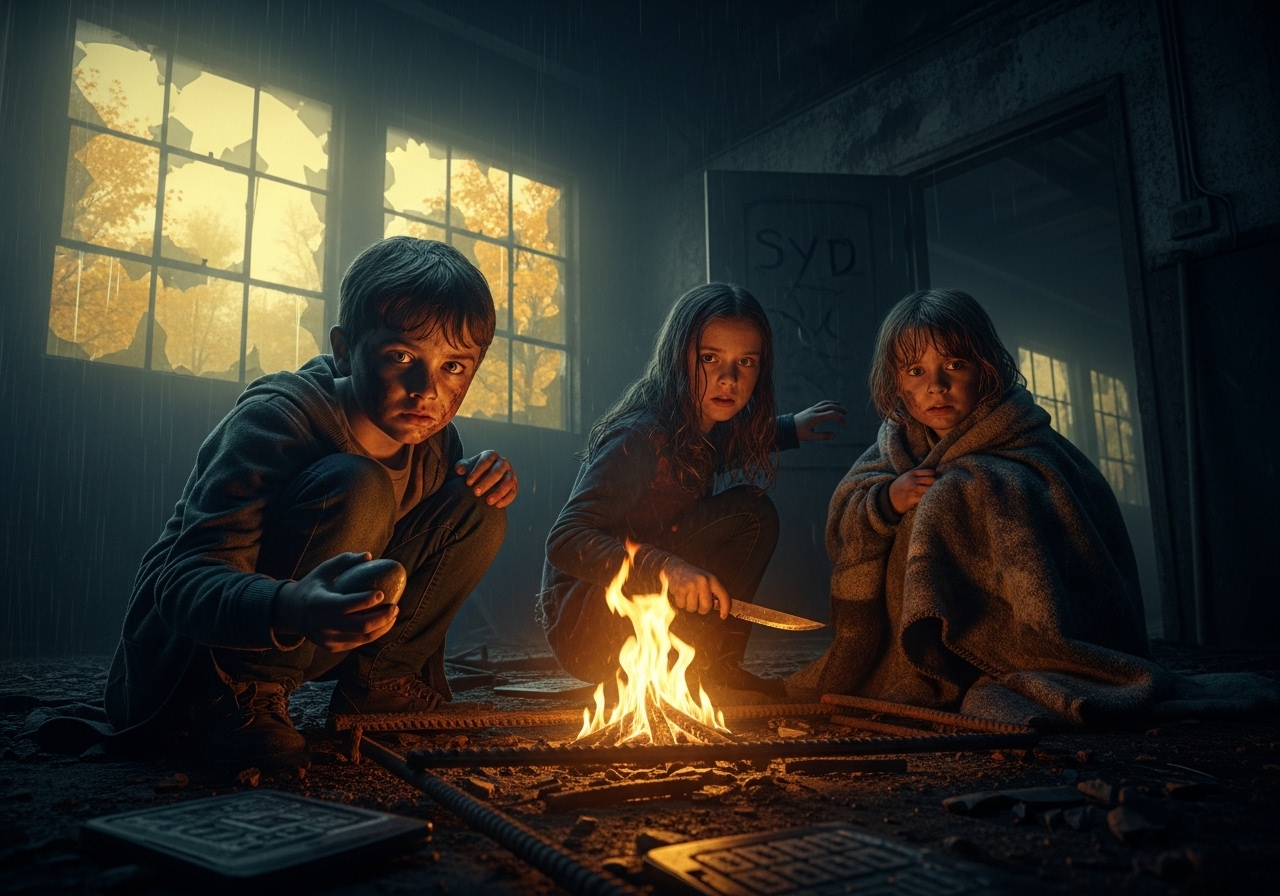
The low, guttural thrum and rhythmic dragging intensified, an unseen predator closing in on their fragile sanctuary. Whatever new horror lurked in the autumn mist, it was large, it was relentless, and it had found them, its presence a cold, tangible threat poised to consume their desperate hope.
Share This Story


