Scavenged Light
The reluctant, sluggish thaw of a Northern spring clutched at the city's periphery, its tendrils of grey slush clinging to the cracked pavements and the bases of skeletal, frost-nipped birches. A perpetual, muted light, filtered through layers of industrial haze and low cloud, softened the sharp angles of the distant Arcology, making it appear less a monument to control and more a smudged charcoal drawing against the pallid sky. Inside the collective's workshop, a repurposed maintenance bay within a forgotten utility complex, the chill still bit at exposed skin, a constant reminder of the season's hesitant promise and the pervasive reach of the Authority's distant hum.
The air in the old workshop tasted of dust, stale circuit boards, and the faint, lingering metallic tang of the building’s original purpose. Outside, the Northern spring was a study in indecision; ice still held fast in shaded crevices, while rivulets of greyish meltwater snaked across the concrete courtyard, seeking grudging passage to blocked drains. Edmund, his hands arthritic knots, rubbed at his right knee, a dull ache beginning its slow climb up his leg. He nudged the ancient projector with a foot, its single, weary lens sputtering to life, casting a pale, trapezoidal light onto the stained screen draped over a section of exposed conduit.
“Right then,” he croaked, his voice rough from the early hour and the persistent dry throat that seemed to come with this city’s recycled air. “ECO-STAR. Another acronym in a world swimming with them.” He glanced around the sparse, functional space. Lucie was sketching, her head bent, a piece of charcoal scratching softly against a salvaged data slate. Steffi, ever precise, had arranged a stack of slim, recycled panels on the chipped laminate table, her fingers tracing the faint circuitry beneath the smooth surface. Simon, as usual, was by the one grimy window, arms crossed, his gaze fixed on the endless, low-rise sprawl that blurred into the Arcology’s formidable silhouette. Charlie, spectacles perched on the end of his nose, adjusted something on a console made from obsolete server components, his movements economical, quiet.
Silence stretched, thick with unspoken observations. They were five, a peculiar collection of old, tired bones and surprisingly resilient minds, gathered to discuss a methodology that promised 'innovation' and 'empowerment' – words that felt, in this city, like forgotten dreams or cruel jokes.
“Environment,” Edmund began, tapping the first letter on the screen, a pixelated green ‘E’ appearing with a soft, electronic hum. “This first step involves a deep dive into understanding the local context, community needs, climate challenges, and the rich cultural landscape you're working within.” He paused, looking directly at them, his eyes sharp despite their age. “Any thoughts on our ‘environment’?”
Lucie stopped sketching, looking up. “The slush outside is a specific shade of industrial grey,” she murmured, her voice soft, almost lost in the room’s ambient hum. “Not clean melt. It’s got a sheen of… something. Oil, grit, residual polymers. And the wind… always carries that metallic scent from the filters. That’s our environment, isn’t it? What’s given to us.”
Simon snorted from the window. “’Community needs’. When was the last time anyone asked the ‘community’ what it needed, outside of a mandated census with pre-programmed answers? They need to feel less watched, less… processed. They need genuine warmth, not recycled heat from the main grid.” He didn't turn from the window, but his shoulders were tight.
Steffi picked up one of her data slates, its surface cool. “The challenge is precisely that, Simon. Finding the cracks. The real needs, not the projected ones. The ‘local context’ includes the Authority’s omnipresent digital surveillance, the way even the air you breathe is analysed. Our ‘cultural landscape’ has been deliberately eroded, patched over with corporate-approved narratives. But it's still there, under the surface. Buried, perhaps. But still present.” She spoke with a quiet certainty that often grated on Simon, but today, he merely shifted his weight, acknowledging her point without words.
Charlie’s fingers hovered over a key, a faint blue glow from his screen illuminating the deep lines around his eyes. “The ‘climate challenges’ are not just the weather. It’s the manufactured scarcity, the manipulated resource allocation. They tell us what we need, and what we’re allowed to have. This framework… it’s a map to navigate the imposed environment, isn’t it? To find the real one beneath.” He rarely spoke so much, and his words hung in the air, weighted with a quiet urgency.
The Unseen Currents
Edmund nodded slowly, feeling the familiar, weary thrum of hope that often accompanied these discussions – quickly followed by the dull ache of reality. “Precisely. And that leads us to ‘Customer’ and ‘Opportunity’.” He advanced the slide. “’Customer’: Here, we identify your audience, beneficiaries, and key stakeholders, often prioritising a community-centric approach to ensure genuine impact. ‘Opportunity’: This phase focuses on pinpointing specific needs, gaps, or potentials for creative or entrepreneurial ventures that align with environmental and community well-being.”
Lucie chewed on the end of her charcoal stick. “Our ‘customers’ are the ones who don’t know they’re customers yet. The ones who are tired of the filtered feeds, the curated experiences. The ones who remember the old stories, or wish they did. The ones who feel the disconnect.”
“And the ‘opportunities’?” Steffi prompted, her gaze fixed on Edmund. “Where are the gaps when every moment is accounted for, every byte logged?”
Charlie leaned in, his voice a low murmur. “The gaps are in the silence. The unrecorded moments. The analogue pockets. There are still old networks, old ways of sharing… data… that aren't easily monitored. Not yet. We could build something there.” He typed a few lines of code, and an abstract, swirling diagram appeared on the projector screen, representing distributed, encrypted nodes.
“Digital folklore archiving,” Lucie breathed, her eyes lighting up. “Stories, songs, historical records. Coded within image files, disguised as low-priority data. We’ve talked about it before. Something that slips beneath the Authority’s filters. Something culturally appropriate, that speaks to the old ways, but in a new tongue.” Her enthusiasm, fragile as it was, was infectious.
Simon finally turned from the window, a flicker of something in his eyes that wasn’t cynicism. “An opportunity to give them back what they took. What they’ve been trying to make us forget. That feels… dangerous.” A half-smile, almost a grimace, played on his lips. “But useful.”
---
“So, ‘Solution’ and ‘Team’,” Edmund continued, feeling a surge of energy despite the persistent ache in his knee. “Once opportunities are clear, this step is about developing innovative, culturally appropriate, and sustainable responses to those identified needs. ‘Team’: Building a strong, collaborative group is essential. This involves drawing on diverse skills and perspectives, often engaging local knowledge keepers and community members.”
“Our solution is clear then,” Steffi stated, her voice firm. “The digital archive. But the ‘team’… we are strong, yes. But we are few. And old.” She looked around at their worn faces, the lines etched by years of living under the Authority’s indifferent gaze. “Who else do we bring in? This kind of work… it needs people with specific skills. And a certain… resilience. A tolerance for risk.”
“The data weavers,” Lucie suggested, almost tentatively. “From the Outer Districts. They know how to cloak things, how to make things disappear in the noise. They live in the gaps.”
Simon immediately bristled. “Unknown variables. Unvetted. We don’t know who they work for, who they answer to. That’s a risk we can’t afford. One leak, and this… this entire collective, everything we’ve built, everything we’ve salvaged, gone.” He gestured vaguely at their meagre setup, a collective lifetime of careful defiance contained within these walls.
“They’re from our community, Simon,” Steffi countered, her voice calm but with an underlying steel. “Displaced, yes. Pushed to the fringes. But still ours. We were all ‘unknown variables’ once. Or have you forgotten?” She met his gaze, and the tension in Simon’s shoulders eased marginally. The unspoken history between them, the quiet struggles they had faced together, was a powerful, silent language.
Charlie, ever practical, interjected. “We could implement a tiered access system. Encrypted chains. Their exposure would be minimal, and their expertise invaluable for seeding the archive effectively. It would allow for a decentralised distribution, harder to trace back to a single source.” He demonstrated with a few rapid keystrokes, a complex web of connections appearing on the screen, showing how data could hop from node to node, anonymised, untraceable.
The Unseen Hand
Edmund watched the network expand, a fragile, beautiful thing woven from code and hope. “Then we have ‘Advantage’ and ‘Results’. ‘Advantage’: This is where you define what makes your project unique, impactful, and resilient, particularly within the distinct Northern context and its opportunities. ‘Results’: Finally, we articulate the desired outcomes, plan how to measure impact (social, environmental, economic, cultural), and strategise for long-term sustainability.”
“Our advantage is our invisibility,” Lucie observed, her gaze distant, as if seeing beyond the room. “They don’t look for resistance from… us. The old ones, the artists. We’re deemed irrelevant. That’s our cloak.”
“And our deep understanding of this land, this climate, these people,” Steffi added. “The Authority only understands data points and consumption. We understand the rhythm of the thaws, the weight of the darkness, the stories that truly shaped this place before they tried to rewrite them all.” She pressed her palm against the cool surface of the data slate, a gesture of grounding.
“Results, then,” Simon grumbled, though his earlier cynicism seemed to have softened into a cautious acceptance. “Connections forged. Memories stirred. A quiet hum of defiance, perhaps. Hard to put a metric on that for the Authority’s quarterly reports.” He cracked a knuckles, the sound sharp in the quiet room.
“We don’t measure it for their reports,” Edmund said, his voice firm, resolute. “We measure it in the way a person’s eyes light up when they hear an old song, or see a forgotten symbol. In the way the community starts to remember its own power. That is our impact. That is our sustainability.”
The room fell into a heavy silence, a shared understanding settling over them. The hum of the projector seemed louder, more pronounced. Outside, the last vestiges of late afternoon light were fading, giving way to the perpetual twilight of the Northern spring evenings. Edmund felt the familiar weariness, a deep exhaustion that seeped into his bones, but it was accompanied by a flicker of satisfaction, a small triumph in simply continuing. Charlie, his head bowed slightly over his console, was just about to close the ECO-STAR presentation file, his fingers brushing the 'Exit' icon, when a small, insistent 'ping' sounded from his auxiliary monitor. Not the soft chime of their internal comms, nor the gentle thrum of the city’s omnipresent network, but a sharp, unexpected, external system alert. A red indicator, small but stark, flashed briefly in the corner of the screen, a protocol notification from an unknown, unauthorised source. Charlie’s hand froze mid-air, the subtle scent of ozone from the projector filling the quiet workshop. Edmund felt the blood drain from his face, his knee ache suddenly forgotten, replaced by a cold dread that seized his chest. The faint, grey light of the receding spring day seemed to mock their fragile plans, illuminating the unsettling truth: someone, or something, had just knocked on their carefully secured digital door.
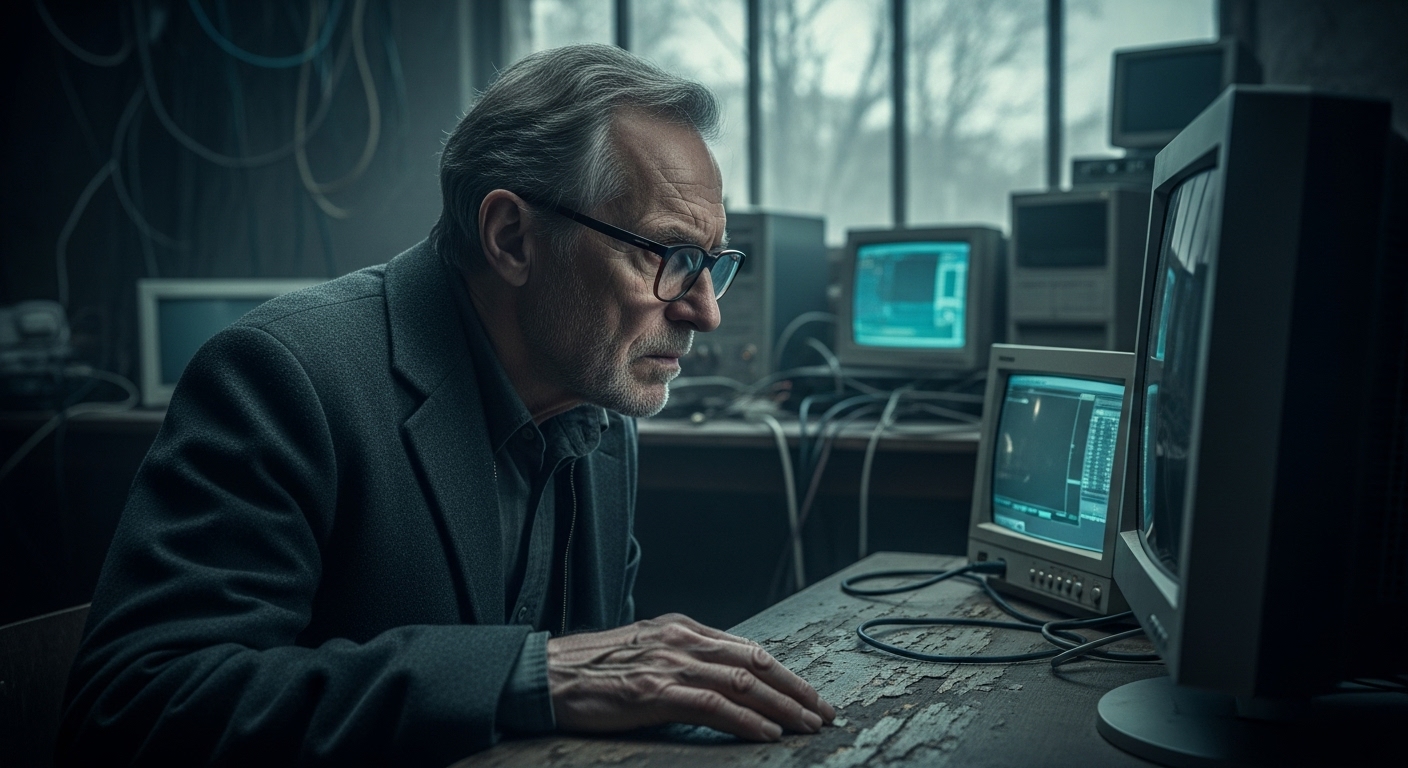
The red light on Charlie's screen pulsed, a silent, undeniable declaration that their quiet rebellion had been observed, their carefully guarded discussions now laid bare to an unseen, ominous intelligence. The secure walls of their haven had been breached, leaving them exposed and vulnerable to the chilling scrutiny of the Authority's watchful eyes.
Share This Story


