A Severed Connection
In the desolate, snow-choked streets of a near-future city, the protagonist, a young tech scavenger, attempts to repair a vital communication device. Alongside a pragmatic companion, they stumble upon a third, desperate individual amidst the urban decay, forcing a confrontation with their own dwindling humanity.
My gloved fingers, stiff with cold and the faint tremble of adrenaline, fumbled with the data conduit. The snap of the connection port, dry and brittle like frozen bone, echoed too loudly in the pre-dawn quiet. Another shard of frosted plastic spiraled into the undisturbed snow at my feet. Lea cursed, a low, guttural sound that seemed to scratch at the silence of the alley.
“You broke it, didn’t you?” Her voice was thin, a threadbare blanket against the punishing wind that clawed at our faces, carrying the metallic tang of distant, decaying infrastructure. Her breath plumed white, momentarily obscuring the grim determination etched around her eyes. She leaned closer, her own comm unit, a battered relic from before the 'Great Static', clutched like a prayer bead.
“No. It was already… compromised,” I retorted, my voice tight, the lie tasting like rust on my tongue. The truth was, I’d been too aggressive, too eager to re-establish the uplink. Our last reliable channel to the sparse pockets of resistance out beyond the Perimeter had just flatlined. The city hummed around us, a low, ominous thrum, like a sleeping beast whose dreams were filled with grinding gears and failing power grids. Snow, thin and sharp as powdered glass, swirled in eddies around our ankles, clinging to the frayed edges of my jacket.
The air smelled of damp concrete and something acrid, a constant, low-grade chemical burn that permeated everything in the outer sectors. Lea sighed, a sound heavy with the accumulated weariness of a thousand grey mornings. “Compromised, he says. Just like our chances, then. Right?” She kicked at a loose chunk of ice, sending it skittering towards a discarded data-slate, its screen cracked like a spiderweb. A fleeting image of a smiling child, caught in a permanent digital agony, flickered then died.
I ignored her. My gaze swept the alley. The skeletal remains of a public transport hub loomed overhead, its once-vibrant holo-ads now dead, cracked panels showing only the pale, bruised winter sky. Every shadow felt like a hiding place, every gust of wind a whisper of unseen movement. The Corporate Enforcers, the 'Civility Squads' as they ironically called themselves, patrolled with brutal efficiency. And without our comms… we were blind. Deaf. Just two more lost souls scraping by in the margins, waiting to be swept up and re-processed.
“We need a junction box, a clean one,” I muttered, pulling my scarf tighter. The bitter cold seeped into my bones, a constant companion. My fingers still throbbed, a dull ache from the delicate, futile work. “Maybe near Sector Gamma? There’s an old relay station, mostly offline, but… sometimes parts linger.”
Lea snorted. “Gamma? That’s a seven-click trek through the ghost sectors, and that’s assuming the snow hasn’t buried half the access routes. For a ‘maybe’?” She wrapped her arms around herself, shivering, not just from the cold, I knew. She was pragmatic, always. Survival wasn’t a concept to her; it was a non-negotiable, brutal fact. Any deviation from the most direct path to staying alive was a luxury we couldn’t afford.
“It’s a better ‘maybe’ than standing here waiting for a patrol to roll by,” I argued, my voice picking up a defensive edge. We argued a lot these days. It was how we communicated, a kind of aggressive shorthand for shared fear. The civility the old world supposedly cherished was long gone, replaced by a bristly, constant vigilance, even among allies.
A glint of something metallic caught my eye. Not the broken pieces of my comm unit, but something else, further down the alley, where the snow piled deeper against a collapsed storefront. It looked like a discarded data-core, but older, more industrial. Curiosity, that persistent, dangerous spark, tugged at me. Or maybe it was just the desperate hope for any salvageable part. “Hold on,” I said, already moving.
“Hold on? To what? Your delusion?” Lea’s voice was sharper now, but she followed, her heavy boots crunching through the fresh powder. The distant, muted wail of a siren, faint as a phantom limb, pierced the air, then faded. Corporate patrols. Always moving, always watching. It was a constant reminder of how small we were, how easily erased.
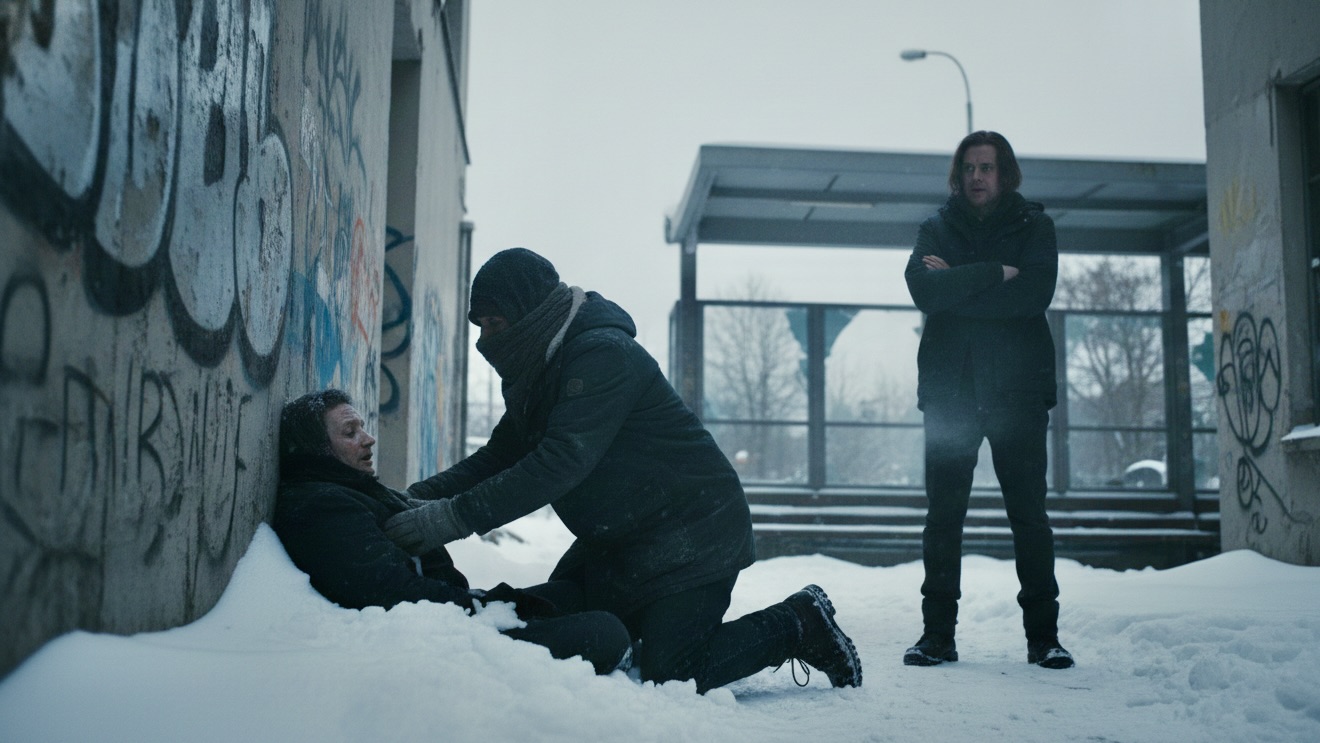
As I drew closer, the metallic glint resolved itself. It wasn't a data-core. It was a person, half-buried in the snow, leaning against a broken-down street vendor cart. Their head was slumped forward, a thin, tattered cloak barely covering their frame. A wave of nausea hit me. Another one. They were everywhere now, the discarded, the forgotten, melting into the urban landscape like sickly snowmen.
Lea stopped beside me, her breath catching. “Gods above, not another one.” Her voice was softer now, tinged with a weariness that went beyond argument. The sight was common, depressingly so, but it never quite lost its sting. A constant, visual indictment of everything we’d become.
I knelt, brushing snow from their shoulder. Their clothes were thin, soaked through. A faint, almost imperceptible tremor ran through them. Not dead, then. Not yet. Their skin was waxy, a sickly pale contrast against the grimy snow. Their hands, gnarled and blue-tinged, clutched a small, ornate wooden bird, its painted eyes faded but still distinct. An old world trinket. Someone had once loved this bird, and perhaps, this person.
“Hey,” I murmured, my voice cracking a little in the cold. “Hey, you awake?” My stomach twisted. Helping them meant risk. Always risk. Calories, time, exposure. In this world, kindness was a liability, a weakness that could get you both killed. But the sight of that little wooden bird… it felt like a ghost reaching out from a better time.
The figure stirred, slowly, agonizingly. Their head lifted, revealing a face caked with grime and frostbite, but with eyes that still held a spark, however dim. Young, maybe my age, maybe younger. Hard to tell with the layers of misery. Their lips, cracked and bleeding, parted. A raspy sound emerged, more cough than word. “The… the circuit…”
Lea crouched beside me, her hand resting briefly on my shoulder, a gesture I recognized as a warning. “Don’t, Alex. We can’t. We just lost our link, remember? We need to move.” Her voice was low, urgent, a practical mantra. She was right. She was always right when it came to survival. My heart, though, beat a ragged rhythm against my ribs.
“The circuit… is gone,” the person whispered, their gaze fixed on something beyond us, perhaps a phantom of their own collapsing world. “They took it. My… my connection.” A single tear, icy and slow, traced a clean path down their frost-chapped cheek.
My mind raced. A circuit? What circuit? The language sounded almost technical, like mine, but their overall state screamed 'unstable'. Was it a comm unit like ours? Or something more personal, more invasive, like the brain-chips the Corps implanted in their 'Re-Education' facilities? That thought sent a jolt of icy fear through me. No, they were too out of it, too broken to be a Corp asset. Just another victim, then.
“Who took what?” I asked, my voice softer than I intended. Lea nudged me sharply with her elbow. I ignored her. The idea of leaving this person, this young soul, to freeze alone in the snow, a relic clutching a wooden bird… it felt like a betrayal not just of them, but of some core part of myself, a part I was afraid of losing entirely.
“They… the Squads. They patrol the abandoned lines. Looking for… for stray signals,” the person gasped, a fresh spasm of coughing racking their thin frame. “My family… they broadcast messages. From the outer rim. I was trying to… listen.” Their eyes, a watery grey, pleaded with me. “Just a connection. To hear them.”
A memory, sharp and unwelcome, flashed through my mind: my own family, years ago, before the Static, before the Civility Corps, before everything went to hell. My mother’s soft laugh, my father’s booming voice over a grainy comm-link, reaching me even when I was at school, miles away. The sheer ease of it, the unquestioning assumption that you could always reach out. A luxury that felt like a myth now.
“They’re looking for stray signals,” Lea repeated, her voice grim, her eyes scanning the alley nervously. “That’s what we are, Alex. Stray signals. Which means he is a stray signal, too. A live wire. A magnet for trouble.” She wasn’t wrong. In this city, every act of humanity was a defiant spark, often quickly extinguished. The Civility Squads weren’t after criminals, not really. They were after dissent, after connection, after anything that threatened the sterile, isolated order of the Corporate Consensus.
“What kind of circuit?” I asked the person, trying to keep my voice even, despite the knot of dread tightening in my gut. If they had been trying to build a comm unit, a rogue one, the Squads would be relentless. The punishment for unauthorized communication was severe: data-wiping, re-education, or worse.
“A quantum circuit. My father… he engineered it,” they choked out, their hand reaching out, trembling, trying to point. “For low-band frequency. To cut through the noise.” Their voice trailed off, lost in another shiver.
My blood ran cold. Quantum. That was high-grade tech, rare, heavily restricted. Not something a lone scavenger typically possessed, let alone someone in this state. This wasn't just a simple comm-unit attempt. This was a direct, brazen challenge to the Corporate grid. A challenge that had clearly failed. And now, they were a walking beacon of that failure, attracting unwanted attention.
“Quantum, huh?” Lea’s tone was dangerously flat. “Well, that just seals it. We can’t. Absolutely cannot. He’s bait. And we’re about to be the catch.” She stood up, her jaw set, looking at me with a hard, unyielding gaze. “We leave him. Now. Or we’re next.” Her voice held the raw edge of fear, but also a deep-seated pragmatism born of endless hard choices. She’d seen too many good intentions lead to tragic ends.
But the person’s eyes, fixed on me, were full of a desperate, unblinking hope. They were young, perhaps my younger sibling's age, if I still had one. My hands, still numb from the cold, still felt the phantom snap of the broken conduit. The irony was a bitter taste. I, too, was seeking a connection, a way through the static. And here was someone who had tried, and paid a terrible price. Leaving them felt like abandoning a part of myself, a recognition that the world had finally won, that kindness had no place here.
“What if… what if we help him?” I heard myself say, the words feeling foreign, reckless, stupid. The sheer lunacy of it. We barely had enough resources to keep ourselves going. We were constantly on the move, two ghosts in a city of millions, trying to stay ahead of the inevitable. Adding a third, weakened, compromised ghost to our burden was suicide.
Lea laughed, a harsh, brittle sound devoid of humor. “Help him? Help him freeze faster? Help him get us all caught? Are you serious, Alex? Do you even remember what year it is? Civility’s been re-coded out of the system. Kindness is a virus now. And we don’t have an anti-C.” She motioned vaguely with her hand, a gesture of exasperated hopelessness. She was right, of course. Everything she said was logical, rational, survival-oriented. But logic felt like another form of cold, another layer of ice around my heart.
“He’s got nothing. No food, no gear, no… warmth.” I gestured to the person, whose shivering had intensified. “If we leave him, he’ll be dead by morning. Or worse, picked up and… processed.” The thought of the 'processing' centers, hidden deep within the Corporate towers, sent a fresh shiver down my spine. They didn’t just re-educate minds; they broke spirits, erasing everything that made a person unique, replacing it with compliant, corporate-approved programming.
“And if we help him, we’ll be dead by morning,” Lea countered, her eyes narrowing. Her gaze lingered on the person’s ragged clothes, the faint, almost invisible brand on their neck – an old, faded tag from the ‘Unregistered’ sector. A death sentence, almost. “Think, Alex. Think beyond the moment. This isn’t a story where the hero saves the day because he’s got a good heart. This is a story where the hero dies because he hesitates.”
The wind whipped through the alley again, carrying a faint, distant clang of metal on metal. A patrol, maybe. Or just the city groaning. Every sound was amplified by the tension. I looked at the person’s face, etched with suffering, and then at Lea’s, etched with a different kind of suffering – the burden of harsh realism. Two paths. Two equally terrifying outcomes. One led to a faster, more certain end. The other… the other felt like a quiet surrender to the prevailing darkness, a giving up on the idea that anything could ever be better.
“Please,” the person rasped again, their eyes flickering to the broken junction box still clutched in my hand. They seemed to understand, somehow, that I was a kindred spirit, a fellow broken circuit in a broken world. “My father… he said to always find the signal. Even in the static.” Their voice was barely a whisper, a thread pulled taut against the howling wind. “He knew… they would try to sever us.”
Lea grabbed my arm, her grip surprisingly strong. “We’re leaving, Alex. Now. Before the sunrise, before they send out the day patrols. We’re already exposed.” Her words were laced with an urgency that bypassed my stubbornness, reaching for the primal fear that always lurked just beneath the surface. My mind rebelled against the cold logic, against the instinct that screamed for self-preservation. But my heart, stupid and foolish, whispered about the wooden bird, the broken connection, the quiet desperation in those grey eyes.
I looked from Lea’s hardened face to the fragile, shivering stranger. The decision felt impossibly heavy, a tectonic plate shifting deep within my core. Kindness in this new world wasn’t a virtue; it was an act of war. A defiance. And I was tired of fighting. But I was also tired of letting the world win. The wind howled, a mournful dirge, and the city lights in the distance, cold and indifferent, seemed to mock our fragile existence. My fingers, still clenched around the shattered remains of my own comm unit, felt the ghost of a connection, a possibility that still stubbornly flickered. And then, without fully understanding why, or perhaps because I understood too well the inevitable consequences, I made a choice that would either save us all or damn us utterly.
“Alright,” I said, the word barely audible above the wind, but firm enough for Lea to hear, to know I’d made a decision. Her face was a mask of disbelief, then resignation, then something else I couldn't quite read. I turned back to the figure in the snow. “Can you walk?” The question felt absurd, almost cruel. But the eyes that met mine held a sudden, fragile spark of something like hope. And then, a low, mechanical hum began to resonate from deeper within the city’s heart, a sound that promised not just the morning patrol, but something far more invasive, far more hungry, about to descend upon our fragile, exposed corner of the world.
And then, a low, mechanical hum began to resonate from deeper within the city’s heart, a sound that promised not just the morning patrol, but something far more invasive, far more hungry, about to descend upon our fragile, exposed corner of the world.
Share This Story


