The Static Veil
The air in the cramped, repurposed server room hung heavy with the scent of ozone and stale coffee, a thin sheen of dust coating every surface. Outside, the early spring rain hammered against the grimy window, a rhythmic counterpoint to the low, anxious hum of overloaded processors. Fluorescent lights, too bright and too yellow, cast an unforgiving glow on the two figures hunched over a tangle of wires and bespoke hardware, their faces taut with a mixture of grim determination and barely concealed dread.
A fresh bead of sweat trickled down Tanner's temple, stinging his left eye. He didn't blink. Couldn't. His gaze was locked on the cascading glyphs on the main display, each character a tiny, flickering ghost in the green and amber flow. The headset, a crude assemblage of repurposed neural net components and salvaged hospital-grade sensors, felt like a vice around his skull. A high-pitched whine, almost inaudible, thrummed against his inner ear.
"Steady," Sasha muttered, her voice tight, a hand hovering over the console's emergency cut-off. "You're bleeding processing. Losing coherency." Her breath hitched, a small, involuntary sound. The air in the room, already thick, felt suddenly denser.
Tanner just grunted, a short, sharp sound. His fingers, stained with carbon from a recent circuit repair, danced across the haptic controls, coaxing, cajoling. The interface, cobbled together from stolen schematics and pure guesswork, was a fickle beast. One wrong parameter, one fraction of a second too slow, and it could short out his frontal lobe. Or worse, trap him in the static with the one they were trying to reach.
A jolt. Not electrical, not exactly. More like a sudden drop, stomach lurching, followed by a rush of cold. The whine intensified, morphing into something more akin to a distant, garbled scream. The glyphs on the screen blurred, then resolved into a chaotic dance of alien characters, a language neither of them understood.
"Hold it, Tanner!" Sasha's voice was sharper now, a hint of panic in the undertone. "It's pushing back. Too much data. We need a cleaner filter, like we talked about."
He ignored her, or tried to. The image forming behind his eyes wasn't of the room, or the rain, or Sasha's worried frown. It was a kaleidoscope of broken memories, not his own. A flash of a hand, delicate, with a distinctive scar across the knuckles. A metallic taste, like old copper. And then, a word. Or a sound that approximated a word, ragged and stretched thin, like fabric tearing. '...Harbor...' It was barely a whisper, a ghost of a thought.
He felt a sudden, crushing weight, as if a deep-sea diver's helmet had been clamped onto his head. His own thoughts, usually a relentless, organised chatter, were suddenly overwhelmed by a tsunami of fragmented sensations. The smell of brine and something burnt. A flash of neon, impossibly bright, followed by absolute darkness. He nearly buckled.
Sasha swore, a low, guttural sound, and slammed her palm onto a auxiliary panel, rerouting power. The hum dropped a few octaves, settling into a more manageable drone. The pressure on Tanner's head eased, replaced by a dull, throbbing ache behind his eyes.
"Are you insane?" she hissed, pulling the headset from his head. He blinked, the room swimming back into focus, the fluorescent glare suddenly unbearable. "You almost ripped your own consciousness apart! And for what? 'Harbor'? We knew Finn worked near the docks before… before."
Tanner rubbed his temples, his fingers trembling slightly. "It wasn't just a word, Sasha. It was... heavy. Like it meant something else. A place. A marker." He struggled to articulate the sensation, the sheer density of that single, fragmented utterance. "And it wasn't just Finn, either. It was... other things. Cold. Scared. So much fear."
---
The Unspoken Language of Loss
She walked to the window, her back to him, hands shoved deep into the pockets of her oversized hoodie. Outside, the rain had lessened to a persistent drizzle, streaking the pane with grey. The city hummed, indifferent. The early spring air, despite its damp chill, carried the faint, hopeful tang of budding leaves, completely at odds with the stale, metallic tang in the room.
"We're doing this wrong," Sasha said, her voice muffled by the glass. "Every time, we just jam another frequency into that thing, hoping it'll connect. It's not a radio, Tanner. It's a memory stream. A consciousness in freefall."
"What's your brilliant plan then?" he retorted, a defensive edge in his voice. He felt exhausted, wrung out. The attempt had taken more out of him than he cared to admit. "We can't just talk to him. He's... wherever he is. Trapped. Broken. That chip he was carrying, it didn't just store data, it fragmented him. This is the only way to sift through the static, to find a pattern, to pull back what's left."
She turned, her face etched with a weariness that belied her years. "The chip. We still don't know what was on it, do we? Not really. Only that Finn was desperate enough to try and hide it, to run. And look what happened." Her gaze drifted to the makeshift cot in the corner, where a worn blanket lay crumpled. A silent reminder of the past few weeks, the desperate, obsessive attempts.
"It was important," Tanner insisted, pushing himself to his feet. His knees cracked, an ungraceful sound. He picked up a half-eaten protein bar, unwrapped and forgotten on the console, and took a bite. It tasted like ash. "Finn wouldn't have risked everything for nothing. And the way he talked about the 'drift'… before. Like it was a place, not just a concept."
He remembered Finn's wild-eyed theories, months ago, over lukewarm synth-coffee. The idea of residual consciousness, echoes left behind in the neural networks of the city, like static on an old broadcast. A digital afterlife, not spiritual, but purely informational. They had dismissed it as late-night paranoia then. Now, it was their only lead.
"The 'drift' is a pretty name for a digital waste bin," Sasha countered, her arms crossed. "A graveyard for forgotten processes and half-baked thoughts. Trying to pull Finn out of that is like trying to find a specific grain of sand on a million beaches. And it's screwing with your head, Tanner. Every time you link, you're getting more agitated. More... obsessed."
He clenched his jaw, the muscle ticking. "Obsessed? He was our friend, Sasha. He found something, something big. And then he vanished. Framed for something he didn't do. Someone erased him. I'm not obsessed, I'm trying to find out what happened. And how to stop it from happening again."
His voice had risen, a sharp, ragged edge to it. He knew she was right, in a way. The dreams, the flashes of others' fear, the lingering metallic taste – it was all starting to fray the edges of his own sanity. But the alternative, to just let Finn disappear into the ether, to let his killer walk free, was unthinkable.
---
Echoes of a Waterfront
He walked over to the schematic pinned to the wall, a hastily drawn map of the city's old industrial waterfront. "'Harbor'," he mused aloud, tracing a finger along the curving line of the docks. "It's too vague. But maybe it's not a physical harbour. Maybe it's a specific data port, a server hub."
Sasha walked to the whiteboard, pulling a marker from its clip. "If we assume Finn was trying to communicate with us, or at least leave a breadcrumb, why would he say 'Harbor'? It's an old term. No one uses it for the commercial data hubs anymore, they're called 'nexus points' or 'data anchors'." She uncapped the marker, her brows furrowed in concentration.
"Exactly," Tanner said, a new energy sparking in his eyes. "Unless it's not about the current function, but the history. Finn was big on old city architecture, forgotten zones. He always said the real secrets were in the foundations, the places the 'new money' forgot about." He tapped a specific, derelict section of the map, marked with a faded red 'X' denoting a condemned chemical plant.
"The old chemical plant?" Sasha scoffed. "That place is a write-off. Toxic waste, collapsed infrastructure. No one's been in there for fifty years. Not even the scavengers touch it. Plus, the network coverage there is dead. Why would Finn even go near it?"
"Because it's isolated. Unmonitored. And maybe," Tanner leaned closer to the map, a speculative gleam in his eye, "maybe it wasn't about the network. Maybe it was about what was under the network. The dark fibre. The old lines. The kind of place you'd hide something you didn't want the grid to see."
He remembered Finn's cryptic messages before he vanished, full of paranoia about corporate surveillance, about a 'deep-state' data mining operation. Finn had hinted at a network beyond the visible net, a parallel structure that ran beneath the city's digital skin, linking forgotten places.
Sasha hesitated, chewing on her lip. "It's a long shot. A dangerous one. And it doesn't explain the fragments. The fear. If he was just hiding something, why the psychic scream? Why the residual terror?"
"Because maybe he wasn't just hiding something," Tanner replied, his voice barely above a whisper, the implications settling heavily in the stagnant air. "Maybe he became the something he was trying to hide. Or a part of it. What if the chip wasn't just data, Sasha? What if it was a trap? A storage unit?"
He glanced at the console, the flickering glyphs, the discarded headset. The 'drift' wasn't just static. It was a holding pen. And Finn was still in there, somehow, sending out distress signals through the fragmented echoes of his own mind. The thought was chilling, far worse than simply being dead.
Sasha's eyes, wide and thoughtful, locked onto his. The rain outside picked up again, a sudden downpour, rattling the windowpane. "So we go there? To the chemical plant? Without any real idea of what we're looking for, or if it's even connected?"
"We go," Tanner said, a new, cold resolve setting in. "Because 'Harbor' wasn't a choice. It was a plea. And I think, just maybe, the key to bringing him back, or at least understanding what happened, is buried in the places the city tried to forget. In the dark. In the cold. Just like Finn."
He reached for a worn utility jacket hanging on a hook near the door, its fabric stiff with dried mud and damp city air. The spring night air would be biting down by the waterfront. His gaze fell on the map again, on that faded red 'X' over the chemical plant. It was a gamble. A desperate, terrifying gamble. But Finn was out there, somewhere, an echo in the static, and they couldn't abandon him to the dark.
Sasha nodded, a grim set to her jaw. "Alright. But we take the heavy gear. And maybe a crowbar. That place hasn't seen light in decades."
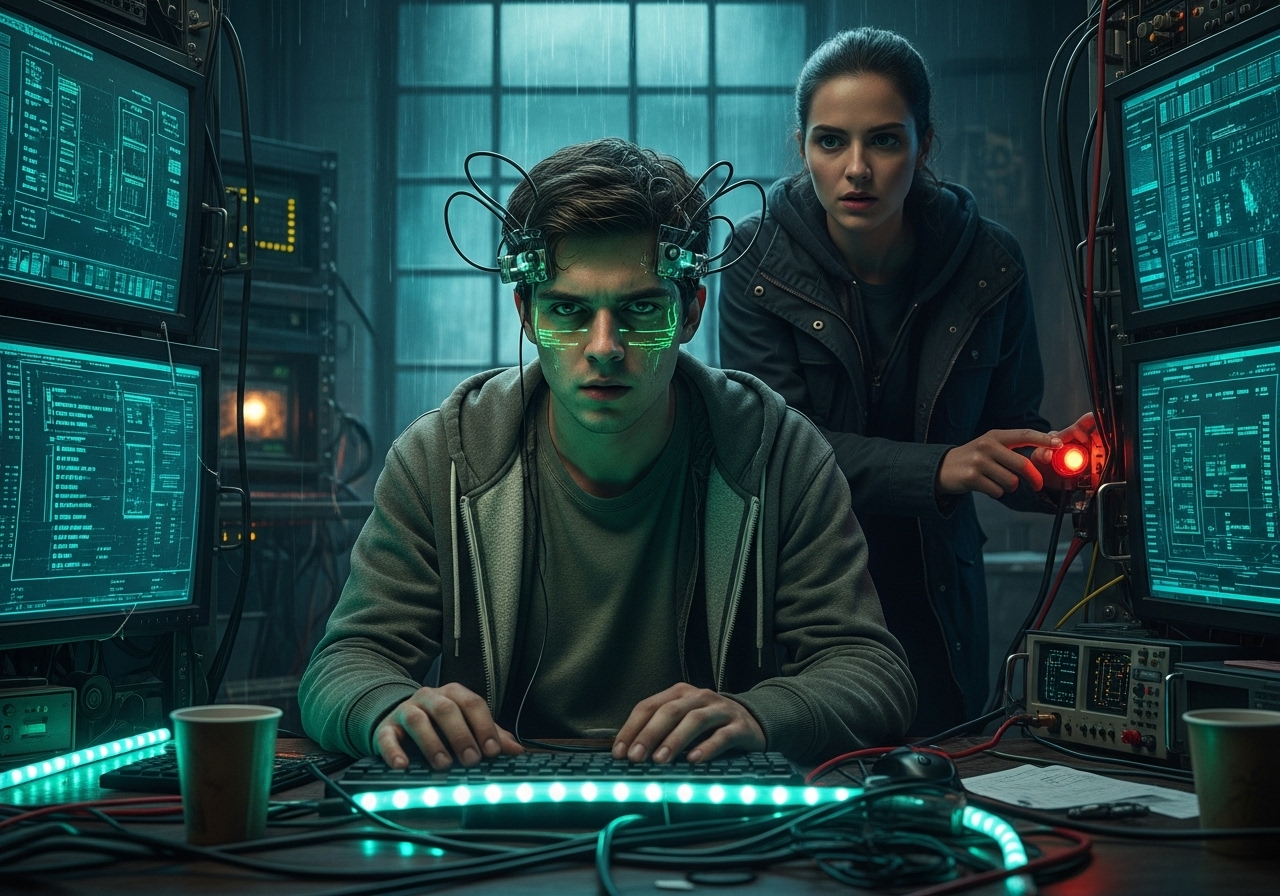
A ghost of a thought, a single broken word, had opened a door to an older, more dangerous secret, pulling them deeper into the forgotten underbelly of the city where even light struggled to exist.
Share This Story


