Frozen Bloom, Fractured Light
The wind, a cutting thing, swept down Portage Avenue, carrying the scent of exhaust and thawing salt. Every lamppost cast a distorted, elongated shadow that danced over the dirty snow. The city hummed, a low, metallic thrum beneath the howl of the January gale, forcing Cassian deeper into the threadbare wool of his coat, his hands shoved into pockets that felt too thin.
Cassian’s breath plumed, a fleeting ghost against the pale January sky. He watched it disappear, just like most of his good ideas did, dissolving into the wide, indifferent expanse above downtown Winnipeg. His boots crunched on the icy pavement, the sound sharp, solitary. The cold bit, a relentless, personal assault that burrowed past the worn layers of his jacket, past the thin scarf Tara had knitted him last spring, straight to the bones. It was a cold that demanded attention, made you pull your shoulders up around your ears, made you walk faster even if you had nowhere urgent to be.
He pushed open the heavy glass door of the coffee shop, a rush of warm air and the smell of stale coffee hitting him like a physical blow. The heat felt alien, almost aggressive, after the biting wind. He peeled off his gloves, his fingers stiff and clumsy, and rubbed his palms together, the friction doing little to bring back the feeling. A small, permanent tremor lived in his left hand now, a nervous tic developed over long hours hunched over charcoal, trying to capture something that always felt just out of reach.
Tara was already there, nursing a lukewarm paper cup, her dark hair pulled back in a loose, practical knot. Her parka, a substantial, sensible thing, was draped over the back of her chair. She looked up as he approached, a slight, almost imperceptible lift of her eyebrow. Tara didn't waste movements, didn't waste words. It was one of the things Cassian both admired and found deeply irritating about her.
“Late,” she said, not as a question, but as a simple, undeniable fact.
Cassian slid into the opposite seat, the plastic cold against his thighs. “Wind,” he mumbled, waving a hand vaguely towards the window, where flakes of snow, fine as ash, swirled past. He knew it was a weak excuse. He was always just a little bit late. It was a habit he hadn’t shaken, even after three years of trying to make a life for himself down south, away from the endless, quiet stretch of the North.
“Right.” Tara took a slow sip of her coffee, her gaze drifting to the window. “Ms. Duvall called again. Said we need to be on time for the ‘orientation’ tomorrow.” She made air quotes around the last word, a slight curl of her lip.
Cassian sighed, a cloud of warm air that momentarily fogged his vision. The ‘Regenerative Arts Sector Capacity Building Initiative.’ It was a mouthful, even for the bureaucracy it represented. He still wasn't entirely sure what it was, beyond a promise of professional development and a monthly stipend that, for once, might cover more than just his half of the rent and art supplies.
“What exactly is ‘mixed-methodological participatory methodology’ anyway?” Cassian asked, picking at a loose thread on his sleeve. The words felt heavy, academic, utterly detached from the tangible grit of charcoal on paper, the rough texture of a stretched canvas.
Tara set her cup down with a soft clink. “It’s how they justify the grant money. Means we’re going to be 'engaging' with 'stakeholders' to 'co-create' a 'framework' for 'sustainable artistic growth.' Or something equally pointless.” She looked at him then, her eyes, dark and sharp, holding his. “You still think this is real, Cass?”
He didn't know. He really didn't. The whole thing felt flimsy, like a thin sheet of ice over a deep, dark current. But the stipend. The chance to actually, properly, just make art without worrying about the grocery bill. It was a siren song, even if the melody was off-key.
“It’s a chance,” Cassian said, his voice quiet, almost pleading. “A real one. Back home, it’s… different. Here, it’s all connections and grants. This is a connection.”
Tara just hummed, a low, noncommittal sound. She shifted, pulling a small, battered notebook from her bag. “Anyway. She wants us to bring a piece. Something that ‘reflects our community.’ Something to ‘inspire conversation.’ Your new piece… the one with the northern lights over the city.”
Cassian nodded. The Aurora Borealis, rendered in electric blues and greens, bleeding into the grimy city skyline, reflecting in puddles of slush. It was his best work in months. A desperate, hopeful collision of two worlds he inhabited.
The Unveiling of Procedures
The next morning, the ‘orientation’ was held in a stark, uninviting meeting room in a government building on Broadway. Fluorescent lights hummed, a persistent, irritating buzz. The air was dry, recycled, and carried the faint, metallic tang of old coffee. Ms. Duvall, a woman who seemed to exist solely in various shades of beige, stood at the head of a long, polished table. Her smile was tight, her eyes darting over the small group of artists, none of whom looked particularly enthusiastic.
Cassian had brought his piece, carefully wrapped in canvas and bubble wrap. He set it against the wall, its vibrant colours a jarring contrast to the muted tones of the room. Tara sat beside him, tapping a pen against her notebook, her expression unreadable. There were perhaps five other young artists, all looking equally lost or suspicious.
Ms. Duvall began her presentation, her voice a monotonous drone. She spoke of ‘synergistic collaborations’ and ‘holistic ecosystem development.’ Her words were a torrent of jargon, meaningless noise that washed over Cassian, leaving him feeling cold and damp, like standing too long in a fine, persistent rain.
“Our goal,” Ms. Duvall said, clicking to a slide that displayed a complex, intersecting flowchart, “is to empower you, our vital cultural producers, with the tools and frameworks to amplify your impact. We will be implementing a proprietary mixed-methodological framework, developed specifically for this initiative.” She gestured to a series of diagrams, grids, and what looked like a bizarre colour wheel of ‘community engagement metrics.’
Cassian tried to follow, he really did. But his mind kept drifting. He noticed a faint smudge of what looked like engine grease on Ms. Duvall’s pristine beige blazer. An odd detail for someone so fastidious. He looked around the room, at the other artists. A quiet young woman with intricate beadwork on her denim jacket chewed on her lip. A tall man with paint under his fingernails stared blankly at the wall.
---
Ms. Duvall then introduced the ‘key facilitation tools.’ She produced a sleek, obsidian-black tablet, unlike anything Cassian had ever seen. “This device,” she announced, holding it up like a sacred relic, “contains the entire interactive methodology. It’s custom-built, loaded with proprietary algorithms for data capture, sentiment analysis, and — crucially — the dynamic 'Art-Connect' module. You’ll each be trained on its operation.”
She passed it around, its cool, smooth surface a stark contrast to the rough feel of Cassian’s own hands. It felt impossibly light, yet substantial. The screen glowed with an intricate network of coloured lines and nodes, abstract and impenetrable. He handed it back, a strange prickle of unease running up his arm.
The session dragged. Lunch was rubbery sandwiches and lukewarm coffee. Cassian barely ate, a knot tightening in his stomach. The whole thing felt… off. Too sterile, too complicated for something that was supposed to be about art and community.
Finally, Ms. Duvall announced a short break. “Please leave your personal items here. We’ll reconvene in fifteen minutes for the practical application segment.” She smiled, a brittle, almost mechanical expression. “Don’t wander too far.”
Tara caught his eye, a flicker of suspicion in her own. “Fifteen minutes to let that woman reorganise her binders. Great.” She stood, stretching her arms above her head. “I need a real coffee. You coming?”
Cassian hesitated. The thought of another five minutes of Ms. Duvall’s droning filled him with dread, but leaving his art felt… wrong. Irrational, perhaps. But the colours of his northern lights piece, a vibrant splash of home, felt vulnerable in this sterile, grey space. He shook his head. “I’ll just… wait here.”
Tara shrugged, pulling her parka back on. “Suit yourself. Don’t let her turn you into a flowchart.” She gave him a small, almost imperceptible nod and left, the glass door sighing shut behind her.
Cassian watched the others trickle out, each with a varying degree of apathy or relief. He was alone in the room, save for Ms. Duvall, who was now meticulously arranging a stack of pamphlets. He wandered over to his painting, running a finger lightly over the canvas. The deep blues felt cold beneath his touch, like the winter sky itself.
He turned, his gaze sweeping over the long table, littered with empty coffee cups, stray pens, and a few crumpled napkins. His eyes snagged on something. Or rather, the absence of something.
The sleek, obsidian-black tablet that Ms. Duvall had presented with such reverence, the one containing the entire 'proprietary mixed-methodological framework,' was gone. Vanished. The space where it had rested, beside Ms. Duvall’s meticulously organised materials, was empty. A smooth, dark patch on the beige tablecloth, as if it had never been there at all.
His breath hitched, a small, involuntary sound. He looked at Ms. Duvall, still humming softly to herself as she straightened a stack of stapled documents, her back to him. Her methodical movements. The odd grease stain. The too-tight smile. Suddenly, the sterile room felt colder than the January wind outside, and a shiver, not from the chill, ran down Cassian’s spine.
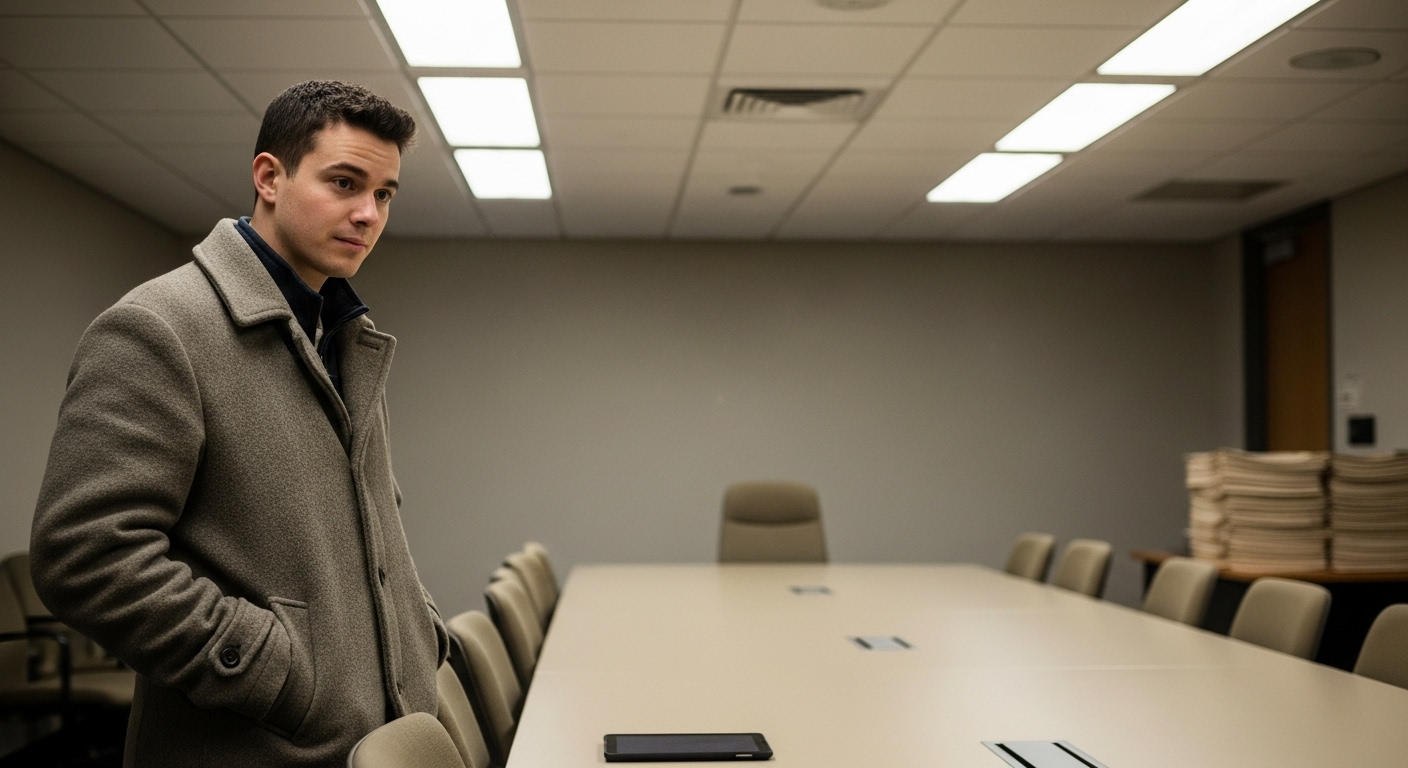
He knew it couldn't have just walked away, yet the room offered no other explanation, no overturned chair, no scattered papers, just the heavy, unsettling silence and the persistent, low hum of the fluorescent lights. Who would take it, and why? And what did it mean for this 'opportunity' they were all so desperately clinging to?
Share This Story


