The Slow Drain of Chromium Rain
The persistent, fine drizzle of Neo-Montreal clung to everything, an oily sheen on the ferrocrete, a greasy film on the flickering holo-ads that promised eternal youth or instant credit. Rust-coloured leaves, long past their vibrant autumn prime, plastered themselves to chrome-plated street corners, bleeding chemical dyes into the perpetually damp ground. The air, thick with the smell of wet exhaust, synth-spice, and something vaguely metallic, carried a low, throbbing hum – the city's ceaseless metabolism. Inside Sammie Taylor's cramped, overheated apartment, the only light came from the glow of outdated screens and the rhythmic blink of a dozen charging indicator lights, painting his face in shifting greens and blues.
I wanted to go away from here. Not ‘away’ in the sense of a trip to some Corporate pleasure dome on the orbit ring, all synthetic sunsets and zero-G champagne. More like ‘away’ in the sense of ceasing to exist within the known parameters of this city, this life, this particular set of grimy circumstances. I wanted to be a faint shimmer on the thermal cameras of some backwater agri-colony, maybe even a ghost in a forgotten server farm, anything but Sammie Taylor, purveyor of digital misdeeds, staring out at the perpetual autumn drizzle that coated Neo-Montreal like a second skin.
My synth-coffee, usually a bitter comfort, tasted like burnt circuit boards this morning. It matched the taste in my mouth, really. Fifty-eight years of scraping by, half of them spent hunched over blinking consoles, trying to make sense of other people’s scrambled secrets. The view from my window, a patchwork of corroded ferrocrete, tangles of data cables like fossilised serpents, and the dizzying, nauseating pulse of a thousand flickering holo-ads, did nothing to improve the flavour. It was all a bit much, especially now that the season’s damp chill had settled deep into my old bones, making every joint protest like a disgruntled mech.
I ran a hand over my bristly scalp, the faint hum of the apartment’s ancient ventilation unit a familiar drone. The city outside seemed to inhale and exhale in slow, mechanical breaths. A particularly garish ad for ‘Eternal Youth Bio-Implants’ pulsed directly across from my window, its smiling, perfect face mocking my own reflection in the greasy glass. I swear, the digital model in the ad winked at me, a tiny glitch in its loop, or maybe just the onset of early morning delirium.
Just as I was contemplating the existential horror of a sentient advertisement, my comm-unit, a relic from the pre-Corporate Wars era that still inexplicably worked, gave a low, resonant thrum. It wasn’t a standard chime; it was a bespoke frequency, an anachronism for an anachronistic contact. Margot Davidson.
I sighed, a long, drawn-out affair that ended in a weary wheeze. Margot. The Ghost. Or ‘The Glamour’ as she liked to call herself, mainly because her operations were always cloaked in a layer of plausible deniability and just enough sparkle to distract from the razor wire beneath. She never called unless she needed something obscure, illegal, and likely to get me a permanent vacation to the data-mines. Still, curiosity, the kind that had killed a thousand cats and probably a few data-brokers, won out over common sense.
“Sammie, darling,” her voice, a smooth synth-silk whisper with just a hint of an old-world accent, flowed through the ancient comm-unit’s speaker. “Always a pleasure to catch you in your… lair.”
“Margot,” I grunted, pushing my coffee cup aside. “Always a pleasure to hear your voice right before a headache starts. What obscure piece of Corporate mischief are you unwrapping now?”
Her laugh was like tiny, shattered glass chimes. “Direct as ever, my love. But this isn’t corporate mischief. This is… art. A very particular kind of art, encased in rather fascinating packaging.”
I heard a faint rustling on her end, like silk rubbing against something hard. “Art, you say? Last time you said ‘art,’ I ended up reprogramming a pleasure bot to recite haikus to a corporate CEO’s prize-winning bonsai collection. He was not amused. The bonsai, however, seemed… meditative.”
“Oh, you’re still talking about that?” Margot chuckled, a genuine, if brief, sound. “He needed some culture. Besides, the bot’s programming eventually reverted. No harm done. Mostly. This, however, is far more… tangible.”
“Tangible trouble is still trouble, Margot,” I mumbled, already reaching for my worn gloves, the ones with the embedded haptic sensors that were more sensitive than any new-gen neural interface. My fingers had their own memory, their own muscle-grammar.
The Sculpted Secret
A delivery drone, sleek and silent, arrived within the hour. It hovered outside my window, its optical sensor a single, unblinking yellow eye. I let it in through the maintenance hatch, a concession I made only for Margot’s parcels, which often required a degree of stealth usually reserved for orbital espionage. The drone deposited a small, heavy package onto my scarred workbench and zipped out without a word.
The package wasn’t a standard data-courier box. It was, as Margot had promised, ‘art.’ A smooth, dark, organic-looking resin, sculpted into an irregular, almost bulbous shape, roughly the size of my fist. It felt warm, surprisingly so, against my gloved palm. Like something recently alive, or perhaps still faintly pulsing with some arcane energy. Not a usual data shard casing at all.
“What in the blazes did you do to this?” I muttered to the empty air, turning the object over in my hand. Its surface was subtly iridescent, catching the dim apartment light in faint, shifting greens and purples, like an oil slick on dark water.
My fingers traced the contours. No visible seams, no obvious access points. It was completely seamless, a perfect natural anomaly. Margot had always had a flair for the dramatic, but this was beyond her usual aesthetic. This felt… primal. And dangerously expensive.
I set it down on a scanner pad, powering up my primary console. The old system whirred to life with a familiar chorus of clicks and hums, a comforting anachronism in a world of silent, solid-state tech. While the diagnostics ran, I noticed a tiny, almost imperceptible tremor in the resin object. A trick of the light? Or was it actually… vibrating?
“You’re getting old, Sammie,” I muttered to myself, rubbing my eyes. “Seeing things. Too much synth-coffee, not enough sleep.” But the tremor seemed to continue, a faint, internal pulse. My internal thoughts were like a tangled mess of old wires, half-frayed, half-connected, leaping from the mysterious resin to the nagging thought of leaving, to the memory of a particularly bad hack in my youth that nearly cost me an eye. My brain was a cluttered attic, full of rusty tools and half-eaten memories.
---
The scan results were… inconclusive, which was a red flag the size of a Corporate Tower. No known material signature. Organic, yes, but not biological in any database I could access. The system identified it simply as ‘Unknown Bio-Synthetic Composite’ with an energy signature that was, frankly, impossible for its size.
“Impossible, my ass,” I said aloud, my voice raspy. Impossible was just ‘not yet understood’ in this city. Or ‘something someone wants to keep hidden.’ Margot’s specialty.
I initiated a more aggressive deep-scan, bypassing standard protocols, pushing the limits of my antique hardware. The console’s fans spun up, a mournful lament. The internal temperature gauges started to climb. I could smell ozone, that crisp, metallic scent that always meant something was working too hard or about to fry.
As the scanner dug deeper, the faint iridescence on the resin intensified. It began to subtly glow, a faint, internal luminescence that seemed to emanate from within its dark core. The light was hypnotic, a soft, green pulse, like a deep-sea creature. I leaned closer, my breath fogging the cool glass of the screen.
Then, the screen flickered. A burst of static, followed by a single, impossible image, overlaying the data stream for less than a microsecond. It was a stylised glyph, intricate and ancient-looking, yet somehow alien. It was gone before I could properly register it, a phantom on my retina. My hand, without thinking, scraped against the rough edge of the workbench as I flinched, a small sting. The hum of the console intensified.
The data stream stabilised, but it was corrupted, fragmented. A full-spectrum encryption, complex and layered, but with a peculiar, almost biological signature to its key. Like a digital lock that changed its shape every nanosecond. My old fingers, usually so sure, fumbled for a moment, hitting the wrong key, a flush of annoyance heating my cheeks. I rarely made mistakes like that.
“Alright, you little digital enigma,” I muttered, adjusting my gloves, ignoring the slight tremor in my left hand. “Let’s see what secrets you’re trying to keep.”
Hours bled into hours. The autumn light outside, already weak, faded into the perpetual twilight of Neo-Montreal’s night. My apartment, illuminated only by the frantic dance of console lights and the unnerving, soft green pulse from the resin-encased shard, felt like a capsule adrift in a sea of data. My back ached, my eyes burned, and my synth-coffee had gone cold and congealed.
Decoding the Resonance
The encryption was unlike anything I’d encountered. It wasn't just code; it felt alive, shifting and adapting, almost mocking my attempts. I tried a dozen different algorithms, a dozen backdoors, even a few archaic brute-force methods from the pre-net era. Each time, the shard seemed to absorb the attack, offering up nothing but digital white noise and a faint, almost musical hum that vibrated through my desk.
I felt a dull ache behind my eyes. I probably needed food, or at least another three cups of that foul synth-coffee. My mind, usually a finely tuned machine, was making associative leaps, jumping from the impossible encryption to the way the rain had sounded on the old corrugated roof of my childhood home, then to the feeling of cold metal in my hands. It was a mess, but sometimes, in the mess, a pattern emerged.
“Okay, fine,” I grumbled. “You want to play hard to get, we’ll play hard to get. Let’s try… resonance.”
Instead of attacking the encryption head-on, I began to probe it, sending out tiny, resonant frequency packets, listening for echoes, for a sympathetic vibration. It was a painstaking, almost spiritual process, like trying to sing a lost key out of a locked vault. And as I worked, focusing intently, the subtle hum from the resin shard seemed to align with the soft clicks of my interface, a low, synchronised thrumming.
It was during one of these deep-frequency probes that I found it. Not a crack in the encryption, not a data-port, but a repetitive, anomalous pattern deep within the background noise. A signal, embedded beneath layers of digital obfuscation, cycling endlessly.
I isolated it, amplifying the pattern, pushing it through a visualizer. And there it was, clear as day, yet utterly disturbing. The same stylized glyph I’d seen fleetingly before. A complex, almost biological-looking symbol, swirling lines and sharp angles, repeating itself, an infinite digital brand. It wasn't just a symbol; it felt like a signature, a claim. And as I stared at it, the autumn rain outside picked up, not the gentle drizzle anymore, but a metallic drumming on the ferrocrete, growing louder, harder, a relentless beat. The entire city seemed to hum, a deep, resonant growl, and I felt a chill that wasn't from the weather, but from a sudden, visceral understanding. Whatever this was, whatever Margot had gotten her hands on, it was far bigger than I’d imagined, and it had just latched onto me, a digital parasite digging in its claws.
The glyph on my screen seemed to pulse, a silent, knowing throb, and for the first time in years, the desire to go 'away from here' wasn't a whimsical thought, but an urgent, desperate scream in the back of my mind. But it felt like 'here' was about to follow me, no matter where I ran.
It felt like I’d just shaken hands with something ancient and very, very hungry.
---
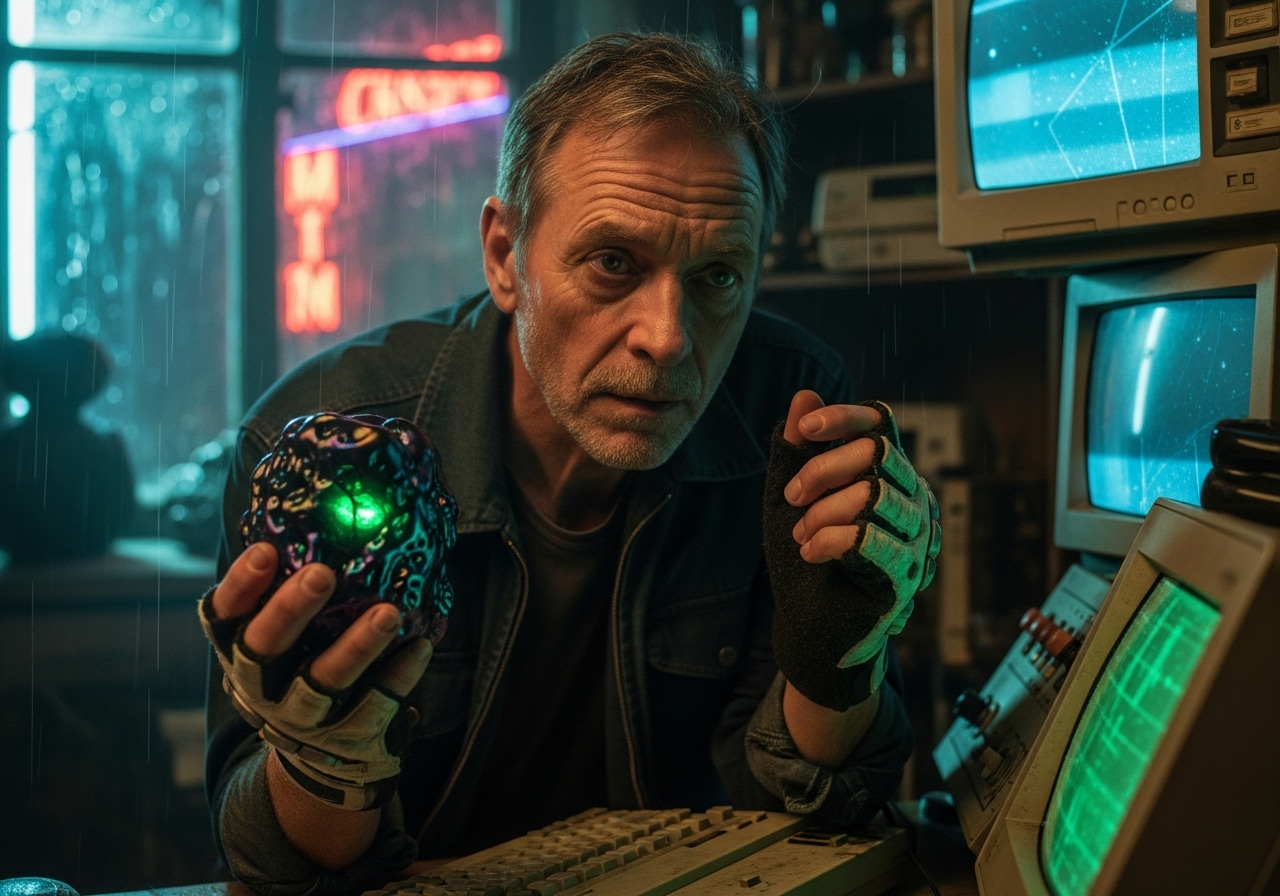
The mysterious glyph pulsed on my screen, a silent, knowing throb, and for the first time in years, the desire to go 'away from here' wasn't a whimsical thought, but an urgent, desperate scream. It felt like 'here' was about to follow me, no matter where I ran, like I'd just shaken hands with something ancient and very, very hungry.
Share This Story


