The Hum of the Old Radiator
The wind outside David's living room window was a steady, insistent groan, a low thrumming against the eaves that spoke of bitter cold and the deep, unyielding hush of a Canadian winter. Inside, the ancient cast-iron radiator hissed, its warmth a fragile bulwark against the invading chill. Dust motes, stirred by the radiator's convection, danced in the scant light filtering through the heavy, velvet curtains, remnants of a forgotten afternoon sun. The air smelled of old wood, faint tea, and the indefinable scent of decades lived in one place. David sat, fingers steepled, watching the patterns the frost etched onto the outer pane, each delicate filament a miniature, silent scream against the glass.
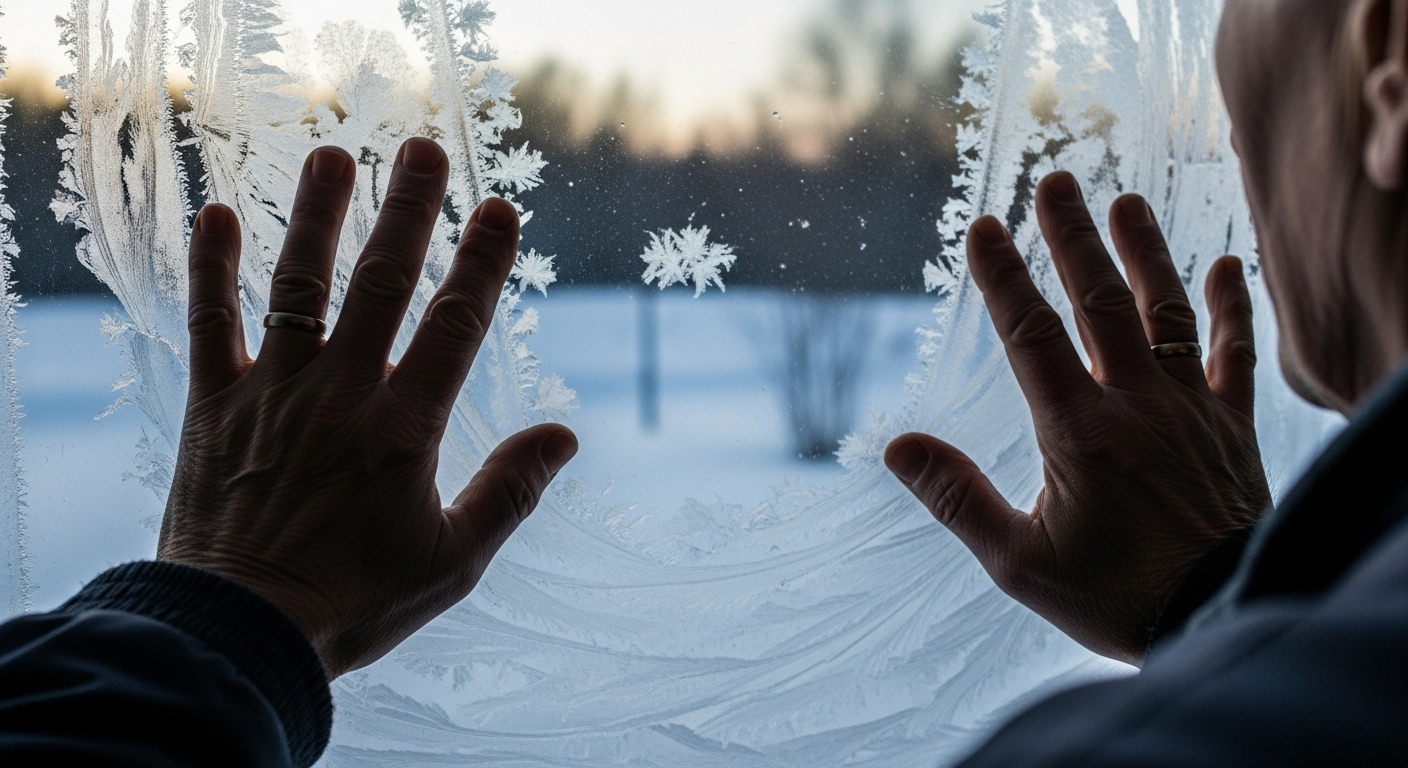
The hum of the old radiator against the insistent groan of the wind outside was the soundtrack to David's afternoons now. Thirty-seven years he and Clara had lived in this house, each winter a familiar cycle of frost, snow, and the steady creak of settling timbers. This was the first winter without her. Five months, three weeks, and two days since the ground had frozen over her. The precise accounting was a silent, internal ritual, a way to anchor himself against the current of time that threatened to sweep everything, even her memory, into a hazy, indistinguishable past. His fingers, knobbly with age, traced the delicate fern-like patterns of frost on the windowpane, each crystalline branch a testament to the ruthless efficiency of the cold.
He remembered Clara's hands, smaller, quicker than his, often warm from kneading dough or holding a mug of tea. She’d hated winter, always complaining about the chill that seemed to seep into her bones, no matter how many sweaters she wore. He’d tease her, calling her his ‘little hibernating bear,’ and she’d swat him playfully with a tea towel. The memory brought a faint, almost imperceptible twitch to the corner of his mouth, a ghost of a smile that faded as quickly as it came. The house, usually bustling with her quiet industry, felt vast now, a cathedral of echoing silences. Every creak, every groan of the old structure, seemed magnified, imbued with a strange, watchful presence.
He shifted in his armchair, the worn leather sighing beneath his weight. His gaze drifted from the window to the mantelpiece, where a single, framed photograph of Clara stood guard. It was from their trip to the East Coast, twenty years ago, her face flushed with the maritime wind, her eyes sparkling with a joy he hadn't seen enough of in recent years. Or perhaps, he thought with a jolt, he hadn't noticed enough of it. The journalistic precision of his grief demanded such brutal honesty.
A sharp rap on the front door shattered the quiet. He blinked, the frost patterns on the glass momentarily blurring into a white haze. Betty. Of course. She had a way of knowing, an instinct for when the silence might become too heavy, too complete. He pushed himself up, his knees protesting with a dull ache, and made his way to the door, the floorboards groaning in a familiar rhythm beneath his feet.
Betty stood on the porch, a woollen scarf pulled high around her neck, her cheeks rosy from the cold. In her gloved hands, she clutched a large, covered casserole dish. The scent of roasted vegetables and herbs, even through the lid, was a welcome assault on the senses, a momentary reprieve from the lingering scent of stale tea and old paper. Her eyes, shrewd and kind, assessed him quickly.
"David," she began, her voice a low murmur, "you weren't answering the phone. I was getting worried."
He offered a shrug, the movement stiff. "Must have turned the ringer down. Didn't hear it." It wasn't a lie, not exactly. Sometimes, he just didn't pick up. Sometimes, the world outside felt too loud.
She stepped past him, a small puff of frigid air entering with her, carrying the sharp, clean scent of snow. "Well, I made that lamb stew you like. Thought you could use something warm." She moved with a familiar efficiency into the kitchen, placing the dish on the countertop. He followed, watching her movements. Her coat, a sensible navy wool, was dusted with fine flakes of snow that glistened like scattered diamonds in the kitchen's weak overhead light.
"That's kind of you, Betty." He rubbed his hands together, the cold from the open door still clinging to him.
She glanced back at him, her expression unreadable. "Someone has to look out for you. Clara would have my hide if I let you starve." The mention of Clara hung in the air, a small, tangible presence between them. Betty turned to fuss with the stovetop, her back to him. "You've been… keeping to yourself, more than usual."
"It's winter," he replied, his voice deliberately neutral. "Gets dark early. Not much to do." He leaned against the doorframe, watching the steam begin to rise from the casserole dish she’d set on the hob to warm. The kitchen felt almost alive for a moment, the clatter of her movements, the gentle bubbling sound from the pot, a stark contrast to the earlier quiet. He noticed a faint grease stain on the front of her apron, just below her waist, a small, human imperfection that made her presence feel more real, less like a concerned spectre.
"The anniversary, then," she said, not a question, but a statement of fact. She finally turned, her gaze direct, unwavering. "It's today, isn't it?"
He nodded. "It is."
She took a deep breath, the sound almost a sigh. "I remember that day. The snow, thick as a blanket. We could barely see the road. It was… terrible."
"It was," he agreed, a flatness in his tone. He remembered the snow too, a blizzard that had descended with a furious, unexpected speed, trapping them all. That was the official version, at least. The relentless snow, the icy roads. An unavoidable tragedy. That was what the papers had said. What the doctor had said. What everyone had agreed upon.
---
A Fading Picture
Betty picked up a framed photo from the kitchen counter – an old, sepia-toned image of Clara as a young woman, laughing, her arm linked through David’s. “She was so full of life, wasn’t she?” Her thumb brushed lightly over Clara's image. “Always planning something, always a project on the go.”
“Always,” David echoed, a pang in his chest. “She was never one to sit still.” He watched Betty, her movements careful, almost ritualistic, as if she were handling a fragile relic. The afternoon light, now a weak grey, filtered through the kitchen window, making the dust motes dance with renewed vigour. The faint smell of woodsmoke drifted in, an almost imperceptible scent that clung to the cold air.
“Do you remember that last winter?” Betty asked, her voice softer now, almost conversational, but with an underlying current David couldn’t quite place. “Before… everything. She was so excited about that trip, wasn't she? To the coast, for the birdwatching.”
David frowned, a slow furrow appearing between his brows. “The trip? Yes, she was. Obsessed with those puffins.” He chuckled, a dry, raspy sound. “Had a whole itinerary planned out. Maps everywhere. Didn’t happen, of course. The snow…” He trailed off, the memory catching in his throat.
“The snow,” Betty repeated, her eyes now fixed on the swirling patterns outside. “Yes. It came down so hard, so fast. But she said… she said she’d found another way to get there. Before the roads closed completely.” Her gaze shifted back to him, sharp and assessing. “Do you remember her saying that? That she’d found another way?”
David’s mind sifted through the archives of memory. Clara’s final days, a blur of preparations, then the sudden, shocking news. He’d been ill himself that week, a bout of the flu that had left him bedridden, his thoughts thick and sluggish. He’d relied on Betty, on Mrs. Thompson next door, for updates on the weather, on Clara’s movements. “Another way?” he mused aloud. “I… I don’t recall that. I thought the roads were impassable. That’s what I was told.” He pushed himself off the doorframe, a sense of vague unease prickling at the back of his neck.
“She was always resourceful,” Betty said, almost to herself. She moved towards the window, pressing her palm against the cold glass. “And stubborn. Once she had her mind set on something…” Her voice faded, leaving the unspoken thought hanging in the air like a cold breath.
David walked to the old pine dresser in the corner, a piece Clara had painstakingly stripped and refinished years ago. He ran his hand over the smooth, cool wood. “She spoke of taking the train, I think,” he offered, pulling at a thread of memory. “But the lines were affected too, weren’t they? Or so I heard.” He opened the top drawer, rummaging through its contents – old receipts, dried flowers, a few faded photographs. He was looking for nothing in particular, just a distraction. A reason not to meet Betty’s piercing gaze.
“The train?” Betty turned from the window, her brow slightly creased. “I don’t remember her mentioning a train. Not for that specific journey, anyway. She was always one for her little car, her old Morris Minor. Loved that car.” She paused, her eyes narrowing slightly, as if searching for something just beyond his vision. “No, I’m quite certain she said she’d found someone with a four-wheel drive, going that way. A neighbour from the next village over. Someone with a heavy truck.”
A cold knot began to form in David’s stomach. He remembered nothing of a four-wheel drive, nothing of a neighbour from the next village. His illness had been severe, but not so severe that a detail like that would have completely escaped him. He remembered the constant, hushed talk of the snow, the impossibility of travel. He remembered Clara, her face pale, worried, as she’d come into the bedroom, her voice soft, saying she had to go, something about a last-minute errand before the storm really hit. That was it. That was the last he’d seen her, before the frantic phone call from the authorities.
“I… I don’t think so, Betty,” he said slowly, pulling out an old shoebox filled with miscellaneous items. “I truly don’t. We had discussed the train as an option weeks before, but it was dismissed. Too unreliable in the winter.” He fumbled with the lid of the shoebox, a small, inconsequential sound in the vast quiet of the kitchen. Inside, tangled up with old spools of thread and forgotten buttons, lay a collection of small, yellowed photographs.
Betty watched him, her posture rigid. “Well, perhaps my memory is playing tricks. It was a long time ago.” But her voice held a brittle edge, a tension that belied her words. She moved back to the stovetop, stirring the stew with a wooden spoon, the rhythmic scraping sound loud in the room. The subtle shift in her tone, the slight narrowing of her eyes – David felt it all. It was like watching ice crack on a winter pond, a barely perceptible change, but one that hinted at a deeper, colder current beneath.
---
The View from Across the Street
Through her own frost-kissed window across the street, Mrs. Thompson watched David’s house. She saw Betty arrive, the silhouette of her car pulling up the snowy driveway, leaving fresh tracks in the pristine white. She saw her leave hours later, the casserole dish now presumably empty. Mrs. Thompson, perched on her worn floral sofa, a tartan blanket tucked around her legs, sipped her weak tea, the porcelain mug warm against her fingers. She hadn’t left her house in days, not since the last major snowfall. The village was quiet, muffled under its blanket of white, and life, for many, had slowed to a near halt.
She remembered Clara’s last winter too. Every detail, sharper than any photograph. Clara, always so vibrant, so full of energy, even then. And David, a shadow of himself, battling that terrible flu. Mrs. Thompson had helped out, bringing meals, checking in. She’d seen Clara the morning she left, seen her car pull out of the driveway, not in the direction of the coast, as everyone presumed, but towards the old logging road, the one that snaked up towards the northern wilderness, a road usually impassable in winter, especially for a little Morris Minor. She’d always meant to mention it, that odd detail, but the shock, the grief… it had overshadowed everything. And then, it just seemed too late. Too unseemly to bring up after the fact.
She remembered the look on Clara’s face that morning, too. Not the usual cheerful, determined look, but something else. Something hurried. Apprehensive. A fleeting glance over her shoulder, as if she were being watched. Mrs. Thompson had dismissed it at the time, attributing it to the stress of the impending storm, the anxiety of travel. Now, years later, watching David’s solitary figure through her window, a shiver traced its way down her spine. The old house across the street seemed to hold its breath, a silent repository of unanswered questions. The light inside David's kitchen flickered, a sudden, brief power surge, and then settled back into its dull glow. Mrs. Thompson felt a cold dread settle in her chest, heavy as a stone.
---
A Different Angle
David, still in the kitchen, sorted through the old shoebox, the photographs crinkling softly in his hands. Most were of Clara, of course. Picnics by the lake, birthdays, a blurry image of her trying to bake a particularly ambitious cake that had collapsed into a sugary heap. He smiled again, a genuine, if fleeting, smile this time. These were the memories he held onto, the ones that felt warm, comforting.
But then he came across one he didn’t quite recognise. It was small, slightly discoloured, and tucked beneath a stack of old postcards. It showed Clara, bundled in her thick winter coat, standing next to her Morris Minor. But the setting was wrong. It wasn’t their driveway. The background was a dense stand of fir trees, branches heavy with snow, and a narrow, unplowed track winding away behind her. Her face, in this particular photograph, was not smiling. Her eyes were wide, her mouth a thin, grim line. She was looking not at the camera, but past it, as if startled. A small detail, almost imperceptible, but it snagged at David’s attention.
He remembered the camera, a little automatic point-and-shoot they’d bought for their East Coast trip. Clara loved taking candid shots. But this was no candid shot from a happy holiday. This was… different. He turned it over, his thumb brushing the smooth, cool paper. No date. No inscription. Just a faint, almost invisible crease where it had been folded. He held it closer, trying to discern more details. The trees were definitely local, the dense, dark evergreens that grew wild along the periphery of their village, especially near the old logging trails. The logging trails Clara was supposedly too frail to traverse alone, let alone in a snowstorm.
His mind raced. Betty’s words about the four-wheel drive, the neighbour from the next village, echoed in his ears. What if Clara had gone a different way? What if she hadn’t been alone? And why would she keep such a photograph, if it wasn't connected to her trip? He thought of the official report: a single-vehicle accident, car found overturned in a ditch along the main road, the blizzard making visibility impossible. An unfortunate, isolated incident. But this photograph… it suggested another narrative, a different departure, one she hadn't mentioned. Not to him, certainly. Not when he was lost in a feverish haze.
The air in the kitchen, once comforting with the scent of stew, now felt thick, heavy with unspoken questions. He looked out the window again, the frost still clinging stubbornly, obscuring the world beyond. The light was almost gone, swallowed by the vast, hungry darkness of the winter afternoon. He thought of Clara, her secretive glance, her sudden urgency, and a cold dread, deeper than the winter outside, began to set in. He felt a profound sense of loneliness, not just from her absence, but from the sudden, chilling possibility that he hadn't known her as well as he'd thought. That there were layers to her he'd never seen, choices she'd made in secret.
He moved back to the armchair, the worn leather welcoming him with a sigh. He sat, the small photograph held delicately between his fingers. The image of Clara, her face etched with that unfamiliar apprehension, stared back at him. It was as if she were trying to tell him something, a warning perhaps, frozen in time. The radiator hissed, a prolonged, almost mournful sound, and the wind outside picked up, rattling a loose pane in the old window frame. The silence in the house was no longer comforting; it was expectant, pregnant with unspoken truths. David felt a cold trickle of suspicion, tiny, insidious, beginning to snake its way through the foundations of his grief.
He turned the photograph over, a shiver, unrelated to the cold seeping through the old glass, tracing its way up his spine. The message on the back was brief, stark, and written in a hand that was not Clara's, not quite. It simply read: 'The ice remembers.'
He turned the photograph over, a shiver, unrelated to the cold seeping through the old glass, tracing its way up his spine. The message on the back was brief, stark, and written in a hand that was not Clara's, not quite. It simply read: 'The ice remembers.'
Share This Story


