The Twisted Berry Vine
A crisp autumn afternoon in the Deepwood Land Lab. The air hung still, carrying the scent of damp earth and dying leaves. A thin, grey light filtered through the skeletal canopy of birch and pine, casting long, wavering shadows across the narrow, winding path. Thomas Caldwell, his breath misting faintly, adjusted the collar of his tweed jacket, his gaze fixed on a particular, unnerving anomaly. The land, usually so generous, seemed to hold a secret in its quiet dormancy.
Thomas Caldwell paused, his fingers lightly brushing the gnarled stem of what had once been a robust raspberry cane. The air, cool and sharp against his exposed skin, carried the faint, sweet decay of fallen birch leaves and the deeper, resinous scent of pine. The silence of the Deepwood Land Lab, now that the summer’s diligent hum of activity had ceased, felt profound, almost surgical. He squinted, adjusting his spectacles, a frown creasing the weathered lines around his eyes. This particular cane, nestled near the edge of the clearing where the cultivated plots met the encroaching, wilder woods, was wrong. Distinctly so.
It wasn’t merely withered by the season’s chill, as were its neighbours. No, this one had twisted upon itself with a peculiar, almost violent intentionality, its desiccated branches forming a tight, convoluted knot where the berries should have ripened. It corkscrewed inwards, defying the natural tendency of flora to reach for light. The colour of the bark, too, was off; not the usual pale brown of a spent cane, but a deep, bruised purple that seemed to absorb the meagre autumn light rather than reflect it. A chill, unconnected to the weather, snaked up Thomas’s spine.
He was a man of law, of logic, of precedent. For over three decades, his mind had sought patterns, discrepancies, and the underlying truth in complex contracts and contentious disputes. This plant, in its silent, defiant contortion, was a discrepancy that snagged his attention. It wasn't a mutation he’d ever seen, nor a disease he recognised from the lab’s extensive agricultural literature. It felt… engineered, but by no hand he could conceive.
A distant, cheerful call broke the quiet. “Thomas! Still admiring the remnants?”
Miriam, her vibrant orange scarf a splash of defiance against the muted autumn palette, emerged from a copse of cedars, a wide, enthusiastic smile lighting her face. At sixty-eight, she moved with the vigour of someone half her age, her grey-streaked braid bouncing against the back of her fleece jacket. She carried a canvas tote bag, its contents jingling softly.
Thomas straightened, pulling his hand away from the strange cane as if it had suddenly grown thorns. “Miriam. Just… observing the season’s final flourish.” He gestured vaguely at the broader landscape, avoiding direct eye contact with the offending plant.
She joined him, her boots crunching through the leaf litter. “Oh, it’s been a spectacular flourish, hasn’t it? The best yield of strawberries we’ve had in years! And the raspberries! Remember those plump, crimson jewels? Barely lasted a day once they were picked.” She chuckled, a warm, resonant sound. “Even the cucumbers, bless their spiky hearts, did marvellously before the first real frost took them. And the tomatoes… well, we’re still processing the last of those, thank goodness.”
Miriam glanced at the specific cane Thomas had been studying, but her eyes, brimming with the memory of summer’s bounty, seemed to skim over its unnerving peculiarity. “Ah, yes, this patch,” she said, bending down, oblivious. “A little temperamental sometimes, but often gives us the sweetest berries. Such a shame to see them go to seed. But, as they say, there’s always next year.”
Thomas merely hummed, his gaze flicking between Miriam’s oblivious cheer and the darkly twisted stem. He wondered if he was imagining the strangeness, projecting some latent legal paranoia onto a simple biological anomaly. But the cold certainty in his gut said otherwise.
“Next year, indeed,” Thomas finally managed, attempting to inject a measure of her optimism into his voice. “Speaking of next year, your ambitious plans for ‘The Deepwood Preserve’ are taking shape, I trust?”
Miriam clapped her hands together, a theatrical gesture that always made Thomas smile despite himself. “Oh, Thomas, they are! Imagine: small batch, artisanal jams, fruit leathers, even a line of savoury relishes from our heirloom tomatoes and cucumbers. ‘The Deepwood Delights,’ perhaps? Or ‘Deepwood Bounty’? We need to brainstorm a name that really captures the essence of this place. Authentic, locally sourced, sustainable… it’s a dream!” She began to walk again, heading deeper into the network of trails that criss-crossed the former logging concession, her enthusiasm infectious.
Thomas followed, his thoughts still lingering on the raspberry cane, but the current of conversation pulled him along. “A laudable vision, Miriam. Particularly for our community. The economic realities here, as you well know, are… challenging. Creative entrepreneurship, as you propose, might very well be the vital spark needed.”
A Community's Hope
They walked in comfortable silence for a moment, the quiet punctuated only by the rustle of their movements and the occasional cry of a raven overhead. The path narrowed, winding past skeletal grey birches and formidable, ancient pines whose needles formed a thick, fragrant carpet underfoot. The air grew perceptibly colder here, the canopy denser, the light struggling to penetrate.
“Challenging is an understatement, Thomas,” Miriam said, her tone softening, losing some of its earlier ebullience. “Sometimes it feels less like a challenge and more like an active, malicious force working against us. We’ve lost so many of our young people to the cities. The mill closed a decade ago, the fishing quotas dwindled, and the tourism, while present, isn’t enough to sustain a year-round economy. It’s a struggle, every single day, to keep this place vibrant, to offer any semblance of opportunity beyond seasonal labour.”
Thomas nodded, a familiar weariness settling over him. He knew this narrative intimately. He’d seen it in countless small towns across the province during his corporate law career – communities stripped bare, left to fend for themselves against an indifferent global economy. “And the land lab, with its educational and agricultural initiatives, offers a genuine alternative. A way to cultivate sustenance, both literally and figuratively, from the very soil beneath our feet.”
“Precisely!” Miriam exclaimed, her spirits rebounding. “And the ‘Deepwood Preserve’ is the logical next step. Taking what we grow, adding value, creating a product that people can buy, that tells a story. It’s not just about jam, Thomas. It’s about identity. It’s about proving that this corner of the world, remote as it is, has something unique and valuable to offer.” She kicked at a clump of unusually dark fungi growing on a rotting log, a fleeting gesture of impatience at the obstacles they faced.
Thomas observed the fungi. It was a deep, inky black, almost velvety, and seemed to pulsate slightly in the dim light, though he knew that was merely a trick of his aging eyes and the shifting shadows. Still, it made his brow furrow. He had seen similar growths on the land around old mining claims, the kind that indicated heavy metal contamination or other environmental degradation. But this land was pristine, or so all the recent environmental impact assessments had declared.
“Indeed,” Thomas replied, his mind already spinning through potential legal structures, intellectual property protection, and sourcing agreements. His lawyer’s brain, even in retirement, craved the elegant puzzle of a new venture. “The brand story, the market positioning, the supply chain… all critical. And the raw material, of course. Our yields have been consistently excellent, as you say.”
He paused, recalling something, a fleeting memory from a decades-old case. A land claim, contentious, involving a tract of boreal forest further north, not far from here. There had been an obscure report then, an addendum to the geological survey, mentioning… what was it? Anomalous subsoil readings? Unusually high concentrations of some rare earth element, or perhaps, a peculiar resonant frequency emanating from certain bedrock formations. It had been dismissed as irrelevant, a footnote in a complex ownership battle. But now, coupled with the twisted raspberry cane and this strangely dark fungus, it pricked at him.
---
Whispers in the Woods
They continued their circuit, the conversation flowing between the tangible challenges of starting a small business in a remote region and the potential for triumph. Miriam spoke of grant applications, of networking with other local producers, of the importance of storytelling in marketing. Thomas offered insights into regulatory compliance, liability, and the delicate art of contract negotiation.
As they rounded a bend, they came upon the remains of the cucumber patch. The sprawling vines, now brown and brittle, lay like discarded fishing nets upon the soil. Thomas noticed, with a renewed jolt of unease, that some of the vines, rather than simply shrivelling, had also taken on the same unnaturally convoluted, almost knotted, appearance as the raspberry cane. It was less pronounced here, perhaps because the plants were annuals, but the pattern was undeniable. A slow, cold dread began to seep into his contemplation of their entrepreneurial zeal.
“This land… has always been fertile,” Miriam mused, unaware of Thomas’s internal disquiet, her voice a little softer here, almost reverent. “Even when it was just wild growth, before we cleared the plots, everything grew with such vigour. It’s a generous place.” She reached down, picking up a desiccated cucumber, now shrunken and hard, its surface strangely mottled with the same purplish-black discolouration he had seen on the raspberry cane.
“Generous, yes,” Thomas echoed, carefully taking the dried cucumber from her. The surface felt unnaturally smooth, almost metallic, beneath his gloved fingers. It was lighter than it should have been, almost hollow. “But also… old. This region, geologically, is ancient. Precambrian Shield. It has seen millennia pass, empires rise and fall in its silence.” He turned the cucumber over in his palm, scrutinising it. The pattern of discolouration seemed to follow the faint ridges of the vegetable, forming an almost geometric design.
“That’s part of its charm!” Miriam laughed, though a hint of wistfulness entered her voice. “The sense of continuity. The Deepwood has always been here. Our families have always been here, or close by. There’s a comfort in that, isn’t there? A sense of roots.”
Roots. The word hung in the air, weighted with a new, unsettling resonance for Thomas. He thought of the deep, twisting roots of the ancient pines, of the unseen network beneath the soil, connecting everything. He thought of that old legal brief, the subsoil anomalies, the peculiar resonance. What if the ‘generosity’ of this land, its remarkable fertility, stemmed from something far older, far more profound, and utterly beyond human comprehension or control?
His legal mind, accustomed to sifting through layers of testimony and evidence, began to connect disparate points. A historical account he’d once dismissed as local folklore, describing strange lights over the lake in winter, or whispers carried on the wind that drove some prospectors to madness. He’d always attributed such tales to isolation, harsh weather, and too much cheap whiskey. But now, a different framework began to impose itself upon these scattered data points.
“Miriam,” Thomas began, his voice a little lower, more hesitant than usual. “Do you recall… any unusual incidents during the harvest? Anything out of the ordinary, beyond the usual challenges of pests or weather?”
She paused, considering, her brow furrowing in concentration. “Unusual? Well, no, not really. The usual deer trouble, a particularly persistent badger, that sort of thing. Oh, and the occasional weird light out by the old observation tower, but that’s just a trick of the marsh gas, always has been.” She waved a dismissive hand, a bright, confident gesture. “Why? What are you thinking?”
He hesitated, the words catching in his throat. How to articulate the sudden, chilling intuition that was taking root in his mind? To speak of 'twisted plants' and 'resonant frequencies' and 'old land claims' without sounding like a man succumbing to his twilight years? He knew the perception of lawyers: precise, analytical, but often prone to overthinking, to seeing conspiracies in every loose thread. This was beyond conspiracy. This felt… cosmic.
“Just… a professional curiosity,” he finally said, offering a weak smile. “Considering the branding for your ‘Deepwood Preserve.’ We must ensure absolute purity, Miriam. No unexpected… additives.” He looked down at the desiccated cucumber in his hand, the strange purplish-black mottling seeming to deepen. It felt wrong, unnaturally dense and light simultaneously, defying the very physics of organic decay. The smell, too, was subtly off, a faint, almost imperceptible tang that wasn't quite earthy, not quite sweet, but something metallic and cold.
---
A Persistent Worry
They continued their walk, the conversation gradually returning to the practicalities of their venture. Miriam described her plans for sourcing jars, designing labels, and navigating health regulations for food production. Thomas, however, found his attention increasingly divided. His eyes scanned the undergrowth, seeking more anomalies. A patch of moss growing with unnerving symmetry, forming intricate, geometric patterns on a granite outcrop. A segment of the path itself, where the fallen leaves seemed to have been swept into a perfect spiral, though there was no wind to account for it.
His mind returned to the old land case. It involved a large timber company, a dispute over logging rights on a remote parcel of land. There had been a series of odd stipulations in the original nineteenth-century deed, covenants that seemed utterly archaic even then, referring to the “sacred stillness of the earth” and forbidding “unnatural excavations” beyond a certain depth. They were dismissed as the quaint superstitions of a bygone era, perhaps put in by a land-owner with a spiritual bent. But what if they weren't quaint? What if they were warnings?
“We should think about local lore for the marketing,” Miriam suggested, oblivious to his mounting internal turmoil. “Something about the ancient spirit of the land, the enduring magic of the Deepwood. It resonates with people, don’t you think?”
Thomas stopped, turning to face her. “Miriam, please. Let us avoid any suggestion of ‘magic.’ We are speaking of a food product, rigorously cultivated and processed. We must present it as such. Any hint of… supernatural elements would be detrimental to our credibility, would it not?” His voice held a sharper edge than he intended, betraying his unease.
Miriam blinked, surprised by his sudden intensity. “Of course, Thomas, of course. Just brainstorming, you know. Trying to find that unique selling proposition.” She gave a small, nervous laugh. “Though, sometimes, when you’re out here alone in the deepest parts of the lab, particularly as autumn draws in and the days grow short, you do feel… something. A presence. The sheer age of it all.”
Thomas merely nodded, his gaze distant, fixed on something unseen among the darkening boughs. The 'presence' Miriam spoke of, he realised with a growing chill, was perhaps not the benign, ancestral spirit she imagined. The feeling that had been a gentle prick earlier was now a persistent ache, a cold certainty. The legal framework he knew, the rational world he inhabited, felt as fragile as the desiccated leaves beneath his feet. He had spent a lifetime trying to understand human laws, human greed, human folly. But this… this felt profoundly alien, a law from another reality entirely.
He remembered the specific wording from the geological addendum: ‘Unusual harmonic resonance detected at depths exceeding seventy metres, inconsistent with known terrestrial geology.’ And then the follow-up note, quickly redacted, that simply read: ‘Anomalous crystalline growth observed in core samples.’ At the time, it had been a footnote, quickly buried under a mountain of environmental impact statements and logging permits. Now, it felt like a scream.
As they circled back towards the main clearing of the land lab, the air grew heavier, thick with the damp perfume of decaying leaves and the distant, unseen waters of the lake. The last slivers of light were draining from the sky, turning the horizon a bruised, deep violet. The familiar outlines of the small wooden shed, the composting bins, and the neatly marked plots began to lose their crisp edges, dissolving into the encroaching twilight.
“Well,” Miriam said, pulling her scarf tighter, her breath pluming in the colder air. “A productive walk, wouldn’t you agree? I feel invigorated, ready to tackle the business plan! And ‘The Deepwood Preserve’… it just has a certain ring to it, doesn’t it?” She beamed, radiating a pure, uncomplicated hope that Thomas found both endearing and profoundly unsettling.
Thomas forced a smile, but it felt thin, brittle. “Indeed, Miriam. Productive. I shall look forward to reviewing your draft proposal.” He still held the desiccated cucumber, turning it over and over in his hand. The purplish black mottling seemed almost to shimmer in the dying light, a silent, cosmic script etched onto a simple fruit. His legal training insisted on evidence, on facts, on a rational explanation. But what if the facts were… inherently irrational? What if the evidence pointed to something that unravelled the very fabric of his ordered world?
He looked back towards the edge of the wild woods, where the twisted raspberry cane stood like a dark, gnarled finger pointing accusingly at the sky. The 'Deepwood Preserve.' Preserving what, exactly? The bounty of the earth? Or something far older, far stranger, something that had lain dormant beneath the Shield for unimaginable epochs, now stirring, slowly, subtly, through the very roots and fruits of the land?
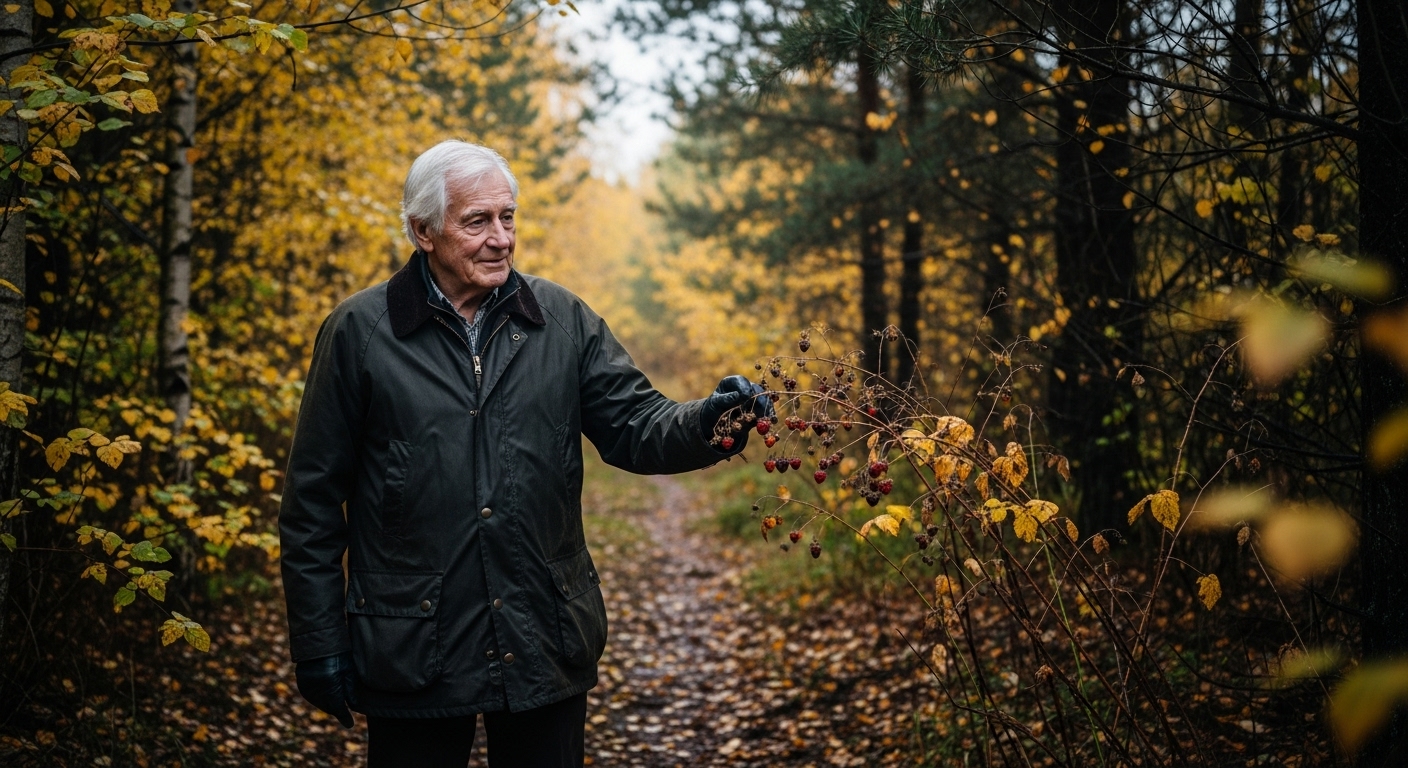
The notion that their simple, hopeful venture might be built upon something so profoundly, impossibly ancient and malevolent, settled over Thomas like the deepening autumn gloom, promising a winter far longer than he could possibly imagine.
Share This Story


