Beneath the Linoleum
The air in the recreation hall basement hung thick with the ghosts of forgotten potlucks and decades of damp, an aroma somewhere between stale coffee and slow decay. Outside, the spring thaw had turned the rutted road to a muddy slur, but down here, beneath the creaking floorboards of community aspirations, the cold still bit with the tenacity of a northern winter. Dust motes, thick as tiny galaxies, danced in the anemic light struggling through the single grimy window well, illuminating a landscape of piled junk and the hopeful but weary faces of the town's most committed volunteers.
The insistent drone started somewhere beneath Agnes's work boot, a low, persistent thrum that vibrated not just the floorboards, but the very marrow in her bones. She paused, the claw hammer still mid-air, a strip of ancient, mottled linoleum peeled back like decaying skin. "Did you hear that?" Her voice, usually crisp, sounded thin in the cavernous chill of the recreation hall basement.
Frederick, hunched over a stack of yellowed newspaper clippings in a nook he’d claimed as his 'archival station', grunted. "Hear what, Agnes? The lament of municipal decay? Or Brenda's incessant humming?" Brenda, a woman whose enthusiasm often outstripped her competence, was indeed humming a cheerful, off-key tune while wrestling a rusted filing cabinet.
Martha, meticulously scraping paint from a section of concrete wall, paused, her movements precise. She had the artist's eye for detail, even in grime. "It's a low frequency," she murmured, tilting her head. "Like… a distant generator, but no. It's too deep. More like a cello playing one continuous, wrong note."
Agnes stomped her foot, a deliberate, testy tap. The hum deepened for a heartbeat, then receded, leaving only the sound of Brenda’s tuneless serenade and the scritch of Martha’s scraper. "Well," Agnes declared, wiping a smudge of dust from her brow, "if it's not the boiler giving up the ghost, it's probably the ghost giving up the boiler. Either way, we've got a deadline, people."
The 'Grand Northern Gallery and Curio Museum' was, in its current state, a gloriously optimistic title for a space that still harboured three decades of discarded sports equipment, broken chairs, and what appeared to be a taxidermied squirrel with one eye missing. The spring thaw outside, bringing with it the smell of wet earth and early buds, felt a world away from this subterranean purgatory. Their vision, however, was clear: a place for local artists, for the community's quirky history, a beacon against the long winters.
Hours later, the hum returned, stronger this time, emanating from behind a section of plasterboard Frederick was trying to coax off a support beam. He wasn't usually so clumsy, but the board seemed to cling, resisting his efforts. A cold patch, distinct and unnatural, pressed against his palm. "Hold on," he called, his voice tight. "There's… something odd here."
Agnes, now triumphantly dragging a mound of splintered particle board to the skip outside, returned, her breath misting. "Odd how, Frederick? Like Brenda's decision to bring her own artisanal oat milk to the coffee break?"
Frederick ignored the jab, tapping the wall gently. The thrum intensified, making his teeth ache. "Hollow. But not empty. And this plaster… it's not quite right. Too thick. Laid over something else."
Martha knelt, running a gloved hand over the surface. "Look at the lines here, Agnes. Beneath this peeling paint, there's a faint seam. Like someone bricked something up, then tried to blend it into the rest of the wall, poorly. A rush job."
Brenda, having finally defeated the filing cabinet, came over, curious. "Ooh, a secret passage! Maybe it leads to a hidden stash of butter tarts!"
Agnes sighed, a long, suffering sound. "Or more likely, a nest of particularly virulent spiders. Alright, Frederick, carefully. Let's see what civic impropriety lies beneath."
---
Unveiling the Unseen
It took a crowbar, a substantial amount of elbow grease, and Frederick's surprisingly robust cursing, but the false wall eventually yielded. Plaster dust plumed, thick and choking, lit by their headlamps like a low-rent nebula. Behind it, not an open space, but a cavity, roughly square, bricked in with a mortar that looked unlike any they'd seen in the hall's original construction. The bricks themselves were dark, almost black, and felt unnervingly cold to the touch.
A collective gasp, even from Agnes. The air within the exposed cavity was different. Still, dead. It didn't smell of mold or damp earth, but something sharp, mineral, like a freshly snapped magnet, with an underlying scent that was vaguely metallic and yet organic, an impossible contradiction.
Inside, on a rough-hewn shelf, sat three objects. Not gold, not jewels, not anything remotely historical or familiar. They were dull, obsidian-like, yet somehow absorbed the headlamp beams rather than reflecting them. Their shapes were utterly alien. One was a polyhedral mass, its facets meeting at angles that seemed to shift as Agnes tried to focus. Another, a flat disc, was etched with swirling patterns that appeared to move, a slow, deliberate crawl of lines and symbols that made Martha's eyes water.
The third was a spindle, almost elegant, but its curves flowed into hard, impossible points, like geometry sculpted by a fever dream. It was small enough to hold, and a strange compulsion tugged at Agnes to reach for it, a bizarre, morbid curiosity that made her fingers tingle.
Frederick, usually so garrulous, was silent, his gaze fixed on the swirling disc. His mouth was a thin, tight line. "These aren't local," he finally whispered, his voice hoarse. "They're… nothing I've ever indexed. No known material. No known culture. This isn't from around here, or even… this world."
Martha, meanwhile, had begun to draw, frantically sketching the symbols from the disc on a scrap of cardboard. Her hand shook. "The patterns… they're not random. They imply a sequence. A language. But it's… wrong. It makes my head buzz."
Brenda, surprisingly, was the most unnerved. She'd retreated to the doorway, clutching her oat milk thermos like a talisman. "My stomach feels… cold. And the humming… it's in here now. Can you feel it, Agnes? It's inside."
Agnes did feel it. A subtle vibration behind her teeth, a low pulse that matched the strange, impossible rhythm from earlier. She extended her hand, her fingers trembling, towards the spindle. It felt colder than anything she had ever touched, yet a strange warmth seemed to emanate from its depths, creating an unsettling paradox. The air in the small chamber grew heavier, pressing against her eardrums. She felt a prickle on her skin, as though tiny, invisible insects were crawling over her scalp.
"Don't touch it, Agnes!" Frederick's shout broke the strange spell, his voice cracking. "It's… it's a void. They're all voids. I've read about things like this. Whispers in the old histories. Before the first settlers. Before the Cree. Things best left buried. Unseen."
But Agnes's gaze was fixed on the spindle, on the way the dim light seemed to bend around its impossible angles. She could hear a faint, high-pitched whine now, deep in her skull. It wasn't the hum. It was something else. A call.
---
Echoes of an Older Dark
The objects seemed to resonate with a peculiar energy, filling the small space. Martha started coughing, a dry, ragged sound. She swore she saw the shadows on the far wall deepen, writhe, then pull back into themselves, as if the chamber itself were breathing. The symbols on the disc now pulsed with a faint, almost imperceptible light, mirroring the thrum in Agnes's teeth. Frederick, pale and trembling, fumbled for his phone, his fingers too stiff to dial.
"This isn't a museum, Agnes," he whispered, his eyes wide, fixed on the objects. "This is… a tomb. Or a trap. Things were sealed away for a reason. Things from a time when the very earth was… different."
Agnes finally pulled her hand back from the spindle, a phantom coldness lingering on her fingertips. A wave of dizziness washed over her, making the familiar concrete floor sway. "What are you talking about, Frederick? More of your local tall tales?" But her voice lacked conviction. The rational part of her mind, the part that organized spreadsheets and community meetings, was battling against a primal dread, a certainty that something profoundly wrong had been unleashed.
"The old stories aren't just stories, Agnes!" Frederick insisted, his voice rising in panic. "They're warnings. Of things that predate memory. Things that sleep. And we just… woke them up."
Martha pointed a shaking finger at the furthest corner of the alcove, where the dark bricks seemed to recede into a deeper, absolute blackness. It wasn't merely shadow. It was an absence of light, a hole in reality. "There's more," she gasped, her artistic eye catching the impossible geometry. "It’s not just a wall. It goes deeper."
The hum returned, not just in their heads, but resonating through the concrete, through the very foundations of the old recreation hall. The objects on the shelf seemed to glow faintly, radiating that impossible cold. Agnes felt a strange, detached curiosity warring with pure terror. What could be down there? What ancient horror had the community, in its earnest pursuit of culture, stumbled upon? The air was suddenly thick with expectation, the promise of something truly vast, truly indifferent, stirring beneath the spring thaw. She glanced at Frederick, then at the unnervingly black opening. A part of her knew they should run. Another part, a deeper, colder part, wanted to know.
Then, from the absolute blackness, a faint, rhythmic scrape sounded, like stone on bone, echoing from unfathomable depths.
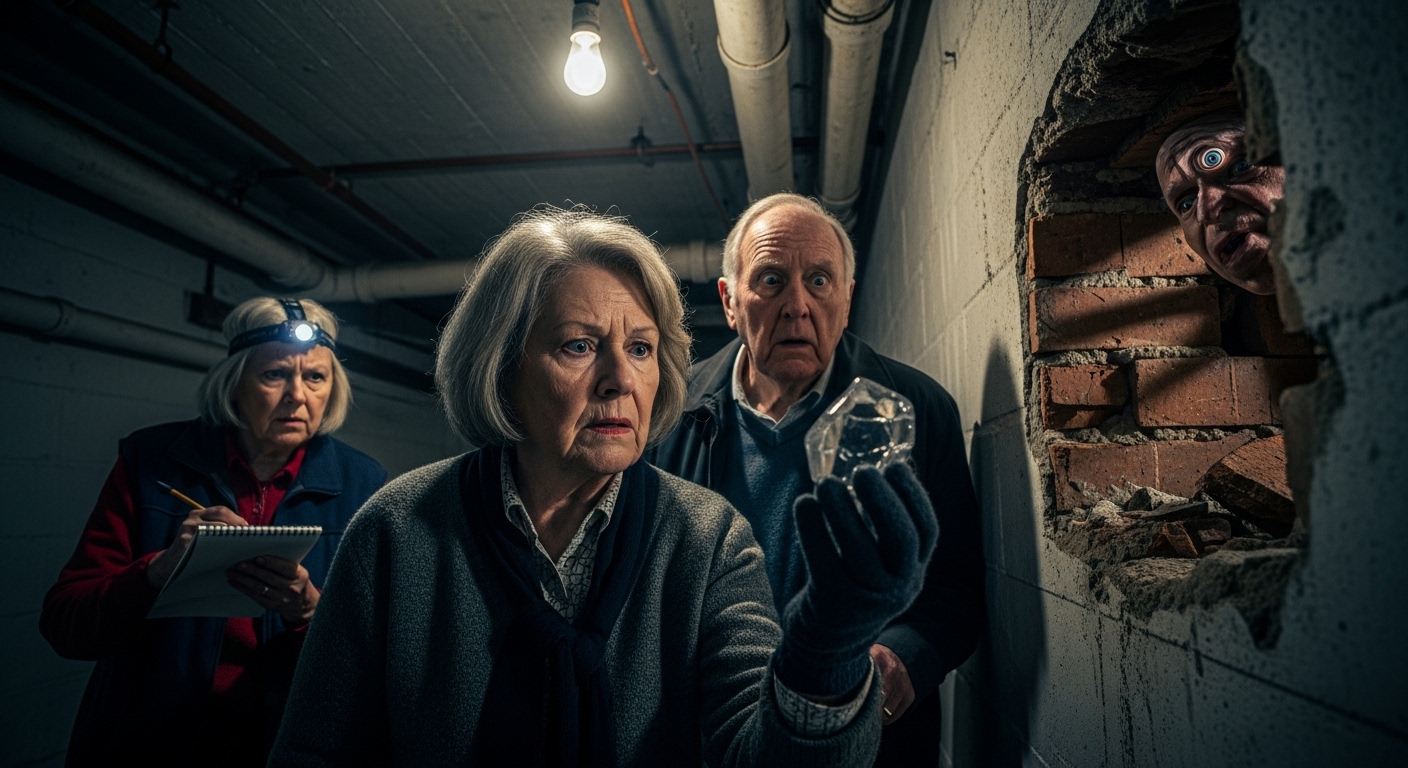
The faint, rhythmic scrape from the impossible darkness was an invitation, a promise, and a warning all rolled into one. Agnes didn't know if she could resist the horrifying allure of what lay beyond.
Share This Story


