A Blue Star in the Grey
The protagonist, a teenager, navigates the desolate, controlled 'festive' atmosphere of their dystopian city and home during the winter holidays. They seek a genuine moment of connection and hope for their family, leading them to an illicit market and a significant act of defiance.
The thin sheet of ice clinging to the ferrocrete window sill felt like a skin, stretched taut and brittle over the city's grim breath. It was supposed to be festive, this time of year. The Central Authority's seasonal display drones, buzzing like oversized mechanical moths, painted the air outside in sterile, flickering reds and greens. Not warm like a real fire, just… light. Cold light. I watched them trace their programmed patterns, a ceaseless, silent ballet against the perpetual grey of the December sky, a sky that hadn't seen a true blue in years, only varying shades of atmospheric filtration haze.
My breath fogged the pane as I leaned closer. Outside, the mandated 'Holiday Spirit' was in full, suffocating swing. Citizens, bundled in their standard-issue cold-weather suits, moved with a determined, practiced cheer. They carried their Ration Pack 12, the festive variant, back to their Housing Units, shoulders hunched against the biting wind that smelled of recycled air and cold metal. No lingering, no spontaneous joy. Just compliance. Just the hum of the drones and the low, distant thrum of the city's power grid, a sound that never truly left you, even in sleep.
Mom was in the ‘recreation’ room, the one with the single, flickering display screen that cycled through approved holiday messaging. Her fingers, chapped and raw from the daily shift at the processing plant, picked at a loose thread on her sleeve. She wasn't watching the cheerful, manufactured families laughing over their synthetic holiday meals. She was just… present. Her gaze fixed somewhere beyond the screen, beyond the grimy walls, probably on a memory I couldn't touch. Dad was at the communal re-education session, mandated for all Level 3 workers this cycle. Something about ‘Optimizing Seasonal Productivity.’ He wouldn't be back until after curfew.
“You gonna help or just watch the sky fall?” my sister, Catherine, mumbled, her voice muffled by the thick, woven scarf she’d pulled up to her nose. She was wrestling with the 'Celebration Unit,' the Central Authority’s version of a Christmas tree. It was a metal pole with pre-drilled holes, into which we were supposed to insert glowing plastic rods. Ours, bought secondhand, was missing three of the rods and sagged slightly to the left. It looked less like a tree and more like a sad, asymmetrical antenna.
I pushed off the window, the cold glass leaving a faint print on my cheek. “It’s falling already, isn’t it?” I said, more to myself than to her. She didn’t respond, just grunted, her small frame straining as she tried to force a bent plastic rod into its slot. The rod snapped with a brittle crack. Catherine swore, a quiet, almost imperceptible sound, the kind you only made when you knew no one was really listening, or when you were just too tired to care if they were.
The air in our unit was thin, recycled, carrying the faint, metallic tang of the heating system. It never truly warmed, not really. Just took the edge off the deeper, bone-chilling cold that seeped in from the outside. I picked up a bag of 'Fizzy Flakes,' a mandatory holiday treat—dehydrated nutrient paste pressed into star shapes, tasting vaguely of citrus and desperation. The packaging, bright red and green, screamed 'Joy!' in bold, official script. I tore a corner off, the crinkle of the plastic loud in the quiet room. They tasted like nothing. Or, worse, like what nothing tasted like after you'd been told it was everything.
Catherine kicked the base of the Celebration Unit. It swayed precariously. “Stupid thing,” she muttered. She had a bruise blooming on her forehead from where she'd bumped it earlier, trying to reach a higher slot. She was only eleven, too young to remember a time before the Authority’s constant, benevolent gaze. But even she knew the difference between real warmth and the sterile glow of the plastic rods.
Mom finally stirred. “Catherine. Don’t break it. We’ll be flagged.” Her voice was flat, devoid of real concern, just a recitation of rules. The Authority rewarded compliance. Any deviation, any ‘non-optimal behavior,’ was noted. My family’s ‘Social Credit Score’ was already hovering just above the minimum. Dad’s re-education sessions were a constant reminder of that.
I knelt beside Catherine, picking up the snapped plastic rod. The tiny wires inside were exposed, a miniature circuit board gleaming dully. “Here,” I said, and she eyed me, suspicious. We didn’t always… get along. Not like families in the old holo-vids. Ours was a unit, a survival pact. Less about feeling, more about shared space and avoiding penalties. I took the broken piece, pulled a strip of adhesive tape from my pocket – a forbidden item, scavenged from the waste disposal unit at the plant – and carefully, meticulously, pieced the rod back together. It wouldn’t glow, not like the others, but it would fit. It would look whole.
Catherine watched my fingers work, her breath held. When I finally pressed it into its slot, a small, dark stub against the programmed cheer, she let out a tiny exhale. “Thanks,” she whispered. It was a rare word, a real word, not one of the pre-approved sentiments. It hung in the stale air between us, a fragile, almost visible thing. Like a breath on a cold window.
The drone hum outside seemed to lessen, or maybe I just tuned it out. My thoughts drifted to last cycle, to the anomaly. The old woman in Sector Gamma who’d been flagged for possessing an ‘unapproved festive artifact.’ It turned out to be a small, wooden carving of a bird. Hand-painted. Faded. Nothing overtly political, nothing threatening. But it was hers. It wasn’t Authority-issued. That was enough. They took her, and the bird. Never saw either again.
I looked at Mom, still staring blankly at the screen. What was she thinking? Was it the same fear? The same dull ache of knowing that even a sliver of genuine, unapproved joy could be a weapon against you, or used against you? This was what Christmas had become. A performance. A mandatory parade of regulated cheer, all to ensure social cohesion and to track deviations.
“I’m going to the Market,” I said, the words surprising even myself. The Sector Market was a grim place, even on a 'holiday.' Mostly regulated exchanges for ration credits, sometimes a few illicit, grimy stalls hidden in the shadows where people traded actual objects, carefully. Things that hadn’t been scanned, categorized, or branded by the Authority. Things with stories.
Mom glanced at me, a flicker of something, maybe worry, in her eyes. “Don’t be late for the evening broadcast. And don’t… draw attention.” She didn't have to explain what ‘draw attention’ meant. It meant don't look too happy, don't look too sad. Don't look too human, unless it's in an Authority-approved way. Be a gray ghost among gray ghosts.
Catherine looked up from the Celebration Unit, her eyes wide. She knew. She knew what the Market sometimes held. My small act of mending the plastic rod had bought me a moment of her trust, a sliver of hope that I might actually bring something real back. Something that wasn't nutrient paste or a plastic rod.
The outer corridor was colder than our unit, the air thick with the metallic scent of static and a faint undertone of stale food. The sound of forced carols, piped through unseen speakers, echoed off the concrete walls. It was a garbled, tinny rendition of 'Jingle Bells,' the lyrics slightly altered to reflect Authority messaging: 'Jingle bells, Authority! Order, all the way! Oh, what fun to follow rules, every single day!' It scraped at my nerves, like nails on a blackboard. I tugged my scarf higher, burying my nose in the rough fabric. The synthetic wool prickled, a small, tangible discomfort in a world full of systemic ones.
The elevator cage shuddered as it descended, smelling of motor oil and too many bodies. A few other residents stood pressed together, their faces impassive. A young couple held hands, their fingers intertwined beneath the cuffs of their identical coats, a tiny act of defiance in plain sight. No one looked directly at anyone else. Eye contact was often misinterpreted, sometimes even flagged. I kept my gaze fixed on the flashing floor numbers, watching them tick down, each one a step closer to the biting wind and the flickering, fake lights of the city outside.
Stepping out into the open plaza was like walking into a freezer. Snow, real snow, not the machine-generated kind that coated the higher-level sectors, had begun to fall, fine and sharp as crushed glass. It stung my cheeks. The ground was already dusted in a thin, unforgiving layer, crunching under my worn boots. The festive drones circled higher here, their lights less obtrusive, replaced by the imposing, monolithic screens that lined the plaza walls. They showed a loop of happy, diverse families, all smiling perfect, Authority-approved smiles, opening Authority-approved gifts. The illusion of contentment was absolute, pervasive.
I moved through the crowd, a river of humanity flowing silently towards the market district. My hands were shoved deep into my pockets, my fingers finding the smooth, cool surface of the flattened tin soldier I carried. A relic. Dad’s. From before. He’d given it to me years ago, when I was small, before the re-education cycles had begun to blur his edges. It was chipped, the paint faded, but it was real. Not manufactured cheer. Not a processed nutrient flake.
The market was a labyrinth of corrugated metal stalls and flickering holographic advertisements for 'optimal holiday purchases.' The air here was thick with the smell of cheap synthetic fabric, ersatz spices, and the faint, acrid tang of illicit alcohol. People bartered in low voices, their eyes darting, always watching. Seasonal Compliance Officers, their black uniforms stark against the drab surroundings, patrolled the aisles, their presence a cold, constant pressure. They didn't need to speak. Their very existence was a threat, a reminder.
I passed stalls selling worn-out data-pads, scavenged circuit boards, and dubious 'protein bars' made from God-knows-what. My gaze lingered on a display of 'Memory Scraps' – tiny, faded photo fragments salvaged from the pre-Authority era. A blurry image of children laughing, a field of impossibly green grass, a bright, unbroken blue sky. They were expensive, a luxury no one could truly afford without risking a flag.
My target wasn’t in the main thoroughfare. It was deeper, in the narrow alleys where the light barely reached, where the drones couldn't easily follow. There was a vendor there, an old woman named Linda, who sometimes had… things. Real things. Relics from before. Dangerous things. I found her stall tucked behind a pile of discarded industrial components, lit by a single, sputtering lumen-lamp. She was hunched over a small table, her face a roadmap of wrinkles, her eyes sharp and knowing.
“Something you need, child?” she rasped, her voice like dry leaves. She didn’t look up immediately, her gaze fixed on the small, intricate movements of her fingers as she polished a tarnished copper trinket. Her stall was a treasure trove of forgotten items: rusty gears, smooth river stones, a small, cracked porcelain doll with one missing eye. Each one whispered of a past that the Authority had tried to erase.
“I’m… looking for something,” I said, my voice barely above a whisper. “Something… festive.” I hated using the Authority’s terms, but it was safer. A coded language. She understood. Her eyes, dark and intelligent, finally met mine. She didn't smile, but there was a knowing glint there, a shared understanding of the unspoken.
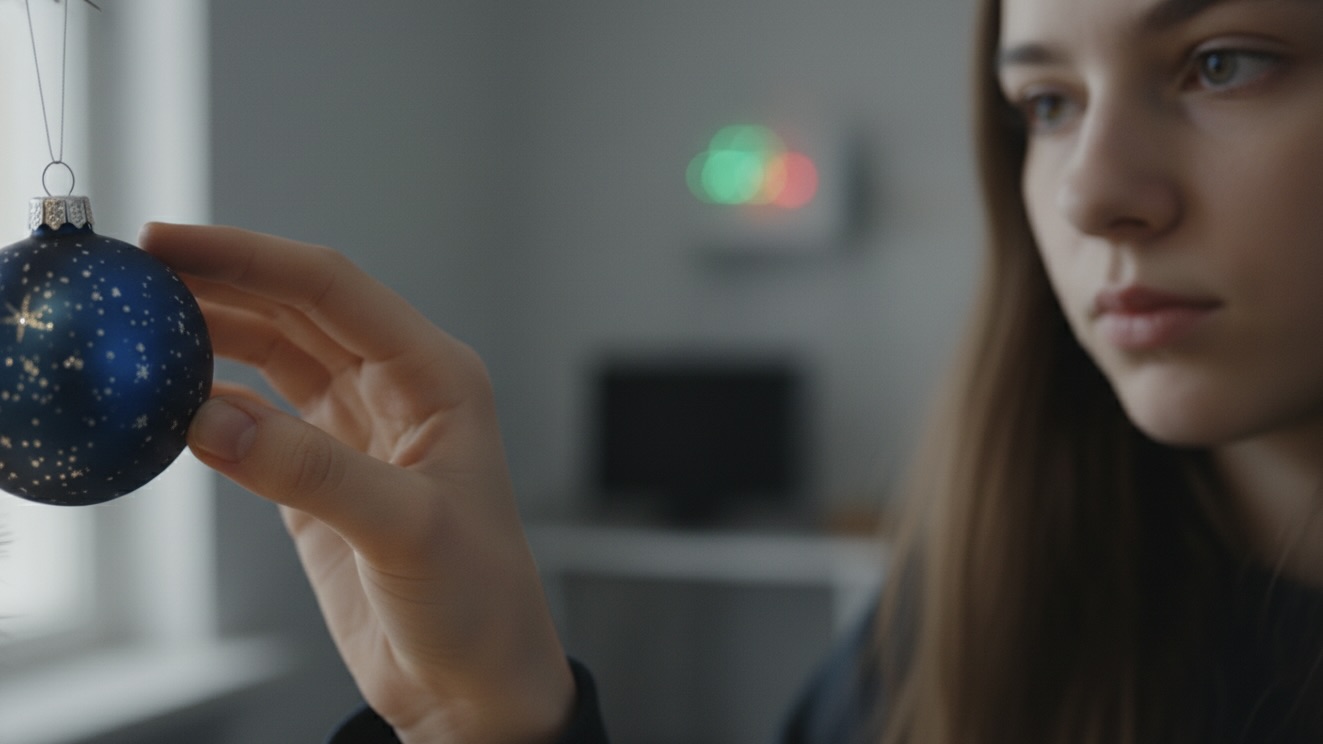
She slowly pushed aside a pile of woven scraps, revealing a small, velvet-lined box. My heart gave a strange thump, an almost forgotten rhythm. Inside, nestled on the worn fabric, lay a small, glass ornament. It wasn’t flashy. It wasn’t new. It was a sphere, perfectly round, a deep, true blue, speckled with flecks of what looked like silver dust, meant to mimic stars. But it wasn’t the stars of our filtered sky. It was the vast, unfathomable black of a true night, glittering with a thousand tiny, unblinking eyes.
It was heavy in my palm, smooth and cool. I ran my thumb over its surface. It didn’t glow. It didn’t hum. It just was. It felt fragile, delicate, and impossibly old. Linda watched me, her expression unreadable. “From before,” she said, her voice a low murmur. “Real glass. Real pigment. They don’t make them like that anymore.” She paused, then added, almost as an afterthought, “Said it was meant for a… pine tree. To hang on a branch.”
A pine tree. I’d seen images of them in illegal data-dumps. Tall, green things, growing wild. My stomach clenched, a mix of awe and a familiar, bitter yearning. This wasn’t a plastic rod. This was a piece of something living, something real, something that connected to a world I’d only ever glimpsed in fragmented, pixelated flashes. I knew it was dangerous to buy it. To possess it. But Catherine's small, hopeful eyes flashed in my mind. The dark stub of the mended plastic rod on our sagging Celebration Unit. She needed to know there was something else. Something beyond the mandated hum.
“How much?” I asked, my voice a little rougher than I intended. Linda named a price that would deplete my ration credits for the next two weeks, an outrageous sum. But she also looked at my face, really looked at me, and saw the desperate, quiet hope in my eyes. The silver shimmer of the glass in my hand seemed to catch the dim light, throwing tiny, fleeting reflections across her weathered skin.
“For you,” she said, after a long moment, “and for the quiet hope in your eyes… fifty percent less. But you tell no one where you got it. No one.” Her words were a warning, a lifeline, a complicity. I nodded, my throat tight. I counted out the credits, the flat metal discs cold and heavy in my palm, and handed them over. The exchange felt like a secret handshake, an oath silently taken.
I tucked the ornament carefully into my inner pocket, wrapped in the precious adhesive tape, the small bulge a strange, comforting weight against my chest. The return journey was a blur of heightened senses. Every shadow seemed to hold a pair of watching eyes. Every drone hummed with accusation. I walked faster, my breath coming in short, shallow bursts, the cold wind whipping at my exposed face. My heart pounded, not with fear, exactly, but with a strange, exhilarating sense of purpose. A small, forbidden warmth, ignited in my chest.
The Celebration Broadcast was already starting when I slipped back into our unit. Dad was home, slumped in his chair, eyes glazed over, absorbing the Authority’s message of ‘peace through regulated joy.’ Mom was beside him, her hands still. Catherine sat by the sagging Celebration Unit, her chin propped on her knees, her earlier spark dulled by the pervasive, monotonous cheer emanating from the screen.
I waited until the first segment of the broadcast ended, during the brief, mandated silence for ‘personal reflection.’ Then, without a word, I walked over to Catherine. Her head barely lifted. I pulled the blue glass ornament from my pocket. It glinted under the dim unit lights, a tiny, silent supernova. Her eyes widened, truly wide this time, no longer dulled by the screen’s light. She reached out a hesitant hand, her fingers trembling slightly as they touched the cool, smooth glass. The silver flecks seemed to shimmer, reflecting something deep and true.
She didn't ask what it was. She didn't ask where I got it. She just held it, her small hand cupping the sphere as if it were the most precious, fragile thing in the world. And in our world, it was. We didn't have a pine tree. We had a metal pole with plastic rods. But she slowly, carefully, found a sturdy spot on one of the metal branches, right near the top, and hung the blue, star-speckled globe. It didn't glow. It didn't hum. It just hung there, a silent, defiant beauty, reflecting the grey light of our room and hinting at the vast, true darkness beyond. For a moment, the sterile carols from the screen, the drones outside, the hum of the city, all faded away. There was only the quiet, shimmering truth of that blue glass, holding the universe in miniature. And the gentle, almost imperceptible warmth of a shared, forbidden hope.
It wasn't much. Just a glass orb. A secret. A quiet rebellion in the face of enforced cheer. But as I watched Catherine's face, a soft, unpracticed smile gracing her lips, I knew that even in this tightly controlled world, even when families were stretched thin and broken, there could still be a flicker of something real. A moment of connection that tasted like truth, not nutrient paste. And that, in its own small, defiant way, was special enough.
And that, in its own small, defiant way, was special enough.
Share This Story


