The Concrete Sky's Embrace
A biting winter wind scoured the city, whipping around the grey towers of glass and steel. Snow, already old and gritty, clung to the corners of buildings and lay in crusty drifts along the sidewalks, reflecting a pale, indifferent light. Inside, the sterile hum of an office building offered little warmth, only the cold promise of another monotonous day.
The train’s low rumble vibrated through the floor, a dull echo against the internal monologue that had been playing on repeat since November. Another grey dawn, another commute spent staring at the distorted reflection of my own face in the grime-smeared window. Twenty-two years old, and already the weight of ‘ought to’ felt like a concrete slab settled on my chest, pressing the air out, making every breath a conscious effort. They’d said this was the path, the sensible one, the one with the benefits and the pension plan and the corner office eventually. But all I saw was a corner, just a corner, shrinking, boxing me in.
My fingers traced the frost patterns on the glass, cold seeping through the thin material of my glove. The world outside was a study in desaturation – bare branches scratching at a pearl-white sky, snow-laden roofs huddling under the chill. It was the same colour palette as my outlook, a bleak wash of muted tones, punctuated only by the occasional flash of a traffic light, jarring and temporary. I thought about the colours I wanted to paint, the vivid, riotous hues that lived in my head, locked behind the grey veneer of responsibility.
Last night, Mum had called. Her voice, usually a warm hum, had been edged with that familiar, gentle prod. 'The junior analyst position, Cassian? It's a stepping stone, darling. A good, solid stepping stone.' Stepping stone to what, though? Another identical stone, just further down a path I hadn't chosen? The thought made my jaw ache, a tension I carried constantly now, a dull throb behind my left ear.
I knew she meant well. They all did. The expectations weren't malicious, just... heavy. They were woven into the fabric of my upbringing, a tapestry of good grades, respectable universities, and secure careers. And here I was, an unravelled thread, pulling at the edges, threatening to undo the whole carefully constructed design.
The train jolted, announcing our arrival at the downtown station. A collective sigh, or perhaps just a ripple of weary resignation, moved through the carriage as people gathered their bags. My backpack felt heavier than usual, not with books or gear, but with the invisible burden of my indecision. My art supplies, shoved into a side pocket, pressed against my hip like a quiet accusation.
The Cubicle's Glare
The office was already a hive of hushed activity, the clack of keyboards a relentless rhythm. My cubicle, a beige box among hundreds, felt like a prison cell with better lighting. I logged into my terminal, the screen’s stark white light a punch to my already strained eyes. Spreadsheets, columns of numbers that blurred into an meaningless sea, filled my vision. I was supposed to be learning, absorbing, becoming. Instead, I felt like I was slowly calcifying, turning into another one of the grey, uninspired drones I saw around me.
Old Man Henderson, two cubicles down, cleared his throat with a sound like gravel shifting. His desk was meticulously tidy, a small, laminated photo of a sailboat the only personal touch in an ocean of corporate beige. He was fifty-five, had been here thirty years, and looked like a man who’d seen all the colours fade to dust. Sometimes, I caught him staring blankly at his monitor, a deep, unsettling emptiness in his gaze. That was my future, I thought, if I didn't find a way out.
The coffee in my oversized mug was lukewarm, bitter. Tasted like burnt ambition. I took a deliberate sip, the heat doing little to thaw the internal chill. My mind kept drifting, sketching the stark lines of the skyscrapers outside, imagining them not as fortresses of finance, but as giant, skeletal hands reaching for a sky that always felt just out of reach. My boss, Mr. Albright, a man whose smile never quite reached his eyes, walked past, his polished shoes squeaking faintly on the carpet. He didn't even glance my way. Good. Visibility was not a goal today.
My task for the morning was to collate market research data. Page after page of consumer trends, spending habits, demographic breakdowns. It was all so precise, so predictable. Life, the way they presented it, was a series of neat graphs and actionable insights. But my life, the one bubbling under the surface, was a chaotic scribble, full of irrational desires and illogical leaps. I felt like a wrong variable in a meticulously crafted equation.
The air in the office was dry, recycled, smelling faintly of stale coffee and desperation. I ran my tongue over my teeth, a nervous habit. The fluorescent lights hummed, a high-pitched whine that seemed to burrow into my skull. My phone buzzed in my pocket – a text from Samir. 'Lunch? Same place?' Same place meant the greasy spoon down the street, surrounded by other beige-suited escapees, chewing on the same stale thoughts.
---
Samir was already there, nursing a sweating glass of iced tea, even in the dead of winter. He looked comfortable, easy, already settled into the rhythm of his own corporate ladder. His tie was loosened, but still impeccable. 'Rough morning?' he asked, not unkindly, but with a hint of something like pity, or perhaps just relief that it wasn't him.
I shrugged, pushing around a piece of soggy fry on my plate. 'Standard. You?'
'Same. Big presentation next week, got to pull some late ones. But, you know, good experience.' He paused, taking a sip. 'So, this internship… thinking of making it permanent? They’re usually pretty keen on keeping good talent.'
The question hung in the air, heavy and inescapable. I looked at the chipped Formica table, at the condensation rings from Samir’s glass. 'I… haven't really thought about it,' I lied, the words tasting like grit. My thoughts were a tangled mess, a frantic dance between loyalty and a desperate need to bolt.
Samir frowned, his brow furrowing slightly. 'Cassian, come on. It’s a great opportunity. Secure. Dad was asking about it last night, actually. Said he heard great things about Albright's department.' His voice was gentle, but the underlying message was clear: don’t mess this up.
I picked at a hangnail. 'Yeah, I know. It's just… a lot to consider.' I tried to sound nonchalant, but my voice felt thin, stretched. My stomach twisted. It wasn't the food, it was the thought of committing, of signing away another chunk of my life to the cubicle's glare.
He leaned back, a sigh escaping him. 'Look, I get it. We all have moments of doubt. But this is the real world. You can’t just… float through it. Eventually, you’ve got to pick a lane.' He gestured vaguely at the bustling street outside, where a snowplough rumbled past, pushing aside the day’s fresh fall, leaving behind a dark, slushy wake. 'You’re good at what you do, Cassian. Just… lean into it.'
The phrase, 'lean into it,' echoed in my head, but all I could imagine was leaning into a brick wall. The noise of the diner, the clatter of plates, the snippets of other conversations – they all seemed to press in, suffocating. I wanted to tell him, truly tell him, about the colours, the shapes, the narratives that clawed at the inside of my skull, demanding to be set free. But the words felt too fragile, too outlandish for this setting, for this conversation.
I just nodded, a non-committal hum escaping my throat. Samir misinterpreted it, offering a small, reassuring smile. He was a good friend, loyal, practical. It wasn't his fault his world was so neatly ordered, so clearly defined. It was mine for feeling like an alien in it.
The Scratched Canvas
The journey home was darker, the city lights shimmering through the ongoing, fine flurries of snow. My small apartment, usually a refuge, felt colder than usual. The heating struggled, a wheezing, ancient machine that barely took the edge off the winter’s bite. I shucked off my damp coat, dropped my bag with a thud, and walked straight to the corner of my living room that was barely a studio. My easel stood sentinel, a half-finished canvas draped over it, a vague, abstract landscape, muted and hesitant, much like my current self.
I ran a hand over the rough canvas, the texture a welcome grit against my fingertips. It smelled faintly of linseed oil and turpentine, a far more inviting scent than the stale corporate air. My stomach rumbled, but the thought of cooking, of anything practical, felt like an insurmountable task. I just needed to be here, in front of this blank space, even if I had no idea what to put on it.
A half-eaten bag of slightly stale pretzel sticks lay on the small table beside the easel. I picked one up, chewing slowly, the salty crunch a momentary distraction. The window, streaked with frozen condensation, offered a distorted view of the streetlamp outside, casting a lonely, orange glow on the falling snow. It was beautiful, in a melancholic way. A beauty I was desperate to capture, to articulate, to make real.
I picked up a charcoal stick, its smooth, cool surface familiar in my hand. For a moment, I just stared at the canvas, then at the charcoal, then back at the canvas. The fear was a cold knot in my belly: the fear of failure, the fear of judgment, the fear of starving. But deeper, more insistent, was the fear of not trying, of letting the colours in my head simply fade to grey.
My phone buzzed again, startling me. I almost ignored it, wanting to immerse myself in the quiet, the potential of the canvas. But the caller ID flashed: Patti. Patti, who ran the small, independent gallery downtown, the one I sometimes volunteered at, dusting frames and handing out wine at openings. Patti, who saw something in my hesitant sketches that no one else seemed to notice.
Her voice was a warm contrast to the biting night. 'Cassian! Perfect timing. Listen, I have an opportunity, but it’s a bit out there. There’s a pop-up art fair, looking for new, raw talent. Small entry fee, small space, but huge exposure. Think you've got anything ready?'
My breath hitched. Anything ready? My mind flashed to the abstract landscape, the tentative strokes, the fear of vulnerability. 'I… I might,' I stammered, surprised by the sudden surge of adrenaline. 'What kind of stuff are they looking for?'
Patti laughed, a bright, clear sound. 'Anything that screams you. No corporate jargon, no safe bets. Just… art. And look, it’s not much, but if you sell, the commission's good. And the contacts, Cassian. The contacts are everything.' She paused, her tone softening. 'I saw that series of winter cityscapes you did, the ones with the really deep blues and purples. Those were stunning. Don't let them hide.'
The mention of those pieces, the ones I’d hidden away, almost ashamed of their raw emotion, felt like a validation. A small, tentative crack in the concrete slab. 'When is it?' I asked, my voice a little steadier now, a fragile hope blossoming in my chest.
'Next month. Gives you time. But you have to commit. Really commit. Are you in?'
I looked at my hand, still clutching the charcoal stick, at the muted canvas. The air in the room suddenly felt thinner, charged with possibility and terrifying risk. My heart thumped a frantic rhythm against my ribs. It was an impulse, a leap into the dark, but it felt more real than any spreadsheet ever had.
A Crack in the Ice
Later, much later, after hanging up with Patti, after a quick, unsatisfying meal of instant noodles, I stood again before the easel. The canvas felt different now, no longer a blank accusation but a challenge. My hand, still holding the charcoal, moved almost instinctively. I started sketching, not the hesitant lines of before, but bold, deliberate strokes. I sketched the train, not as a symbol of monotony, but as a vessel, carrying me somewhere, anywhere. I sketched the city, not as a cage, but as a vibrant, complex organism, full of hidden beauty.
My old art textbooks lay open on the floor, their pages dog-eared and marked. Not for academic study, but for inspiration, for techniques, for the sheer joy of seeing what others had created. I remembered a quote, something about art being the lie that tells the truth. And in this moment, the truth I wanted to tell was that I was not meant for the safe, sensible path. My fingers smudged charcoal across the paper, the rough texture a grounding sensation.
The heat of my small apartment continued its wheezing struggle, but I barely noticed the cold now. There was a different kind of warmth building inside me, a quiet fire, small but fierce. It was the thrill of creating, of giving form to the formless, of finally, finally choosing. But with that warmth came a sharp, cold fear. The fear of what this choice truly meant. The certainty of an income, the security of a respectable title – all of it was slipping away, replaced by the terrifying, exhilarating blankness of a future entirely of my own making.
My breath fogged in the air as I worked, lost in the lines and shadows. The noise of the city outside seemed to recede, leaving only the scratch of charcoal on paper, the whisper of my own thoughts. This was it. The decision was made, in a quiet, almost imperceptible shift. Not with a grand declaration, but with the steady, insistent pressure of a hand on a canvas, making a mark.
My eyes lingered on the half-completed sketch, then drifted to the window. The snow was still falling, thick and silent, blanketing the world in a fresh, pristine white. A new canvas, waiting. And below it, the dark, slushy tracks of the snowplough, showing where a path had been cleared, but not necessarily where one should go. The cold outside was immense, but the uncertainty in my stomach felt even colder. Yet, for the first time in months, I felt a flicker of something that resembled a faint, fragile hope. What came next, I had no idea.
---
I pulled up the art fair application form on my old, sluggish laptop. The light from the screen cast a pale, bluish glow on my face, illuminating the faint smudges of charcoal on my cheek. My hand hovered over the 'submit' button, a trembling uncertainty in my fingers. This was it. The point of no return. A sudden, sharp gust of wind rattled the windowpane, and I flinched. The world outside, immense and indifferent, felt like a vast, cold ocean, and I was about to step off the shore, into the unknown. The thought was terrifying, exhilarating. There was no going back, only forward, into the relentless, beautiful, and utterly unpredictable storm.
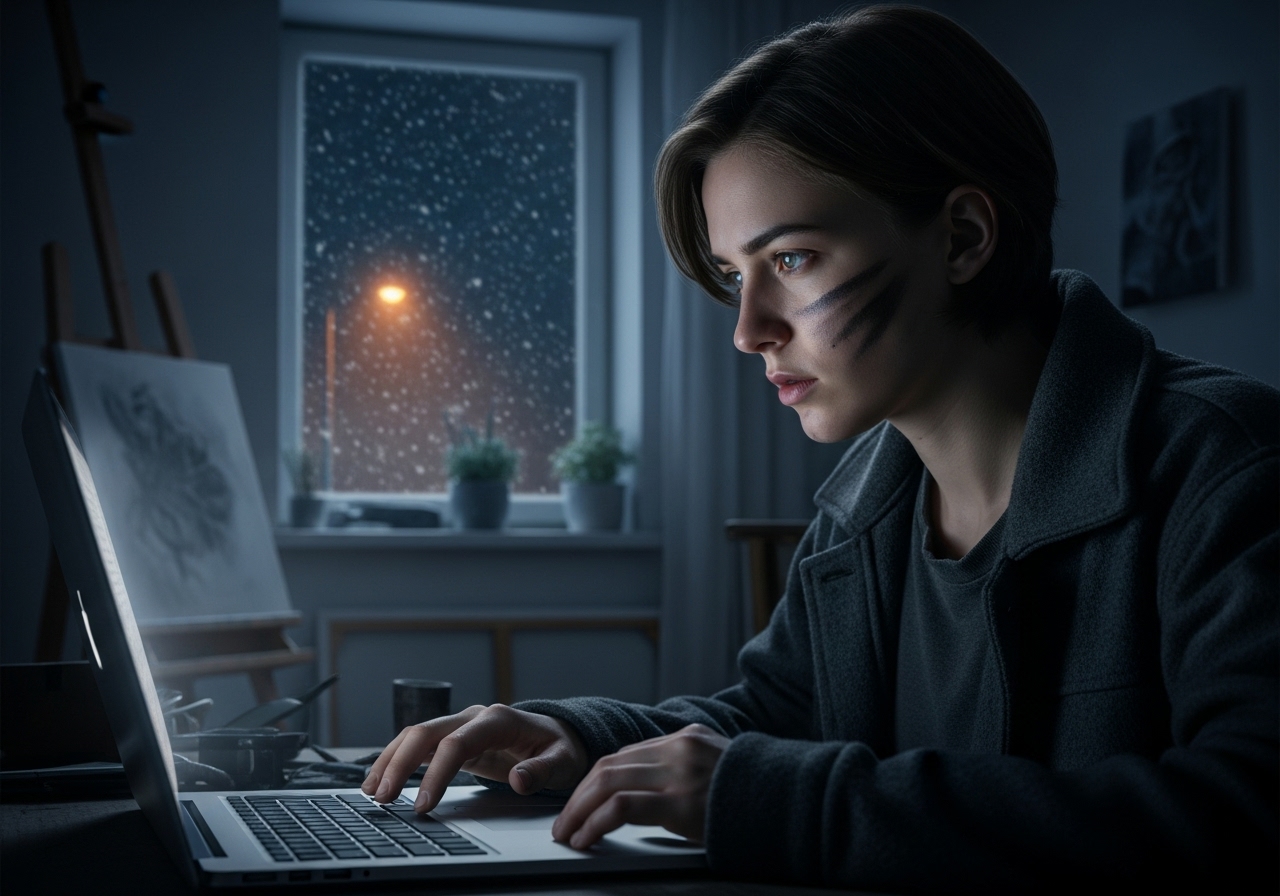
My hand hovered over the 'submit' button, a trembling uncertainty in my fingers. The world outside felt like a vast, cold ocean, and I was about to step off the shore, into the unknown, with no map and no guarantee of safe harbour.
Share This Story


