Asphalt and Ozone
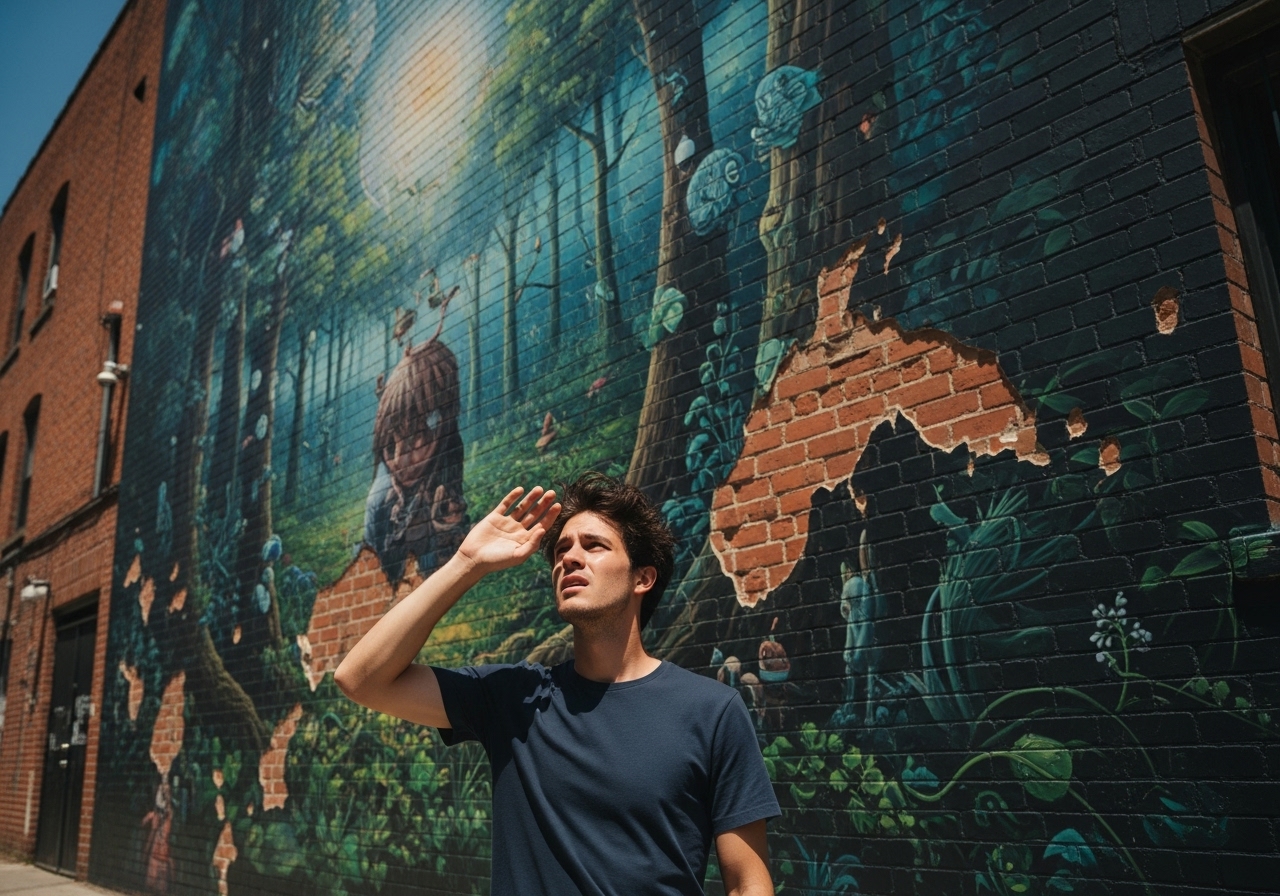
The heat coming off the pavement in the alley was a physical blow. It was only ten in the morning, but Montreal’s summer had decided to dispense with pleasantries. The air, thick enough to chew, smelled of hot asphalt, ozone, and something else… something like wilting flowers and ozone. That was the mural. That was the problem. It covered the entire side of a brick warehouse, and from a distance, it looked fine. Up close, you could see the sickness.
The alley behind Le Collectif was an oven. The air shimmered above the dumpsters, and the brick wall radiated a heat that felt ancient and angry. I squinted up at the mural, my t-shirt already sticking to my back. It was supposed to be a riot of impossible colours, a sprawling, street-art depiction of a forest that wasn’t quite of this world. And it still was, mostly. But patches of it were… wrong. The vibrant, otherworldly greens had faded to a jaundiced olive, and the impossible, shimmering blues looked thin, like watercolour left in the sun.
Worse, I could see the brick through it. Just faint outlines, but they were there. A month ago, that wall looked like a portal. Now it just looked like a portal that was glitching out.
“It’s the heat,” a voice rasped from near my ankles. “The iron in your city’s air. It’s poison.”
I looked down. Grainne, a brownie no taller than my knee, was standing with her arms crossed, scowling at the wall. She wore a patched-up denim vest over a linen tunic and had a face like a weathered walnut. As the collective’s self-appointed archivist and chief complainer, she had been a constant, thorny presence since I’d inherited this… position.
“Morning, Grainne,” I said, wiping sweat from my forehead. “It’s getting worse, isn’t it?”
“Of course it’s getting worse,” she snapped, kicking at a loose piece of gravel. “This isn’t just paint, you fool. It’s a glamour. It’s a story told in pigment and intent. And this bloody, suffocating summer is burning the words right off the page.” She pointed a gnarled finger at a section where a silver stag was depicted drinking from a river. The stag’s antlers, once opalescent, were now a dull grey. “The boundary thins. Mortals will start to notice more than just a ‘cool piece of graffiti.’ They’ll start to feel the hum. Then they’ll start to wander in, and then where will we be?”
Le Collectif was, on paper, an underfunded arts non-profit. In reality, it was a sanctuary. A patch of the Old World stitched clumsily onto the new, providing a haven for the displaced, the exiled, the Fae who couldn’t or wouldn’t go back. And my job, as the great-nephew of the previous caretaker, was to be the bridge. The human face that paid the hydro bill and told the city inspector that the strange humming was just ‘faulty wiring.’
“Can’t we… touch it up?” I asked, knowing the question was stupid as soon as it left my mouth.
Grainne shot me a look of profound pity. “Touch it up? With what, a can of Tremclad from the Canadian Tire? It was woven by the Green Man himself, before he left. The pigments are bound with First Summer Dew and the memory of a world without pavement.”
“Right. First Summer Dew. Where do we get more of that?”
Before she could answer, a guttural growl echoed from the fire escape above us. A Redcap, his filthy woolen cap dipped in what I really hoped was rust, was perched on the railing, glaring down at me. His name was Borag, and he hated me on principle.
“This is your fault, mortal,” he snarled, his voice like grinding stones. “Your kind and your foul, hot seasons. The glamour held for a century. Then you arrive, and it curdles like milk on a hearth.”
“I didn’t personally cause climate change, Borag,” I sighed. It was an argument we’d had before.
“You reek of it! Of iron and disbelief. You’re an anchor, weighing us down in this drab, miserable world.”
---
A Catalogue of Faded Things
I ignored him and followed Grainne inside, the cool, dusty air of the warehouse a welcome shock. The interior was a chaotic jumble of art studios, weaving looms, and strange, organic sculptures that seemed to be slowly growing. The air smelled of turpentine, damp earth, and ozone.
Grainne led me to the archives, a cramped office overflowing with scrolls, leather-bound books, and shoeboxes filled with index cards.
“The Green Man’s notes are… allegorical at best,” she muttered, pulling down a heavy tome bound in what looked suspiciously like bark. She blew a cloud of dust off the cover and opened it. The pages were filled with elegant, looping script and detailed botanical drawings.
“He writes that the pigment base is ground river stone, mixed with crushed petals from the Moon-Lupin,” she read, tracing the lines with a claw-like fingernail. “Fairly standard. But the binding agent… here. ‘The glamour is given life by the First Dew of Summer, collected from a spider’s web on the morning after the solstice, in a place where the veil between worlds is thinnest.’”
I leaned in, looking at the drawing next to the script. It showed a spiderweb, glistening with dew, strung between the branches of a hawthorn tree. “Okay. So we missed the solstice. That was last month. What does that mean?”
“It means,” Grainne said, closing the book with a definitive thud, “that we have none. And without it, the mural is just… paint. It will flake away to nothing by the first frost, if it even lasts that long. The glamour will collapse completely.”
A cold knot formed in my stomach. A collapsed glamour didn't just mean nosy graffiti tourists. It meant exposure. It meant panic. It meant everything my great-uncle had worked his entire life to protect would vanish.
“There has to be another way,” I said, my mind racing. “Another source? A substitute?”
Grainne looked at me, her ancient eyes holding a flicker of something I hadn’t seen before—not annoyance, but genuine fear. “There is no substitute for a first thing, Leo. The dew holds the memory of the entire summer to come. Its potential. Its power. That is what fuels the illusion.”
I paced the small office, the scent of old paper and dust filling my lungs. The heatwave was forecasted to last another two weeks. The mural wouldn’t survive. I stopped, looking at a map of the city tacked to a corkboard, covered in strange, spidery markings only my great-uncle would have understood. Places where the city’s grid seemed to warp. Parks, old cemeteries, forgotten patches of riverbank.
“‘A place where the veil between worlds is thinnest’,” I repeated, turning back to Grainne. “The solstice might be past, but those places still exist, right?”
She nodded slowly. “They do. But they are not always… stable. And the dew itself, even if you found it, would be weaker now. Less potent.”
“But it’s better than nothing,” I insisted. A plan, fragile and insane, was beginning to form. “We just have to find one of these thin places. And hope there’s a spider who’s a very, very early riser.”
Grainne tapped a faded map of the city tacked to the wall. "There might be one other source," she said, her voice barely a whisper. "But it's not dew. It's a tear. And it would mean making a bargain with a creature the Green Man himself forbade us from ever contacting."
Share This Story


