A Cold and Public Miracle
The cold was a physical presence, a thing that scraped at the lungs and turned the moisture of your breath into a cloud of tiny, instantly freezing knives. It was the kind of cold that made the city’s festive lights look brittle, like coloured glass about to shatter. Steam plumed from sewer grates along Portage Avenue, ghostly and slow in the windless dark, while the hollow chime of a distant bus announcement echoed off the icy facades of office towers.
The thing in the bus shelter was the first mistake in a night that was rapidly collecting them. It sat perfectly upright on the frozen bench, hands folded in its lap, wearing a ridiculously expensive-looking crimson coat that still had the security tag clipped to the cuff. A mannequin. From a distance, Stefan had assumed it was a person sleeping, another piece of Winnipeg's winter furniture. But up close, the skin was too smooth, the expression too placidly serene. It was plastic. Just some stupid prank.
Except for the warmth.
He’d only touched it on a whim, a stupid, freezing-glove-to-plastic-cheek impulse. But a definite, undeniable warmth radiated from the fibreglass shell. Not hot, not even body-temperature. Just… not the biting, absolute zero of everything else in the universe. It felt like something left in the sun on a cool day. He snatched his hand back, his heart doing a frantic little kick against his ribs.
He pulled out his phone, fingers clumsy and stiff. The screen flared, painfully bright. He dialled Melissa.
“What?” Her voice was muffled, probably buried under a scarf.
“You need to come to the bus shelter opposite the Bay.”
“Stefan, it is literally minus thirty. I’m walking home. My face is gone. I don’t have a face anymore. Whatever it is, text me.”
“I can’t text it,” Stefan said, his voice tight. He glanced at the mannequin. It hadn’t moved. Of course it hadn’t moved. “It’s… a situation.”
A long, suffering sigh came through the phone. “Is this another one of your ‘ethically ambiguous pigeons’?”
“No. Just… get here. Please.”
He hung up before she could argue and shoved his phone away. He paced the small glass enclosure, his boots scuffing on the salt-stained concrete. He kept stealing glances at the figure. Its painted eyes stared blankly at the traffic, at the pulsing red and green lights that bled across the slushy street. It was just an object. An unusually warm, well-dressed object left in a bus shelter. Nothing to panic about. It was the cold, it made you weird. Made your brain seize up.
---
Melissa arrived ten minutes later, a storm of righteous indignation wrapped in three layers and a parka the size of a small car. “This had better be a dead body, Stefan. Or a suitcase full of money. A dead body in a suitcase full of money would be ideal.”
She stopped when she saw it. “Okay. It’s a dummy. You called me here for a dummy.”
“Touch its face,” he said.
“Absolutely not.”
“Melissa, just do it.”
She rolled her eyes so hard he could practically hear it, then pulled off a mitten and cautiously pressed her fingertips to the mannequin’s cheek. Her expression shifted. Curiosity. Confusion. She moved her hand to its neck, then its shoulder.
“Okay,” she breathed, her own breath pluming white. “That’s… weird. Is it plugged in? Is it, like, a heated mannequin?”
“It’s a bus shelter! Where would it plug in?” Stefan gestured wildly at the empty space. “I’ve been watching it. I swear… I swear its hands were farther apart when I got here.”
Melissa squinted. “You’re losing it. It’s a thing. It doesn’t move.” She turned her back on it to face him. “So, some art student’s project? Stolen from the Bay? What’s the plan?”
“I don’t know. We can’t just leave it.”
“Why not? It’s not our problem.” She turned back to the mannequin. And froze.
Stefan followed her gaze. He felt the blood drain from his face, a cold, sick feeling that had nothing to do with the temperature.
The mannequin’s head was now tilted slightly. A minuscule adjustment, maybe five degrees to the left. But it was different. Its serene, painted gaze was no longer fixed on the street, but seemed to be angled directly at the entrance of the Hudson’s Bay building across the way.
“No,” Melissa whispered. “No, that’s not… Did you see it move?”
“No! I was looking at you.”
“Me too.”
They stood in silence for a full minute, two statues flanking a third, more graceful one. The city hummed around them, indifferent. A bus hissed to a stop nearby, its doors folding open with a pneumatic sigh, and then closing again, empty.
“Okay,” Melissa said, her voice a low, urgent tremor. “New plan. We’re getting it out of here.”
“What? Where are we gonna take it?” Stefan’s mind was a frantic blank. “My place? My mom will have a full-blown aneurysm.”
“Not your place. Not my place. Somewhere… neutral. For now. We can’t leave it here. What if someone takes it? Or smashes it? It’s… I don’t know what it is, but we found it. It’s our responsibility.”
“Our responsibility? It’s a haunted dummy!”
“It’s not haunted, it’s just… different,” Melissa insisted, though she didn’t sound convinced. “Come on. You grab that arm.”
An Unwieldy Grace
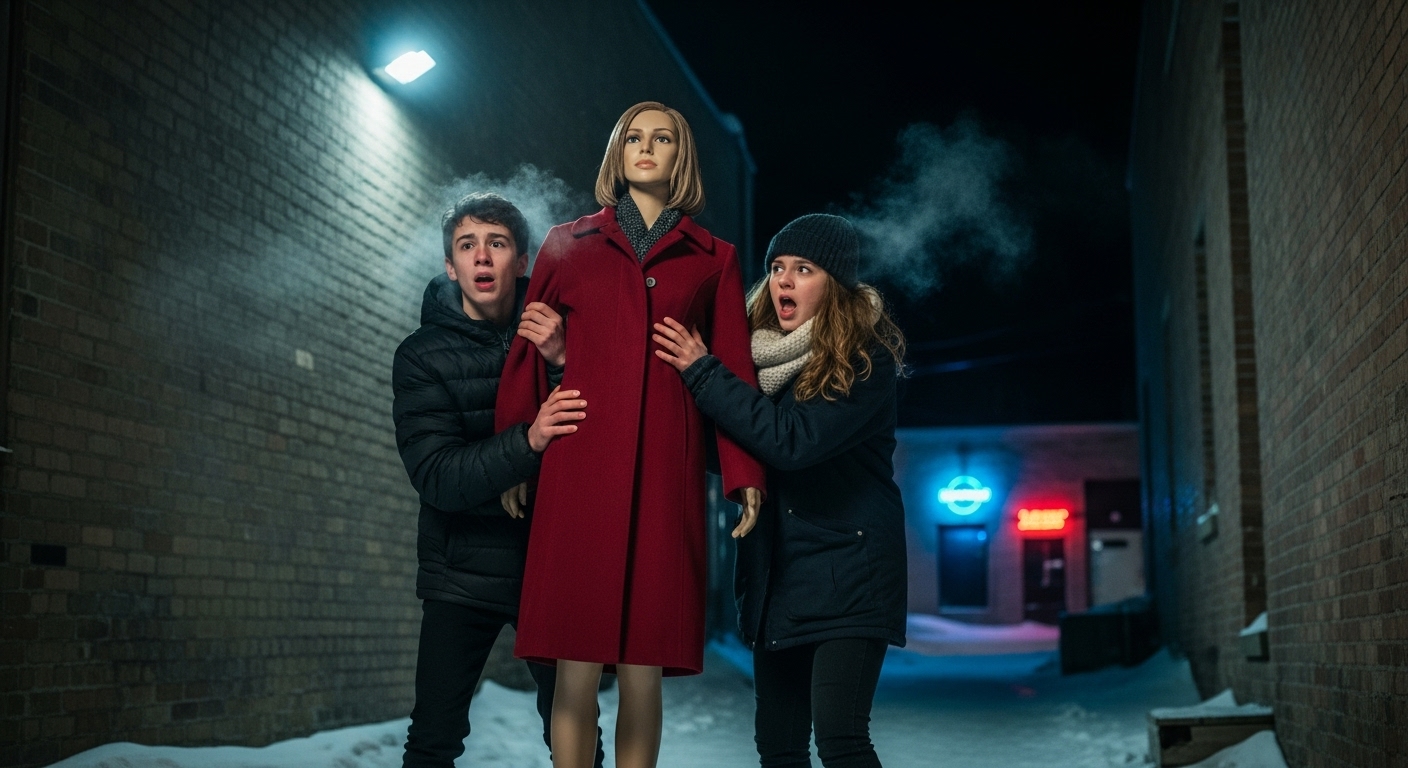
Getting the mannequin to its feet was like trying to dance with a block of concrete that had a secret, uncooperative soul. It was heavy, awkwardly balanced, and its joints moved with a stiff, unnatural smoothness. They each took an arm, hoisting it up. For a moment, its feet scraped the ground, and its head lolled back, staring straight up at the starless, orange-tinged sky.
“Okay, okay, act natural,” Melissa hissed, pulling one of the mannequin’s arms over her shoulder.
“Natural? We look like we’re helping a very fashionable, very drunk person who has died,” Stefan muttered, doing the same on the other side. The crimson coat was surprisingly soft under his gloves.
They shuffled out of the bus shelter and into the brutal wind tunnel of the street. A couple huddled for warmth by a storefront stared at them. Stefan tried a weak, reassuring smile that felt like his face was cracking. The couple just stared harder.
“Where are we going?” Stefan grunted. The mannequin’s weight was deceptive. It was a dense, solid thing.
“The underground. The concourse. There are empty corridors down there. Places nobody goes.”
“That’s like a fifteen-minute walk!”
“Then we’d better hurry up.”
Their procession was a masterpiece of absurdity. Two teenagers wrestling a life-sized doll through the festively decorated, deeply frozen heart of downtown Winnipeg. The mannequin’s hard plastic heels clicked on the icy pavement with a rhythm that was just slightly out of sync with their own steps. Every time they had to stop for a traffic light, Stefan felt a hundred pairs of eyes on them from inside the warm, steamy windows of passing cars and buses.
“We should give it a name,” Melissa said, breathless, as they navigated a particularly treacherous patch of black ice. “It’s weird just calling it ‘it’.”
“We are not naming the haunted dummy!”
“Florence,” Melissa declared, ignoring him. “She looks like a Florence.”
“She looks like she’s about to star in a horror movie!”
They passed a group of smokers outside an office building, who fell silent and watched their approach. One of them, a man with a tired face, took a long drag from his cigarette and nodded slowly, as if this was the most normal thing he’d seen all day. The sheer strangeness of their task had wrapped them in a bubble of unreality. They were doing something so bizarre that nobody knew how to react.
They reached the entrance to the Portage Place mall, the promise of warmth and shelter just beyond the sliding glass doors. A security guard stood inside, watching the street with bored eyes.
“Okay, new new plan,” Stefan said, his teeth chattering. “We can’t go in there. He’ll stop us in a second.”
“We just have to be confident,” Melissa said, squaring her shoulders. “We walk in like we own the place. Like we take our friend Florence shopping all the time.”
“Melissa, no.”
But she was already moving, dragging him and their silent companion toward the entrance. The doors slid open, bathing them in a wave of warm, recycled air that smelled of cinnamon and floor cleaner.
The guard’s eyes snapped to them. He straightened up, his hand going to his radio.
“Hey! You kids! What do you think you’re doing?”
Melissa didn’t break stride. “Her blood sugar is low!” she yelled back, her voice echoing in the cavernous, mostly empty atrium. “We’re getting her to the food court! Diabetic emergency!”
The guard paused, his face a mixture of suspicion and uncertainty. The excuse was so specific, so audacious, that it short-circuited his brain. He watched them half-walk, half-drag Florence past the shuttered lottery kiosk and toward the escalators leading down to the concourse. He didn’t follow.
“Diabetic emergency?” Stefan whispered, his voice cracking with a hysteria that was half fear, half laughter.
“It was the first thing that came to mind!” Melissa shot back. “Now come on!”
---
The concourse was a different world. A warren of beige tunnels connecting buildings, smelling faintly of stale coffee and damp wool. It was mostly deserted at this time of night, the silence broken only by the hum of the fluorescent lights overhead.
They found what they were looking for behind a boarded-up former newsstand: a service corridor, its door propped open by a rusty fire extinguisher. The air inside was still and smelled of dust and concrete.
With one last collective grunt, they maneuvered Florence into the darkness and leaned her against a cold brick wall. She stood there, perfectly poised in the gloom, her crimson coat a slash of impossible colour.
They both stood back, panting, chests heaving. The adrenaline was starting to fade, replaced by a profound and bone-deep weirdness. They had stolen a mannequin. A warm, moving mannequin.
“So,” Stefan said, breaking the silence. “What now?”
Melissa just shook her head, staring at their charge. “I don’t know. We come back tomorrow. We figure it out. We just… needed to get her somewhere safe.”
Safe. The word hung in the dusty air. He looked at Florence, at her placid, perfect face. He didn’t feel safe. He felt like he’d just invited a nightmare into their lives, a quiet, well-dressed, perfectly still nightmare.
“Okay,” he said finally. “Okay. Let’s go. Before someone finds us.”
He took one last look, a knot of dread tightening in his stomach. He turned to leave, following Melissa back toward the concourse light. After a few steps, he risked a glance back over his shoulder. In the dim light filtering from the corridor entrance, Florence stood exactly where they had left her. Except for one small detail.
Her hand, which had been resting by her side, was now raised in a small, graceful wave.
He turned to leave, following Melissa back toward the concourse light. After a few steps, he risked a glance back over his shoulder. In the dim light filtering from the corridor entrance, Florence stood exactly where they had left her. Except for one small detail. Her hand, which had been resting by her side, was now raised in a small, graceful wave.
Share This Story


