Fading Light Over the Land Lab
The air was thick with the scent of damp earth and something indefinable—the last gasp of summer’s green, giving way to the sharp, metallic tang of encroaching autumn. The sun, a low, bruised orange orb, bled light across the rows of raspberry canes, their leaves now a dull, tired green, some already flecked with the rust of impending dormancy. Dust, disturbed by our boots, hung briefly, stubbornly, in the heavy air. The quiet was immense, broken only by the hum of late-season insects and the crunch of shale underfoot, each step an echo in the vast, indifferent landscape. Another season, another cycle, winding down. Another year of trying.
The air was thick with the scent of damp earth and something indefinable—the last gasp of summer’s green, giving way to the sharp, cool of autumn. The sun, a low, bruised orange orb, bled light across the rows of raspberry canes, their leaves now a dull, tired green, some already flecked with the rust of impending dormancy. Dust, disturbed by our boots, hung briefly, stubbornly, in the heavy air. The quiet was immense, broken only by the hum of late-season insects and the crunch of shale underfoot, each step an echo in the vast, indifferent landscape. Another season, another cycle, winding down. Another year of trying.
I kicked at a dry clod of dirt. It crumbled, a small, satisfying puff of dust. The wind, when it finally found us, carried the faint, sweet-sour ghost of ripe berries, long since picked or left to the wasps. We were walking the perimeter of the land lab, a ritual of sorts, now that the last of the cucumbers had been pulled, the tomato vines barren. The strawberries, months ago, were just a memory, a sticky sweetness on our fingers that faded with the heat of July. Esther walked beside me, her steps lighter, less burdened by the gravity of the season’s close.
“Good run,” she said. Her voice, usually bright, was muted, respectful of the encroaching evening.
I grunted. “Good enough.”
A small lie. It was always ‘good enough’ in these parts. Never truly stellar, never a bumper crop that changed everything. Just enough to validate the effort, to convince ourselves the earth hadn't entirely given up on us. The light deepened, painting the skeletal remains of the sunflowers in shades of amber and rust. A lone bumblebee, fat and sluggish, buzzed past my ear, probably looking for a last drop of nectar. What a waste, I thought, all that effort for a fleeting moment of bloom.
Esther stopped at a row of wilting raspberry canes, running a hand over the dry leaves. “Still. Plenty here. Next year.”
Next year. The perennial promise, the lie we told ourselves every autumn. As if the land, or the economy, or the slow, steady drain of young people wouldn’t simply repeat the same cycle. As if ‘next year’ wouldn’t bring its own set of quiet, crushing disappointments. I could feel the cynicism like a dull ache behind my ribs, a familiar friend.
“What if,” she started, her voice a little softer, a little more tentative. “What if we did something else with it?”
I waited. She always had an 'else.' A new angle, a fresh perspective. A way to polish the perpetually tarnished.
“Like what?” I asked, my tone flat. My eyes traced the distant line of boreal forest, dark and ancient against the bruised sky. It felt like it was watching us, waiting for us to fail.
“A product,” she said, turning to face me, her eyes catching the last glint of sun. “Something to sell. Something more… stable than just raw berries or veg.”
My brow furrowed. “We do jams. And pickles.” Small-batch, for the local farmers’ market that barely broke even after gas. It was more a social club than a commercial enterprise.
She waved a hand, dismissing my words. “Bigger. Branded. Something beyond the kitchen table. Something that lasts.”
I picked up a stray, shriveled raspberry, rolling it between my thumb and forefinger. It was hard, dessicated, clinging to a few seeds. This was the reality. Not plump, juicy fruit. Not endless abundance. “Lasts where, Esther? Here? We’re a few hundred people, a seasonal tourism bump. Who’s buying industrial quantities of artisanal raspberry coulis from… from us?”
She didn’t flinch. She rarely did. That was one of her more frustrating, or perhaps admirable, qualities. “We ship. We market online. We target specialty stores in the city.”
“Logistics,” I countered immediately. “Cost of shipping. Storage. Capital. We’re working with donated space and volunteer labour. This isn’t a commercial operation, it’s… it’s a goodwill project.” I watched a moth flutter haphazardly past my face, caught in a beam of light. Irrelevant, yet distracting.
“That’s the point,” she insisted, stepping closer, her voice gaining a touch more steel. “It could be more. We’ve proven we can grow good produce here. Superior produce. The soil, the climate… it’s unique.”
Unique. Another word people used when they wanted to justify something difficult. “The soil here is clay and rock, Esther. We fight for every inch. And the climate means six months of winter where nothing grows but cabin fever.” My boot scraped against a loose stone. It bounced off a dying plant stem, making a small, sad sound.
She sighed, a quick, impatient sound. “Yes, it’s hard. But that’s a challenge, not a dead end. Think about it. Raspberry jam. Raspberry sauce for pancakes. Candied strawberries. Something that embodies the north.” She paused, chewing her lip. “Not, like, a 'wilderness spirit' thing, just… authentic.”
I shook my head. “Authentic and profitable are often mutually exclusive, especially when you factor in the ‘here’ part. We’re small. Remote. No infrastructure. We lose people to Thunder Bay, to Toronto, every year. Why would anyone invest in a niche food product when they can barely keep the local hardware store afloat?” My voice had picked up a bitter edge, I knew. It wasn't just about the berries. It was about everything. The slow erosion of possibility in places like this.
“Because,” she said, her voice now quiet, but firm, “that’s exactly why. We leverage that. The story of resilience. Of local pride. Of making something beautiful out of something difficult.” Her gaze locked with mine, and I saw a flicker of something in her eyes—not just optimism, but a deep, stubborn conviction. “It’s creative entrepreneurship, Donald. It’s finding a new path when the old ones are overgrown.”
Creative entrepreneurship. The buzzword. The lifeline thrown by academics and city planners who’d never spent a winter north of the 49th parallel. I had heard it all before, the endless cycle of grants and committees and pilot projects that eventually just… fizzled out, leaving behind a faint odour of disappointment. “And the ‘creative’ part,” I said, my tone almost a sneer, “is where we pay ourselves in… well, in ‘creative’ exposure?”
She huffed a short laugh, devoid of humour. “No. The creative part is how we make it work with what we’ve got. We start small. Farmers’ markets, yes, but we brand it. High quality. Limited run. A scarcity model. We tell a story. This isn’t about becoming a multinational, Donald. It’s about building something sustainable, something that gives back to here. Something that creates a few local jobs, keeps a few people from leaving.”
The wind picked up, rustling the dry leaves like old paper. The temperature was dropping fast now that the sun was almost gone. I shivered, though not entirely from the cold. Her words, though idealistic, had a surprising weight. A different kind of weight than the usual 'feel good' rhetoric. She wasn’t blind to the challenges; she just chose to see past them. And I hated that. Hated that she could still see beyond the immediate, soul-crushing reality of things.
“Okay,” I said, rubbing the back of my neck. “Let’s say. Hypothetically. We could make a raspberry jam. A really good one. How do we even get the volume? The summer was good, but not that good. We’d need more land, more growers. More people willing to put in the back-breaking work for… for what?”
“We pool resources,” she replied, pragmatic now, her voice losing its edge of idealism. “We reach out to other small-scale growers. There are a few homesteads around, people with a couple of rows of berries they don’t do much with beyond personal use. We offer to buy their surplus. Fair price. Creates a small, local network. A supply chain.” She looked up at the sky, her gaze sweeping across the darkening expanse, as if mapping out a future visible only to her.
A supply chain. I almost laughed. It sounded so grand, so corporate. Here, a supply chain meant driving an hour down a gravel road to pick up five pounds of wild blueberries from an old woman named Margie. But the image, for a moment, settled in my mind. A network of small, independent growers, all feeding into one central idea. It wasn’t entirely outlandish. It was just… incredibly difficult.
“And the cost of ingredients? Jars? Labels?” I continued, trying to poke holes, to find the inevitable flaw that would bring her back down to earth. “It all adds up. And a small loan won’t cover much. Who’s going to take a risk on a couple of idealists making jam in the middle of nowhere?”
She turned fully towards me then, her expression unreadable in the fading light. A silence stretched between us, filled only by the whisper of the wind through the tall, dry grass. I braced myself for another passionate defence, another plea for optimism. But she just looked at me, a long, steady gaze that seemed to pierce through my layers of cynicism, right down to the tired, hopeful core I kept hidden.
“I already did,” she said, her voice barely a murmur. “I put up the first round of seed money. My savings. Applied for the co-op registration last week. It’s a go, Donald. If you’re in.”
---
The words hung in the twilight, cold and sharp. My savings. A co-op. It was no longer a hypothetical. This wasn’t just talk on a trail, a pleasant distraction from the end of summer. This was real. A knot tightened in my gut. My gaze fell to the ground, to the exact spot where a small, withered raspberry, the one I had been holding, had slipped from my fingers. Gone, buried in the dark earth, indistinguishable from the other debris. The thought of her sacrifice, the sheer audacity of her faith, felt like a punch to the stomach. All summer, I had treated this like a philosophical exercise, a safe intellectual sparring match. And now. Now she’d actually done it. She’d laid a wager, not just on the idea, but on us. On me. The cold from the ground seemed to seep into my boots. My entire body felt heavy. I didn’t know if I was ready for this kind of weight. For this kind of hope. It was a terrifying, exhilarating proposition, and I suddenly felt very small under the vast, indifferent sky. This was bigger than berries. Bigger than jam. This was… everything. I looked at the sky, that bruised, indifferent orange. This was it. The real thing. Not just talk, not just a summer project. A leap, off a cliff I hadn’t even realized was there. And the only question now was whether I was falling alone, or if Esther was pulling me down with her.
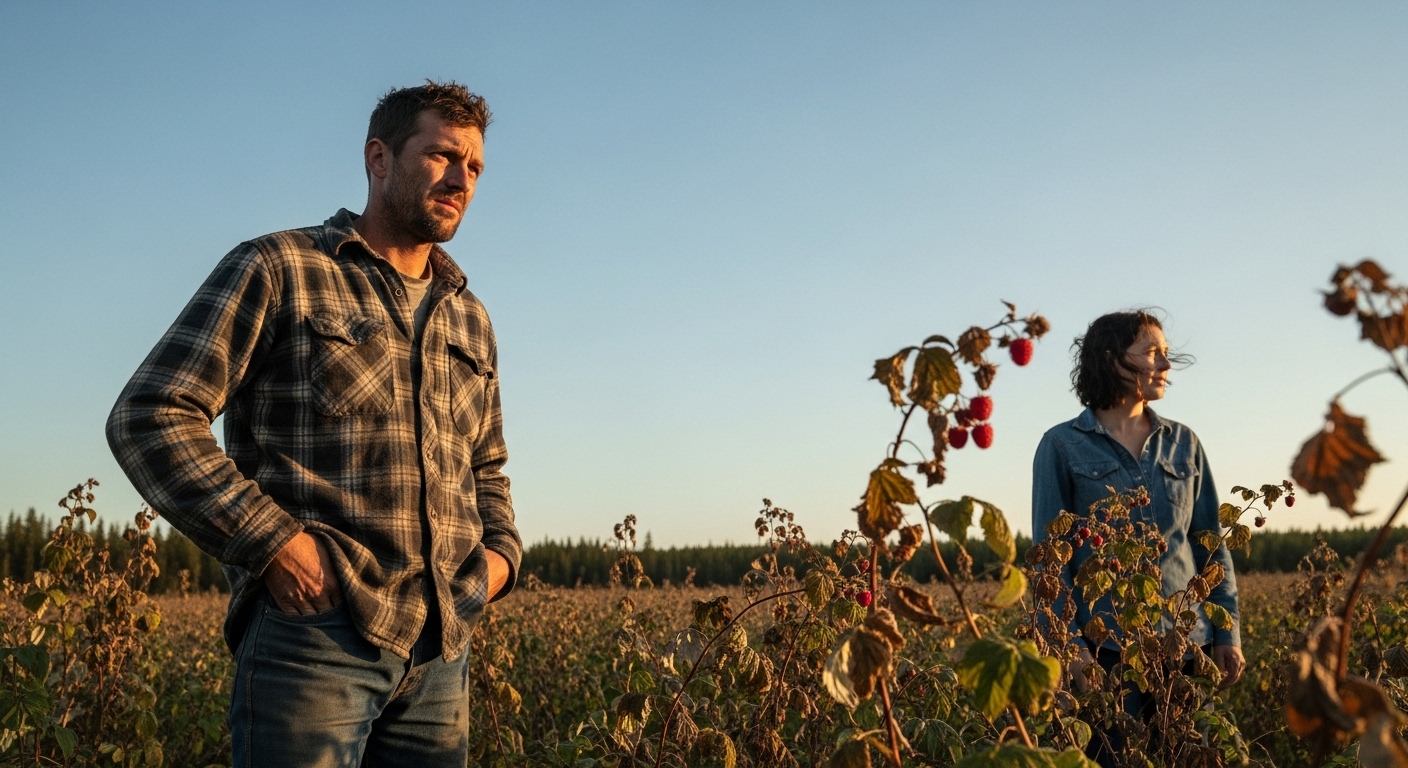
I looked at the sky, that bruised, indifferent orange. This was it. The real thing. Not just talk, not just a summer project. A leap, off a cliff I hadn’t even realized was there. And the only question now was whether I was falling alone, or if Esther was pulling me down with her.
Share This Story


